◊♦◊
Other Wordless Friends—
Cheryl Andrews
Allison Howard
Barbara Lambert
Allyson Latta
Elizabeth Yeoman
◊♦◊
Other Wordless Friends—
Cheryl Andrews
Allison Howard
Barbara Lambert
Allyson Latta
Elizabeth Yeoman
On my way to the library I see a man pacing in his garage, smoking. I’ve seen him there before. He pretends he doesn’t notice me as I pass and I sense I’m meant to do the same. I feel sorry for those who like to indulge in a cigarette. They’re always huddled outside but no one waves, no one says Hello, fine weather, isn’t it! the way you might to someone raking a lawn. I may have to change this pattern next time I go by.

Further along the same street, a boy, playing hockey on his own,

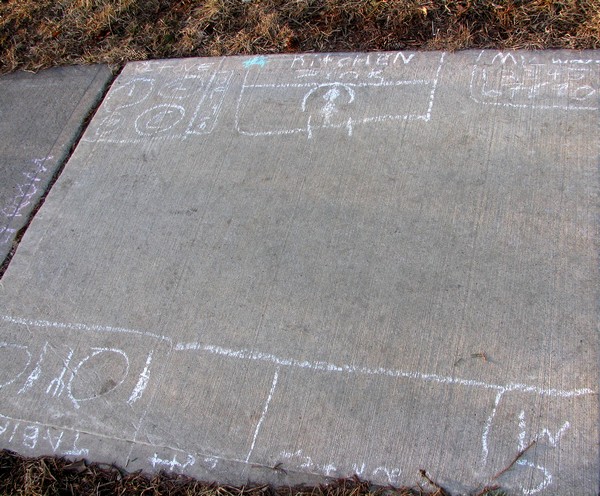
and the blueprints for a house interior sketched onto several squares of sidewalk.
This is the kitchen. The living room is to the left; bedrooms to the right.
Around the corner, a man in a green ski jacket cleans a ski-doo the exact same shade as his coat. When I stop a few houses down to make some notes, I look back and notice the man staring at me. He’s actually stopped cleaning the ski-doo and looks concerned about me jotting things on a notepad with a pencil. It occurs to me that if I’d stopped to look at my BlackBerry or equivalent [which I don’t own] he’d be feeling much calmer. It reminds me of my experiment at the casino, and the unexpected things that frighten people.
At the library, a woman comes up to me, says, quite out of the blue, “You must be an artist,” and I assume she means because of the hat but I ask whatever makes her think so. She says she was driving by and saw me walking, saw me stop on the sidewalk and go back and take a picture of something on the ground. “Only someone with a certain kind of eye would do that,” she says. I tell her she must have a pretty good eye herself and we laugh the laugh of strangers.
This is the picture she saw me take.
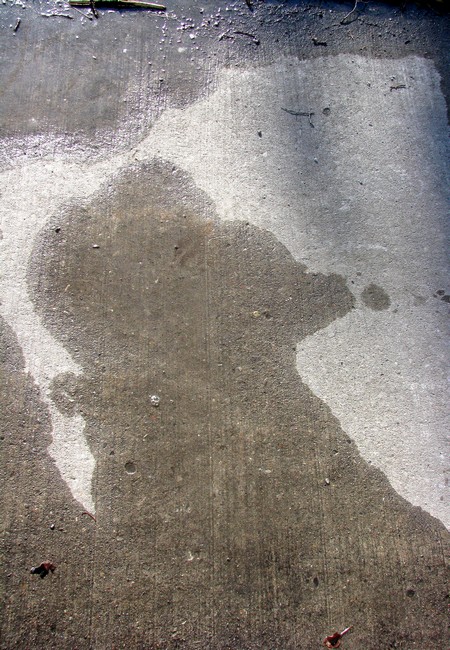 Tell me this doesn’t look like a monkey spitting out an apricot.
Back outside a black pick-up truck goes through a red light and from the other end of the street, totally unrelated but at the same moment, tires squeal.
A woman in white plays drums on her steering wheel and sings while waiting for the light to change.
I take a different route home and find a nest of feathers. Not a good kind of nest.

And in a nearby window, what appears to be a rather self-satisfied expression…
Close to home I find a bag crackling in the wind and so I detach it with the idea of collecting a few bits of the always-debris that is everywhere.
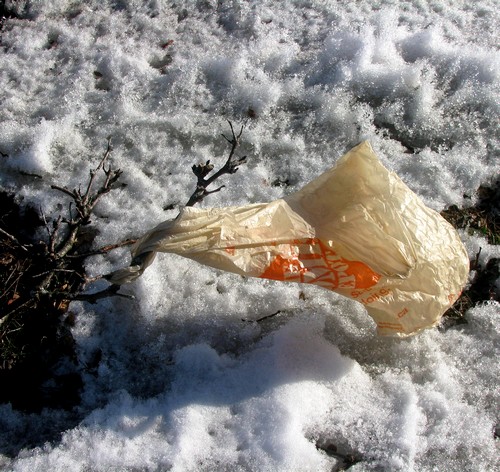
Less than ten minutes later, I’m out of bag.

◊♦◊
Other Wordless Friends—
Cheryl Andrews
Allison Howard
Barbara Lambert
Allyson Latta
Elizabeth Yeoman




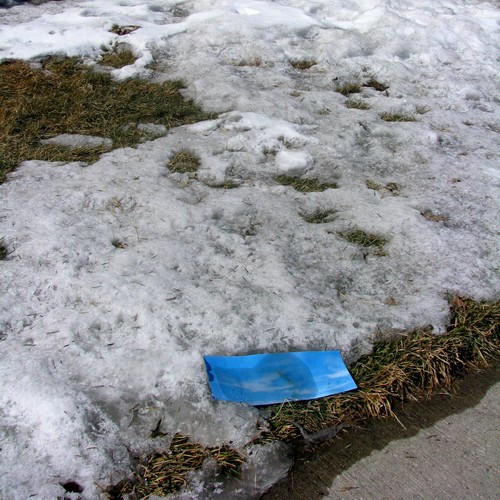


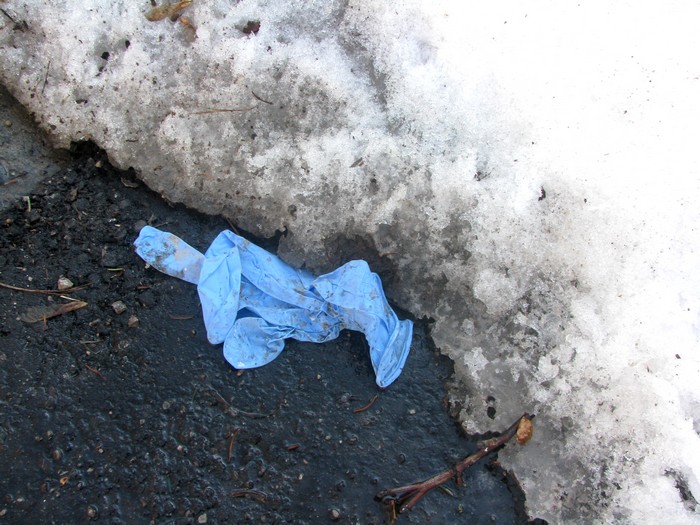 Umm, is this glove giving me the finger??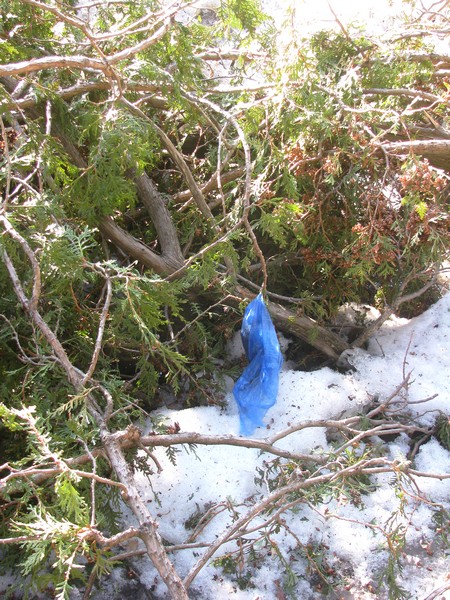
They’re everywhere. A certain kind of young mother, single, unemployed, pushing prams, kids in tow as they walk and walk… yet something suggests there’s no real destination—that hours, days, years, are merely something to get through… until… what? More kids maybe, another guy, another unfortunate choice. Because for some people life is a series of unfortunate choices or, worse, unfortunate events. Whatever the reason, they keep moving, these mothers, as if in the hope it’ll all somehow ‘become’ right. They’re recognizable—not by any expression of hope—but by their sadness, sometimes by the look of fear in their eyes. We worry about them for a moment but mostly do nothing. We wring our hands for the children: what chance do they stand?
and then we drive on by…
This is the impression we take. We of the narrow minds.
Fran Kimmel either doesn’t have a narrow mind or is just a lot brighter than many of us. Or more aware. Her book The Shore Girl, the story of Rebee Shore, shows the world of single 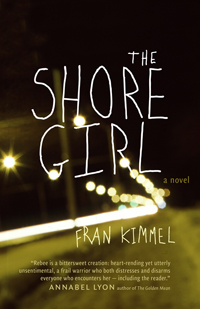 motherhood and their kids from the inside out, through a child’s eyes and [in dedicated chapters] through the eyes of everyone who is—by blood or choice—connected to her.
But there’s a difference: Rebee’s mother [Elizabeth, who prefers to go by Harmony] isn’t a pram pushing sort of mum. She’s on the run, rejecting her past and doing her best to dodge the present, which happens to include her daughter. From infancy into her teens, Rebee’s life alternates between moving constantly from van to motel to trailer to relative’s couch. “… Harmony gets restless. For her, a new place has a three-month expiry date, same as fruit bars.”
And if she’s not moving with her mother, she’s being temporarily abandoned by her.
In other words, the kid has every reason to be angry, to follow suit, to make a mess of her life. She has the excuses. But that’s not what happens. Rebee is one of those miracles who, instead of becoming resentful, learns through the very debris of her childhood that she has to be strong because her mother is preoccupied just keeping them alive.
She gets it.
It’s why she keeps a box of fingernail clippings, mostly Harmony’s, the various shades of nail polish reminding her of places they’ve stayed; it’s the only constant in her life, the only thing that reminds her of where she’s been and the only part of her mother that she can protect from disappearing.
“We rumble along the highway under a watery sky, past wheat rolled into giant soup cans, cows frozen in muck. I think about where we just came from. I can’t remember the colour of the walls or feel of the curtains or shape of the bathroom sink. Blank as water, like on a test day in a new school and I end up at the fountain, gulping, drowning… I slip off my runners and slide my toe across my bag until it touches my nail box. We’ll get to wherever we’re going tonight… I’ll wait awhile. Sprinkle the brittle bits on my blanket. Sift them like seashells.”
While often told from Rebee’s perspective, it’s very much Harmony’s story too, one that has her cemented in shame and anger.
All that and yet… The Shore Girl is ultimately hopeful. It’s about connection, the small and unfathomable ways we touch each other and thereby save each other. About reclaiming what’s ours and how family comes in various forms. It’s about getting beyond what’s ‘normal’. About using the scraps you’ve been tossed.
Above all, it reminds us that our story is never obvious to others, nor is it entirely ours alone.
**
As is customary with the (at) Eleven series, a meal of my choosing—appropriate to the book—follows the Q&A, because… “Eating is our earliest metaphor, preceding our consciousness of gender difference, race, nationality, and language. We eat before we talk.” ~Margaret Atwood from The Can Lit Food Book
And now, without further ado, may I introduce Fran Kimmel… who I thank so very much for her time, her insight and her kind heart.
**
1. What literary character did you most identify with as a child?
FK—As a young kid, I devoured Trixie Beldon books. I loved all her insecurities and her grumbling about chores and homework and brothers.
2. Can you recall one of your earliest pieces? (Crayola poem, a finger-painting storyboard…?)
FK—Okay, here goes:
Across the shadow of the moon and ever so slowly gliding
Through the leafy-figured trees, a starlit shape was sliding
Up and down with swirling streaks, across the snowy hills
With patterns of rejoicing grace, and lacy moving frills
It’s so bad, it’s memorable. This poem won a contest in Grade 4 and I had to read it in front of the whole school on assembly day. I cried a lot beforehand, trying to get out of going on stage, but neither my teacher nor my mother would give in. I made it to the end without collapsing, but this marked the end of my poetry career. (Likely a good thing)
3. What were you reading at fifteen?
FK—Girl gets boy stories, killer gets caught stories, town goes berserk stories, world on verge of collapse stories. Lots of junk sprinkled with a hearty dose of the Bronte sisters, which I could not get enough of back then.
4. Can you describe what was on the bookshelves, or on one specific shelf, in your childhood home?
FK—While my sisters and I usually had stacks of library books beside our beds, our family bookshelves were pretty sparse. I remember a shiny set of A-Z Encyclopaedias with more pictures than words, as well as a few volumes of Girl’s Own Annuals, leftovers from Grandma’s house. These were huge tomes from the 1930s, 800 plus pages, packed with illustrated stories and ridiculous amounts of sage advice about how to sit still, take care of your stockings, or knit the perfect skating outfit. Hah!
5. A favourite passage from any book and why.
FK—This is such a hard question. Every week I read a new passage that blows me away. But here is a long-time favourite taken from Girls by Frederick Busch.
“The dog and I live where it doesn’t snow. I can’t look at snow and stay calm. Sometimes it gets so warm, I wear navy blue uniform shorts with a reinforced long pocket down the left hip for the radio. I patrol on foot and sometimes on a white motor scooter, and it’s hard for me to believe, a cop on a scooter in shorts. But someone who enforces the law, laws, somebody’s laws, fall down like that. Whether it’s because he drinks or takes money or swallows amphetamines or has to be powerful, or he’s one of those people who is always scared or because he’s me, that’s how he goes—state or federal agency or a big-city police force, down to working large towns or the dead little cities underneath the Great Lakes, say, then down to smaller towns, then maybe a campus, maybe a mall, or a hotel that used to be fine.”
This quiet, understated passage comes early on, page two. With these words alone, the reader is given everything needed to fall hard for Jack, the book’s main character. Such tension and bitter regret here, the unravelling of a life. You know Jack will get only halfway near the harsh truth, but you’re rooting for him already. My favourite passages and phrases are almost always deceptively simple. The eight-word sentence, “I can’t look at snow and stay calm,” gives me shivers.
6. Do you ever find recurring themes in your work, things that surprise you?
FK—I seem to want to write about life’s damages. (My husband grumbles, Can’t you try to be a bit funny?) And it does surprise me that loss keeps coming back again and again. I’m not sure why exactly, except that I’ve been forever interested in the fragile connections that hold us together and what happens when these connections are broken. I think I’m drawn to what I don’t want to know about myself.
7. The Shore Girl opens with the heartbreaking scene of Rebee as a toddler, alone in a motel room, thirsty for a glass of water and yet reluctant to disobey the parent who isn’t there. How do children like Rebee manage to find such resilience?
FK—I’m left speechless by what children are able to endure. I think that kids like Rebee are always on the outside looking in, which gives them a lot of time to observe and to reflect on what they’re observing. They learn to somehow distance themselves emotionally (and physically) from the source of their heartache. Some of these kids – the lucky ones – are able to become stronger in the process. I’ve met some amazing women at book clubs who endured childhoods much like Rebee’s and they’ve gone on to lead brilliant lives.
8. Rebee’s mother, ‘Harmony’, is a wonderfully drawn character, and the only one [of the central cast] that we don’t hear from directly. She’s alluded to, pined for, despised, misunderstood, tolerated, fallen in love with; she makes us want to give her a shake one minute and then breaks our heart the next. No matter what, she’s the ‘always elephant in the room’ There’s an expectation, a desire to hear Harmony tell her side of things, yet if she did, the book would be less. It’s the very absence of Harmony’s voice that creates the character; she emerges as both the problem and the appeal and the lack of her own platform is a kind of metaphor for her life, also her choices. The ‘silence’ fits her confusion and her abdication of so many things and, most importantly, it reflects for the reader some of the mystery, frustration and longing that Rebee feels. My question is this: how did you ever find the courage [read: wisdom] to NOT give her a platform? It surely must have been tempting to do otherwise. [and I’m guessing she probably kicked up quite a fuss!]
FK—Harmony did kick up a huge fuss. She was a powerful presence underneath everything else that went on in this book, and I was inside her head and heart all the way through. I feel a huge swell of tenderness towards Harmony, but if I had given her a voice, she would have taken over the book and the story would be hers and hers alone. I wanted more for Rebee than that. It took me a ridiculously long time to figure this out.
9. Was there any unexpected outcome in writing the book that you might share? (I’m thinking of characters that resisted where you wanted them to go or who walked on or off the stage spontaneously; something you discovered in research, elements that you cut/added because of info gleaned ‘en route’…)
FK—The book itself was its own unexpected outcome. I’d been writing short stories for some time and this, too, began as just that – a short story about Rebee and her fingernail clippings. After I sold the fingernail story, I thought well that’s that, but then I’d wake up night thinking about her. I wanted to know what it would feel like to run across a girl like Rebee, a girl who stumbles out of a run-down van, bedraggled, and then just disappears again. Who would reach out to her? Who would turn away? I wrote and wrote, character after character, story after story. It wasn’t until a long way in that I started to see these pieces melding into a book.
In earlier drafts, I had a large section told from the town’s point of view after Rebee moved to Chesterfield. And a section by a crusty old neighbour named Gunther who I absolutely adored. But in the end, I cut huge swaths and whittled the writing down to this small band of characters who I felt told Rebee’s story best. On a side note, I didn’t intend for Joey to keep puking. No matter how many times I wrote that out, I’d turn around, and he’d puked again.
10. In your opinion, what are some positives in the ‘new publishing industry’?
FK—Since the self-publishing industry has blown wide open, there is an infinitely large space for writers who want to go it alone. New spaces for writers is a positive. Some excellent books are coming online that might not have made it past the gatekeepers in the old publishing world. This brings a crazy surplus of junk, too, but that’s a whole other issue.
And despite doom and gloom forecasts, small independent publishers are still alive and well in Canada. If I want to be assured of a good reading pick, I check out my favourite inde publishers’ new line up and am seldom disappointed.
11. Choices:
Pen or Keyboard? Keyboard definitely. In a coffee shop, I’m one of those high-maintenance laptop users who pulls out the wireless mouse and huge portable keyboard and cushy wrist rest.
Tent or Trailer? Tent trailer. I love the smell of canvas and all the zipping before bed, a solid floor beneath my feet and the half-aluminum door between me and the bears.
Poetry or Song? Leonard Cohen.
Theatre or Film? Film if I want to kick back and absorb. Theatre if I want to lean in and participate. I love both (but nothing coming out of Hollywood these days).
Prairie or Lake? Yellow fields and the big, open sky. Although prairie lakes are pretty cool too.
eReading or Paper? Paper. I keep promising to buy myself an e-reader, but really, how serious can I be.
Salad or Cheese? I’ve become a bit more flexible since my tuna-salad decade, but lunch without lettuce doesn’t work for me. I throw in everything I can find, including lots of cheese.
♦

Peanut Butter on Graham Crackers
Choice of grape juice or bottomless pitcher of cool, fresh water
Wintergreen Lifesavers for dessert
(to be eaten in the dark)
◊♦◊
 Born and raised in Calgary, Fran Kimmel has worked all kinds of jobs including youth worker, career counselor, proposal writer, communications coordinator, and VP for a career consulting firm. Fran’s short stories have appeared in a number of anthologies, including twice in The Journey Prize Stories, and her first novel, The Shore Girl, was a 2013 Canada Reads Top Forty selection and winner of the 2013 Alberta Readers’ Choice Award. Fran now writes and teaches in the small prairie town of Lacombe, Alberta, where she lives with her husband and overly enthusiastic Labrador retriever. www.frankimmel.com
The Shore Girl is published by NeWest Press.
◊♦◊
Other Wordless Friends—
Cheryl Andrews
Allison Howard
Barbara Lambert
Allyson Latta
Elizabeth Yeoman
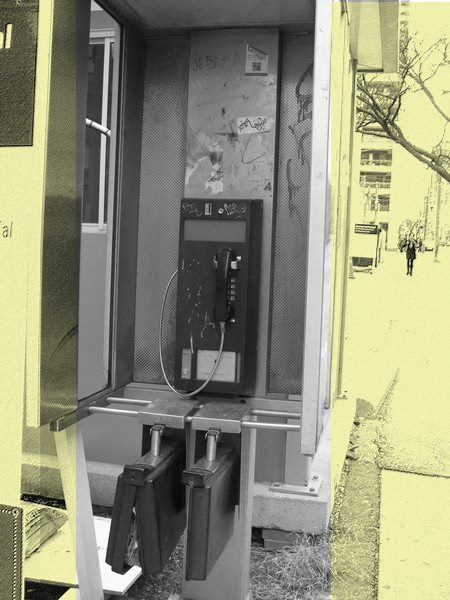
The streets where I live are considerate.
For one thing, they make it very, very hard to lose your way.
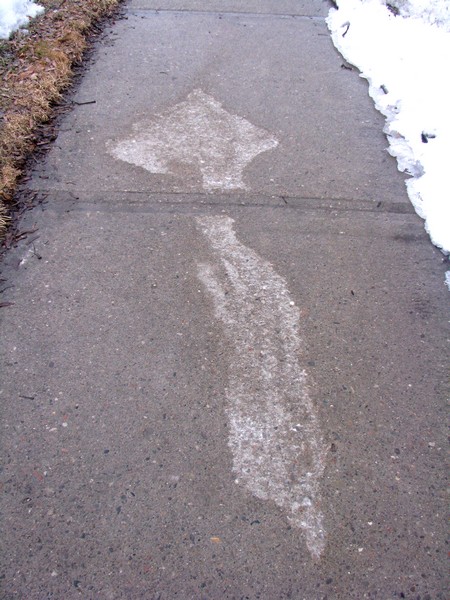
But if you should, don’t panic. There are places to take shelter.

Or stop for a drink.
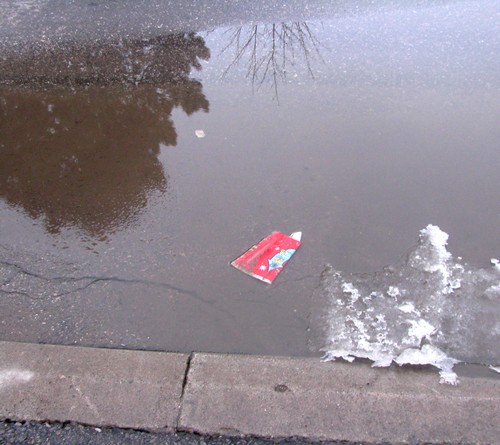
Some with a view.

[Choices are chilled or unchilled; puddled or bottled…]

Big plus: there’s never a shortage of drinking vessels.


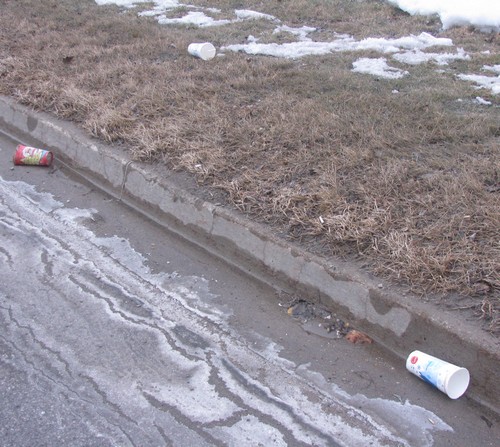
And please use a napkin. [No need to be uncivilized.]
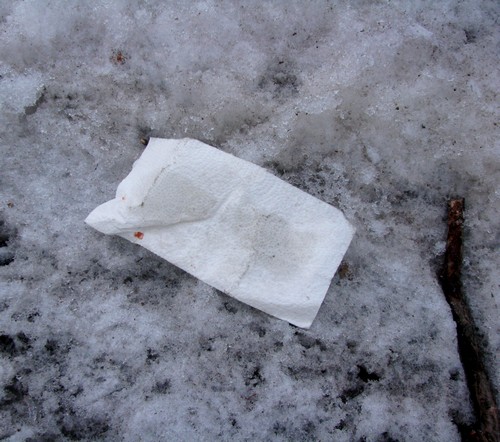
There’s reading material.

Complimentary coat check and/or coat.

And excellent company.

Thank you, streets…
◊♦◊
Other Wordless Friends—
Cheryl Andrews
Allison Howard
Barbara Lambert
Allyson Latta
Elizabeth Yeoman
Imagine picking three books at random—three short story collections—from your ‘favourites’ stack. Imagine having read these books before and this time you just want to read one story from each, to compare styles. Random is the key word here. There’s no rhyme nor reason to any of the choices.
So you open the first to a page that’s part of a story called ‘An Evening in the Cafe’ about a woman from Montreal who is near the end of a teaching term in an unnamed German city. She has a room above a butcher shop, the smell of fleisch is everywhere, even permeating a handkerchief in a dresser drawer. The Chinese restaurant across the road teems with life, while in the café [attached to the butcher shop] where she feels obligated to take her meals, the days and evenings are quiet and predictable—as are the people, including “Oma and Opa… digging into their Schmalz, their broad knives bring up thick portions of seasoned lard from the blue-grey pottery. Now they would be spreading it on their Brot. They would be sipping at their wine and spreading Schmalz on their Brot.”
A letter arrives and creates a stir.
You open the second book at a story called ‘Plum Dumplings’ about a woman in Montreal, anxiously preparing for a [dreaded] visit from her Austrian grandmother, a woman who has nice things to say about Hitler and considers her granddaughter an idiot for living in Canada [she refers to it as keiner da: no one here]. Despite the “fairy wisps of hair” that escape her long braid she remains a tough nut, but then food plays a significant role in shifting attitudes [and is not limited to the title dish]. “Soup in the evening—true gourmandise—brought forth a more expansive Oma. Spooning up broth, folding a slice of bread in half and buttering the end each time she bit…”
Finally, the third book, which you flip open [all still very random] at the story ‘Little Bird’. A young man, an ‘entertainer’ in Berlin, is haunted by his unsettled childhood and his father’s past. He recalls the moment he’s forced to face an awful truth while living in the Caribbean where his Mutti reads Tarot cards and his father sings German folk songs, and where he’s been invited to another’s boy’s house after school, someone he has mistaken as a potential friend. The boys have a snack… “The cook took two slices of white bread from the breadbox and sprinkled them with chocolate, then put the plates in front of us.”
And then things get ugly.
**
Imagine your delight at these odds: three exceptional stories, randomly stumbled over and each featuring Germany or Austria, the German language, an Oma or a Mutti, references to bread and, in two cases, protagonists from Montreal.
You just can’t make this stuff up.

‘An Evening in the Cafe’, from Truth or Lies, by Frances Itani (Oberon Press, 1989)
‘Plum Dumplings’, from Ruins & Relics, by Alice Zorn (NeWest Press, 2009)
‘Little Bird’, from Oh, My Darling, by Shaena Lambert (Harper Collins, 2013)
I rush outside this morning with the intention of catching a spectacular sunrise. But it’s not all sherbet colours as expected, merely yellow.

Still, I’m well into the ravine by now, cleats attached to shoes and the crusty icy snow crunching and cracking, the weird human rhythm of it propelling me onward. [Animals, by contrast, are so quiet.]
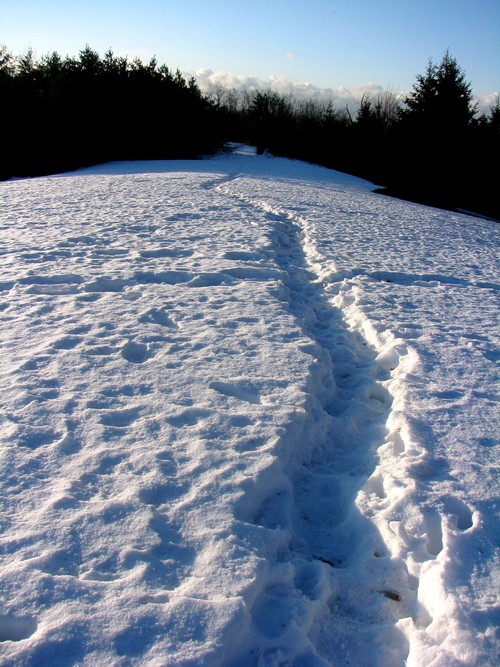
And so onward I gallump through the woods and into the park with the merely yellow sun rising to my left…

and then once I get around the big loop…
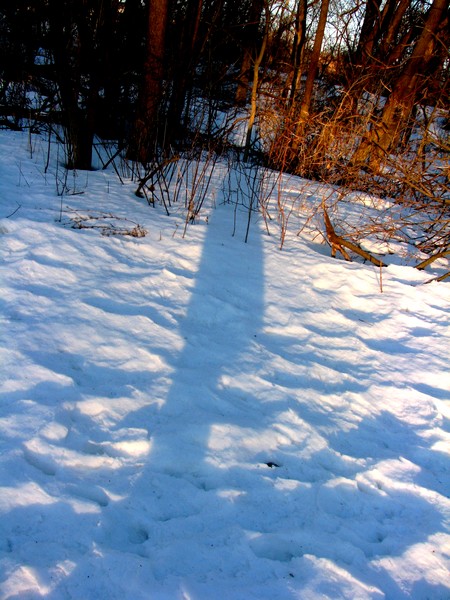
on my right.
No one about this early, or maybe because of the cold. My crunch and clack disturbing only one black squirrel and a flock of chickadees huddled among the lowest branches of a spruce.
Nothing to see but white white white…

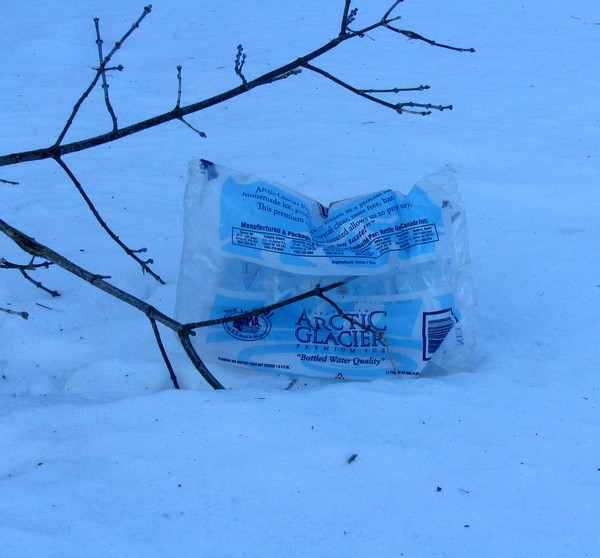
and then a splash of blue, turquoise even.

Every time I see one of these colourful bags I wonder how it gets left behind. Does someone set it down in order to play fetch or Frisbee or chat at length with other dog walkers while sipping a Timmy’s and then simply wander off in a haze of forgetfulness? I think that’s why they’re made in these very striking ‘hello!!’ colours, so they’re hard to not see once the Frisbee is over, and yet…
There’s always something.
 Matilda Magtree