there oughta be a law

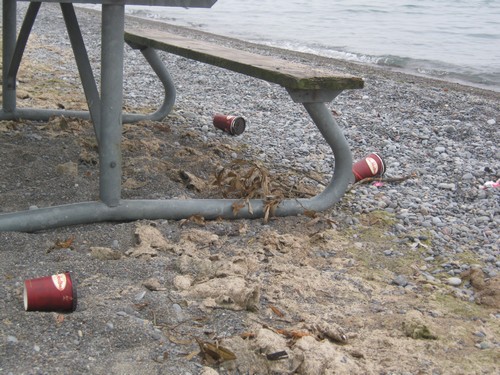
Better yet, there oughta be a land where litterers live. A pretty little place with lakes and trees and green green hills knee deep in rusting cans—(three cups is not nearly enough)—plastic bottles, fast food containers, cigarette packs and newspapers. There should be no garbage service in this land, no trucks nor people employed to pick things up, put them where they should be. Because then one day with a bit of luck the hills would be obscured, the lakes choked with debris— and the plastic bags would be where the litterers like them: all a-flutter in the spring blossom’d boughs of trees.

More from Planet Litter:

—the colour of winter (aka: a red litter day)

—fancy a cool one?

—garbage magic 101

fuel for small talk of a purple nature…

“It is the irresistibly deep and beckoning colour of leather, heather, feathers, sagebrush, winter slush, Tibetan mush, age, sage, shade, grapeade, a forest glade, mince pies, winter skies, a harlot’s eyes, a baby’s cries, vicious lies, butchers’ dyes, and purple drifts of evening snow.” ~from The Secondary Colors, by Alexander Theroux

From the same book, and the essay titled Purple, come the following bits of essential trivia:

1.    Shakespeare never once uses the word violet as a colour, only purple; nor… does he ever employ the words heliotrope, mauve, lilac, or fuchsia. Burgundy was a place, a duke, and, by extension, a wine.

2.    The Nile, in literature, is often said to be purple.

3.    An amethyst placed under the pillow promotes pleasant dreams, and wine drunk from an amethyst cup is said never to intoxicate.

4.    The infamous [in some circles] shade of ‘Tyrian purple’ was discovered by the Phoenicians by extracting the dye from the cyst or vein near the head of a mollusk; 250,000 shellfish were required to make one ounce of dye as each mollusk secreted only one drop.

5.    Rimbaud regarded the letter ‘i’ as purple.

6.    There is, apparently, purple soil [somewhere] in Tahiti.

7.    Henry James saw Italy as picturesquely violet.

8.    A polar bear’s tongue is purple. [Also a giraffe’s.]

9.    Also the sunshine through a person’s paper-thin ears.

10.  The spaceship Endeavour went into orbit on March 2, 1995, with the specific mission to try to determine the nature of ultraviolet light in space emitted from stars and quasars.

11.  The rarest of food colours. There are no purple M&Ms, for instance, though they were made for a short time but proved so unpopular, they were replaced by tan ones in 1949.

12.  Horace on purple prose: “Often to a work of grave purpose and high promise, one or two purple patches are sewed on to give the effect of colour.”

13.  There’s speculation [in some circles] [what circles would these be??] that all seven of Salome’s veils were purple.

14.  The dominant colour of Gillikin Country in L. Frank Baum’s The Wonderful World of Oz.

15.  Except for plum, all shades of purple lose their lustre in candlelight.

16.  The naturalist, John Muir, wrote a letter to a friend on purple sap from a 4,000 year old redwood.

17.  Rumour has it Anatole France, Voltaire, Diderot, Flaubert and Balzac all wore a purple dressing gown while they worked.

18.  Sherlock Holmes, on the other hand, owned three dressing gowns. One brown, one blue, one purple.

19.  Daisy, in the film version of The Great Gatsby, wears a violet dress, scarf and hat, on her reunion with Nick, who sports a purple silk shirt.

20.  Twiggy’s favourite colour.

21.  Harriet Quimby, first women pilot to fly across the English Chanel, always wore a plum coloured flying suit.

22.  From The Colour Purple, by Alice Walker: I think it pisses God off if you walk by the colour purple in a field somewhere and don’t notice it.

23.  Gloaming = Twilight [and, according to Theroux, it is dark purple brown]

because it’s sunday

“…Wake early one Sunday and smell the person sleeping next to you. Do it. Lean over. The inside of the neck will do, just below the ear. Take a deep breath. The knowledge of this scent is lodged in the deepest part of your brain.

“Breathe deeply, if only to remind yourself of why you are where you are, doing what you’re doing.

“Now go into the kitchen. Throw two eggs into a bowl with a cup of milk and a cup of flour. Add a quarter teaspoon of salt and a tablespoon of melted butter. Mix until smooth, but don’t overdo it.

“Pour the batter into buttered muffin tins, filling the cups no more than half-full. Put the tins in a cold oven. Turn on the heat to 450F. After fifteen minutes, turn the oven down to 340F. Wait for fifteen minutes more.

“This recipe comes from the Fannie Farmer Baking Book by Marion Cunningham. It’s an important book, with clear recipes and much new thinking. For example, prior to Marion, popovers, were always started in a hot oven. This is a small thing, but one which changed my life.

“While you’re changing yours, make some coffee and squeeze a couple of oranges. Do want you want with a pear or a pineapple. Get a tray ready to take back to bed.

“Now open the oven. It will make you smile. They don’t call these things popovers for nothing. They look like little domes, golden brown and slightly crispy on the outside.”

~From Comfort me with Apples, by Joe Fiorito (McClelland & Stewart, 2000)

(p.s. If you like this, here’s more from the same book.)

with thanks, always

Last year I was with my mother on November 11th for Rememberance Day ceremonies at her nursing home. I remember how much she enjoyed the outing, slept through the whole shebang. This year, she’s no longer here and at 11 a.m. I found myself somewhere far less reverential, in a busy shop, running late. I don’t wear a watch and didn’t know the time until a bugle suddenly sounded from outside; a few people looked at each other as if wondering what they should do, I mean, in the middle of a store and all, in the middle of shopping. But no one ignored it.

And then—unlike a fire bell where you assume it’s probably not even real—everyone, every single person, just stopped what they were doing. No one came in or went out. The cash registers were quiet, people stood still, stopped talking. I don’t think anyone even looked around. It was just this amazing group action, this vibe of tacit reverence, and whatever individual things were going through individual minds was overshadowed by a kind of collective understanding. Though still taken by surprise in many cases, and distracted to some degree, people were nonetheless willing—seemed grateful even—for the opportunity to recognize this moment, and to do so in a public space—a space that too often keeps people separate. Just for this moment, all of us, strangers from countless backgrounds, saw each other in a different light, one that reminds us that on possibly the only level that really matters we are deeply connected.

And I think we liked that thought very much.

For that and so much more, hats off to the men and women of the past and not so long ago, who did their best on our behalf in the insanity of war.

More than ever, here’s to peace.

what happened to jumping in?

I’m watching a woman vacuum leaves. She’s strapped on a sort of large black bag, something like what newspaper boys and girls used to carry on their rounds, before their parents started driving them. The bag is attached to a long, fat nozzle which she points at the leaves she’s raked into a pile. At first things seem to go well enough. When the pile is sucked up she turns off the machine and empties the black bag into a paper sack intended to be put out onto the curb.

But it’s not quite that simple. 
 
You can’t imagine the difficulty she’s having transferring the leaves from the black bag to the paper one. It takes forever and it’s all a bit of a mess. When she’s done she sucks up the trillions of escaped leaves then rakes up another pile for vacuuming.
 
Now she stops to empty the black bag again but it won’t detach from the nozzle. She fiddles with it for several minutes until the neighbour guy who doesn’t miss a thing saunters out his front door with his hands in his pockets all nonchalant like he wasn’t watching from the window. He offers to help. You can see that he covets her large nozzled leaf sucking machine and is annoyed that he didn’t get one first but pretty soon relief replaces envy as he realizes the thing is a new-fangled piece of crap, unlike his trusty old-fangled leaf blower, which he uses to blow every single leaf off his lawn and onto the street where they’re left in great drifts, free to find their way onto other people’s lawns [possibly causing unpleasant muttering amongst those neighbours who don’t covet leaves as worm food or mulch].
 
The guy has now patted the woman on the shoulder in a good luck with that stupid thing you just wasted your money on kind of way. He chuckles as he almost heads back to his own house but decides to first offer up some long-winded verbosity that I can’t hear but the woman looks bored and irritated and who can blame her? She still has a whole lawn to rake and suck and transfer from one bag to another. At this rate it make take all night. I want to yell: you live on a ravine, for god’s sake—put the leaves in a wheelbarrow and dump them under a tree!
 
The guy goes home.
 
The woman turns the vacuum back on.
 
Then off.
 
Something else is wrong.
 
She fiddles with it.
 
Turns it on.
 
And off. Fiddle fiddle.
 
She does this several more times. On. Off.
 
Meanwhile, the rake is right there. Leaning against a tree. The paper bag is still half empty. It’s getting dark out.
 
On. Off. On. Off.
 
It’s so sad. The rake is just there…
 
This is what I call an alien moment. Things we do that make we wonder how we might appear to someone other than ourselves, to, say a spaceship that happens to be passing by. We’re all guilty in different ways. And not guilty at all of course. Given that we’re only human.
 
The first time the alien thing occurred to me I was at a Sandals resort in St. Lucia where I lay in the sun, slathered in oil (an alien moment right there), watching a couple ride about on those giant paddle boats, my sun-addled brain thinking: hmm, looks like fun until they got semi-stuck, and bobbed about helplessly against this gorgeous backdrop of land and sea, turning in endless circles, waving their arms madly and arguing about how to correctly manoeuvre their fluorescent plastic containers.  
 
Alien moments are times when it strikes me as not that far-fetched to imagine we aren’t the most intelligent life form in town, and that should the little green men and women be looking out their spaceship windows, they could be forgiven for thinking yes! this is it, the perfect time to swoop in, launch an attack, never more confident about their chances of taking over the planet…
 

since i was up anyway…


Lovely as it is to have this extra hour today, I kinda like dark mornings and lighter nights and wonder why we switch back and forth anyway.

Didn’t it have something to do, several thousand years ago, with an agricultural lifestyle — farmers and children needing to get up to feed livestock or walk twelve kilometres to school, every single one of them getting crankier by the day as they bumped into low slung beams and fell into wells until someone with a bit of clout said: I have an idea, let’s rearrange the daylight by mucking about with the clocks.

To which I say fine, but the world is less agrarian now and the lightbulb has been invented and everything. And furthermore, I prefer dark mornings and lighter evenings so I’m often tempted not to Fall Back… but one must conform in these things or one finds oneself missing many buses. Still, if anyone out there is taking a survey, would you please put me down for LET’S JUST PICK ONE TIME FOR PETE’S SAKE AND STICK WITH IT.

Until sanity prevails however… Happy Return to Bright Mornings!

epigraphs, dedications and other things worth mentioning up front


This book is for
my wife Diana and our siblings Carol, Fiona, James, Neil, Adam, Charles and Jo-Jo, together with any others whom I may have inadvertently overlooked.
~ Douglas Sutherland, The English Gentleman’s Child (Penguin Canada, 1979)

The names of all the white people who worked at the Indian schools mentioned in this book have been changed. The events actually happened. We genuinely regret any inadvertent similarity between these fictitious names and the names of real persons.
~ Jane Willis, Geniesh: an Indian Girlhood (New Press, Toronto, 1973)

This book is dedicated to the humble cod. May its fate be a lesson to those who would be humble. Let the meek and tasty stand on guard.
~ CODCO,  The Plays of CODCO (Peter Lang Publishing, 1992)

I was thinking about the way a girl had talked to me on her houseboat in Chelsea, and the way two girls had talked in a singles bar in New York, and the way a German girl had talked in Hamburg, and the way the women used to talk on Saturday night on the last bus from Liverpool to Prescot, when I was a conductor, and the way Germaine Greer and Betty Friedan and Kate Millett and Shulamith Firestone and Marion Meade and other stalk through their books, when it struck me that I had hardly ever heard women talk like this in the theatre; there was a silence like Siberia.
Then in Doris Lessing’s The Golden Notebook I read this sentence: “I thought there here is a fearful trap for women, but I don’t yet understand what it is. For there is no doubt of the new note women strike, the note of being betrayed. It’s in the books they write, in how they speak, everywhere, all the time.”
And so, Old Flames.
~E.A. Whitehead, Old Flames (Faber & Faber, 1976)

Author’s Note: I am not I; thou art not he or she; they are not they.
~Evelyn Waugh, Brideshead Revisited (Little Brown and Company, 1946)

truth

I was at the beach the other day looking for a picnic table I remembered seeing months ago, in summer, that had Truth written on the seat— I wanted to take a picture of it.

The table had been on the sand, close to the water, but now it was gone. Well, it couldn’t be gone, it’s a big heavy picnic table, I thought, it had to be somewhere; somebody must have dragged it onto the grass nearer the barbeques and swings so I wandered about looking for it among the maybe thirty tables—I remembered bold black lettering in magic marker, easy to read—but I couldn’t find it.

Then it occurred to me that despite its bulk it was made of wood and technically could have been burned or broken and after checking every table twice I had to admit there was no reason to assume it should still be there.

But I checked a third time.

And then I saw it. The lettering had faded to almost invisible—I’d never have noticed had I not been looking for it especially.

Thing was, it didn’t say Truth. 

I remembered now.

Truth would have been a fine thing to write, but I’m not sure the single word would have caught my attention the way this had. I remembered reading the bold lettering on that lovely summer day and feeling sadness and shock and wonder at how alone this person must be despite any number of friends. I wondered: where were they now and how were they now, and how would they be…

I remembered feeling helpless, and angry that anyone should feel so alone, hopeful that whoever it was would find the strength they needed, and that we, that society, too, would find the intelligence and compassion needed to understand in a meaningful way. 

Funny how I remembered it all as Truth.

What it actually said was: I wish I was born a girl.