it’s not them, it’s us

Several years ago I was picking my mum up from the hairdresser and as I waited in the parking lot of a small plaza, a huge green pick-up truck pulled in beside me. The window was open and the guy driving was heavily bearded, ruddy-faced, plaid-shirted, the kind of guy you just know spends a lot of time outdoors; you could almost smell the pine boughs and bait—I guessed fisherman, hunter, lumberjack. Maybe all three. When he opened the door I expected a giant to emerge but what happened was he lowered a tiny step-stool attached to a rope, then turned and slid himself off the seat and onto the running board and, with a cane for balance, hopped down to the step stool and onto the pavement. Then he tossed the stool back into the truck, shut the door and made his way into the plaza.

He was maybe three feet something tall.

A few minutes later he was back, walking just ahead of my mum and her fresh perm. He reversed the stool routine and got into his truck as my mum sat down beside me.

Poor man, she said. It must be terrible to be handicapped.

Had I just glanced at him I might have agreed, but I’d had time to watch, time to think what it means to be handicapped, because this man certainly wasn’t. He was a short man functioning very well in a world designed for people who fall into certain categories, certain heights.

I wondered how well I’d do in a world designed for his height. A whole world where everything, everything, was way too low. My back aches just thinking of it.

The word handicapped just doesn’t seem right somehow, the way we use it, except to suggest that anyone could be handicapped in a situation not ideally suited; we, who thrive in this world, would be handicapped in a world not constructed for us—not by our limitations, but by the limitations imposed on us by awkward ‘constructions’.

It seems that in our narrow view of what’s ‘normal’ we’ve built a rather limited world, one for sighted, right-handed, hearing people of a certain size. I suppose it’s a ‘majority rules’ kind of thing, which really isn’t a good answer but if that’s the best we’ve got then you’d think at least we could get our perceptions straight and see things for what they are—that very normal people who happen to be blind or smaller than the ‘majority’ are seriously inconvenienced as a result of those ‘majority’ rules.

They are not handicapped.

If anything, our thinking is.

I’ve been meaning to write about this guy ever since I saw him. He came to mind again when, the other morning, I heard about Oscar Pistorius qualifying for the Summer Olympics.

“My disability is that I can’t use my legs. My handicap is your negative perception of that disability and thus of me.” – Rick Hansen, Man in Motion, 1987

sounds of summer

Gulls. Always gulls.
Then something else, a party of black birds, a celebration.
Ten thousand voices in the reeds.

The sound of roses.

—Wilting in the heat, the kerplunk of falling petals almost lost against the din of all that invisible black bird revelry.

Seaweed drying.
It sounds like this: schwimfftmtzwuft
You have to lean over to hear it.

The splash of a dog named Winston belly-flopping into the drink.

The slosh of my feet and the surf blocks voices of walkers, strollers, the breath of joggers, a herd of cyclists and a grown man working out on the monkey bars.

But a woman comes through loud and clear, warns of dog poop ahead.
“Somebody let their dog just poop, poop, poop…”

The skip of a stone.

Scrunch of pebbles.

Me cursing the mentality that appreciates beauty enough to come here, then spits in its face.

But no one warns of litter ahead…

Inhale.

Exhale.

the happiness vortex

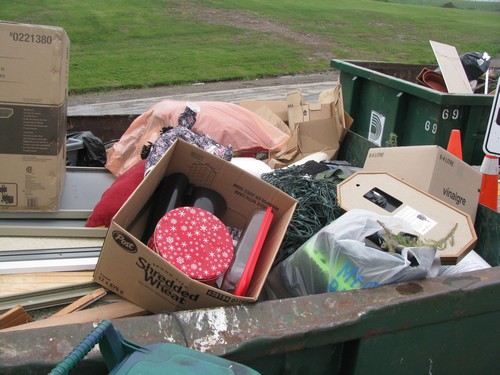
I can’t explain the pleasure I get from visiting the local dump.

Pretty sure it started with weekend jaunts as a kid when my dad would take in a load of old lumber and then nose around for wotnots, spare parts, a hubcap. It was like a free garage sale. That was when you could still nose around and the junk really was mostly junk. Treasures were rare. Now there are fines for scavenging.

Oh the irony.

Because it’s not just plywood that people are dumping anymore. Now the bins are heaped with treasure. You could open several stores daily with the amount of quality goods being pitched.

A woman with a load of furniture tells me she’s a professional recycler, she’ll come to your house, pick up any junk you’re getting rid of, sell what she can, keep what she likes, and take the rest to the dump. She says she’s furnished her whole house this way, including appliances, and makes a decent living on top of it.

I watch a guy toss in two whole bikes.

What are the odds both are broken? And anyway, didn’t people used to fix bikes?

While I’m considering this, another guy tosses in another bike, a tiny one, so tiny it was probably ridden exactly three times. And okay, so the kid’s grown out of it. You’d think there might be someone it could get passed on to… like maybe dear old Sally Ann?

It’s staggering the amount of crap we have in our lives and the ease with which we toss and replace it. In the few minutes I’m there I see more than a few bins replaced or the contents squashed to make room for more. There’s always more. The bulldozers and bin movers and squashers are busy everywhere you look.

Despite all that, I’m oddly happy here.

And it’s not just me. The staff are consistently cheerful. From the guy in the booth when you arrive, to the one who tells you what dumpster to use, the woman in the building that takes cardboard or the guy in hazardous waste, the people you pay on the way out… everybody’s so friendly, so pleased to see you. It occurs to me that I’ve never met one cranky employee at the dump. Ever.

Sure, it could be drugs.

But I have another theory. Isn’t it just possible that all those people letting go of all that stuff, all that purging, creates a giant cleansing vortex? And who wouldn’t be happy in a spanking clean vortex?? By which reasoning it can be assumed that a shopping centre, a place where stuff is accumulated, would be one of the less therapeutic places to work. [It’s starting to make sense isn’t it?]

Anyway—not that anyone’s asking—given the choice, shopping centre or dump, I’d pick the dump.

For the vortex, obviously.

Plus I’m pretty sure they get dibs on the loot.

a few trashy stories

So there’s the one about the guy who walks over, slow like, walks all the way over from wherever he lives on the street opposite the park where Peter and I are clearing litter from the tall grass area and creek bed that never gets mowed. It’s a pretty big space and we have a few green garbage bags already filled. So the slow walking guy stands there, hands in pockets, smiling, and says it’s great what we’re doing. He wants to know if we’re part of a group or something. (What, like the Kiwanis maybe? I’m not sure what he means). No, I say, we’re just  us. He looks momentarily confused, or perhaps it’s just gas, then rattles on about the sin of littering and how it brings down house prices. He asks if we live in the neighbourhood. Nope, I tell him, we’re on the other side of the ravine but we come through here all the time. His hands are still in his pockets. He’s wearing khakis and a golf shirt. Well, he says, bouncing a little on his toes, brightening considerably, why don’t we form a committee, get a group together to clean the area. But we are cleaning the area, I say, we do this all the time. I explain how you can’t just clean it once, it gets messy again very quickly, and how a group, nice as it would be to have company, won’t do any long-term good… better to just have many people pick up a few things on a daily basis. Or do bigger clean-ups on their own as and when they feel like it. I suggest that groups have a way of getting complicated. They argue. People will find ways to disagree about how to pick up litter. We’re not group people, I say finally… but, hey, thanks, and good luck.

He’s suddenly all crestfallen and slightly pissed off and I silently wonder if in declining the offer to whip up a litter committee what I’ve really done is dashed his hopes for whatever else was attached to the plan. (Brain-storming BBQs? Bake-sale to raise funds for garbage bags? Motivational street party with face-painting for the kids and Larry the Litter Loving clown?)

He mumbles something like yeah, right, and walks back from whence he came, hands still firmly planted in pockets.

If a committee has been formed, I haven’t noticed.
The litter continues to fall.
We continue to pick it up.
We’ve never seen the man nor his pockets again.

__

Then there’s the couple who sit on their porch comparing their lawn to everyone else’s. We don’t have a lawn. We’re weird. And when I walk past the porch-sitters the man says something I don’t hear and I shout back Yes, it’s a lovely day! and he repeats the thing that I don’t understand. I move closer and he says “What’s that in your hands?”

I tell him it’s litter; I say it’s amazing what you can pick up in just a short walk around the block. Ha!  I toss in some laughter to keep it light.

He makes a bad smell face, goes slightly indignant. The woman also, just stares. So now I’m standing way too close to their tidy porch holding a squashed Timmy’s cup and other bits of debris and I realize the exchange has ended, that I’ve been dismissed, and as I shuffle off I wonder how I’ve offended them. Have I caused them to feel guilty for not picking up litter? Or have I simply confirmed their suspicions about the sort-of-people-who-don’t-have-a-lawn? (Beware the Timmy’s cup, the flattened water bottle, the muddy Rothman’s pack… strange powers to unsettle the masses lurk there!)

__

A friend of mine gathers litter as she walks to work at King and Bay—which is brilliant because the better dressed the anti-litter warrior, the more influence they have in a 100 monkeys kind of way. (Recently I’ve noticed a guy around the corner who takes regular walks with a No Frills bag or two, filling them with rubbish. I honk as I pass. Wave and smile. I hope he doesn’t get the wrong idea.)

__

Last but not least is the woman who says—in her not-very-sincere-smiling way (and who insists recycling is a scam)—that it’s very nice to pick up litter and all but don’t I worry that I’m taking away the jobs of people who are employed to do such things?

Though I’ve never seen the ’employed’ scrambling through ravines… I call the Town, present my concerns, and am met with laughter.

Followed by reassurance that no one will lose jobs.

Seems there is indeed enough litter for us all.

On the street, in parks, wherever.

You can imagine my relief.

call it what it is

Dear Hudson’s Bay Company:

Your cosmetics brochures. Every month or so when they come out it’s the same thing: a striking, artistically rendered cover, showing the manipulated face of a woman (manipulation including use of, not only the products listed in the brochure, but lighting, air-brushing and computer magic—standard tricks to achieve the ‘effect’).

All of which is fine. However none of it equals beauty.

Beauty would be the un-manipulated face of the models.

But if this ‘artistic’ rendering is what you prefer, then at least consider that your title is inappropriate and misleading. A more realistic title might be, for instance, ‘Makeup’.

There are other suggestions of course, but I’m trying to be helpful.

While I understand that the subliminal message being sent is important for your bottom line, I feel it’s equally important not to further confuse real beauty with manipulated appearance—given how young women and girls, especially, are already confused about what beauty is. A company with your clout could go a long way to make things better in that regard and still achieve a living wage bottom line. Or you could make it worse and continue to be part of the problem.

Just a thought.

Your choice of course.

Sincerely,

friday the thirteenth

Starts with a massage.

My occasional luxury of choice. (Which really isn’t a luxury at all if you talk to Hippocrates.)

No complaints there. Even though the massage therapist tells me she’s not a morning person. I worry momentarily about cold stiff hands and lethargic moves, yawning from above, but she turns out to be great. Even gives me a couple of tips:

1) buy a timer to remind myself to stand up at my desk now and then, move about, roll my shoulders, breathe, etc.

2) get a new mattress every ten years.

So I go to the dollar store and buy a timer in the shape of a pear and while I’m in line I think about evolution and wonder if humans accidentally stopped evolving a lot sooner than we were meant to. I mean, everything else in the universe seems to have the sense to remember to roll its shoulders without the help of plastic fruit.

The woman ahead of me has two baskets filled with what I recognize as the fixings for loot-bags and I remember the first birthday party I organized for my stepson. He was nine. We did the usual: cake, lunch, games, arts and crafts, then a trip to the bowling alley for some five pin action. At the end of the day, as the parents started arriving to pick up their kids, and as we waved and said bye bye now, you little darlings, one of the kids said: so where are the loot bags? I had no idea what he was talking about. Last kid party I’d attended I was nine myself and the only thing I brought home was a piece of cake wrapped in a soggy serviette.

From there I take my still squishy, flushed, massage face with its massage table indentations to the library where I hope not to frighten small children. I smile the smile of the freshly massaged who have three books waiting to be picked up:

Gould’s Book of Fish: a novel in twelve fish, by Richard Flanagan
Indian Horse, by Richard Wagamese
We Tell Ourselves Stories in Order to Live, by Joan Didion

I wander over to the free-giveaway shelves where I find a bumper crop of Canadian Gardening magazines. It would be selfish to scoop them all so I sit down and flip through each one in order to choose. Then scoop them all. (I paint a rosy cast over this unbecoming behaviour by telling myself I’ll return them to the giveaway shelves once I’ve finished reading them and have become a brilliant gardener; it could be a while…)

There are also a number of French books, including dozens of Harlequins, which remind me of a friend who once told me she learned French by reading stacks of Harlequins while living in Paris. I grab one for her for old times’ sake and one for me, as a learning aid.  Also find a copy of Gabrielle Roy: De quoi t’ennuies-tu, Eveline?  The cover shows a matronly woman in feathered hat and fur collared coat, a snow-covered field and two small houses in the background. I like it already. Er, that is… Je l’aime deja. (BTW, I had to google translate that, which tells you all you need to know about my French; I can only pray the Harlequin will do its magic.)

I should be heading home now but instead find myself entering a little second-hand clothing shop. The woman sitting by the till is covering for her daughter who has pleurisy. She’s taking care of her grandkids also. She looks tired. She lost her husband in February and helping her daughter keeps her mind off things, she says. I tell her she must remember to look after herself as well and she nods, smiles, says no one sails stormy seas forever. When I knock over a display with my shoulder bag she calmly fixes it while I apologize and worry about any teacups in the debris. She says no, nothing breakable, laughs, says it happens all the time. She’s one of those people. I’ll bet it doesn’t happen all the time at all.

I buy a floral print jacket in lime green and pale pink. An odd choice given that I mostly wear black with occasional splashes of white or grey. Never prints. Especially flower shaped ones. (Could it be that I picked up some weird pourquoi pas? c’est printemps! vibe among all those books with their covers of feathery hats, heaving bosoms and holiday themes…?)

By now it’s almost lunchtime so I decide to get some rotis and fish cakes from the Carribean place next door, and a new thing called ‘doubles’—a spicy chick pea wrap.

At home I pick dandelions in the garden, sorrel leaves too, make a salad and watch The Big Bang Theory, which I admit I’ve developed a slight addiction to.

I write.

I hang sheets.

I tidy the yard and make a note to buy more seeds.

Later I will have a glass of chardonnay on the patio and eat grilled salmon and Peter’s double baked potatoes, which we will douse with butter and sprinkle with garlic chives.

We will talk about the day. His, mine.

There will be reading.

Some gossip about the neighbours.

Plans for tomorrow.

And—despite the possiblilty of evolutionary glitches—very big chunks of gratitude.

the shape of our blue monkey thoughts

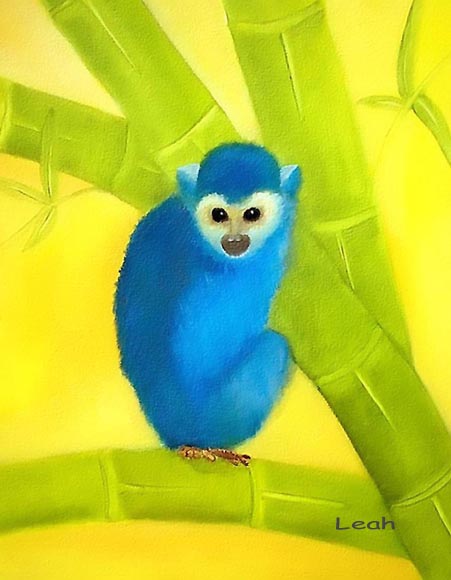
I was thinking why handwriting is read so differently than on-line type and have decided it has something to do with how in handwritten notes we not only share words but the shape of our thoughts. ‘Blue monkey’ typed, is a series of letters, identical no matter who types it. But write ‘blue monkey’ by hand and I have a better idea of what your particular blue monkey might look like.


I thought I’d invented the idea of ‘blue monkey’, but apparently not
—thank you, google…

three girls

So I walked to the library.

And inside, the first thing I see, a girl, maybe five or six, in a red dress with big black polka dots, skip, skip, skipping, towards the kiddie book section—arms overhead and long blonde pony tails bouncing and swinging from side to side, unbridled as her joy.

On the way home, a girl, maybe fifteen, in cutoff shorts and tiny tee-shirt. Long brown hair, tied back, exposing round, freckled face and big smile. An apple-cheeked, wholesome Daisy Duke. She delivers newspapers in a wooden wagon and as I walk past she says Hello! in this way that feels like she’s actually happy to see me. Some people can do that. Some people can be fifteen and beautiful and not know it, and make being a paper girl who hauls around an old wagon seem like a very enviable thing.

Around the corner, an old girl. Maybe eighty. Maybe more. Grey hair, wavy, cut in a bob, shoulders hunched forward like a parenthesis, as if it’s been a long time since her back was straight. Comes out of one of the swanky houses that abutt the ravine. She’s in smart trousers and a light khaki jacket with a Burberry collar, black patent leather flats. She walks toward the dead-end of the street; I assume she’s off to visit a neighbour for tea or a few hands of bridge. But no. She walks to the end, then pauses, turns back and walks home. All in perfectly polished patent leather pumps.

venus and mars (the rocket science version)

“She was an attractive French Canadian in her forties named Julie Payette, who had flown one shuttle mission and would fly another in July 2009. She was dressed in blue NASA coveralls, her dark hair tied back in a ponytail. On the screens above us, in the briefing center, the space shuttle Discovery crouched, steaming, as the countdown progressed. Payette was too kind to laugh in my face when I asked her bout the silence of space, but she looked as if she wanted to.

“There is always noise in space,” she said. “When you don’t hear noise, it’s a problem, especially in a space suit. It means the interior ventilators are not working, not circulating air; the carbon dioxide [that humans breathe out] has a different density in zero gravity, it makes pockets around us.” She had intense brown eyes and a mouth that tried hard not to twist upward at my cluelessness. In order to sleep weightless, she continued, she had to find corners to wedge herself in, but “it’s hard to find comfortable places.” Her favorite nook was in the space-suit bay, jammed between two parked suits. “The helmets purr, ” she said, then repeated it happily, in French: “ils ronronnent.”

~from Zero Decibels: The Quest for Absolute Silence, by George Michelsen Foy (Simon & Schuster, 2010)

~

Here’s the thing: were the author speaking with Neil Armstrong, would he have noted Armstrong’s hair colour and how he wore it; would the intensity of his eyes, or lack thereof have warranted even one line of ink? (Not to mention the shape and/or tendencies of Armstrong’s mouth to turn up at the corners.)

Granted, he may have asked about sleeping arrangements on the shuttle, but I’m not convinced he’d have asked Neil to repeat anything in French…

Furthermore, I wonder: if a woman had interviewed Payette [or Armsrong for that matter] would attractiveness, hair, mouth and eyes have figured in a story about the quality of sound and silence in space?