my day, in food and words

It begins with a haircut.

Not at the cheap place where you can just walk in without an appointment, where I ususally go—essentially a unisex barber—but to my old, more expensive, hairdresser who I used to see when my hair was long and didn’t need cutting every twenty-five minutes. It still feels like I’m having an affair, this new place; I’ve never accepted that I really left the old place. Just taking a break. I go back a couple times a year for a decent cut, a template for the uni-barber to follow. A little unconventional but it seems to be working for all three of us.

It’s a day of errands and appointments. There is the usual traffic. A bus pulls in front of me at a dangerous angle; I consider making my feelings known but the sun is shining and it’s easy to be nice, so I keep my hand on the wheel.

A woman, sixties, stout in a pink house-coat with permed hair the colour of cardboard, smokes on her balcony, and later, in a different part of town, there is a man, also in his sixties, trying to get on a unicycle. I round the corner and never know if he succeeds.

The appointments and errands go on and soon it’s late afternoon and I haven’t eaten and I know I won’t get any work done even if I return to my desk so I decide to take myself out for a bite, treat myself to that place inside the art gallery, but it’s closed. The gallery itself, however, is open and though my stomach is growling the exhibit draws me in: William Brymner, his own work and that of his students, Prudence Howard, Morrice, A.Y. Jackson, et al.

The Quebec paintings are always easy to spot—all church steeples and snow. Even the houses have churchy elements, even the log cabins alone in their forests of birch— especially the cabins.

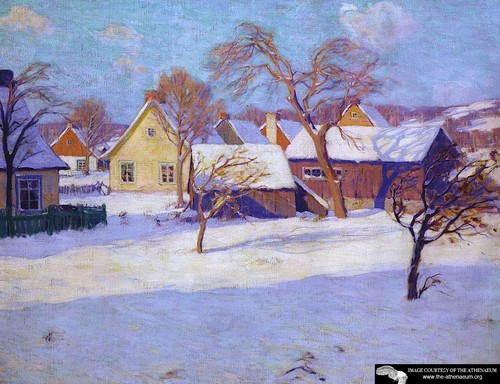
In Clarence Gagnon’s ‘Winter, Village of Baie-Sainte Paul’, a wind blows on a sunny afternoon. Lunch has been eaten, slabs of cold tortiere and glasses of cider. The dishes are done. The men have gone back outside, the children too. It might even be a school day. Inside the slope-roofed houses women breathe on the glass as they look out onto frozen gardens, broken fences and knee high drifts of snow.

I like the idea of painting en plein air and vow to do some soon.  Pourquoi ne pas en hiver?  Well, maybe just a quick sketch…

I still haven’t eaten so I stop at a deli on my way home, the one I used to take my mum to on errand days when she’d come with me for the ride, staying mostly in the car, especially if I parked in a sunny spot. She was like a salamander then. I’d stock up on her favourites: blocks of smoked bacon to slice or grind with garlic and eat with fresh rye bread, brandy filled chocolates, sauerkraut and a bag of pfeffernusse—a spicy cake-like cookie. I’d always buy one square of ice-chocolate from a box near the cash register—creamy milk chocolate that feels cool when you eat it. She wakes up when I open the door and all groggy wonders where we are; I hand her the chocolate and like a child, she brightens immediately, fumbles with the gold and turquoise foil, pops the whole thing into her mouth. I hear her dentures clatter and soon she begins to sing crazy old songs about chickens and underwear, songs I’ve been listening to all my life. I tell her I got the smoked bacon, and she hoots, says let’s go home and eat!

That was then.

The last few months of her life, after the stroke, she was in a nursing home and for a while she still ate the bacon and the rye bread, the chocolates and cookies. Surprisingly, it wasn’t this stuff that killed her, in fact it’s what kept her going, all that was left. When nothing else mattered, the bacon was still a small joy, some connection to better times—she always talked of home when she ate it, the mountains, her mother; it even made her sing occasionally, even in that hideous room.

The chocolates and cookies went first, and when one day she said no to the bacon and bread, I knew the last corner had been turned.

All this comes back to me as I stand in the delicatessen, choosing meat for a sandwich, my stomach still growling.

I buy the meat. And a bag of pfeffernusse, a block of smoked bacon, which I’ll put through a meat grinder with garlic, salt and pepper. I buy sauerkraut and brandy filled chocolates. I want to buy more but I leave it at these things, some of which I don’t even like, it just feels good to place them in front of me on the counter. And then even better to carry them outside into the sunshine.

I open the car door, set the bag down on the passenger side. Only the square of chocolate is missing.

I start the engine. It’s time to go home.
peeping tomettery

I love walking in that hour just before dinner when it’s already dark but doesn’t yet feel like night and people are coming home, on foot and by car, stepping off busses, picking up kids, dragging home groceries. It’s like there’s a universal aaaahhhh in the air. I love the way windows are lit and I can see the wee slivers of life of those who don’t draw their curtains—which I assume they leave undrawn because they, too, want to see wee slivers of life outside, which occasionally includes me, walking by, looking at them, feeling a little like a peeping tomette (although I think that only applies if you actually stop walking).

Last night the sky was mostly clear with a few scudding clouds and the moon, an almost perfect half, and in the first of a row of old brick townhouses painted bright blue, I see a young man and a slightly older woman at a table in the front window, leaning back in their chairs, talking and drinking red wine from stemmed glasses.

In a low-rise apartment, an elderly woman checks her mail in the lobby, keeping the door open with her foot, then goes back inside empty-handed; I sense the length and weight of her days in the slouch of her shoulders, the shuffle of slippers.

Another woman, also elderly, sits with a tray on her lap, and a few doors along, in a house the size houses used to be, with a tiny carport and a milkbox, a couple are eating at a table with a white cloth; the woman catches my eye as I pass while her husband stares straight ahead at something else, a wall, a TV, a daydream, and just chews.

In a front yard that’s all plants and no lawn, a bench has been placed right next to the public sidewalk as if to offer a moment’s rest to those who have been a long time travelling. I think about stopping, but carry on instead.

A man sweeps his front porch and on the corner a fridge is being delivered. Or stolen.

A woman in jeans walks a stroller and a golden lab and a child skips to the front door of her house with a pink backpack ahead of a woman in stockings who moves much more slowly, locks the car door with a remote and a beep beep.

Across the road, a gate is over-grown with dried clematis and in the tiny wooden house attached, a couple sit back to back at computers as their faces shine blue in the light.

there oughta be a law

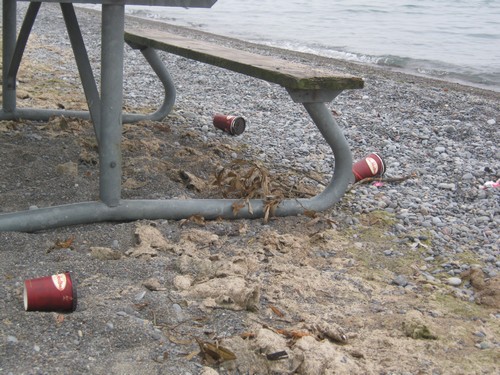
Better yet, there oughta be a land where litterers live. A pretty little place with lakes and trees and green green hills knee deep in rusting cans—(three cups is not nearly enough)—plastic bottles, fast food containers, cigarette packs and newspapers. There should be no garbage service in this land, no trucks nor people employed to pick things up, put them where they should be. Because then one day with a bit of luck the hills would be obscured, the lakes choked with debris— and the plastic bags would be where the litterers like them: all a-flutter in the spring blossom’d boughs of trees.

More from Planet Litter:

—the colour of winter (aka: a red litter day)

—fancy a cool one?

—garbage magic 101

what happened to jumping in?

I’m watching a woman vacuum leaves. She’s strapped on a sort of large black bag, something like what newspaper boys and girls used to carry on their rounds, before their parents started driving them. The bag is attached to a long, fat nozzle which she points at the leaves she’s raked into a pile. At first things seem to go well enough. When the pile is sucked up she turns off the machine and empties the black bag into a paper sack intended to be put out onto the curb.

But it’s not quite that simple. 
 
You can’t imagine the difficulty she’s having transferring the leaves from the black bag to the paper one. It takes forever and it’s all a bit of a mess. When she’s done she sucks up the trillions of escaped leaves then rakes up another pile for vacuuming.
 
Now she stops to empty the black bag again but it won’t detach from the nozzle. She fiddles with it for several minutes until the neighbour guy who doesn’t miss a thing saunters out his front door with his hands in his pockets all nonchalant like he wasn’t watching from the window. He offers to help. You can see that he covets her large nozzled leaf sucking machine and is annoyed that he didn’t get one first but pretty soon relief replaces envy as he realizes the thing is a new-fangled piece of crap, unlike his trusty old-fangled leaf blower, which he uses to blow every single leaf off his lawn and onto the street where they’re left in great drifts, free to find their way onto other people’s lawns [possibly causing unpleasant muttering amongst those neighbours who don’t covet leaves as worm food or mulch].
 
The guy has now patted the woman on the shoulder in a good luck with that stupid thing you just wasted your money on kind of way. He chuckles as he almost heads back to his own house but decides to first offer up some long-winded verbosity that I can’t hear but the woman looks bored and irritated and who can blame her? She still has a whole lawn to rake and suck and transfer from one bag to another. At this rate it make take all night. I want to yell: you live on a ravine, for god’s sake—put the leaves in a wheelbarrow and dump them under a tree!
 
The guy goes home.
 
The woman turns the vacuum back on.
 
Then off.
 
Something else is wrong.
 
She fiddles with it.
 
Turns it on.
 
And off. Fiddle fiddle.
 
She does this several more times. On. Off.
 
Meanwhile, the rake is right there. Leaning against a tree. The paper bag is still half empty. It’s getting dark out.
 
On. Off. On. Off.
 
It’s so sad. The rake is just there…
 
This is what I call an alien moment. Things we do that make we wonder how we might appear to someone other than ourselves, to, say a spaceship that happens to be passing by. We’re all guilty in different ways. And not guilty at all of course. Given that we’re only human.
 
The first time the alien thing occurred to me I was at a Sandals resort in St. Lucia where I lay in the sun, slathered in oil (an alien moment right there), watching a couple ride about on those giant paddle boats, my sun-addled brain thinking: hmm, looks like fun until they got semi-stuck, and bobbed about helplessly against this gorgeous backdrop of land and sea, turning in endless circles, waving their arms madly and arguing about how to correctly manoeuvre their fluorescent plastic containers.  
 
Alien moments are times when it strikes me as not that far-fetched to imagine we aren’t the most intelligent life form in town, and that should the little green men and women be looking out their spaceship windows, they could be forgiven for thinking yes! this is it, the perfect time to swoop in, launch an attack, never more confident about their chances of taking over the planet…
 

apropos of nothing

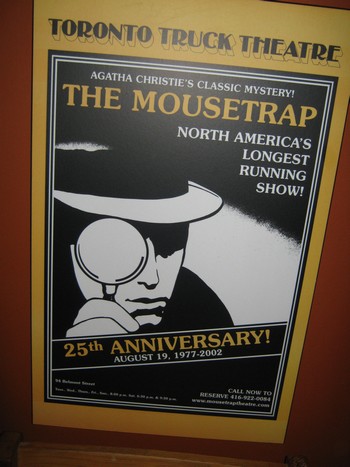
The Mousetrap played at the Toronto Truck Theatre on Belmont Street from 1977 to 2004. For years I walked past the place on my way to and from work, yet didn’t see the production until minutes before it closed for good. Lucky for me, I’d never read a thing about it or spoke with anyone who’d seen it or heard the slightest peep about the premise. In other words, I was completely and blissfully in the dark—the perfect condition for going in. Certainly Agatha Christie would have approved. It’s said she requested that audiences be asked, at the end of each performance, not to divulge who-dunnit to those ‘on the outside’.

It might be worth mentioning that I’m the kind of person who doesn’t flip to the end of a book to see how it turns out and if you give me a journal filled with juicy bits of gossip and ask me not to open it, there’s a very good chance I won’t. Nor do I poke, shake or otherwise try to determine what’s in a wrapped gift before its time. I’m not especially blessed with willpower, my curiosity just doesn’t live in those areas. Well, okay, the journal would be interesting…

Plus I tend to prefer a natural unfolding of events.

In any case.

And apropos of nothing—

—except that the dust on the poster on my wall caught my attention recently and reminded me how, a couple of days before we were about to see the show—in the last week of its 27 year run— Andy Barrie, on CBC’s Metro Morning happened to be talking one day about having seen the Mousetrap in London and how he was late getting to the theatre and forgot to tip the cab driver who was so pissed off he yelled after him: The (XXX) did it!

Only in his version he said Who did it.  (I’m omitting that bit in respect of Ms. Christie’s request…)

Ha ha! Oh that Andy Barrie, I thought. He does tell a good story… and then it occurred to me that… pffft… just like that, a whole lifetime of useful ignorance on my part was down the pan. 

The good news is that, in the end, it didn’t actually matter because the story is brilliant and much bigger than Who.

 [Does it ruin it for you to know the ending of a book/play/story/film?]

nature studies

1.  A turtle the size of a small bread plate is trying to cross the road beside the Shoppers Drug Mart. A large crow walks behind, peck pecking pecking at its shell. The car in front gets so close I see the turtle duck. I pull over, blocking almost a whole lane. I get out of my car. The crow flies off and I’m standing beside the turtle, pointing at it, indicating to oncoming traffic in both directions that it should go wide. People smile. No one honks. I’m grateful.

I don’t want to pick it up; I’m partly afraid of hurting it and partly afraid of it hurting me. It occurs to me how little I know about amphibians. They don’t bite do they? My plan, such as it is, is to shuffle along, keep directing traffic until the poor thing gets to the other side. The problem is all these cars. The turtle soon retreats into its shell and stays there. Another car stops, a woman gets out. She says she’s not afraid to pick up the turtle, that she’s got paramedic grade hand sanitizer in her trunk. I continue directing traffic while she takes pictures (oddly, I’m without a camera), then asks me to take one of her holding it. She smiles like it’s an award (and in a way it is) while traffic veers around us. Finally, we get down to business, agree it was probably heading toward a small pond down a grassy bank opposite us. She carries it to the edge of the water and I see its head come out, see the yellow markings under its chin as it scoots into the reeds.

Back at our cars, the woman shows me her paramedic grade hand stuff; she has a whole medical kit, although she’s not a paramedic, she says, just likes to be prepared. In fact, she tells me, not long ago, she helped clean up an elderly woman who’d fallen in a parking lot and scraped herself from head to toe. We get into our respective cars and drive off in the same direction. Eventually she turns into a Timmy’s and I continue on to Canadian Tire.

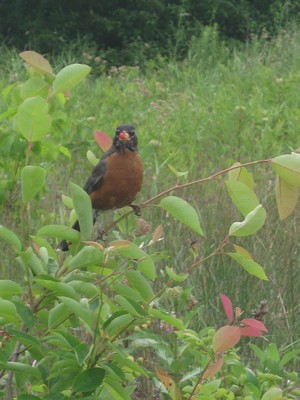
2.  There are baby robins somewhere in our yard. I haven’t seen them but I can hear them. The serviceberries are disappearing and the worms are looking worried. 

3.  I noticed yesterday for the first time that a yellow finch doesn’t fly like other birds. It flies like this: flapflapflapflapflapflapflap… gllllllllllllllllllllliiiide…. flapflapflapflapflap…. gllllllllllllllllliiide. Like aerial running jumps before becoming a wee missile, wings tucked close to its body.

4.  When a fly enters your car at, say, point A, and doesn’t exit (despite open windows) until, say, point X—about 50 kms away—how confused will it be? Will it find its way home or just move into the new neighbourhood? What about its kids? Do flies sleep?

5.  A van cuts me off. I watch as the driver—a guy who hangs his whole left arm out the window, his multi-ring-bedecked hand dangling down the side as if broken—continues to veer in and out of traffic, erratically, cutting off every car in turn, a Baby on Board sign prominently displayed in his back window.

just doing it (my way)

There are a couple of people in my neighbourhood who don special outfits to go walking or running or cycling—bodysuits, skinny tops, colour-coordinated shoes and shorts and shades. I’m torn between thinking they’re making a bit of exercise way too complicated, and envying their whole dashing I-take-every-damn-thing-I-do-seriously “look”. 

I”m aware, of course, that there’s a multi-trillion dollar industry behind The Look—possibly men, possibly unfit—wielding extraordinary powers, convincing folk they need accoutrements to be fit. Even so, it doesn’t stop me occasionally thinking maybe I should get some spandex of my own, a tank top with wicking, one of those all-weather jackets that comes to a saucy little point at the back. A pedometre, a headband. I’d wear a water-bottle-belt (say that three times), read running magazines, get reflecting tape, strap a radio to my arm and groove to the beat as I thundered dashingly about town.

If people still groove to beats, that is…

It’s a colourful fantasy. Short-lived though. Fact is, I’d laugh if I wore spandex—it would crack me right up to see myself in The Correct Walking Outfit. This is for Other People. Not me. Despite illusions of being part of the active-wear set, the whole culture is counterintuitive to my DNA. Always was. As a kid I tried out for things, field hockey, for instance; I was so proud of my shin pads, walked around with them strung over my shoulder even when there wasn’t practice, hoping people would notice that I was an athlete. First time on the field though, when some big girl shoved me—which I didn’t know was part of the game—I found it so alarming I handed  my pads in right then and there. My parents signed me up for tennis lessons one summer but I preferred cherry popsicles and comics in the shade of a nearby tree. The instructor didn’t care, he’d been paid whether I played or not.  I was the last kid picked for the baseball team and I kind of liked it that way.  More time for hopscotch and skipping and walking in ditches after it rained.

I’m not made for organized activity. I’m made for writing postcards and taking them to the mailbox in my regular shoes, which are often sandals. And riding my bike to the grocery store and the library. I walk downtown and to the creek and along the beach, and I watch things—the way tall grass moves in the wind, geese land on water, a kid with a silver tinsel wig runs to catch up with friends. I hike and I cross-country and snowshoe in winter. I jump on a trampoline to work out plot points. I swim as a meditation. I work in the garden because it needs it, and so do I, and do yoga daily to bring myself back to the centre of my own life. I wash floors and windows and sort out closets because order helps me think. Sometimes before lunch, I dance.

So, yes, I think I’m finally old enough to admit that, despite the not-to-be-denied allure of the dashing active-wear crowd… that’s one club I’m never going to join.

on a brighter note…

I thought on this downer of a day after the night that wasn’t, I might share a bit of ancient wisdom, one of the mini philosophies my dad was semi famous for in certain circles (some of which run along the lines of: A parking lot is the most dangerous place in the world, and Never go to bed with your vice grip open).

The one that strikes me as most relevant to the current state of affairs however, was one he delivered when I was about twenty and having some major drama from which I was certain I’d never recover. We were in the car, he was driving, I was in the back seat—I’m not sure why, a cat may have been involved in some peripheral way—and when I finally stopped whinging about whatever my tragic situation was, long enough to blow my nose, he said something like this:

I hope you know how lucky you are.

Huh? Maybe my ears had blocked. Surely what he actually said was oh-you-poor-sweet-trodden-upon-angel-would-a-hundred-bucks-help?

But no. He repeated the luck thing and then explained how, when you were about as low as you could go, you should be happy because according to the law of physics or the universe, or possibly carpentry, you have no place to go but up. In his books, gloom and doom was precisely the time to rejoice.

Then he added: It’s when everything is going just fine that you have to worry.

I don’t remember saying thanks. Probably blew my nose a bit longer and started talking to the cat; it didn’t matter though, he’d worked his magic. I’ve never forgotten the message. Ever since, every time life seems to suck, I think, okay, don’t panic, an upswing is around the corner. And every time, there is.

The point—and there is one—of all this, is to say I’ve decided not to mourn ‘What Could Have Been’ had last night’s election gone differently, but to accept the reality as a kind of juicy lemon. There may well be some sort of ‘law of balances’ out there and all will magically revert to good, but I think the real key to finding success after failure is the way failure can feel like a kick in the butt that rocks you out of complacency.

The point is this: as individuals, we all have choices about our future, including the kind of society we create, and despite what ‘They’ would have us believe, our lives are not in someone else’s hands and society isn’t built by governments but by what ‘We’ do and what we support. Let’s remember that we live in a country where we can exercise choices every single day. And in the long run, maybe making the decision to make those daily choices count is what will serve us best.

thirty truths: 29

I said I didn’t care, that it was just a wedding, a couple kids getting married, what’s the big deal? All that money down the pan. Who cares about The Dress? The whole thing’s a little too ‘too’ for my taste. I said I wouldn’t watch.

The truth? Ah well… didn’t they look happy?
Balcony kiss still to come.
And much to my own bewilderment, I’ll be there.