this is not a review: ‘toxin, toxout’, by bruce lourie and rick smith

My intention was to skim through this book (subtitled: Getting Harmful Chemicals Out of Our Bodies and Our World) as I assumed there wouldn’t be tons of new information, i.e. we pretty much know that chemicals + bodies and/or environment = bad. What I was looking for was not confirmation, or more to grumble about, but some clear and realistic ideas as to what can be done about this noxious issue—not what the purveyors of chemical-laced products should do, but what WE can do. Us. The simple folk. The minions with wallets. The ones who say we care.

Turns out this is precisely what Toxin, Toxout  serves up… a do-able plan for the minions. Along with some eye-opening background as to how and why all that chemical ooze exists in the first place. (Bottom line: we are a species of sheep-like beings that too often chooses cheap and convenient and lots of it) Also clarification on things like the importance of ‘organic’, which is not just to put less crud into our own bodies, but to allow agriculture to work in a way that’s beneficial to a whole chain of events, including environment and economy.
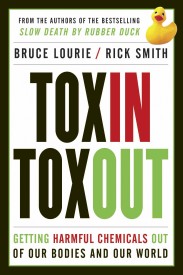
Toxin-Toxout-canadian-cover-e1384688557263I especially liked the conversational tone of the book and that it’s not smothered in stats, nor is there any fear-mongering or the drama of doom and gloom. It’s simply well-researched (a bounty of footnotes and source material provided) and straight-forward in its message: yup, there’s a lot of bad stuff out there but we can make a huge difference by what we choose to buy. Of course corporations and government hope we’ll never figure this out, or believe it…

Best of all, Lourie and Smith remind us that it’s actually possible to improve the world. That WE are not necessarily at the mercy of THEM, nor do we have to wait for THEM to smarten themselves up. WE can begin today  to create change by the purchases we make. And the path to doing this is a simple one. Really, REALLY simple… 

So, no, I didn’t skim. I devoured every page in fact, and am happy to say the book’s info-factor is surpassed only by its offer of serious hope to a seriously growing problem.

Three thumbs up.

Here are some excerpts.

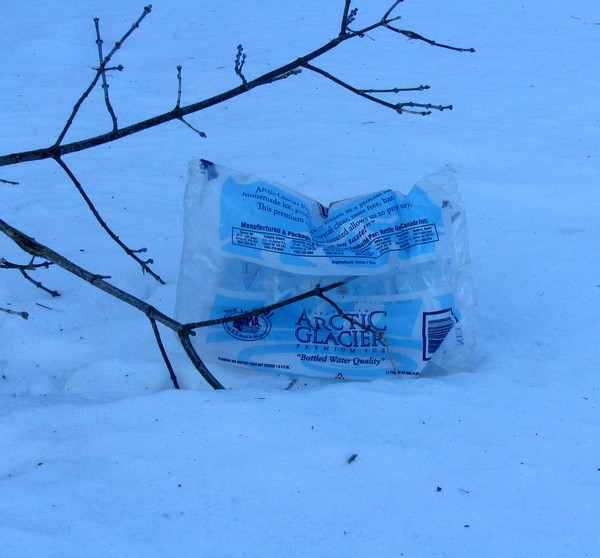
Photos are mine. (Wanted to find a mountain of cell phones but apparently they live in China where they’re sent by the boatload to pollute the air, land and water horribly as they’re broken down and re-shaped into toys and other novelties we don’t need and shipped back to us.)

Another image that’s missing is what’s happening in the oceans with all the plastic.

*

“I like to describe organic agriculture as the hundred-year diet. It’s a system of agriculture that perpetuates itself, that creates a healthy ecosystem that will in turn continue to support plants in the long term, so you’re not in this deathly cycle of creating short-term nutrients—which then can contribute to pest infestations that need to be counteracted by immediate and short-term chemical pesticides, which then kills the life in the soil, which then requires another synthetic input. Just like we need to give our bodies the right tools and conditions to do their detoxifying jobs, organic tries to enable and facilitate the natural predators and the natural nutrition and micro-flora and fauna that should be in the system.”
img_9442

“A smartphone is replaced, on average, every 18 months, and by 2015 over a billion smartphones will have been sold world-wide. And they don’t just sell themselves: In 2012 Samsung and Apple spent over three-quarters of a billion dollars on advertising campaigns trying to convince us to buy new ones. How much did they spend dealing with the e-waste from the phones they encouraged people to toss out?”


“The big issue isn’t simply what kinds of stuff we should buy; it’s the fact that we need to buy way less stuff, period.”

img_7847

“We need to be working on all fronts to stem wasteful production  and consumption. And consumers are part of the equation… the big issue isn’t simply what kinds of stuff we should buy; it’s the fact that we need to buy way less stuff, period. Furthermore, that stuff—whether it’s a car, a soft drink or a smartphone—needs to be regulated by governments, not by the companies who have no interest apart from endless growth in sales. These regulations need to cover what the products contain and how they are disposed of.”


“If there is one simple thing that every human can do to improve environmental conditions, it is to stop buying bottled water.”


DSC00200_1 DSC00199_1


“The rules of the game we’re playing now are best defined by the Malcolm Forbes maxim: “He who dies with the most toys, wins.” We need a different game, with different rules—perhaps “Those who use the least stuff win.” And our economic and regulatory systems need to reinforce that motto with another one—such as this: The more you use, wasted, pollute and discard, the more you’ll lose financially.”

img_7845


degrees of bilingual

I blame the seventies for any sense of inherent confusion I might possess. I was a teenager for much of that decade—a confusing enough time of life, but on top of that, and other mind-altering details floating freely about in those groovy days, it was when Canada went metric.

Here’s the question though: did we actually go metric… or did we more sort of ooze into it?  Either way, the point is this: by the time the eighties rolled around I was a functioning dysfunctional bilingual.

And in large part I remain so.

What I mean is that I’m not completely comfortable in all areas of metric, nor am I comfortable in all areas of whatever the other way is called. The miles and inches way.

For instance. I am five feet, seven inches tall. If you asked my weight I would tell you in pounds. [maybe…]

Area is measured in square feet. But fabric, in metres. The height of a tree or a building is metres also. Yet I have a ruler and a yard stick.

I know what the air feels like in Fahrenheit from about 60 degrees up. Below 60, I wouldn’t be sure what to wear. I’d need to know what it is in Centigrade.

I register all AIR temperature in Centigrade. But water temps only make sense to me in Fahrenheit.

With respect to distance, I can wrap my mind around a mile if pressed [it’s less than a kilometre, right? or more??], but, truthfully, I prefer the metric version. Even so, I say things like: we walked for miles; it may as well be a million miles away; you can see for miles…

Speed, also, must be in metric. I don’t know how fast 75 mph is except that a cab in St. Louis did it once and it wasn’t good.

A kilo has no weight at all. And ovens are in Fahrenheit for good reason.

I can process one litre easier than 1000 thingies but please don’t ask me to pour you anything in millilitres and if you refer to a gram I will ask Which one? Your mum’s side or your dad’s?

IMG_1878

If a tree falls in the forest and no one is there to measure it, is it still bigger than a breadbox?

If you remember the metric conversion era, you will remember breadboxes.

But I digress.

I blame the seventies.


a rant for friday, after dinner on thursday


The waiter brings the apps, sets mine down and says, “There you are, young lady.”

He sets down my husband’s. “And for you, sir.”

We are the same age, my husband and I.

And I am no young lady.

When the main course comes the waiter repeats his little service mantra and I point out the above—lightheartedly, but clearly wrapped in a message. It rattles the poor soul but he’s not the sort that moves easily beyond his ignorance and chooses to stand firm instead, explaining that many people like being called ‘young lady’.

“People?” I say. I point out that in our case, my husband is called ‘sir’ every time.

He looks to my husband who purposely says nothing. This is my discussion and that seems to rattle the waiter even more.

He says some people prefer ‘sir’.

Again with the people.

I should mention that the waiter is thirty something. In other words nowhere near old enough to be calling anyone young. Were he my parents’ vintage or older, or even my vintage, it would be another story and more acceptable, because it would be coming from a whole different place. Does this chap call twenty-five year olds ‘young lady or man’? I doubt it but if he does I’m guessing it might also come across as odd. In fact I can’t think of any age, beyond maybe eight, when I would have thought it normal. But more important than the age thing, is the gender thing. My husband is referred to with respect, as in ‘Sir’. While I’m expected to be content with the nonsense of ‘young lady’.

Women may be subjected, generally, to more dears and sweeties and hons, than men, and from both genders, and that’s another story, but this is about more than endearments or habits of speech. The ‘young lady’ thing, however, seems to come predominantly from males… and is directed at females who are not young. Perhaps these misguided men think of it as some kind of gift…

I try to explain this, to enlighten him with the news that women don’t actually enjoy being condescended to and that this ‘young lady’ thing is just plain silly, and then I present him with a challenge so that he might see the silliness more clearly. I suggest he turn things around, call all male customers, of any age, ‘young man’.

His face falls a little.

I smile. “Go on,” I tell him. “Give it a whirl. Maybe some people will prefer it…”

No answer to that and I’m suspecting he doesn’t give it a whirl.

I swear if I was his boss I’d insist he do it.

Later, when I pass on dessert and hand back the menu, he says, “Thanks, love.”

“You’re welcome, darling,” I reply.

If he gets where I’m coming from he doesn’t let on.

It’s only when he places the bill on the table and I immediately reach for it—and I know he sees this—that for the first time all night a light seems to come on for this boy as he realizes he’s made a terrible mistake…


tour de blogs

I love a tour. And so I was especially pleased to be invited to join this mad literary romp, blog-style, where we answer a set of questions in our own merry way. Many thanks to the always madly wonderful Alice Zorn over at Rapunzel’s Hair for asking. Alice is the author of Arrhythmia, the short story collection, Ruins and Relics, and often translator of Grimms fairy tales.  Among other things, she blogs about her travels and her beloved Montreal neighbourhood, Pointe St. Charles. Her contribution to the game is here.

So… bon voyage, and here goes…


—What am I working on?

I tend to go through phases of working at more than one thing at a time. Currently I’m revising a few stories to send out, preparing a collection of essays and occasionally checking on the brine in which my novel manuscript is marinating… It often needs more salt.
IMG_4221
—How does my work differ from others of its genre?

It occurred to me recently that I’m not a good rule follower. Not because I’m a renegade or anything as quaint as that, but simply because I’m often not aware of the rules. And even when I manage to figure out what they are, I can hardly believe it: those are the rules??  I have a hard time talking with people who want to discuss trends. I have no idea *what* is popular. Nor do I want to belabour any knowing. I recently wrote a story from the perspective of a chair.
Chairs 004
—Why do I write what I do?

One of my interests is relationships, especially those within the constraints of family. I realize I’ve been watching various families all my life—my own of course and those that lived on my street as a kid; aunts and uncles that weren’t, or were; the families connected to friends as I grew up; the manufactured ones through marriage and children, or no marriage and no children, or some other configuration therein or thereof. I’m fascinated with the way roles are assumed and played out to various ends and for what reasons and how we judge it all… and how we pretend it doesn’t matter and how it matters so very much. I’m interested in what’s remembered and how in a family there’s nothing even close to a consensus of truth. My writing often pokes about in this tender territory, trying to make head or tail of things. Why??  Who the hell knows.
People 003 - Copy
—How does your writing process work?

A large part is thinking out loud. Also known as talking to myself. I run through scenes, interview myself, ask myself what is the point of such and such… what is the point???… until I either come up with a point or scrap the whole damn such and such. I write in a journal most mornings, about dreams and grocery lists initially, but eventually making my way to the day’s work and what I want to accomplish, which inevitably leads me back to the such and such and the point, and pretty soon I’m no longer writing but talking to myself…

Best places to work through a problem: in the car, on a walk, weeding the garden.
IMG_7059

~

The tour continues with Barbara Lambert, author of The Allegra Series,   A Message for Mr. Lazarus  and The Whirling Girl. And Maria Meindl, author of Outside the Box; Maria’s essay ‘Junior’ appears in the anthology The M Word. Thanks to both for bravely accepting this mission. Am looking forward to visiting their blogs in the coming weeks and will post links here.

Stops on the tour include:

Theodora Armstrong
Ali Bryan
Marilyn Bowering
Janie Chang
Jaime Forsythe
Susan Gillis
Jason Heroux
Cornelia Hoogland
Ellen S. Jaffe
Eve Joseph
Susan Juby
Anita Lahey
Barbara Lambert
Steve McOrmond
Maria Meindl
Sarah Mian
Elise Moser
Kathy Page
Julie Paul
Pearl Pirie
Shelagh Plunkett
Ryan Pratt
Jael Richardson
Devyani Salzman
Cassie Stocks
Ayelet Tsabari
Patricia Young
Julia Zarankin
Alice Zorn

hello, spring

On my way to the library I see a man pacing in his garage, smoking. I’ve seen him there before. He pretends he doesn’t notice me as I pass and I sense I’m meant to do the same. I feel sorry for those who like to indulge in a cigarette. They’re always huddled outside but no one waves, no one says Hello, fine weather, isn’t it!  the way you might to someone raking a lawn. I may have to change this pattern next time I go by.
IMG_5870
Further along the same street, a boy, playing hockey on his own,
IMG_5868
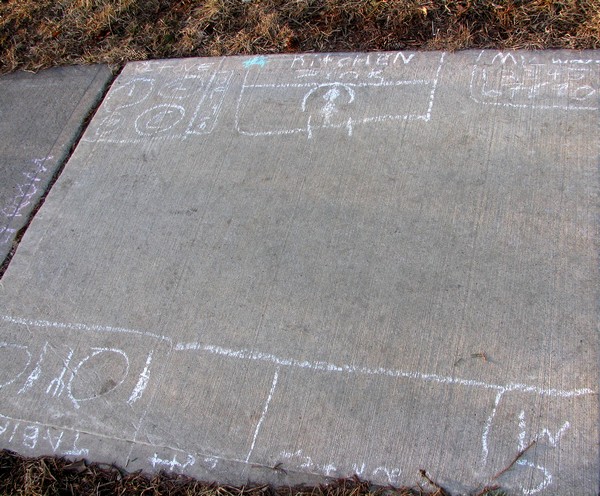
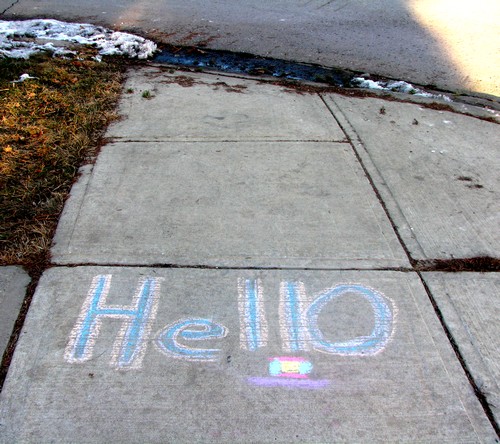
and the blueprints for a house interior sketched onto several squares of sidewalk.

This is the kitchen. The living room is to the left; bedrooms to the right.
IMG_5866
Around the corner, a man in a green ski jacket cleans a ski-doo the exact same shade as his coat. When I stop a few houses down to make some notes, I look back and notice the man staring at me. He’s actually stopped cleaning the ski-doo and looks concerned about me jotting things on a notepad with a pencil. It occurs to me that if I’d stopped to look at my BlackBerry or equivalent [which I don’t own] he’d be feeling much calmer. It reminds me of my experiment at the casino, and the unexpected things that frighten people.

At the library, a woman comes up to me, says, quite out of the blue, “You must be an artist,” and I assume she means because of the hat but I ask whatever makes her think so. She says she was driving by and saw me walking, saw me stop on the sidewalk and go back and take a picture of something on the ground. “Only someone with a certain kind of eye would do that,” she says. I tell her she must have a pretty good eye herself and we laugh the laugh of strangers.

This is the picture she saw me take.
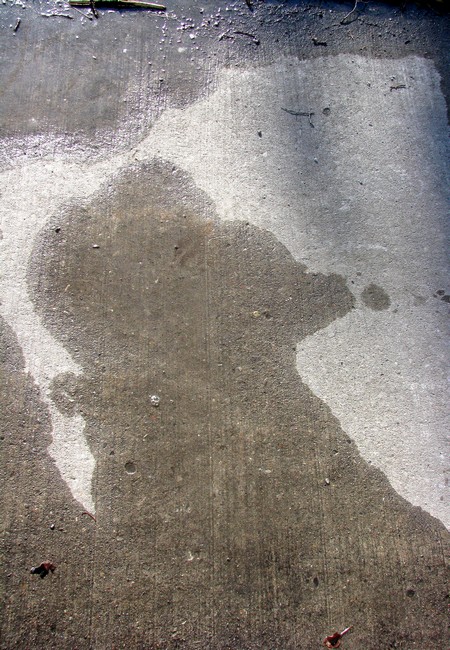
IMG_5875Tell me this doesn’t look like a monkey spitting out an apricot.

Back outside a black pick-up truck goes through a red light and from the other end of the street, totally unrelated but at the same moment, tires squeal.

A woman in white plays drums on her steering wheel and sings while waiting for the light to change.

I take a different route home and find a nest of feathers. Not a good kind of nest.

IMG_5877
And in a nearby window, what appears to be a rather self-satisfied expression…IMG_5878
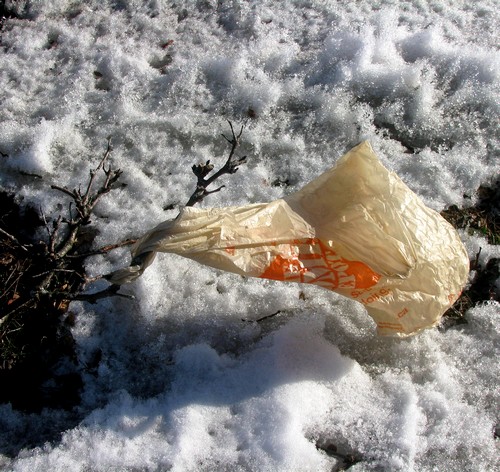
Close to home I find a bag crackling in the wind and so I detach it with the idea of collecting a few bits of the always-debris that is everywhere.
IMG_5879
Less than ten minutes later, I’m out of bag.IMG_5884
IMG_5867

amenities

The streets where I live are considerate.

For one thing, they make it very, very hard to lose your way.
IMG_5796
But if you should, don’t panic. There are places to take shelter.
IMG_5797
Or stop for a drink.
IMG_5800
Some with a view.
IMG_5810
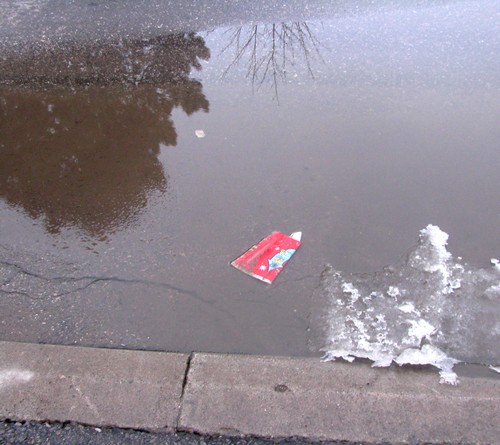
[Choices are chilled or unchilled; puddled or bottled…]
IMG_5812_1

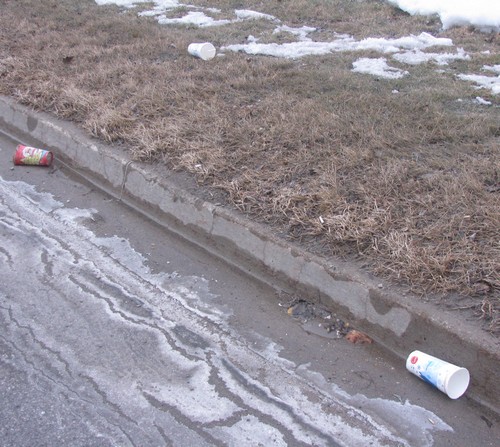
Big plus: there’s never a shortage of drinking vessels.
IMG_5801IMG_5803IMG_5806IMG_5807
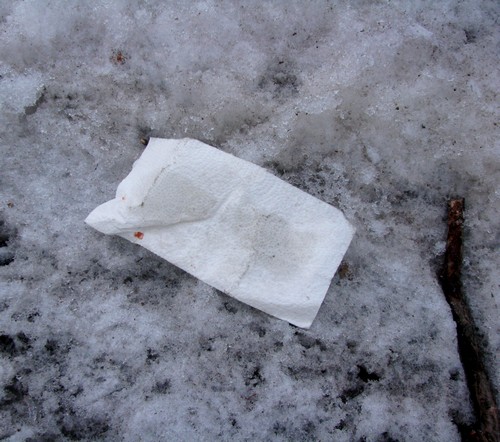
And please use a napkin. [No need to be uncivilized.]
IMG_5808
There’s reading material.
IMG_5809
Complimentary coat check and/or coat.
IMG_5804
And excellent company.
IMG_5802
Thank you, streets…

always something

I rush outside this morning with the intention of catching a spectacular sunrise. But it’s not all sherbet colours as expected, merely yellow.
IMG_5741
Still, I’m well into the ravine by now, cleats attached to shoes and the crusty icy snow crunching and cracking, the weird human rhythm of it propelling me onward. [Animals, by contrast, are so quiet.]
IMG_5752
And so onward I gallump through the woods and into the park with the merely yellow sun rising to my left…
IMG_5750
and then once I get around the big loop…
IMG_5746
on my right.

No one about this early, or maybe because of the cold. My crunch and clack disturbing only one black squirrel and a flock of chickadees huddled among the lowest branches of a spruce.

Nothing to see but white white white…
IMG_5751
and then a splash of blue, turquoise even.
IMG_5745
Every time I see one of these colourful bags I wonder how it gets left behind. Does someone set it down in order to play fetch or Frisbee or chat at length with other dog walkers while sipping a Timmy’s and then simply wander off in a haze of forgetfulness? I think that’s why they’re made in these very striking ‘hello!!’ colours, so they’re hard to not see once the Frisbee is over, and yet…

There’s always something.
IMG_5744

yes, deer… tea


So I’m at a place. A place where I have just ordered a cup of tea. Not a coffee shop but a café-ish, snack-ish place in a high end facility of high-end art.

Wait. Let me start again. I have NOT ordered a cup of tea. Not quite yet. There’s a couple ahead of me who have ordered an Americano and a latte and the ‘beverage maker’ is tending to said order with an inordinate amount of flourish, twirling and dramatic gesture. It’s a production, a real bean-fueled drama, complete with intensity of face, a body one with the urns, flicking this way then flicking that. The only sound is the whooshing of steam. Whooooosh. We, the audience, are silent, some of us possibly in awe.

The whole thing seems a titch overblown but then I’m not a coffee drinker.
I stifle my inclination toward cranky cynicism at this point and consider the value, the ‘art’, of preparation instead…

The whole thing takes time.

Finally the coffees are served and the Americano and latte couple leave. It’s my turn. I step up to the counter.

“I’d like a cup of tea please.”

[cue the crickets]

The visual is this: picture a deer in the headlights. This artistse of foam and froth just stares blankly, no words, and then…

“Tea??” he asks in a tone that suggests concern, like maybe I’m making a rash decision.

“Yes,” I confirm.

He takes a cup and sticks it under a tap labelled ‘hot water’, drops in a teabag, shoves it in my general direction. “There you go.”

I laugh—part amusement, part delirium from having stood in line this long—and say I was hoping for a bit more ‘art’, and he, all seriousness and java wisdom says: “Nope, tea’s real simple.”

Real simple indeed.

It occurs to me that it would be pearls before swine to enlighten him… I make a mental note instead that next time I’m in the snack place of the high-end facility of high-end art, I’ll do us all a favour and just have a V-8.
622PX-~1

pinning, pining and penning

So the other day I was repairing clothespins.

Because, yes, I hang my clothes on a line. Two lines, actually. In good weather, outside, on a circular thingy. And in bad weather, or in winter [for everything but sheets, which go outside year-round], a line in the basement. The clothespins I use are wooden, held together with an ingenious metal squiggly [there may be an even more technical name for it that I’m unaware of]. It delights me to what is probably an unusual degree that somewhere there is a factory making these tiny works of art, that they are still necessary and that [while they’re also made in plastic] for the most part they haven’t become scientifically enhanced, engineered or in some other way ‘improved’.

There are the dolly peg kind as well but I never got the hang of using them. As a child I was taught the art of laundry, using the wooden/metal squiggly kind and it would be like breaking rank… plus, to be honest, they annoy me because once they break it’s finito la musica… They can’t be repaired.

Unlike the avec metal-squiggly version.

Which brings me back to my point.

I was sitting at the kitchen table, fixing a basket of broken clothespins and thinking: well, this is pathetic. Shouldn’t I be doing something grander than this?? Shouldn’t I be at work on that next great novel, the one that will allow the world to continue turning? Shouldn’t I be penning brilliance of a poetic or opinionated nature, blazing trails in form and incomprehensible voices with short fiction, or hammering away at something entirely made up, like creative non? Shouldn’t I be painting? Or compiling something? At the very least, shouldn’t I move that bag of leaves to the compost?

And as much as logic wanted to say damn right, another part, much brighter than logic, kept insisting that, no, these clothespins were where it was at right now and that these few moments of tending to something so mundane were to be relished, that there was a gift in the seemingly ‘backwardness’ of this kind of work. I thought of my dad, a master of fixing things; he’d prefer that route any day to buying new, and it had nothing to do with saving money. It just pleased him to take the time to repair something. There was the satisfaction with the end product of course, but it occurred to me as I mended those pins that part of what he enjoyed may well have been the meditative quality of mindless but worthwhile tasks… the sort of thing we’ve gotten out of the habit of doing in our never-ending search for faster, better, easier, more—as we get sucked into thinking we don’t have time for this sort of thing in our clever-clever Jetson world—but if we’re honest we waste more than mere minutes doing a lot less of value… it’s just that we do it with things shinier than clothespins.

Anyway, the point [at last] is this: what a difference I felt once I allowed myself the luxury—a sliver of time to do this wee job—once I allowed myself the odd and simple pleasure of it rather than feeling I must always and forever be getting on to something more important…

Important being decidedly relative.
IMG_4795