this is not a review: ‘this is not my life’, by diane schoemperlen

 
I confess I pretty much enjoy everything Diane Schoemperlen writes. I’m fond of structure and she plays with it like nobody’s business but never in a way that sacrifices story. I can’t figure out if her approach is egg or chicken first but, either way, she manages to create the perfect stage for each book, each story, each telling, so that you cannot imagine each book or story being told another way. (Is she post modern in a way that isn’t post modern at all?
I haven’t a clue what post modern is so I wouldn’t know… but possibly.)

This is Not My Life,  is told more or less chronologically about the years between 2006 and 2012 when she met and fell in love with a man serving a life sentence for second degree murder. So deeply personal is this story that very often I’d stop reading and actually think: good lord, how is she able to share this and this and this??

“How long did it take me to understand that he thought it was perfectly okay to come into my formerly peaceful home and turn it into a battleground? How much longer did it take me to understand that he was proud of himself for having won the contest, torn away my dignity and self-respect, reduced me to the lowest common denominator, and driven me into a violent rage?”

It’s a wild ride and the honesty of her self-analysis touches a lot of nerves.

The extraordinary thing is that all that sharing, that exposing of private ‘self’ isn’t in the least gratuitous. She tells us what we need to know in order to understand how and why she fell for a murderer. This is, after all, a big question, one she is asked repeatedly by friends, and continues to ask herself. I’m guessing the need to find an answer was a strong motivation in writing the book.

And this is precisely what the best kind of memoir does: it excavates rather than simply reveals.This-is-Not-My-Life-low-res

Schoemperlen avoids the icky places so many memoirists go when they talk too much about themselves (I was born on a dark and stormy night…) which usually amounts to a lot of nothing, more interesting to the author than the reader. Who cares if you were born in the crawl space at the Taj Mahal and your mother was a unicorn if it has zip to do with the story you’re telling? For the record, Schoemperlen was born in Thunder Bay. She tells us this because it’s important we know the vulnerability she felt coming from a small town and a family where thinking too highly of yourself was not encouraged.

Remember: she’s trying to work out why she’s dating a murderer.

And so are we, the readers. We’re trying to understand it too; we’re working it out together because, really, the book speaks to anyone who has ever fallen for the ‘wrong person’. (So, yes, her guy was in for murder. A questionable choice of beau perhaps. But only one version of questionable.)

“Who would we be without the pain we so desperately cling to?”

In every scene, Schoemperlen shares the process of walking the road of this ‘choice’ while teasing out the why  of it. Why has she chosen to spend ‘dates’ in penitentiary visiting rooms and conjugal visits in locked-from-the-outside trailers? (The insider’s view of how prisons work is, by the way, a whole other brilliant element of the book. Short story: it’s insane. For instance, she had to wash her drivers license every time she went because it was scanned and might set off the drug detector if she’d touched it after touching an Aspirin, or something. However, those conjugal visit trailers? They were equipped with kitchens and carving knives.)  An irony to the whole thing is that these ‘prison days’ were the best days of their relationship. Once her chap is released on day passes, then weekends, then moves into her house, things become progressively unmanageable. This is, after all, a guy who’s been inside since he was twenty-something, and prisons aren’t big on teaching you how to function on the outside. The insight she shares in these chapters is heartbreaking.

“This was when I had to go into the bathroom several times a day and look at myself in the mirror, checking to see if I was still me, if the extent to which I felt diminished and demoralized showed in my face. It did.”

Though we know from the beginning the relationship ends, it’s still an edge of your seat ride trying to work out the how and the when, and what will be damaged in the process.

“He’d said often enough in the early days that we would fall in love and become one. By ‘one’, I knew now, he meant him.”

I kept expecting the mushy middle of the story to present itself but there isn’t one. It’s a solid read from start to finish. (I read it over a weekend, taking it everywhere, sometimes reading as I walked from one room to another.)

In a nutshell: This is Not My Life  is Schoemperlen looking back, finally out of the forest, and seeing the madness in a way that was impossible at the time.

“That night I understood that for all those years, I’d been in love with the story—0not the reality—of my life joined to Shane’s. The story of myself as the one who could lead him out of the darkness, the one who could make him whole, healthy, happy. The story of myself as the one who could save him.”

The best memoirs are not a list of who, what, when and where, but are, instead, a study of human nature from the inside out. They tell us about the author while making us think about ourselves as we ask what would we  do in this or that situation…

This is one of the best.

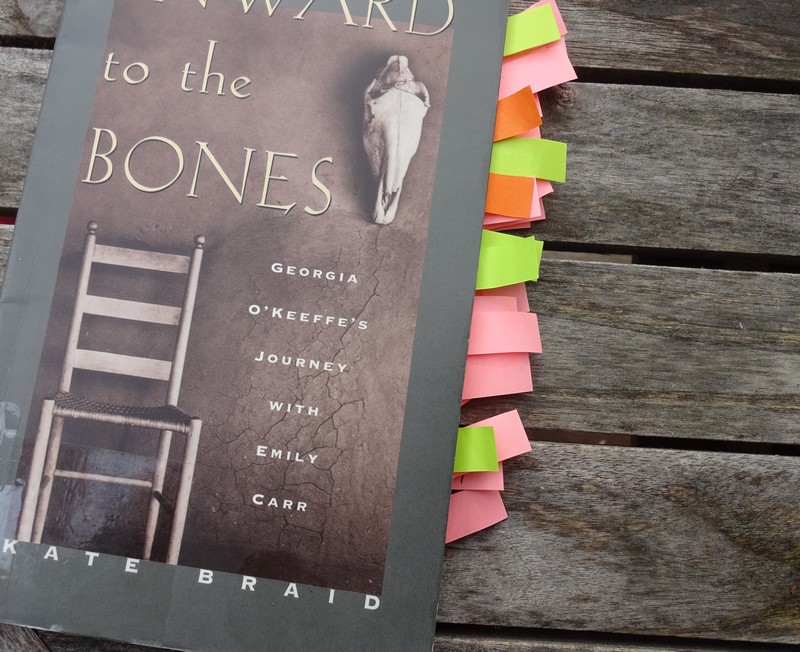
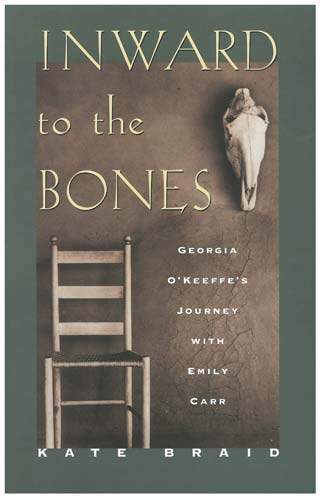
this is not a review — ‘inward to the bones’, by kate braid

As with so much of what crosses my reading path, I can’t recall how this book initially came to me. Originally published in 1998 by Polestar, it was reissued by Caitlin Press in 2010.

Inward to the Bones  is an imagining of a relationship between Georgia O’Keefe and Emily Carr. A relationship that never existed. The two women barely met at a 1930 showing of O’Keefe’s work in New York City. In her introduction Braid writes “To me, this passing incident was a spark that struck fire. Here were two of the great abstract painters of the 20th century—among the very few women of the time with a commitment to being artists. What if they had caught each other’s attention?”

And with that Braid begins the imagining.inward-to-the-bones2

The result is a slim, gorgeous volume of poetic verse written in the voice of Georgia O’Keefe (so true is this voice that the book feels more whispered than written) and based on Braid’s research of both women. Many of the details are founded in actual events (footnotes are included at the back of the book and, in themselves, make good reading).

The story she tells begins with a brief nod to the era in which O’Keefe grew up, the late 19th and early 20th century, a time when women were not taken especially seriously in the art world; O’Keefe tells us about her involvement with the photographer Alfred Stieglitz and, eventually, her thirst for something more, a deeper relationship, a sisterhood of artists.

By the time she meets Emily Carr we’ve pretty much forgotten this telling isn’t entirely real, that the invitation from Carr to join O’Keefe in New Mexico to walk and paint the desert with her, never happened. And yet, there is Emily Carr in the desert with Georgia O’Keefe. There is Carr, feeling out of place and  pining for green in the heat of New Mexico while Georgia O’Keefe looks on and complains about this weird companion.

“She… insists/ on painting my hills/ in shades of British green./ They’re everything but! I snap / Try purple! Try yellow! Try red!”

Then a trip to Bandelier National Park changes everything and suddenly Carr finds connection among the cacti, mesa, bones and bluer than blue sky.

Braid paints a convincing picture of similarities that might have brought these two together, not the least of which their dedication to art in a man’s world. But it’s the case she makes for their differences that moves the book forward, as when O’Keefe wonders at Carr’s ability to function without privilege, wealth, the assistance of a patron such as Stieglitz. Wonder turns to awe and then envy…  “I am brittle and thin, starving/ for what feeds her.”

Ultimately their similarities win out… different lives, shared passion.

“I know absence rather than plenty./ Our only difference is rain.”

O’Keefe also visits Carr’s world and tromps about Vancouver Island in her black clothes and fedora, finding nothing among the giant red cedars, dampness, moss, rotting logs and lichen that speaks to her in a language her desert soul understands.

“When we go into her woods together to paint/ I don’t tell her I am terrified.”

She feels constrained by the city of Victoria’s culture, its population of tea sippers “with knees together impossibly tight and polite”. It’s the ‘violence’ of the ocean that finally soothes her, the “waves speak in an accent”  she understands. “It is the silence of the desert, made manifest in motion.”

But the friendship continues to grow and the fascination for each other’s work is also personal. “I want what she has./ I know no other way to get/ than to be here, in her forest, siting under this damned dripping tree for hours,/ trying to see through her eyes/ with her.”

You might say the book is like a painting made by either O’Keefe or Carr, the power of emotions visible through what appears to be the most ordinary of things. In this case: respect for the sisterhood of artists.

What if they’d caught each other’s attention? 

Such a good question. Braid makes us feel it’s a loss that they didn’t, while at the same time convinces us that surely they did.

DSC05174


this is not a review: ‘newfoundland, journey into a lost nation’, by michael crummey and greg locke

 
So very happily stumbled over this book recently. Published in 2004, the ‘lost nation’, in the title refers of course to the loss of the cod some twelve years earlier, which, in his opening essay, Michael Crummey likens to Saskatchewan losing its grain, or the Arctic its snow. In one short but powerful passage, Crummey takes us back to the moment fishermen were given the news of the moratorium in 1992. (They were asked to sit in a separate room and watch a video of John Crosbie speaking to *invited* guests and media in the next room, behind locked doors.) Crummey offers an account of the lead up to this “public relations disaster” and the subsequent fallout.51P3DRC75FL._SX374_BO1,204,203,200_

He writes about the fishermen before that day, memories from his father and grandfather being especially poignant. And he writes about Newfoundland since that day: the leaving of so many people, the collapse of communities, lost skills, the tourism that is both a boon and a sadness as it turns traditions into commodities… as well as a surge in arts and the forming of new communities.

It’s all quite dandy until something starts to feel ‘missing’. Oh, yeah. Women. What he doesn’t write about is the women. There’s not a sliver of anything from their perspective in the loss of this ‘nation’. And as much as I enjoyed Crummey’s essay, and the photos by Greg Locke – beautiful, unsentimental shots of, well, men, mostly – there’s no getting away from the fact that, not only something, but much, is weirdly absent from this story. While the devastation of the cod certainly affected the boys who made a living on the water, I suspect not all was trifle and joy at home. I imagine the women had some feelings on the subject, that their lives, too, were affected.

I mean if we’re going to include a shot of men at a kitchen party, then there’s room for more than the ‘fellows and fish’ side of things.

And yet, for some reason, Crummey has chosen to tell, and Locke has chosen to shoot, a Newfoundland pretty much devoid of gals (who certainly don’t involve themselves in the fish business according to this telling) (not sure that’s entirely accurate, but never mind). Worse, though, it’s a story told as if there’s no one inside those houses, those canneries, no one hanging that laundry, raising those children, working at the bank, the grocery store, putting food on tables with less and less money. The guys are fishing. We get that. They’re mending nets. Then they’re not fishing. They’re angry, sad, lost. All very well conveyed in both word and portrait. But what are the women of the lost nation doing, thinking, feeling, while their men are out to sea for all those generations… and then are suddenly not?

I’m guessing that having them lolling about the house in all their misery shook up those girl lives something serious.

There are 101 photos.

Of these, 68 feature men or boys, only males.

21 are un-peopled land or seascapes.

10 are a mix of both male and female, adults and children.

12 feature women or girls only.

While twelve out of 101 is better than nothing (although it’s very close to nothing), the text that accompanies the ‘female’ pictures adds insult to injury by focusing on things other than the female, such as the one where a woman looks at an iceberg (text refers to iceberg alley); or the woman and child walking on beach (text refers to sewage plant); a girl and her pony (text about ponies originally used in mines and how they almost became extinct). Another of the precious twelve shows an elderly woman smoking at a bingo table. Still another has a winsome wench staring out to sea clad for some reason in a long Victorian dress and cap.

There’s a shot of a guy selling jam from the back of his car. I suspect we’re meant to understand that the he’s been reduced to this. Sad, yes. But who made that jam? Did he make it? If not, where’s the shot of the person who did? Let’s see sweat dripping off a brow as that jam cooks in a hot, tiny kitchen. Let’s see that brow being wiped with an old apron because maybe the person making that jam is suffering too, doesn’t have a lot, doesn’t ask for a lot, is merely loyal, merely living the cards they’ve been dealt.

Where’s that story?

And what about “the girl” referred to on page ten (Crummey’s quotation marks), who slept on the other side of a makeshift curtain in a cabin full of fishermen. Crummey, here, is writing about the chaps (including his grandfather) who went to fish along the Labrador coast, difficult to get to, with even more difficult conditions once they arrived.

“Each spring he hired a crew of three or four… along with “the girl” – sometimes as young as thirteen – who cooked for the men and helped clean and cure the fish…. It was rough living and rough work…. The skipper had his own room downstairs, while the crew usually slept under the attic eaves in the loft, on mattresses stuffed with wood shavings. The girl required a room to herself, though this often consisted of nothing more than a blanket hung between her and the men.”

The next lines refer to outhouses being too awkward to construct so they used the shoreline and tides instead as their ‘facilities’. From there immediately to vermin and blackflies. The girl is but a mention, never to be mentioned again. We have no idea why a child would be sent to cook and clean for these men and why must it be a girl? Wouldn’t it have made more sense to send a boy so as to learn the trade? One wonders what more “the girl’s” story involves? Her own hardships beyond vermin and blackflies perhaps.

Where’s that  story in this lost nation?

Some years ago I sat for an hour or so on a hill on the eastern shore of the Avalon Peninsula in Newfoundland. I watched a few boats come in or go out and I revelled in the scenery, but mostly I stared at the houses in this small coastal community and wondered about the women who ‘manned’ them in all weathers, literal or metaphoric.

And then I wrote this tiny thing, called ‘Petty Harbour’:

They hide in square wooden houses,
the women of the boatmen, leaning
on each other’s shadows, thighs
pressed together against the fog
until—all but one returns; thighs
loosen for a moment before they are
alone, immersed in salt and gravy,
hiking cloud paths for berries to send
with him next time; yet for the one
whose boatman doesn’t return—
thighs loosen and life begins.

~

Too often the female side of the story, or the view from there, is considered women’s literature and dismissed as something minor. In the case of Newfoundland: Journey into a Lost Nation, and in the opinion of this ‘woman’, an excellent telling from a narrow perspective weakens the overall experience of the book.

this is not a review: ‘the adventures of miss petitfour’, by anne michaels

 
The Adventures of Miss Petitfour  does pretty much what I like a book to do, it makes me hungry for cake and tea and cheese and adventures with a tablecloth; for another cat or two. (She has sixteen and no complaints at her end.) In fact the cats play a huge role in this gorgeous collection of sweet but not in any way saccharine stories. On the contrary, there’s much authorly humour, of the kind that allow two levels of reading: adult and child. Both will be amused but at different things.

We begin with an introduction to the lovely Miss Petitfour by way of an illustration “…just to be sure you recognize her”.  (And is it just me or does she look a little like the also-clever-but-in-a-very-different-line-of-work, Tabatha Southey?) By the way, Emma Block’s colour illustrations throughout are a pleasure to contemplate all on their own and, in fact, the whole book feels a little like a kind of petitfour… beautifully made with tea and pastry endpapers, a fixed ribbon marker, the kind of smooth semi-gloss pages your hands happily glide over and over and the whole thing just the right size for holding comfortably with one hand, leaving the other available for tea drinking, cake noshing or petting of resident kitty. Because after reading this you may have to get at least one.

The opening story takes Miss P. and her sixteen cats on an outing to find marmalade. This naturally includes a visit to a bookshop, which is cleverly divided, as all book shops should be, into two sides, marked ‘ho-hum’, and ‘hum’… that is, one side for people who prefer “books where nothing ever happens”  and the other for people who feel the need to “visit another planet, or to run away to sea to meet pirates, or to fall down holes, or to be blasted by a volcano, and that sort of thing.”

Wind plays a role, as wind ought. (Miss P. has a good command of air currents generally, a characteristic missing in most protagonists.)“It is often the case that the wind is not blowing in the right direction. This is just another petifour_hitiresome fact of life, like the fact that your feet grow too big for your favorite shoes, or that your favorite crayon gets shorter and shorter the more you use it.”

In the story ‘Birthday Cheddar’, my personal favourite, we go in search of Minky’s gift (she’s a “snow-pawed cat,” who fancies cheese). Correction, not merely fancies… “… she adored cheese, flirted with it, danced with it and brought it lovely presents, like pebbles from the garden, before devouring it with her little Minky teeth.”  There follows a description of how Parmesan affects the leaves of a salad and how, on cheese toast, the “cheddar melted into every little crevice and crater…”  And that’s just for starters. The whole passage is delicious. And then, because we aren’t happy/hungry enough, Michaels lists ten or so varieties of cheese. Minky of course has a cheese calendar that she sleeps with on which “Each month there was a big picture of a different kind of cheese in a mouthwatering pose: blue cheese cavorting with pears, cheddar laughing with apples, Gruyere lounging with grapes, Edam joking with parsley.” (Oh how I covet this calendar!)

Lessons on the art of storytelling are a brilliant thread throughout in highlighted, upper-case or bold type. Michaels points to words and phrases such as ‘unbelievably’, ‘by great good fortune’ and ‘by chance’, etc., revealing them as the devices they are to change the course of the story. And then she uses them to do just that. And then she might digress, telling us (in parenthesis) that this is a digression. It’s all so beautifully, tongue-in-cheekily done, like the ways of a favourite eccentric teacher.

So, yes, this is one seriously charming, creative and really quite perfect kid book (recently and somewhat reluctantly passed on to my niece) that any adult will easily love. Impossible to meet Miss Petifour, to travel with her in this tablecloth riding, tea drinking, food-filled land where you are encouraged (by Miss Petitfour herself) to hear only the parts of sentences you like the sound of… and not come away feeling just a bit lighter for it.

“Some adventures are so small, you hardly know they’ve happened. Like the adventure of sharpening your pencil to a perfect point, just before it breaks and that little bit gets stuck in the sharpener.”

One flaw, and that’s the unfortunate and (always) annoying use of U.S. spelling. Flavor. Color. Etc. Boo to that.

Three thumbs up to everything else.

the (anti) shopping list


Here is my not-quite-but-almost annual list for them wot don’t especially like ‘stuff’… Also, coincidentally, it’s a list of my favourite things to both give and receive… (note for those intent on giving:  the asterisked books? got ’em.
But I’m wide open for all the food items… leave baskets on the porch).

1.   Food. Any form. You can’t go wrong with cheese. If you live in the vicinity of Country Cheese… fill my stocking with the goat brie (coated in ash). It’s absolutely heaven sent, this stuff. Appropriate for the time of year, no?

2.   A book about  food. I’m mad for anything Laurie Colwin, also *The CanLit Foodbook  and most recently, *a Taste of Haida Gwaii,  by Susan Musgrave. And… Euell Gibbons’ Stalking the Wild Asparagus.  I can’t believe I don’t own this.

3.   Music by Laura Smith.

4.   Gift certificate to a garden centre. My choice would be Richter’s Herbs for the following reasons: the staff know things and are pleasant (this is no longer the case at all garden centres). The selection is amazing and mostly edible. They play classical music to the seedlings. (Also, and not insignificant, the route home goes right by my favourite place for pizza.)

5.   Gift certificate to my favourite place for pizza. (This is an excellent gift and comes with a good chance of being invited to share a slice.)

6.   If you have made anything pickled, I would welcome a jar. (FYI, I’m not much for jam.)

7.  Honey. Unpasteurized of course. Local please. Or a kombucha mother. And who would say no to a bag of Atlantic dulse???

8.  And because we can’t ever have enough… books, books and more books from across this literary land. One from each province/territory — mostly published this year:

YUKON — Ivan Coyote’s *Gender Failure (Arsenal Pulp Press) actually came out in 2014. So sue me.

NWT — Ramshackle: a Yellowknife Story,  by Alison McCreesh (Conundrum Press)  (this review by John Mutford sold me)

NUNAVUT — Made in Nunavut,  by Jack Hicks and Graham White (UBCPress) Because we could stand to know more about this part of the country.

BC — Please don’t think Amber Dawn’s *Where the Words End and My Body Begins  (Arsenal Pulp Press) is only for those in love with poetry. It’s for anyone who loves words. Trust me.

ALBERTA — Rumi and the Red Handbag  (Palimset Press), by Shawna Lemay.

SASKATCHEWAN — *The Education of Augie Merasty  (University of Regina Press), by Augie Merasty and David Carpenter.

MANITOBA — A writer new to me, Katherena Vermette. I want very much to read her North End Love SongsAlso the more recent The Seven Teachings  (Portage & Main Press, 2014/15).

ONTARIO — A Rewording Life,  a fabulous project by Sheryl Gordon to raise funds for the Alzheimers Society of Canada. 1,000 writers from across the country were each given a ‘word’, which they then returned in a sentence. Essentially, it’s an anthology of a thousand sentences. I’m proud to have been invited to join the fun. My word was ‘nettles’.

QUEBEC — Okay. This came out in 2013, not 2105, but I haven’t read it and have always meant to and now it’s long listed for Canada Reads. So it’s time. Bread and Bone  (House of Anansi), by Saleema Nawaz.

NEW BRUNSWICK — *Beatitudes  (Goose Lane Editions),  by Hermenegilde Chiasson. This was published years ago (2007) but I include it because it’s truly one of my favourite books ever and I don’t get to talk about it enough.

NOVA SCOTIA — *These Good Hands  (Cormorant), by Carol Bruneau.

PEI — *Our Lady of Steerage  (Nimbus Publishing), by Steven Mayoff.

NEWFOUNDLAND & LABRADOR — Ditto the Canada Reads argument for Michael Crummey’s 2014 *Sweetland   from Doubleday.

9.  Donations to any number of good causes. And a few more ideas (some repetition, but also not). And this, recently discovered: The Native Women’s Association of Canada.

10.  The gift of art.

11.  The gift of lunch, or a walk, a phone call, an hour to really listen to someone who needs to be heard. A visit to a nursing home. A poem tucked into a card. An invitation, a freshly baked pie for the neighbour who could do with some cheering. The gift of letting someone give to us too. Margaret Visser wrote a wonderful book on that… The Gift of Thanks.

12. The gift of a promise kept.

13.  And never to be overlooked or forgotten: the gift of massage.

You’re welcome.

And thank you.

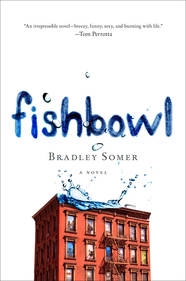
this is not a review: ‘fishbowl’, by bradley somer

 
I can’t always say how it is that a book comes to my attention but with Fishbowl  I do remember that ‘must read!’ moment. Mind you, I use the word ‘remember’ loosely… it’s more like I have this vague idea that someone whose book sense I value posted somewhere how she was giving this book to everyone she knows for xmas… I could list a few possibles of who that might have been but then everyone’s friends would be living in hope of receiving a copy.9781250057808

Because to get Fishbowl  as a gift would indeed be a happy day.

What we have here is an exceedingly readable, well-written book whose story takes place over the course of thirty minutes. We begin with the knowledge that Ian (resident of the fishbowl) will (only at the end of the book) fall off the balcony of his twenty-seventh floor apartment and will pass all twenty-seven floors in the process.

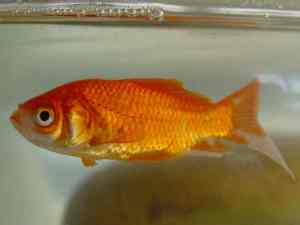
Not only an interesting set-up but in just a few pages Somer has managed to make Ian the goldfish someone we care about… with aquatic information such as the length of a goldfish’s memory (what memory?) and bits of fishbowl zen: “Less thinking, more doing” is the goldfish’s philosophy. “Having a plan is the first step toward failure,” he would say if he could speak.

After we learn that Ian *will* fall… the book, essentially, is our introduction to a few people living in the apartments that Ian will pass on the way down.

By the time he falls, we’re hooked. We want to know about Petunia Delilah and her impending baby, her future; about Herman, home schooled, weird, wonderfully naive and easy to swoon; Connor the bastard who dates far too many women (and on whose balcony Ian lives so that he doesn’t stare at the doings in Connor’s bedroom); a construction worker who likes to dress up; a lonely building superintendent; an agoraphobic phone sex worker.

The characters, despite their tics, are represented as fairly ordinary. It’s not about the tics. The point, instead, is that we all have peculiar elements to our lives. Their stories, not their quirks, are what keep us reading… (that and the dry humour, and sentences that consistently offer up happy surprises…)

“The elderly couple, with no pressing engagements after the funeral service, even visited her in the hospital. They brought her flowers and chatted with her for an hour, their manners as impeccable as any hero’s in an old science fiction book.”

The bigger story is how we feel at the end of the book and how we might understand the wider world just a titch better. For a moment anyway.

A credit to the author that a single fish could do so much.

And even if our vision of the whole wider world isn’t altered, then maybe this:
I dare you to look at an apartment building quite the same way again.

Peixe010eue(my vision of Ian; courtesy of wikicommons)


(at) eleven with carol bruneau: these good hands

 
Carol Bruneau has done a couple of pretty exceptional things in the of writing These Good Hands,  not the least of which is introducing us to Camille Claudel, a sculptor living and working in Paris during the Belle Époque of the late 19th and early 20th century. Considered a near genius, possibly superior in talent to her mentor and lover, Auguste Rodin, yet in many camps her name remains connected more to the word ‘mistress’ than to ‘artist’ in her own right.

On this side of the ocean anyway.

Until now.97817708642706

Bruneau has been researching Claudel for years, travelling to France several times, visiting places the artist lived and the asylum to which she was committed by her family and where, after thirty years, she died. While in the asylum Claudel wrote to a number of people, but most of them never received her letters because of her sequestration. In Bruneau’s imagined version the letters are written to an unknown recipient, the identity of whom is gradually revealed as her younger self. It’s through these letters that we are privy to Claudel’s life in Paris at the turn of the century, the relationship with Rodin, the passion for her art. Bruneau alternates the letters with journal entries made by the nurse who cares for Claudel and who ultimately comes to understand the (by now) elderly woman in a way that changes her own life.

Bruneau’s obsession with the artist is contagious and it’s impossible, I think, to read this book and not want to see examples of Claudel’s work. Happily, the author suggested a couple of excellent links to appease my need to *see*… the Musée Rodin …and this one, especially wonderful because it focuses entirely on Claudel.

I’m so very grateful to Carol Bruneau for bringing Camille Claudel to North America. And for this opportunity to chat a little about the book… and a few other things too.

~

1.  What literary character did you want to be as a child?

CB—Lucy Maud Montgomery’s famous Anne, that’s who—I envied her spunk, her dreaminess, her over-the-top poetic sensibility, all quaintly subversive qualities, and I identified intensely with her love of place. This aspect of Anne was most inspiring, and was imitated/usurped/transferred into my earliest attempts at writing stories.

2.   Can you recall one of your earliest pieces? Poem in crayon, a narrated finger-painting?

CB—I vividly remember the magic, at age seven, of stringing words together, first in phrases, then in sentences, and the mind-blowing epiphany: THIS is how you can make a poem or, even more exciting for me then, a story! One of my first pieces was a poem about a hummingbird in rudimentary printing with a crayon drawing of a mutant orange thing with wings. What I remember much more vividly is the ‘novel’ I wrote in Grade Five—a blatant Anne of Green Gables rip-off, only my character was ‘Camilla of the Dingle Woods,’ named for the large park in the neighbourhood where I grew up. I wrote it with a cartridge pen in Schaeffer’s peacock blue ink on loose-leaf meticulously kept in a black binder. I worked on it every day one entire summer. Then it disappeared. I don’t know if someone inadvertently threw it out, or if, suddenly “growing up” in Grade Six, I decided it was embarrassing, and tossed it.

3.  What were you reading at fifteen? And can you recall something you got out of a book at about that time, or a special memory of where you read it… at the beach, under the covers, in the back seat on the way to Cape Breton, in class…

CB—Fifteen? Much of that year I was too busy being a teenager to read much outside of school. (Part of the problem was the Grade ten curriculum, which required us to read Lord of the Flies, Steinbeck’s The Pearl, and Hemingway’s Old Man and the Sea—all of which I hated.) But then we read Thomas Raddall’s Hangman’s Beach, and my imagination was captured—sort of a reprise of my Anne of Green Gables-esque fixation on setting—because much of its story took place a five-minute walk from my house. So I vividly recall walking along the shore of Deadman’s Island on Halifax’s Northwest Arm with one of my best friends, while picturing Raddall’s male protagonist doing the same. Deadman’s is the site of hundreds of unmarked graves of soldiers captured during the Napoleonic Wars and the War of 1812. It’s spooky and atmospheric enough without a swashbuckling drama playing in your head. Walking there with my friend that day—it was April, Nova Scotia’s cruellest month, grey, cold, bits of rotten ice on the rocks, and a garbage bag that may or may not have contained dead kittens—I felt myself seeing the place through Raddall’s character’s eyes. This was another epiphany for me, the realization that stories people read—and enjoyed—could be set so locally.

4.  These Good Hands is written in alternating letters by Claudel to… we aren’t sure whom (a younger self?)… and diary entries by a nurse at the asylum where she spent the last 30 years of her life. How did you come to choose this (very effective) structure? Was it obvious from the start that it would work this way, or did it evolve?

CB—Great question. The structure definitely took time to evolve. As I worked through numerous drafts I continued to fret over whom exactly Claudel (or Mademoiselle as she’s called in the book) was addressing. For a while I imagined her cornering Nurse as a kind of ‘confessor’ but this quickly became onerous—for Nurse and for me. Subconsciously I was thinking of Mademoiselle’s listener as a muted version of herself, but it wasn’t until my editor/publisher, Marc Côté, pointed out its possibility—the idea of Camille addressing her younger, relatively unscathed self—that I was able to direct and refine her narrative in this way. The technique of using Nurse’s journal entries, on the other hand, came a lot sooner, as the logical extension of her situation and her personality.

5.  Given the years of research, were you ever tempted to write a non-fiction account of Claudel? And what has the novel allowed you to explore that the non-fiction would not have?

CB—Writing non-fiction gives me the willies! Although I have made every effort to be as true as possible to the facts of Claudel’s biography, from the beginning my interest was in exploring her character and predicament in ways that only fiction allows or enables. It sounds arrogant, but I wanted to try and give her a voice, to get inside the character of someone so feisty yet so vulnerable and—in just about every worldly way—defeated. I was interested in writing about her art, but never in a documentary or critical manner. Because her work is heavily autobiographical, I saw it as a wonderful pathway into her psyche as I imagined it, and into her creative process. When I began this project in 2005 there was very little fiction about her published in English, although at least one non-fiction writer had published a biography in English. Ultimately, giving Claudel’s story a fictional treatment allowed me the poetic license to get beyond its tragedy. I never entertained the idea of doing a non-fiction account.

6.  Please tell me you have a background in art, or at least took classes to research the experience such as you’ve captured on p.33 and elsewhere throughout the book… because it’s all so vivid…“…pinching and pummeling a lump of clay, spitting on it as he worked to keep it moist.”

CB—Ha! Any background I have in visual art is strictly the product of research, observation and experience teaching writing at a visual arts school—in other words, flying by the arse of my pants. I have taken beginner’s classes in life drawing, weaving and pottery, but have little to no talent in these areas. But my sister is an artist, and my job at NSCAD surrounds me with artists, and though as a word-nerd I feel on the outside of art looking in, perhaps this has been a useful perspective for absorbing then using the details necessary to ‘sculpt’ Claudel’s story. I’ve been extremely lucky, getting to see artists at work and visiting the odd studio space not all that different from those Claudel would’ve been accustomed to—and I’m continually discovering and delighting in how the creative process itself crosses boundaries of form and media.

7.  To what degree would you say Claudel’s relationship with Rodin was motivated by her passion for her own art?

CB—I would say hugely, enormously—quite possibly completely. More romantic individuals might disagree.

8.  Why do think it is that Claudel’s story has been missed in North America? And how is she perceived in France? And why was it important to you to tell her story?

CB—It remains baffling to me how and why Claudel’s story has been so slow in crossing the pond. She is legendary in France, legendary not only for her tragedy—her mental illness and her sad affair with Rodin—but for her art. Perhaps in French Canada people are more aware of her? I don’t know. The first time I went to France I was—naively—shocked to see her picture posted everywhere, to the point of it appearing on buttons and fridge magnets. When I first heard of Claudel and began reading about her life, my initial impression was that she had been committed and confined to Montdevergues asylum quite unjustly. What I discovered over the course of three research trips to France—and getting a clearer sense of how she is perceived there—is that she was in fact seriously ill and, given the stigmas and mores of the times, her family had little choice but to put her away. More is the tragedy when you see her sculptures first-hand. Her work is brilliant, and I have no doubt that had she been able to continue her practice she would have outstripped Rodin not just in achievement but reputation. It’s galling to me how until recently her work has been under the radar, so profoundly overshadowed by his. Though I was initially drawn to her biography because of its tragedy, seeing and experiencing her artwork soon became the motivation to try and create a more expansive, ‘truer’ version of her story: to show her primarily as a brilliant artist who happened to be Rodin’s student, mistress and model—a fiercely talented, feisty woman who devoted everything to her work.

9.  Camille Claudel is  seated next to you at a dinner party. What single thing do you ask her?

CB—Depending on the party and how early in the evening, it would be why she didn’t ditch Rodin for Debussy. But, no, seriously: There is no suggestion or evidence anywhere that Claudel ever harmed herself or another person. So, depending on how much wine we’d consumed, I’d ask why she didn’t take her own life, or attempt to, as an alternative to those thirty long years in the asylum. I would like to know what enabled her to choose an outwardly hopeless life over death.

10.  It’s a visual book that lends itself to walking tours! I can see people wanting to retrace Claudel’s steps, your steps… (I found myself googling all sorts of things, places… and I loved following your photo threads on FB). If you were asked to recommend only three things to see, to someone travelling to France for the Claudel Tour… what would they be?

CB—I love this question. The first stop has to be 19 Quai de Bourbon on Ile St-Louis in Paris, to stand outside Claudel’s former flat, her final home before she was committed in 1913— to go there at dusk and watch the lights on the Seine and know that this was her view. The second stop is Musée Rodin, to see a couple of her pieces exhibited alongside his. (Or, if you prefer to skirt Rodin, visit Musée d’Orsay to see her mistress-piece, Maturity or L’Age Mur.) The third stop, and most vital, is Musée Ste-Croix in Poitiers, home of the world’s only permanent collection of Claudel’s work—where it’s displayed in its glory with no mention whatsoever of her famous partner’s.

11.  Choices:

Chardonnay or Pinot Noir?   Pinot Noir—unless it’s a hot summer day after a trip to the beach, and then chardonnay is good.

Morning or Evening?   Morning, before the world wakes up and gets noisy.

Brie or Mille Fueille?   Brie, brie and more brie—my favourite treat in the world is cheese.

Mountain or Prairie? (no, you can’t say ‘ocean’)   Mountain. (Flat places make me claustrophobic, unless they’re beaches.)

Urban or Rural?   This is a tough one. I love visiting large foreign cities and I love walking in wilderness, as in rugged, out-of-the-way places near salt water. (Sorry, but lakes just don’t do it for me.) As for day-to-day living, I must confess I’m a bit of a suburbanite, in the sense that I like living close to amenities but need lots of green space and close proximity to woods and seashore for daily dog walks.

Poetry or Song?   I prefer Song, as I’m surrounded by a musical family—but that said, I love lyricism whether words are set to music or not, and a song’s quirky lyrics will hook me as fast as a catchy tune, if not faster.

Dylan (Bob) or Dylan (Thomas)?   Bob—as in my response to your previous question.

Keyboard or Notebook?   A notebook (and pencil rather than pen) is my go-to device for portability and no-fail simplicity. I love the directness of hand-to-paper transcription of ideas.

First or Last Lines?  I struggle with writing both, but find the last lines of novels come more readily than the first lines. It takes a ton of tinkering and tweaking to get them right, either way.

Mittens or Gloves?   Mitts, with gloves inside them if winter is as bad as last year’s.

Baguette or Croissant?   Baguette, unless the croissant is an almond one (I’m thinking specifically of the almond croissants at Patisserie Patrice et Christof in Chartres, France, which are irresistible).

andre-kertesz_the_fork_1928_500px

Because I believe food and books go together, I like to offer a tailor made menu for all @eleven books…

Voila…

For These Good Hands, may I suggest:

Roast Chicken

Pommes a l’Huile

Bread and Cheese

Chocolate Mousse

au moins une bouteille de vin rouge

Bon appetit!

DSC_0139Carol Bruneau is a novelist, essayist and reviewer who lives in Halifax, Nova Scotia. Her most recent book, These Good Hands (Cormorant Books, 2015), is based on the life of French sculptor Camille Claudel. She teaches writing at NSCAD University.

She can be found at www.carolbruneau.com

(at) eleven with laurie lewis: little comrades

I don’t know of (m)any other memoirs about growing up in a Communist family, in Canada or elsewhere, or why such an account might be scarce. The habit of secrecy perhaps, not wanting to name names? Whatever the case, in Little Comrades, Laurie Lewis has chosen to leap where few have leapt.

And I’m pretty sure the result is not what 9780889843424you think.
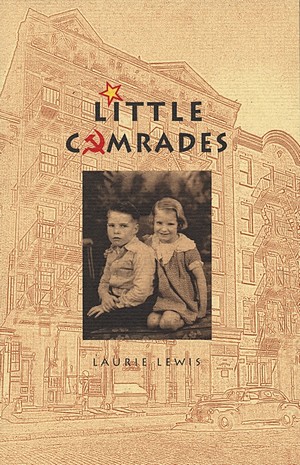
There is a strong-willed mother, a departure from the west to Toronto, another to New York City, an abortion in the 50’s, alcoholism, The Great Depression (and how to survive with style; the lost art of great style is everywhere…), the war, few women’s rights (women could be ‘legally bedded’ at age eighteen). There is Kill a Commie for Christ, racism, sexism. And secrets. Always secrets.

There is also Mulberry Street and her love of NYC. In fact, despite all the ‘isms’ of the era, it’s love that comes out strongest. For her mother, for freedom, for the people who helped them, for Sol whose loud, robust family, culture and food she craved after a fairly white-bread upbringing that didn’t encourage independence, creativity or opinions outside party lines.

“My father had written a letter to the Communist Party Central Committee… so they’d know that he had given his wife permission to leave him.”

While describing the larger issues of the day, the unorthodox turbulence of her home life and the difficulties of being a little comrade in general, Lewis manages to maintain a voice appropriate to her youth and still-innocence. Describing a visit to an avant garde cinema as a young teen, Lewis writes: “The theatre showed ‘foreign’ movies. Sometimes British, sometimes European, with sub-titles, so you’d know what people were saying.”

Her writing is beautifully precise, often tactile, so that the reading at times feels a little like wandering about with the author as she confidently points things out that, pretty soon, we can also see just as plainly.

I’m delighted to have read this book (which ends in 1952) and have already purchased the sequel: Love and All that Jazz.

So without further blather, and with enormous thanks to the author, here is (at) eleven with Laurie Lewis:

1.   The first question I always ask in this series is what literary character did you relate to as a child. Given your unusual childhood, I’ve never been more curious to know the answer.

LL—I’m afraid I can’t tell you the answer to this. Perhaps something will come to me as I get further along into this process.

2.   What were you reading at fifteen?

LL—Oh, that I do remember clearly… two very different things: In my early teens I was very interested in math and science, and one of the books I received (from my father, a great surprise) was Mathematics for the Millions, by… how good is my memory? Yes, Lancelot Hogben, or a name very much like that. I could probably ask Mr. Google right now and get the right answer!! [Yes!! He’s there, and the book is there, still in print! Amazing!] The other thing I was reading was Dorothy Parker, who had a new collection of short stories out just then, 1945. I remember reading them to my mother when she was ill. She was a smart sassy woman speaking her mind. Very avant-garde. What a role model! And Robert Benchley, Ogden Nash, James Thurber. The New Yorker writers of the period… my mother’s choices, of course. Elizabeth Barrett Browning. And I remember my very first Virginia Woolf story, although I don’t know how old I was, perhaps younger than 15, I believe. “Flush”.

(I should say here that my mother didn’t believe in “children’s books” as such. She grew up in a working-class home of a skilled carpenter from England, with a room full of Dickens, which she regarded as books for children, since that’s what she had read.) To my own daughter, I read Alice in Wonderland and Through the Looking Glass, of course, and Mary Poppins. The Mary Poppins movie came out shortly after she and I moved to Toronto, when Amanda was 8 years old. I vividly remember that when a school friend asked her if she had seen the movie, she told her, “No, but I’ve read the book.”)

Pre-teen poetry: Vachel Lindsay (a sort of pre-beat poet. Sort of “tribal” as I recall.) Emily Dickinson, of course. Robert Burns from the Scottish side of the family.

3.   Did it ever occur to you that it wasn’t the norm for children to be as aware politically as you were? Looking back on it, how did this awareness, this lifestyle, affect friendships? Did you feel different from other children; did you see the difference in your family?

LL—I think you are perhaps not correct in thinking it was not the norm. Those were intensely political times in the history of the world, both during the Depression and World War II. During the “Great” Depression politics were part of people’s lives, I think. Not only mine. (In the way that the Vietnam war was a part of the lives of Americans during that difficult time. And everyone had an opinion.) Extreme, extreme(!) poverty creates its own awareness. Yes, I was generally aware of how it might have affected friendships… One of the pieces I wrote about, called “Lumpen”, was about a potential friendship that was out of bounds because the parents were “lumpen” (i.e. non-political working class – non-politically aware). And I remember being invited somewhere by a little girl of about my own age, a girl who put on a pretty dress every Sunday and went to some sort of party. Sunday School. I asked my mother if I could go, and she dressed me up in my best dress, my school dress. (Perhaps you know that a poor girl in those times might have two dresses. One for school and one for play. No jeans, or anything like that, of course.) I’m sorry to report that I was asked to leave when I, at about six years old, questioned the story of Adam and Eve (since I knew about Darwin).

Also, I became very aware of a class divide. We were definitely not “middle class” in either our economic circumstances or our outlook on life. I think the children we now call “disadvantaged” (not “poor”… we never say that anyone is “poor”!) are very aware of a class divide, regardless of what it is called. I assume it affects their friendship patterns. To some extent I think economic disparity affects our friendships at any age.

4.   In the New York City chapters, while you were often worried, knowing that you or your mother might at any time be questioned, or worse, for communist connections, and despite the many moves and difficult encounters, I sense that the city offered you a new kind of happiness and freedom. Was this a turning point in your life? Would you say your mother experienced something similar?

LL—Yes, certainly there was a kind of freedom. The important thing, especially for my mother as a newly-separated intelligent and creative woman, was that the city was wide open for anyone who had talent and drive, and she had both. That’s not quite the same thing as “happiness”, but I’m not sure what that word means. I was a young teenager. Certainly I had more opportunities than I would have had in a small town, or in a “provincial” city like Vancouver. There was freedom from the coercion of the domestic politics of power, and a more cosmopolitan, more diverse “ethnic” environment. More people from more places, not the homogeneity that was Canada at the time. (A tad more financial security would have helped both of us, of course.!) Yes, certainly it was a turning point. When I got my first job, as an usher in the movies (they had them then!), I was terribly proud of myself. I could earn a living!

5.   Also, those chapters so beautifully and vividly describe a city that it’s said no longer exists. What was it like to revisit in the writing? And what are some of the more regrettable losses?

LL—Yes, we revisit places and “social environments” when we remember. I don’t think I have ever tried to compare the old and the new… Well, yes, I suppose I have, but what can I say? The buildings have changed, the people have changed, the way of life has changed. And I have changed. Especially now, in my old age, I am more aware of the vast spaces where people I knew, people I loved, do not exist any more. That is the most regrettable loss, the loss of those we loved, cared for. The rest is just history, just “stuff”. Beat was beat; hip was hip; hippy was hippy. So vastly different! And what is cool today will be passé tomorrow.

6.   Despite being surrounded by writers in your family, and in your publishing career, you didn’t begin writing seriously until your sixties. This rather late start not only makes you an inspiration to many late starters, it also gives you a rare perspective, i.e. how differently, if at all, might the story of Little Comrades have been presented had you written it at, say, age 35 or 40?

LL—A very tricky question. I’m not sure how different the story would have been, but if I had written it then, when communism and therefore anti-communism were still very powerful and antagonistic forces in the world, the reception would undoubtedly have been different. Communism, these days, is looked back on almost with nostalgia. (Not the specifics of Russia, of Stalin, but the economic principles.) As far as I, personally, am concerned I think it’s important to say that age gives me a kind of power, through the freedom to say whatever I damned please. This is a power that perhaps young people with young careers rarely really have. And I certainly felt the freedom to present my story with – well, of all things! – the dignity it deserved. I think I was aiming for something like social history, told through the mind of a child.

7.   While still in high school, you had an affair with a man that resulted in your getting an abortion. The affair ended and a few years later you were surprised to see “a new and handsome face” appear in Hollywood movies. “That same face with the high Greek cheekbones, the dark eyes, artfully dishevelled black hair. His name? Yes, it could be a good Anglicization of the one I remembered but never spoke.” You tell us that he eventually became a director and married a ‘10’… all wonderful clues for what is a wonderful parlour game… Was this a promise to the man or a promise to yourself, not to reveal his name?

LL—I am merely being cautious. Two things: First, I can’t be absolutely sure that’s who it was. When I asked Mr. Google about him, the early bio made me a bit unsure. And if I had ever done more than hint, I could have been open to a suit for libel or slander. Probably because of my childhood experiences, I think I tend to be careful about keeping my activities legal. I’m a trifle paranoid, perhaps.

8.   Your memory for detail is extraordinary, adding rich layers to the story, tapping various senses. That you recall people, how they looked, what they wore, what they did for a living, a pawnshop window… What was your process in getting ‘back there’—was it photographs, conversations, general research, letters, all of the above?

LL—I wish I had had letters, photographs, etc, but I didn’t. But I think memory is quite wonderful. My “chicken soup” theory of memory says: The first time I ask my memory about something, there’s almost nothing in there. There’s just sort of a weak chicken broth, warm and salty. The next time I go looking into that memory, there are a couple of peas, maybe a piece of carrot. And so it goes. Every time I look, there is more in that memory-space. [I think recent research shows that the soup in which the synapses operate between the dendrites must be sort of re-assembled, reconstituted, into the memory.] And some of it is pure deductive invention: for example, in a story about my aunt getting married I have said she wore a blue dress. Well, what do I really know? I don’t remember, but the dress wouldn’t have been either black or white. Nor red or pink or purple. Because they were Scots, it would have been unlikely to be green. Given the years of the forties, the colours were apt to be muted and “feminine.” All of that, for me, equalled a light blue.

And just because it’s a memoir doesn’t mean you can’t make things up! I mean, I am a writer! How much do I actually recall of what was in the window of the pawn shop? Two out of five things? One thing? But once I have written it, it becomes true for me, and I can see the window very clearly.

9.   You had a close relationship with your mother, who comes across as a very independent woman for her time. She lived an unconventional life in many ways, not the least of which was leaving your father and giving you the choice of staying or coming with her. Also her work with the Communist party, the risks that involved and the lifestyle it required. Yet at some point it became clear to you that you had different values and ideas about lifestyle. How difficult was it to admit this to yourself and to become independent in your own way?

LL—She was a very independent woman for any time. Most of that was, I think, an independence formed by the combination of pride and desperation. She had some pride in herself, some idea that she had a mind, that what she thought mattered, and she was desperate to get out of a bad personal situation even if that put her into a desperate economic situation. In my mother’s time, if women were desperate to leave their husbands, they usually had another man to help them out… to help them get out, I mean. So then just, a few years later, we were two more-or-less young-ish women living together… when I was 18 and she was 38, for example. We really needed our own spaces. Perhaps the differences you mention – values and lifestyle ­ might have had more to do with the simple matter of generational differences. And the number of years between the generations was much smaller than it is now, thanks to the easy availability of birth control in North America. All young people, male or female, have different outlooks on life than their parents have. I know that some may make choices to stay closer to the zeitgeist of their parents, for whatever reason. In the 1960s, rebellion was in the air, change was in the air. I was just a few years ahead of my time, as Ellen (my mother) was a few years ahead of hers, always.

10.  It feels like a life of many secrets. You say that even today there are names you “won’t name”… people who were once involved in the Communist party. Did you have to think twice about writing this book?

LL—In the beginning I didn’t know I was writing it. I was just writing stories about what I thought I knew. When I began to write some of the early family stories, my mother said, “It wasn’t like that”. We each have our own truths, the things that we believe to be the truth of our lives. And we can’t let anyone else decide for us what it’s okay to reveal. My mother’s memoir, “Always and After” is much more cautious politically. I don’t think mine is a broad tell-all memoir, full of scuttlebutt. I was focussed on specific areas of our lives: politics, gender, personal growth, insight. By the time I had finished writing Little Comrades my mother had died, and so there was no one to tell me I had done it wrong. (And I didn’t name names, as you know from question 7.) Also, I probably still have lingering fears, some paranoia, from the McCarthy era, and so, even with my general “mouthiness” I have some caution in me. I don’t feel that I have said anything truly dangerous, either to myself or to anyone else. (And everyone’s dead now.)

**

I will go back now to the first question, which literary character I related to:

At the end of this, I have come back to the beginning, and what has come to me is Heidi: homeless and hungry. What a surprise that is to me!! Thank you for asking. I think this is the secret of my childhood, Heidi. I could cry, even now, for that poor little girl. But I think I will go out to dinner instead.

11.  Choices:

Coffee or tea?    Tea in Canada, coffee in Mexico.

Poetry or song?   Poetry   

Sweet or savoury?      Savoury

Dessert or Appetizer?      Appetizer

Winter or Summer?     Summer

Pen or Keyboard?  Keyboard, although as a graphic designer I flirted with calligraphy.*

Bicycle or Canoe?  Bicycle… it’s in the garage right now with a flat tire.  

Ocean or Lake?    Lake

Morning or Night?     Morning

Film or theatre?      Theatre

The Ten Commandments or Exodus?      ha ha ha… Exodus.

* Here’s another note about Pen or Keyboard: Keyboard, although as a graphic designer I flirted with calligraphy, and so the “pen” has artistic value rather than any writerly presence. Whereas, I learned to touch type when I was 17, and so I firmly believe that my fingers know stories that they are eager to tell me. My fingers do their work, and then I read what they have said. There is a direct line from a part of my brain into my fingertips.

andre-kertesz_the_fork_1928_500px

Matilda’s Menu for Little Comrades:

Bacon Sandwich

Alymer Soup

Blintzes

Prosecco

As is customary with the (at) eleven series, a meal of my choosing—appropriate to the book—follows the Q&A, because… “Eating is our earliest metaphor, preceding our consciousness of gender difference, race, nationality, and language. We eat before we talk.”  ~Margaret Atwood from The Can Lit Food Book

Happy Reading, and bon appetit

◊♦◊

laurieLaurie Lewis is a Fellow of Graphic Designers of Canada and is editor emerita of  Vista, the publication of the Seniors Association in Kingston, Ontario.

She began writing in 1991 after retirement. Her written work has been on CBC and has been published in Contemporary Verse 2, Queen’s Feminist Review, Kingston Poets’ Gallery, Queen’s Quarterly, and  The Toronto Quarterly. Her memoir, Little Comrades, was published by Porcupine’s Quill in 2011 and was named by the Globe and Mail among the Top 100 Books of the Year. A second memoir, Love, and all that jazz, was published in 2013 by Porcupine’s Quill. She is currently working on a collection of essays and stories about age, but is not persuaded that the title “Mouthy Old Broad” will have much commercial appeal.

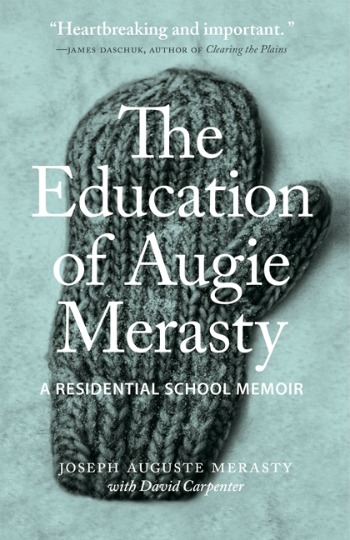
this is not a review: ‘the education of augie merasty’, by augie merasty with david carpenter


You may think this is a story you know—residential school horrors.

Or at least one that’s already been told.

You’d be wrong on both counts.fsp-050420151

While the gist of the horrors has been conveyed over the years in books about  the horrors… and documentaries about the people involved in the horrors… and articles in magazines and papers, more and more in recent years covering the horrors from various angles… still, all of that is different than this book, which is a personal account by a man, now in his eighties, who lived  the horrors from age eight to fourteen.

Joseph Auguste Merasty.

What makes his account in The Education of Augie Merasty   different from what we already know about the story is that he’s able to tell the story at all.

He’s an alcoholic, often homeless, sometimes in rehab. Many of the people who shared his childhood are also drunks, druggies or dead. Many by suicide.

Most of them aren’t writing memoirs.

That’s the familiar part. That and the abuse, the hypocrisy, the cover-up, the abdication by governments, and so on. The surprising part is that this isn’t the stuff Merasty wants to talk about. He wants to keep things positive. For his own sanity I suspect. How he finds The Positive is both a testament to the power of survival and a tiny miracle of human spirit.

In 2001 he writes to the University of Saskatchewan asking for someone to help him get his story on paper, someone with a “good command of the English language”.

The someone turns out to be David Carpenter, a professor at the university.

In his compelling introduction Carpenter explains the process of meeting and communicating with Merasty, a retired trapper who is hard to pin down and not especially disciplined or organized about handing in his notes.

The back and forth goes on for more than a decade.

The memoir itself takes something like 75 short pages. Merasty begins by listing what he refers to as the ‘kind’ or ‘jolly’ people at the school. What he’s really doing is working himself up to remember the not so jolly.

“It was that fall that I first laid eyes on the one human I would dislike… for the rest of my life… but I will not talk about him now. I want to keep talking about the nice ones.”

The “nice ones” include people who would throw blocks of wood at the children and call them bastards, occasionally strapping them.

“…but [they were] okay.”

It’s the others that were the problem. Right…

At no point does he get maudlin nor does he blame. He simply says here are some of the things that happened. We know enough about the story that he doesn’t have to tell us the gruesome details. I’m guessing the details are the irrelevant part anyway. I mean how hard do you have to hit a kid, how many times do you sexually abuse them, how long do you starve them, what kinds of names or threats or other horrors do you hurl at them or force them to live through before it matters enough that it needs to be added to the list?

That it happened at all is the point.

And that thousands upon thousand of lives have been affected by not only the abuse but the way the rest of the world turned its head. Still turns its head. There’s the point.

Details, well, they’re just that.

There are a few though.

The time he and a friend each lost a mitten on an outing the day before and were made to retrace their steps in minus 40 temperatures. He didn’t find his mitten and on his return he was strapped twenty times on each hand. He was eleven years old. There was the stale porridge they ate while watching trolleys with white linen and fresh eggs, meat and cake being delivered to the adults.  There was the dreaded Brother Lepeigne, sexual abuse, beatings for smiling, for accidentally farting. For nothing.

“I figured now the reason… was to keep my mouth shut about the sexual abuse. He did a good job because I have never told anyone about those assaults until now. They were too painful and shameful to me, and I would have been the laughing-stock for everyone, even to this day.”

The reason to read this book is not to know his story, because I suspect there’s much that isn’t being told, that can’t be told, even now. The reason to read it is to understand the courage it took to write it. And to understand that there are thousands and thousands and thousands for whom he speaks.

The residential school system ran from the 1840’s to 1996. Think about that.

The last entry in the book is a drawing, a sketch Merasty has made of a northern scene, apropos of nothing that has come in the pages before and yet it makes perfect sense. It’s perfect, because it rings true.

“… I want to end with this good memory of the fishing and all the reindeer up north.”

**

More about the book here.

The Education of Augie Merasty  (University of Regina Press) can be ordered online at Blue Heron Books.

this is not a review: ‘missing sarah’, by maggie de vries

 
In Missing Sarah,  Maggie de Vries recalls the life, disappearance and death of her sister Sarah de Vries, whose murder was confirmed when her DNA was eventually found on a psychopath’s farm in Port Coquitlam, B.C.

DSC03213

Published in  2003, the book won the George Ryga Award for Social Awareness, the VanCity Book Prize, and was nominated for a Governor General’s Award.

I’ve wondered about Missing Sarah every time I’ve heard about another missing woman, but only recently read it… after chatting with a friend about books that need to be discussed more often.

DSC03215

Sarah de Vries disappeared from a Vancouver street in 1998. She was a young mother, an artist, a keeper of journals, a poet. She was kind, loving and funny, honourable and dignified. She had gorgeous wild hair and a big smile and in the last house she lived, in the scruffiest part of town, where junkies often stayed, there was a small, thriving garden planted beside the front door.

This image has stayed with me, this need to nurture, this need for beauty.

“The tragedy is that she never seemed to be able to turn that love and caring toward herself or accept from others in a way that would allow her to change her life as she always wished she could.”

DSC03216

She had two brothers, a sister, loving parents. A regular family. The family were white. Sarah was black. She’d been adopted as a toddler. She loved them deeply but on some level didn’t feel she fit in. When she discovered Vancouver’s downtown scene, something clicked for her. These were people who also didn’t fit in and together they made a different sort of family, dysfunctional and real as any other.

DSC03227

In her journal Sarah writes about the idea of home… “… but it’s too late. You’re already on your way and you don’t want to hear the words “I told you so”.”
DSC03217

Through letters, drawings, journal entries and conversations with people in Sarah’s life and the various relationships each had with her, Maggie de Vries comes to know her sister in a way she never managed while Sarah was alive.

DSC03222

She feels guilt over this, and it breaks my heart. Because how could she have known her any better? When Sarah was alive, things were chaotic. Not only with the drama of Sarah’s life—the constant coming and going, the worry over her safety, her health, her children—but the way it played havoc with her parents, whose marriage eventually broke down, which in turn caused further stress on family dynamics and individuals.

It’s in the writing, from this distance, that de Vries begins to realize there was never an opportunity to ‘get to know each other’, that everyone was simply getting through things in their own way.

This is the way of families. We only think we know them.

We barely know ourselves.

DSC03219
I was struck with the bravery of de Vries’ writing. How she said that it’s easy to believe that drugs are the problem rather than what’s going on at home.

“Kids are not only responding to tempting bait on the outside, they are driven by some deep discontent on the inside.”
DSC03224
She adds that getting rid of the ‘bad people’ out there won’t solve the problem, that it’s not enough to arrest the creeps and murderers.

“More ‘bad people’ will appear in their place; and, as long as we do not solve our problems at home, our children will continue to leave.”

Now there’s a hard truth. It would have been so much easier to blame anyone else. But de Vries doesn’t play the sympathy card, or even the shock value card. She’s writing this book, she says, “…to make it real for myself, to gather all that has passed in the last four years and pin it to the page.”  In the process she shares her road to understanding as she realizes that to effect change, we have to look at what we’re doing in our homes before we point fingers to the problems in society.

It’s beautiful, honest and bare-naked writing.

DSC03221

It’s about Sarah but it’s also about so many others, women, who found themselves working on the streets to survive.

They are individual stories and yet share a common bond.

Like life.

Your story, mine. Different and the same. The point, it seems, is to know this.
DSC03225

It’s about being human.

DSC03226

And it’s the kind of book you can read again and again and, like getting to know someone, you learn a new thing each time. And your eyes are opened and this world that you know nothing about suddenly becomes part of the world you live in, not the separate place you pictured. And you might be surprised to know the people in it bleed and laugh and love and *need* the way people do.

DSC03062

It’s a book to read and discuss as long as there are women disappearing from streets and dying in hotel rooms after ‘rough sex’ and perpetrators of ‘rough sex’ are being allowed to live their lives as if nothing happened.

DSC03223

Not everyone has a sister who will write books about them.

Sarah de Vries did.