lunch time read: georgian bay gourmet summer entertaining

I love old cookbooks. Oldish. My favourites being from the 40’s through the 80’s. Depression era ones are also good, but there’s something irresistible about all that apres war poncing about with the discovery of avocados and kebabs and mandarin oranges in syrup; the way corn flakes and potato chips are used as crust, maraschino cherries and olives are tossed onto everything and platters of undercooked hams, shellacked and skewered with slices of tinned pineapple and unripe honeydew melon. Oh the things you can do with tuna! Or, when in doubt, throw some cream or sugar or liquor into whatever you’re making, and while you’re at it have a swig yourself!

A deliciously hideous pseudo-culinary flamboyance that continued for decades, seeming to peter out only with the arrival of celebrity Chefs and food channels and all-of-a-sudden real food from places beyond the British Isles.

There’s something comforting in all that kitsch, all those olives. Takes me back.

Happily, my most recent acquisition, Georgian Bay Gourmet Summer Entertaining, contains all of the above-mentioned in one form or another, plus people are smoking in the accompanying pictures. It not only took me back to an era, its cheerful everyone-must-have-fun bonfires and boating banter delivered me vicariously to some oddly frenetic cottage where placemats and napkins match and an aproned woman in pumps is all Martha in the kitchen morning til night while three year olds play with lawn darts and a guy in a safari jacket swills rum-laced pineapple juice and burns enormous olive-studded hamburgers. The book was published in 1983 when, evidently, no one was eating local or seasonal as any kind of rule. Lots of jellied salads, tinned fruit and things with marshmallows where marshmallows should never be—but as well, many gems, like a tomato and basil soup with gin, frozen watermelon daiquiris, and bits of trivia such as Georgian Bay has 30,000 islands and is the world’s largest fresh water inland bay. And pears—who knew they ripened from the inside out?
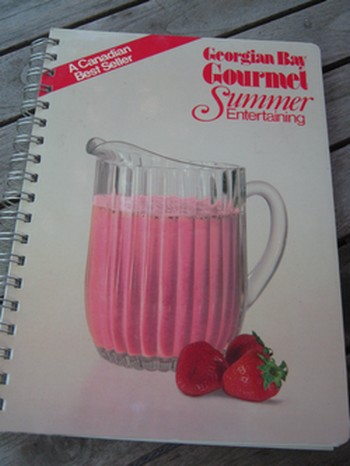
One of my favourite items is something called a Disaster, made by putting popsicles and ice cream into a blender til smooth then “pouring into glasses”. Admittedly, I was hot and thirsty while reading the book, which gave Disaster some added appeal. I haven’t tried it yet. Thinking about it now I see how it might be brilliant or… it could live up to its name.

Ah well, if it’s no good I’ll float some marshmallows, add a maraschino cherry or a splash or three of cognac.

Will report once the experiment has been conducted. :)

Happy weekend!
book run

Given that I don’t shop at Amazon—and won’t darken a Chapters doorway other than for literary journals (I don’t even buy my candles or patio furniture there)—and given that I live in a medium sized town without a bookshop (ridiculous)—it’s a half hour drive north to pick up my order from the nearest bookseller (to a town much smaller but obvioulsy more bookish than mine) and another fifteen minutes to the second nearest. Not complaining; they’re worth the drive. Plus, there are such very merry things I can do on the way. For instance—

—I can stock up on the best buttertarts in the world from an amazingly innovative farm market-slash-golf-course-slash-outdoor patio-slash-apparent bridal photo hot spot-slash-tobaggoning run in the middle of nowhwere (as well as fresh-from-the-field veggies and fruit, happy meat and over-the-moon eggs).

Go canoeing or, better yet, watch other people go canoeing while I have lunch

—Commune with emus

For starters.

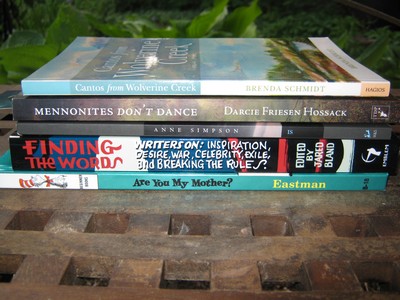
That said, here’s the most recent haul (picture of  buttertarts not taken fast enough):

Cantos from Wolverine Creek, by Brenda Schmidt

Mennonites Don’t Dance, By Darcie Friesen Hossack

Is, by Anne Simpson

Finding the Words: Writers on Inspiration, Desire, War, Celebrity, Exile, and Breaking the Rules, edited by Jared Bland (for PEN Canada)

Are You My Mother?, by P.D. Eastman (and yes, it’s for me)

leisured young women take note

“…For the rest of 1912 and the first half of 1913, I went to more dances, paid calls, skated and tobogganed, played a good deal of bridge and a great deal of tennis and golf, had music lessons and acted in amateur theatricals; in fact I passed my days in all these conventional pursuits with which the leisured young woman of every generation has endeavoured to fill the time she is not qualified to use.”
—from Testament of Youth, by Vera Brittain

mr. fish, you write good book

“It is often said that the job of language is to report or reflect or mirror reality, but the power of language is greater and more dangerous than that; it shapes reality, not of course in a literal sense—the world is one thing, words another—but in the sense that the order imposed on a piece of the world by a sentence is only one among innumerable possible orders. Think about what you do when you revise a sentence: You add something, you delete something, you substitute one tense for another, you rearrange clauses and phrases; and with each change, the ‘reality’ offered to your readers changes. An attempt to delineate in words even the smallest moment—a greeting in the street, the drinking of a cup of coffee, the opening of a window—necessarily leaves out more than it includes, whether you write a sentence of twenty words or two thousand. There is always another detail or an alternative perspective or a different emphasis that might have been brought in and, by being brought in, altered the snapshot of reality you are presenting.”

from How to Write a Sentence and How to Read One, by Stanley Fish

passing it on

Thanks to to whoever gave away these books (found on discard/share shelves at my public library).

What My Father Gave Me, anthology edited by Melanie Little, with work by Lisa Moore, Melanie LIttle, Susan Olding, Saleema Nawaz, Cathy Stonehouse, Shannon McFerran, Jessica Raya

Belle, by Florence Gibson

In Green, by Robin Blackburn

“In my hands I’ve got a jar. A large one, the kind my grandma uses for canning. I’m here to fill it. Then I’ll stuff it in my knapsack. And tomorrow morning I’ll cart it to the woods, where, with forty giggling, hiccupping, and wise cracking petty thieves just like me, I will chug its contents before my first class of the day, arriving at school glassy-eyed, rubber-kneed, and instantly popular.

“My best friend, Brenda, has agreed to bring orange juice for the mix.

“I stare at the bottles. The bottles stare back. From the rec room downstairs, my parents’ voices rise and fall in staccato bursts, punctuated by the clink of ice cubes as they set down their tumblers or raise them for the next sip. I need to time this perfectly, before my mom comes upstairs to start supper, before the doorbell rings, and one of them comes to answer it, before their next refill. The time is now.

“I reach for the vodka. Goes better with orange juice, I tell myself. Vodka’s so much better for the morning.

“But the truth is different. In fact, I’d never be able to go through with this plan if I stole the rum. Rum is my dad’s drink. Rum and Coke. Sticky and sweet. It hardly tastes like alcohol at all. It’s a liar’s potion. A denier’s potion. The smell of it makes me vomit. A few years from now, when my friends and I start going to bars with fake ID, they’ll suck back the Daiquiris and the Pina Coladas—bright, like liquid cotton candy. But I won’t order those. Give me Campari and soda or a gin and tocnic. Something bitter. So I remember what I’m doing.”

from ‘Thirteen Answers for Alateen’ by Susan Olding, from the anthology What my Father Gave Me, edited by Melanie Little, Annick Press, 2010

~

mud pies and pure design

“What I Want to Say”  by Pat Schneider

Well, I was playing, see,
in the shadow of the tabernacle.
I was decorating mud pies
with little brown balls
I found scattered on the ground
like nuts, or berries.
Until some big boy came walking by
and laughed. Hey,
don’t you know you’re puttin’ goat doo
on your mud pies? I bet
you’re gonna eat ’em, too!

That day I made a major error
in my creative life.

What I want to say is this:
I liked those little balls
on my mud pies. I was a sculptor,
an artist, an architect. I was
making pure design in space and time.
But I quit
because a critic came along
and called it shit.

—from Another River, by Pat Schneider

to name but a few

“… The Female Body has many uses. It’s been used as a door-knocker, a bottle-opener, as a clock with a ticking belly, as something to hold up lampshades, as a nutcracker, just squeeze the brass legs together and out comes your nut. It bears torches, lifts victorious wreaths, grows copper wings and raises aloft a ring of neon stars; whole buildings rest on its marble heads.

“It sells cars, beer, shaving lotion, cigarettes, hard liquor; it sells diet plans and diamonds, and desire in tiny crystal bottles. Is this the face that launched a thousand products? You bet it is, but don’t get any funny big ideas, honey, that smile is a dime a dozen.

“It does not merely sell, it is sold. Money flows into this country or that country, flies in, practically crawls in, suitful after suitful, lured by all those hairless pre-teen legs. Listen, you want to reduce the national debt, don’t you? Aren’t you patriotic? That’s the spirit. That’s my girl.

“She’s a natural resource, a renewable one luckily, because those things wear out so quickly. They don’t make ’em like they used to. Shoddy goods.”

—from ‘The Female Body’, by Margaret Atwood; Good Bones, 1992, Coach House Press

~

feeling with the eyes

“When I first knew Gertrude Stein in Paris I was surprised never to see a French book on her table, although there were always plenty of English ones, there were even no French newspapers. But do you never read French, I as well as many other people asked her. No, she replied, you see I feel with my eyes and it does not make any difference to me what language I hear, I don’t hear a language, I hear tones of voice and rhythms, but with my eyes I see words and sentences and there is for me only one language and that is English. One of the things that I have liked all these years is to be surrounded by people who know no English. It has left me more intensely alone with my eyes and my English. I do not know if it would have been possible to have English be so all in all to me otherwise. And they none of them could read a word I wrote, most of them did not even know that I did write. No, I like living with so very many people and being all alone with English and myself.”

—from The Autobiography of Alice B. Toklas, by Gertrude Stein (pub: Harcourt, Brace—1933)

~

perhaps special powers

“My friend Cody, the legendary creature with painted nails and black ringlets that reach halfway down his back. It is rumoured that he is a hermaphrodite, that he possesses extra plumbing, perhaps special powers. I have never asked him, because it is none of my business, and Cody has never inquired about the bulge in my own pants. He is a creature of immense grace and beauty, and that is all I need to know.

“I take Frances into the cafe where Cody works, to introduce them to each other with all the pomp and circumstances reqiured when in the presence of royalty.

“”Cody, I’d like you to meet my godson, Frances. Frances, this is Cody.”

“But Frances doesn’t acknowledge Cody, or his ringlets, or his fingernails at all. Something else more pressing has caught his attention. He reaches his small hand up to caress the fabric of Cody’s silver velvet shirt, tight and shimmering over his slender torso. Frances smiles in wonder to himself and his mother places her hand on my shoulder, and laughs like a leprechaun.

“”That’s my boy,” she says, and for a second I am unsure whether she is referring to Frances, Cody, or myself, but it doesn’t matter, because we are all where we belong. Home.””

from ‘Red Sock Circle Dance’, from the collection Close to Spider Man, by Ivan E. Coyote.

say no to slibber sauces

“It is a world to see how commonly we are blinded with the collusions of women, and more enticed by the ornaments being artificial than their proportion being natural. I loathe almost to think on their ointments and apothecary drugs, the sleeking of their faces, and all their slibber sauces, which bring queasiness to the stomach and disquiet to the mind. Take from them their periwigs, their paintings, their jewels, their rolls, their boulstrings, and though shalt soon perceive that a woman is the least part of herself.” (‘Collusions of Women’, from Euphues, by John Lyly, 1578)

(From A Book of Pleasures, an anthology of words and pictures, compiled by John Hadfield, Vista Books, London, 1960)

A Lady at Her Toilette: Water-Colour by J.M.W. Turner, 1830