always something

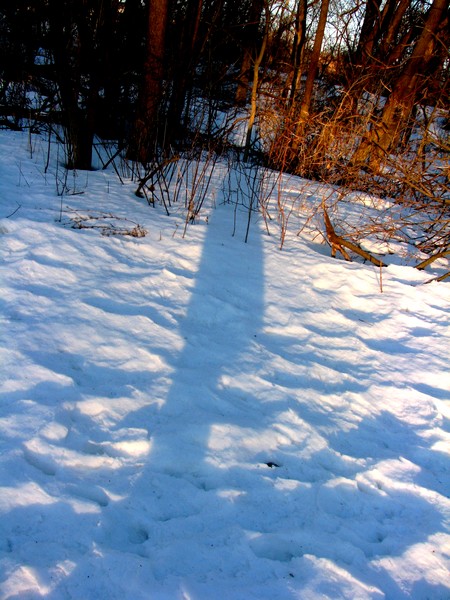
I rush outside this morning with the intention of catching a spectacular sunrise. But it’s not all sherbet colours as expected, merely yellow.
IMG_5741
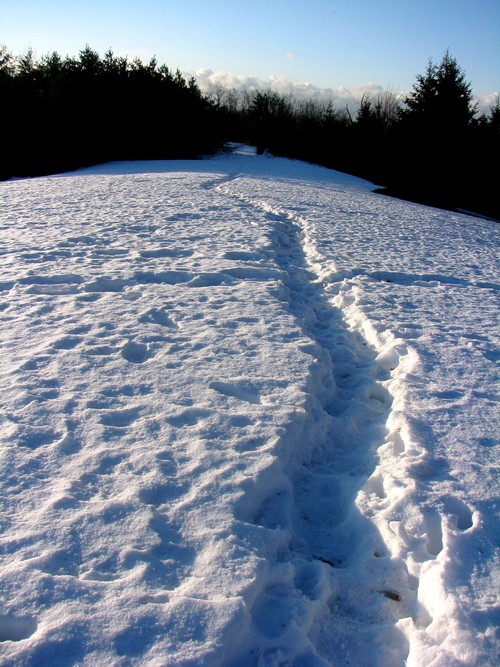
Still, I’m well into the ravine by now, cleats attached to shoes and the crusty icy snow crunching and cracking, the weird human rhythm of it propelling me onward. [Animals, by contrast, are so quiet.]
IMG_5752
And so onward I gallump through the woods and into the park with the merely yellow sun rising to my left…
IMG_5750
and then once I get around the big loop…
IMG_5746
on my right.

No one about this early, or maybe because of the cold. My crunch and clack disturbing only one black squirrel and a flock of chickadees huddled among the lowest branches of a spruce.

Nothing to see but white white white…
IMG_5751
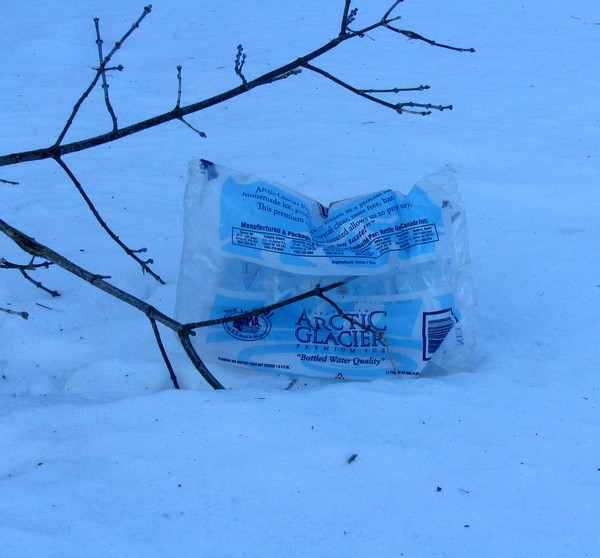
and then a splash of blue, turquoise even.
IMG_5745
Every time I see one of these colourful bags I wonder how it gets left behind. Does someone set it down in order to play fetch or Frisbee or chat at length with other dog walkers while sipping a Timmy’s and then simply wander off in a haze of forgetfulness? I think that’s why they’re made in these very striking ‘hello!!’ colours, so they’re hard to not see once the Frisbee is over, and yet…

There’s always something.
IMG_5744

pawsing the mantra

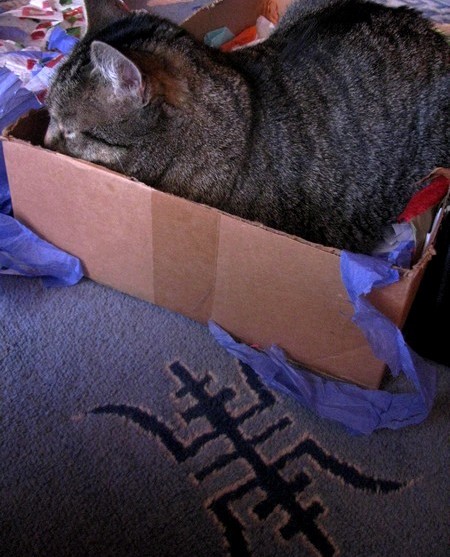
When—cross-legged on the living floor, palms up, silently reciting my ohms—I hear a rustling in the tissue paper next to me… I open my eyes and count this as part of my meditation.

And when tail and paws and one side of striped and whiskered face are sufficiently clean, another shuffle and re-shifting in cardboard nest is followed by stillness… then a deep breath is drawn—and we both close our eyes, Zen master and student.
IMG_5387

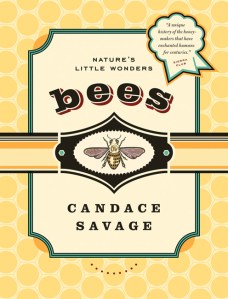
this is not a review — nature’s little wonders: bees, by candace savage

“The life of a bee is like a magic well. The more you draw from it, the more there is to draw.” ~ Karl von Frisch

—A beautifully made book of satiny semi-gloss pages, colour photos, drawings, side-bars rife with fascinating facts, bee lore and poetry. Co-published (2008) by D&M Publishers (Greystone Books) and David Suzuki Foundation.  A joy to read. And important too. [Excellent gift idea. The bees will thank you. Which, in turn, is good for us human bee’ns.]

Here’s but a few things I learned from its delightful pages

Bees evolved from wasps.

They are herbivores, sting only in defence; raise young on protein rich pollen while wasps are carnivores, sting for food; eat other insects; also like people food [especially mine].

There are currently 16,000+ species of bees, ranging in size from that of a fruit fly to half the size of a human palm. (4,000 species in N. America)

A colony is about 300-400 bees of which most of those are worker bees.9781553655312
All worker bees are female; they live 60 days or so, except for those born late in season, which will spend a winter in the hive.

Only a few males are produced in late summer for one purpose: to mate and thereby produce fresh queens for the following year.

After the once-in-a-lifetime mating spree, the queen has enough sperm stored in her body to fertilize each egg she lays. Fertilized eggs become female (worker bees). Unfertilized become male (drones).

A Queen bee lays eggs (1,500 each summer day/ half a million in a lifespan of two years) while worker bees help raise successive broods of females.

The eggs are fed and raised by the female worker bees. Only a very few are reared in special areas of colony and fed the ultra-nutritious royal jelly, which allows them to grow into queens, i.e. egg layers.

Worker bees know that it’s time to raise a new queen (i.e. feed the royal jelly) when the current queen’s pheromones no longer predominate in the hive.

Drones die immediately after mating, or are killed. [I’ll spare you the gruesome details.]

Bee stingers don’t get stuck in bee flesh the way they do in human flesh. So they ‘can’ sting one another to death. [see above… but this is merely one method of getting rid of unwanted drones]

Honeybees can see colour.  [The book outlines how this was first shown by placing a bowl of sugar water on a square of blue paper. The bees, of course, were attracted to the sugar. Then the bowl was removed and the blue square moved to a different position among several grey squares. Didn’t matter. The bees still went to the blue square.]

The book cites the work of Karl von Frisch, A Nobel Prize winner for his research on the honeybee, and Martin Lindauer, a student of von Frisch, and a renowned bee expert in his own right. Of Lindauer, Savage writes:

“Through the glass walls of his observation hive, Lindauer could watch the workers as they scurried around performing their household tasks. Here, bees were cleaning out vacant cells in preparation for reuse, by removing old cocoons and re-coating the walls with wax. Over there, others were poking their heads into occupied cells, the ones with grubs in them, to check on the larvae and see if they needed to be fed. (According to Lindauer’s data, nurse bees inspect each larva, on average, 1,926 times during the five or six days before it makes its cocoon but feed it on only 143 of those visits.) Elsewhere in the hive, bees were busy building comb, capping comb, packing comb with pollen. Tucked away in a quiet corner, an individual might be flicking a droplet of nectar in and out on her tongue, waiting for the honeyed glob to thicken. At the same time, others were fanning their wings near the entrance, for cooling or ventilation, or standing guard in the doorway, with their forelegs raised and their antennae up, at attention.”

Lindauer noted that bees are hyper aware of various stimuli, changes in temperature, texture, taste, and instinctively know how to respond or communicate direction to others. When he inadvertently put a heat lamp too close to the hive he noticed the bees stopped foraging for pollen and collected water droplets instead to flick into the hive for a cooling effect.

Savage addresses the issue of colony collapse and other problems we’ve contributed to, while noting that “Bees [bring] sweetness out of chaos. Humans, on the other hand, [seem] to have an instinct for devastation. Could it be that these insects have something to teach us?”

And this, perhaps my most favourite morsel of all:

“Unlike human groups, which often seem less intelligent than the individuals who make them up, a swarm of bees is always smarter than the sum of its parts.”
American_foulbrood_honeycomb_drawing

today’s walk

Uneventful.

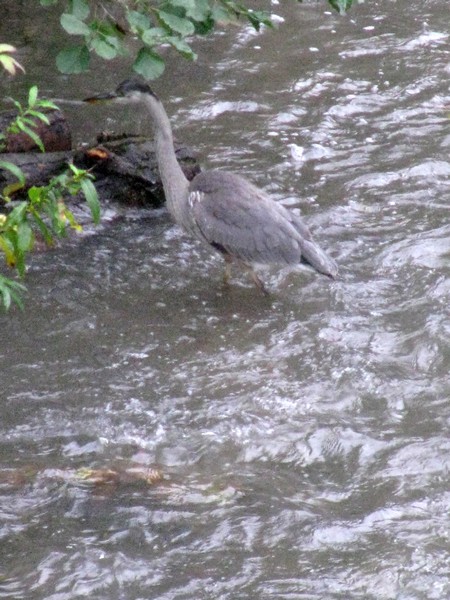
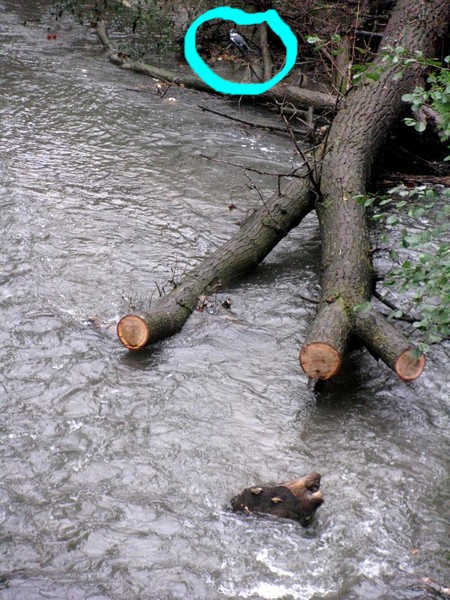
Except for the daring blue heron that wades in the creek up to its icy blue thighs, and the black and white bird that watches from an overhead branch. No idea what it is. Magpie?  But we don’t get those here… I haven’t seen one since Edmonton in the eighties when everything was a revelation. I had a friend there who grew up on a dairy farm so we spent a lot of time in the country. That’s where I learned that magpies aren’t exactly the most beloved birds. Also, that you can drink directly from a cow. No middleman or cartons required. This was big. I didn’t believe it at first. Could not fathom that a tin bucket in the kitchen was what I was meant to ladle milk from for my Cheerios. One afternoon I took a walk in the back forty, picked some flowers, brought them inside, found a jar and filled it with water, a gift for the dinner table. When my friend’s mother came in she said Where did those stink weeks come from? It’s true that there was a very distinct and un-gift-like odour in the room… I’d assumed it was the fermenting milk.
IMG_4152IMG_4154
But today’s walk.

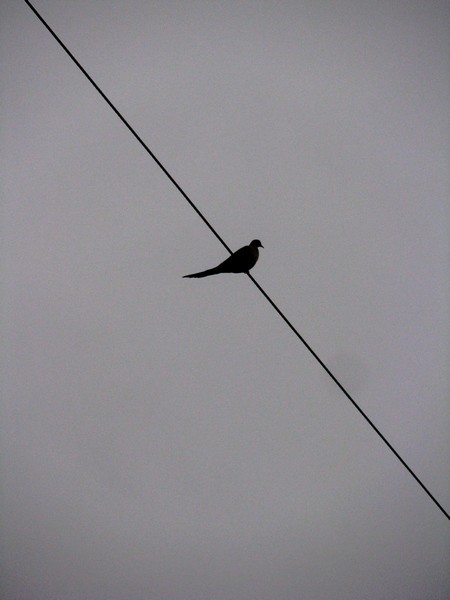
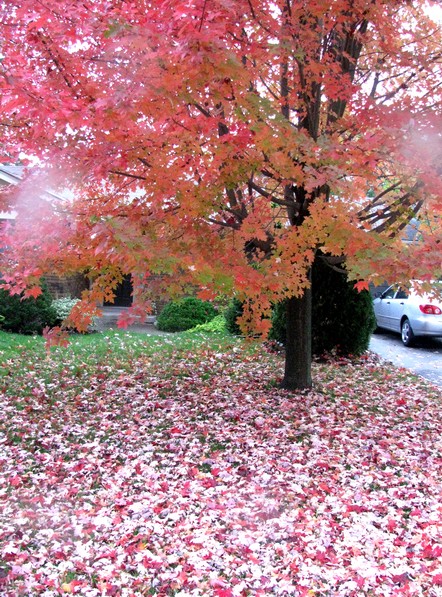
Uneventful, except for the above and a dove too— just because the sight of them always makes me happy. They needn’t be doing anything and they usually aren’t; something about their shape pleases me, the way they look to the left, the right, left again, as if always curious, forever surprised at the sameness of things. And a blackbird soaring above yellow and crimson leaves, circling and dipping and dipping some more, just because it can. A sparrow hiding under a Toyota Camry, or maybe just keeping out of the rain.
IMG_4156IMG_4158
And a man in his eighties, wrinkled from laughter, bright-eyed and sprightly, carrying two logs from the back of a house where I hear a chain saw working. He tells me he’s looking for volunteers to help… I tell him I’ll help him look, send them all his way. I circle the block and when I pass his house again, he’s there carrying more logs. He laughs, calls out, says in a wink-wink tone, “You haven’t forgotten where you’re going have you??” I realize the fact that I’m carrying a full shopping bag makes it look as though I should be heading home with my groceries, not strolling about the neighbourhood. I don’t tell him the bag is full of litter… I’m simply pleased that I’m finally worthy of insider status to an octogenarian’s joke…
IMG_4160

on a morning like this

When you wake up all grumpy and don’t feel like taking a walk because you’d prefer to wallow in grumpiness and toast but then the sky’s like this…
IMG_1524 - Copy
and you can never argue with a sky like that. It always wins.
IMG_1028 - Copy
So you put on your sneakers and you walk.
IMG_1422
Until it occurs to you that maybe you’re walking a little too fast…
and thinking too much about your grumpiness and not enough about the sky, which is still there but changing every minute…
IMG_1522 - Copy
along with everything else.
IMG_1515IMG_1511IMG_1540IMG_1517IMG_1420 - CopyIMG_1541IMG_1544
Until… and, at last, you wonder where grumpiness goes when it’s not being used.
IMG_1519

trashy spring thawts

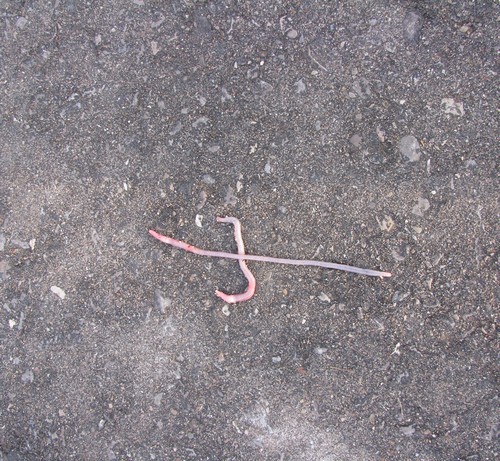
Who would be a worm? Such a thankless job. Having survived all winter in frozen ground with slim pickings food-wise only to be lured to the surface by a splash of springtime rain then end up stranded on scratchy bits of pavement as sun shines and feet and wheels are everywhere carelessly about.
IMG_1163

Worse, though, to be forgetful. Worm or human. To not have the sense you were born with. What else but a dose of dementia or dangerous daze could explain how it’s possible to find a lovely place for a cup of something and then wander off without it? Alas, beware, poor sweet forgetful soul! There are brick walls and open manholes out there…
IMG_1164

But the saddest thing of all must surely be the human who lives the sort of life where four large bags of garbage every two weeks cannot contain its rubbish so it must sneak under cover of darkness to public receptacles where it crams its excess…
IMG_1166

…forcing purveyors of said receptacles to take action with locks and smaller entry points. IMG_1162
(This of course does not apply to worms as they are clever enough to eat their own detritus.)