this is not a review: join the revolution, comrade, by charles foran

Charles Foran’s ‘Can’t Think for the Racket’ is a stunningly lovely essay on the moment a writer finds the courage to use their own voice. The moment when you realize that the truth of what you want to say comes not from your head or how clever-clever you are or what you’ve learned, but from an ability to notice the precise colour of juniper berries after a rain, or tap into some deep awareness of every experience you’ve ever had and translate that into what a bar of dark chocolate tastes like on a warm day in September.

Or whatever.

The berries and chocolate are mine. Food is my portal. Foran’s was music.

He wanted to play guitar but it didn’t go well; a musician friend tried to help by saying that to really get music “…no thinking was allowed. Whatever you do, don’t think. Whatever you decide to play, don’t ponder why you did it. For sure, whatever you are feeling—ah, feelings, again—don’t fuss or fret or worry about figuring it out. Don’t figure anything out. Just play.”

Despite himself, words were more this thing and eventually he found himself wandering about listening to the rhythm of language, trying to force what he heard onto the page.

While the friend’s advice stayed with him he didn’t really understand the message until he was living in Ireland, working as bartender, trying to capture the lingo, the music of the Dublin dialect, repeating descriptions he’d heard of wankers and omadoons and writing about their devotion to U2 and Thin Lizzy in a manuscript where the narrator is a Canadian working in a Dublin bar among characters— “wankers and omadoons who thrashed to U2 and Thin Lizzy…”

One day while he’s busily writing this dross, a piece of music, for whatever reason, offers up a moment long enough to replace the square peg in a round hole effort of trying to get all that ‘external’ stuff, all that thinking, down.

“One afternoon I put down my pen at the opening notes of a reel played on solo flute. The musician had the breathy style I associated with prog-rocker Jethro Tull. From the start, the music was fluid. I turned up the volume and watched through the window as a weather formation, stately as a regatta, floated out into the Atlantic ocean to the melody, wisps of angels’ breath scurrying along the margin between earth and sky. A second reel merged from the first. Now the flutist was adding ornamentation–triplets and trills and grace notes. Certain notes were stretched and held. Others were blunted or bitten. All manner of non-thoughts flashed through my mind while I listened and watched. everything seemed in motion, in flight; everything seemed at once exact and permanent, fleeting and evanescent. Like the weather. Like a young Canadian in a school house in Galway.”

And there it is. The moment beyond which a writer can never again not ‘know’ when their work is hitting a false note. We may try to fool ourselves into thinking it’s okay, that no one will notice, that the darlings are so effing cute they’ll make up for any weak areas—but no matter what tricks we try to play on ourselves—after The Moment there’s no going back. We will know when our work sucks and when it sings. (We may not know how to fix it, of course, but that’s another thing entirely.)

The piece ends with a quote from Northrope Frye that Foran had clipped and kept since his university days, proving his connection to rhythm and language from the start, but words that only now, decades later, sink in: “If the music of  a sentence is right, the sense will take care of itself.” 

Seems it’s all about listening. Not thinking.
But then, so much is. When you think about it.

excerpts from the essay ‘Can’t Think for the Racket’,  from the collection Join the Revolution, Comrade, Biblioasis, 2008

~

From the Re-Run Series: orginally posted in February, 2011.

i’ve got mail…

An especially nice delivery today included the gorgeous piece of always-art that is The New Quarterly, issue 121—reason enough to stop everything, boil some leaves and find a comfy chair—but this issue also features a [new] novel excerpt from the smart and funny Michelle Berry

[Note to self: brew extra big pot of tea.]

Also got three lovely chapbooks, ordered through Alberta Books after hearing about their literary salons. Events are intimate gatherings of twenty or so in private living rooms throughout Calgary—not designed to sell wagon-loads of books, but rather to appreciate words in the best way: with others who appreciate words. Each chapbook, simple but beautifully presented, is signed by all contributing authors, who vary from established to emerging and include, among others, Aritha van Herk, Jeramy Dodds and Betty Jane Hegerat.

What I love best is the nod these salons give to perhaps a more elegant past when life was possibly a bit slower and the world definitely a bit smaller and the pleasure of one’s company was what it was all about.

And the word ‘salon’.
I just love that word.

 “Mohammed told me that Palestinians are born knowing how to sling a stone. He joked that West Bank boys emerge from their mother’s womb swinging their umbilical cords over their heads. I stood behind the shabaab, afraid of being hit by an errant rock, and watched as they co-opted King David’s weapon against his own heirs. Some wrapped keffiyehs around their head to hide their faces, but most didn’t bother. The rain slickened cheeks too young for beards, and soaked through their blue jeans. Slings dangled from pockets like something cool.”  ~from In the Shadow of the Wall: Travels Along the Barricades, by Marcello Di Cintio (to be released by Goose Lane Editions in Fall, 2012)

More Mail:

art lesson

pocalogging to my own tune

dear mr. postman

the reason i like mail

so the money thing… it’s not just a rumour??


Advertisement for the Palmer Institute of Authorship, from which a “free typical lesson package and book: The Art of Writing Salable Stories”, can be requested by mailing coupon to: 1680 N. Sycamore, Desk GD-16, Hollywood, CA.
~as seen in Astrology Guide, Vol 19, No 1, Jan-Feb 1956

Now then, should there be even the slightest doubt about the validity of writing programs offered in the front pages of astrology magazines… please consider a testimonial from J.G. Doar, whoever he may be: “After completing only the first few lessons I felt I knew what a short story is. My success will not affect my study of the Palmer Course.”

If that isn’t enough to convince the cynics, there are other devotees—equally giddy, confident and obscure in their success. (A.B. Aretz anyone?)

Had the Palmer folks been really smart or, better yet, prescient, they’d have asked for a few words from a young Raymond Carver who was among those that sent away for the package— and also came to know what a short story is. More or less.

(Though they did get one from A.E. Van Vogt, who claimed the Palmer course was a milestone in his career, after which his entire income, he said, was made through writing.)

[Incidentally, the man in the photograph above the caption: “Famous Author Praises Palmer” is Howard Hughes’ brother, Rupert Hughes.]

Interesting times.

read me a story… no, wait, don’t

“Readings can be tricky affairs,” Irish author Aidan Higgins wrote. “There’s nothing more calculated to cause a gritting of the teeth, a shudder of the spirit or even a rising of the gorge than to be voluntarily confined in a Function Room to endure an hour-long ranting by the author in person, of predigested matter now regurgitated, delivered in a monotonous drone. It is enough to make a cat laugh or a dog throw up.”

So begins a piece by Douglas Bell in Saturday’s Globe, in which he goes on to wonder why readers “…who experience the writer’s work as an entirely private matter turn out in such numbers to experience it again as a public performance?”

Good question, though I’m glad they do. While it’s true that a bad reading can make you look around for something tall to jump off, a well executed one can be great fun, enhancing the private read and giving another dimension to the work. Also, not everyone at a reading has read the book; for many it’s their introduction. This is a good thing, no? People who haven’t read it are likelier to buy it. Which is why I can’t understand authors who don’t make the most of these events by making it an event rather than a dry reading. How hard is it to offer up a little background to the story, for instance? A bit of chat. A merry anecdote or two about the research or the way such and such a character wouldn’t take no for an answer. Anything.

Granted, public speaking and/or reading is an art and some people are just easier with it than others (recently heard Claudia Dey ‘do’ How to Become a Bush Pilotnow there’s an event; and the first time I heard Ann-Marie MacDonald, well, you forget she’s reading, you think you’ve bought tickets to a one woman play) still… readers seem to fall into three categories.

1/ Naturally brilliant (usually meaning they’ve taken the time to prepare and treat the whole business in a professional manner even if they appear ultra casual).

2/ Naturally enervating (often due to an over-infatuation with one’s own voice).

3/ Naturally somewhere between brilliant and enervating (a tolerable scenario, but why not, with just a soupcon of effort, be so much more… I mean we can all read the stuff ourselves… what the audience wants is not to hear the words but to experience the book through the experience of the author).

I say all this as if I know what I’m talking about. As if I spend my days poncing about entertaining the masses. Pay no attention. Just random thoughts on how maybe to enhance a fairly essential aspect of the The Process, for both reader and listener.    

Additions to the list would be welcome!

—  use a mic if you’re a soft speaker or if the room warrants it; it’s a rotten business to have to strain to hear

—  unless you’re reading a whole short story (in which case, dear god, please make it short) let the audience know a bit about the overall premise of the piece/book

—  best not to read the dullest bit even if it has the cleverest words; action is good, humour is best

—  mark up places to pause, and then pause there (you will not come off looking like a dork, honest)

—  slow down; however slowly you think you’re reading… slow down

—  preface and/or break up the reading with those afore-mentioned bon mots and asides to the audience

— leave time for questions, and have a few favourites from past readings that you can share to get things started

Finally, as an audience member, pack a few general questions— even if we haven’t read the book we can ask about the subject matter, or what inspired the writer to begin the project. It’s always so painful when no one raises their hand for the first five minutes. Heart-breaking if it goes on any longer.

Happy reading, happy listening.

Let’s see… I think I’ll start with the bruschetta…

the power of retreat


The bay window of a friend’s Muskoka kitchen.

Giant black Newfoundland pup snoring by the back door. Green tea.

No one else around. I sit on pillows, watch blue herons flaap flaap by; a black squirrel travels down a long path, jumps onto the deck of the boathouse, peeks around the corner, realizes it’s a dead end, not to mention a poor place to hide nuts. He comes back up, disappears. I have some tea, open the book I’ve brought. I have two hours to read before I need to be anywhere. I close the book. Reach for a stack of typed pages—the chapter I’ve been working on for a month and which somewhere along the line has turned into cement, an ugly confusion that just stares back at me, obstinate, exactly what you’d expect from cement. I should throw it out but I have optimistic moments when I think there’s something in there—I just don’t know where, or how, to make the crack to let it out.

I reach for the book again.

The squirrel, the herons, are gone. The view remains. My tea is cold but still good. I put the book down and my hand reaches for the typed pages even as part of me shouts You fool… you’re about to waste two perfectly good hours in Shangri-la on GD cement…

I make notes, draw arrows. I jot “Insert A”  then write a scene and call it A. I find B within the existing mess. Then C. I mark it, move it to a better place. The dog is still snoring as I re-write what becomes D, and find E. I print “Insert E”. More arrows. And then, checking the clock, I jot a final scene and christen it F and I know—despite the tangle of lines and notes, inserts and cross outs—that a bouncing baby chapter has been born.

I’m stunned at first, that I could do in two hours what I hadn’t been able to crack in weeks. I’m inclined to put it down to the view, the solitude, the drowsy dog—all of which is great, all of which has set a mood—but it occurs to me that what is really powerful is the way my friend’s house makes no demands of me—how my thoughts are allowed the freedom to just ‘be’.

Because, truthfully, I have peace and solitude at home also. But laundry winks. Floors scowl. And the squirrels don’t mind their own business on long paths, they knock on windows and complain that they’re out of bird food. I can work at home of course—it’s where I’m happiest—but sometimes what’s necessary—for clarity, for permission to colour outside the lines, the courage to smash the cement… not merely find a ‘crack’—isn’t the familiar, but the bountiful disentanglements of  ‘away’.

That, and an unfamiliar window.

today’s colour

Another reminder this morning of how closely linked are the processes of gardening and writing—all that pruning and timing and structure-is-important-or-the-whole-thing-goes-to-hell-pretty-quickly-no-matter-how-nice-it-looks-when-you-plant-it.  Not to mention the yanking of weeds, watering, muttering about what needs to be moved, propped up, filled out, eliminated. Deadlines. Frost warnings.

It never fails. I go outside to air my brain, get away from the pages but they follow me and what I end up doing in the garden turns out to be some parallel version of what I’m working on at my desk.

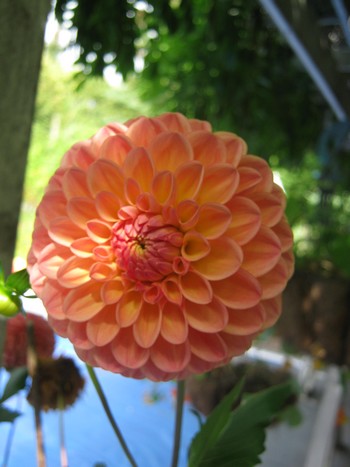
So this morning, after cleaning up some edges along a stone path, I decided to do a colour post; I was taking pictures of red things, tomatoes, bee balm, unripe blackberries, but none of it was grabbing me. Then I noticed the nasturtiums and they looked nice so I changed my focus to orange. I had no idea how much of it was out there, hadn’t seen it til I started looking (to my surprise, I was even wearing an orange shirt). I took these pictures then went back inside, inserted an orange scarf into a scene I’d been struggling with and, well, not exactly presto—there’s much more to write—but it changed the direction of the whole chapter for the better.  It was the colour, the ‘orange’ that did it: a red scarf, or blue or green, wouldn’t have worked. And yet I couldn’t see it…

Weird.

And wonderful.

Moral of the story: air your brain.   [and when all else fails, employ scarf trick]

stars, eggs, editors, and other bright lights

Must be the way the stars are lined up. Or something. February’s darkness and promise of light? The way the snow crunched under my boots this morning? A perfectly poached egg?

Whatever it is, I’m full of the joys today.

Could be that I’ve begun serious revisions on the ms with the help of a freelance editor—whose help I should have enlisted moons ago. But one has to be ready, there’s marinating time, other things to be written and (thank god) published in the interim. Other games to play.

‘Games’ as in both politics and pure fun. The first is a given, everyone’s up to their necks in that, but the second, the play, the lightheartedness that allows for pleasure in the ‘process’—that sometimes gets overlooked, shoved aside for later. And when later never comes Jack turns into such a cranky pain in the butt.

And yes, I know, I know, the sky is falling over publishing, and true, the industry may not be perfect and the work may sometimes feel like dancing in cement and no one understands us or treats us with respect…wah wah… but jeezuz, would you really rather be doing anything else?  

Here’s what I’m saying: there’s altogether too much grumbling out there.

My ears and eyes hurt from it. I’m thirsty for positive thinking. Maybe we could look at the problems as opportunity?? A new world to embrace, even be enthusiastic about, rather than cynical and bitchy. Some very novel things happening on this front, as revealed over at Book Madam.  More of that please. Constructive action, not whinging, is what we need.

Let’s talk about what works, celebrate the good stuff—because it’s happening out there. Just maybe not to the naysayers. Or not at the moment. Or maybe it’s happening and they’re just not seeing it because they want what the other kids have. Wah.

So much is perspective and, granted, on another day in another mood, I might not be writing any of this. But today I’m feeling (annoyingly?) perky.

Truth is much of my current perky joyful positivity has to do with good news received by two writerly friends in the space of just a few months. 

No one is more surprised at how their success has added a zing to my own spirits.

The first is Steven Mayoff, whom I met at a workshop a few years ago on the beautiful shores of PEI and whose short story collection Fatted Calf Blues was not only short listed for the ReLit Award, but went on to win the PEI Book Award. The second, a former Humber classmate, Darcie Friesen Hossack, whose (also short story collection) Mennonites Don’t Dance has just been short listed for the Commonwealth Prize.

Egad. I should be knotted up with envy and bitterness, no? Both Darcie and I had work nominated for the 2009 Journey Prize, neither of us made the cut. She went on to make a book. I’m still revising. I should be asking myself: why am I still revising? But oddly, I’m euphoric rather than frustrated. Could be symptoms of a mania, but actually, I think it’s more honest to god joy that maybe the sky isn’t falling. That good things— yes they do!—still happen.

The bonus is that when they happen to really good people, it’s impossible not to be thrilled.

And revelling in the success of others, it seems, is not only good for the soul, but for the writing. An inspiration and a happy reminder that anything is always possible.

As for me, sir, I’ll take my pleasure anyplace I can…

~

…the confines of the mediocre

“… At that time I was sharing two rooms and a hip bath with the actress Vicky Licorish. She had no money, I had no money, we could not afford the luxury of a separate whites wash and so were thankful of the fashion of coloured knickers which allowed those garments most closely associated with our self-esteem, not to be grey. Dinginess is death to a writer. Filth, discomfort, hunger, cold, trauma and drama, don’t matter a bit. I have had plenty of each and they have only encouraged me, but dinginess, the damp small confines of the mediocre and the gradual corrosion of beauty and light, the compromising and the settling; these things make good work impossible. When Keats was depressed he put on a clean shirt. When Radclyffe Hall was oppressed she ordered new sets of silk underwear from Jermyn Street. Byron, as we all know, allowed only the softest, purest and whitest next to his heroic skin, and I am a great admirer of Byron. So it seemed to me in those days of no money, no job, no prospects and a determined dinginess creeping up from the lower floors of our rooming house, that there had to a be a centre, a talisman, a fetish even, that secured order where there seemed to be none; dressing for dinner every night in the jungle, or the men who polished their boots to a hard shine before wading the waters of Gallipoli. To do something large and to do it well demands such observances, personal and peculiar, laughable as they often are, because they stave off that dinginess of soul that says that everything is small and grubby and nothing is really wroth the effort.”  —from the Introduction to Oranges are not the Only Fruit, by Jeanette Winterson.

the reason i like keeping old notebooks

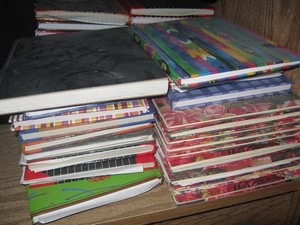
Well, there are several reasons. Not the least of which is that I can open one willy nilly from the dusty pile under my desk whenever I like and find odd things written inside that alternate between (only to me) mind bendingly brilliant, to (only to me) amusing bon mots, to… what the?

I posted an example of the latter on my ‘other’ blog recently. No flipping clue what any of it meant. But it did amuse me and could very well be brilliant.

Or… ahem…uh, not.

The thing is even if there’s no apparent purpose, if all those words from all those years ago amount to meaningless dreck, so be it. The fact is that they were written, jotted, recorded with intention. There was a message, an impression to share. And maybe it’s the sense of that ‘something’, more than the specific, that resonates. There’s pleasure and even welcome discomfort in stumbling across that kind of rawness in ourselves—like a piece of us that we choose to forget but that, at some level, still exists.

Not everyone feels this way. A friend of mine burns her notebooks at intervals, doesn’t want to be reminded of what she thought was important then. I understand wanting to avoid the cringe factor, but still, I think she’s missing something.

Anyway, after having that bouncing round my head for the past few days, this morning I opened a new old notebook and the first entry was this—a quote by Mr. Housman:

“The reason the words can have such a physical effect as to raise the hair on one’s neck is because these words are poetry, and find their way to something in us which is obscure and latent, something older than the present organization of our nature.”

Not that it has anything to do with notebooks. But to which I still say yeah.  
~

can we ever stop comparing??

In last Saturday’s Toronto Star, Karen von Hahn wrote a piece suggesting—no, stating—that not only does Chicago sit “smack dab in the middle of the North American continent” (by the way, it doesn’t), but that its music, architecture, shopping, dining, general amusements, and occasional citizenry are superior to Toronto’s. 

Oh why bother I say…

I’m just so (yawn, yawn) tired of the endless comparing ourselves with anyone; it’s a bad, silly, and negative thing to do. And serves zip purpose. Except of course to encourage people to take sides and engage in conversation, which is always divine. So, okay, well done and thank you, Ms. von Hahn, for that, for igniting some small debate at this end.

My response (which ran in yesterday’s paper—for some reason without my final comments re Winnipeg) is as follows:

Re Karen von Hahn’s “Chicago wins style smackdown”— Sat., Oct. 9th/2010

Sigh. Not again with the comparing. This is so tiresome, and ultimately pointless. Fine, fine, Chicago has a brilliant waterfront and a few things Toronto doesn’t have. So? Do we really want to be like Chicago? Are we meant to come back from every little sojourn bleating and mewling that Pisa has a tower that leans…why doesn’t ours? And why aren’t we like Stockholm or Reno or Santiago? Why can’t we have Ayres Rock?? Seriously, do we really care that there’s no Barney’s on Bloor? Is that how low we’ve sunk that we define our style by some other city’s retail spaces?

In any case, if we must make lists, may I suggest the article missed a few key things. Like beaches, parks, the islands—the wisest minds may not have been at the wheel when configuring the waterfront, but we do have some spectacular green spaces right in the middle of our city. And true, we don’t have ‘Chicago blues’ but neither does Portland or Berlin. We do, however, have Caribana, the Pride Parade, the Toronto International Film Festival, to name but an easy three.

As for the Shedd Aquarium ‘equivalent’ Ms. von Hahn says “we’re still waiting for…” —we are? I’m not waiting. Is anyone waiting for this? Frankly I’m very proud we don’t have an upscale Marineland in our midst. This is style?

Ms. von Hahn says Chicago has Oprah and Obama. Yes but we had/always will have Jane Jacobs. Now there’s style for you. And she chose to live here. Imagine that. Especially when she could so easily have returned to the States, moved to, oh, I don’t know… Chicago maybe.

Ms. von Hahn suggests these comparisons matter because great cities attract great leaders, or vice versa. The implication being, I guess, that Chicago’s had some good management in the form of a “mayor with a vision for positive and stylistic changes, and the power to make it happen”. Maybe so, but not until they clean up the mess that is Chicago’s west side or the south side’s Englewood, will I covet what they’ve got.

And probably not even then because everything’s a package—the good, the bad—and I’ll take Toronto’s good along with some of its bad—including an opera house that lacks a piazza—anytime.

Finally, and if nothing else I’ve said changes your perspective one iota, please, please, Ms. von Hahn, get this straight: Chicago is NOT the centre of North America. That distinction—you will find if you only press google—is Winnipeg’s.

~