—Writing from a garret in London, Ontario.
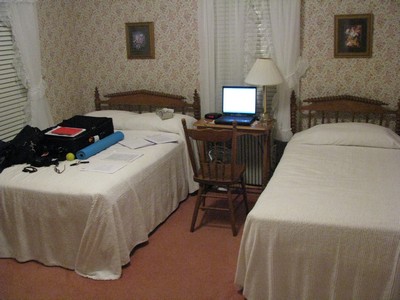
8a.m.— Gorgeous golden day. Huge trees outside the window. Blue boxes line the street. Yesterday when I arrived, I shoved two arm-less arm chairs together to make a sort of chaise lounge in the 3rd floor bay window alcove, then wrote like mad. It’s quiet here, the only sound an occasional car, glass and tin cans being dumped, and there’s very good food in the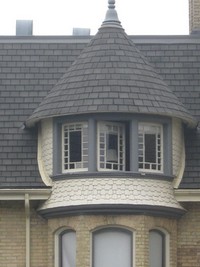 restaurant downstairs (I recommend the mixed greens with dried cranberry and pistachio, and goat cheese/yoghurt dressing), a porch also for contemplating, which I did some of after lunch. Mostly on the colour grey. Surprising results.
Today I’m devoting time to reading Emma Donoghue’s Room, which I brought with me not knowing that Ms. Donoghue lives in London, Ontario. Possibly in a garret?? It doesn’t say on the jacket. Anyway, I found that a strangely lovely coincidence.
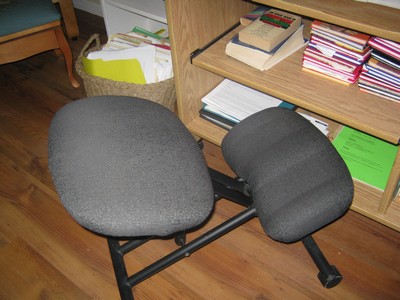
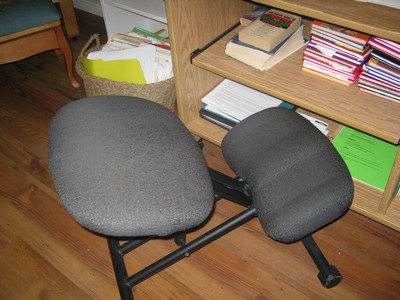
So because I’m out of my usual routine, and am using a keyboard that is driving me slightly bonkers, I decided that instead of trying to write one coherent post I’ll write several small incoherent ones throughout the day—a sort of real time account of reading progress and life in the garret generally.
Have only just begun the book and, although the rhythm takes a minute to get used to, I’m thoroughly enjoying the narration by a five year old as he introduces us to his world and to his mother.
“I still don’t tell her about the web. It’s weird to have something that’s mine-not-Ma’s. Everything else is both of ours. I guess my body is mine and the ideas that happen in my head. But my cells are made out of her cells so I’m kind of hers. Also when I tell her what I’m thinking and she tells me what she’s thinking, our each ideas jump into our other’s head, like colouring blue crayon on top of yellow that makes green.” (—from p.10 of Room)
While this perhaps should leave me doubting that a five year old can put things into terms that involve cells, it doesn’t— it just leaves me looking forward to finding out how he can.
“Bunnies are TV, carrots are real…” (p.17, Room)
9:15 a.m.— A man walking three dogs on three leads passes a woman walking two children on two leads. Honest to god.
11 a.m.— On the street opposite my window a black cat and an orange cat have been playing together for hours. They cross the road together, jump on stone walls together, stand around the sidewalk, then run off and disappear for a while, together, then reappear, at first just the black and then seconds later, the orange. Seems there’s never one without the other. It’s a very nice little vibe watching them. When do you see anyone, kids even, so consistently, without argument, for this long, enjoy each other’s company? Must take a walk later, have a closer look, maybe say hello.
1:30 p.m.— Smoothed out some wrinkles in the final chapters of the WIP. Celebrated with perfectly cooked Arctic char in mustard and cider reduction, and arugula salad. Am enjoying this garret life.
2:30p.m.— For Jack, the boy narrator of Room, having a grasp of what cells are is the least of  his accomplishments (see 8a.m. entry). He’s a little genius who, literally, lives in a world ofhis own making and with the help of his twenty-six year old mother, who’s spent the past seven years living in the trumped-up and sound-proofed garden shed of her abductor, Old Nick. Because of her, Jack has a better grasp of reality, however unreal, than most people. She has, it seems, taken enormous strength from the need to protect and nurture and teach him, in turn, to be strong. Together they’ve invented dozens of games using ordinary objects or just their senses and words. They have rituals and traditions and rhythms to their days. He trusts her completely and is shocked and frightened when he learns that she’s hidden some chocolate to keep as a surprise for his birthday. If there are “hidey places”, he thinks, then there are places for vampires and bogey men. In such a confined space that would be a very bad thing indeed. Secrets are equally not tolerated.
Because he was born in the room (a stain on the carpet marks the spot), and has seen nothing else (other than TV, which he believes is a two-dimensional ‘unreal’ place) this tiny universe makes perfect sense to him. His mother, on the other hand, is becoming increasingly unhappy, concerned that Old Nick will eventually leave them to die, and begins to tell Jack about the ‘real’ world, about her parents and her life as a child. At this point I’m not sure if she’s doing it as a gift to him, some new exciting thought to fill his mind, or a way of consoling her own grieving self.
“Stories are a different kind of true.” (p.71, Room)
5:45p.m. A few weeks ago there was some flap about how writing in the present tense was a cheap trick employed by three of the six Man Booker finalists, of which Room is one. It struck me as an absurd discussion at the time, even moreso now that I’m reading Room. The reason—for Philip Pullman’s and Philip Hensher’s information—that Room is written in the present tense is because if it were written any other way it wouldn’t have the same brilliantly creepy effect of drawing us into that place in real time, which is a place we don’t want to go but can’t stop peering into. Perhaps I’m in the minority but I enjoy first person, present. Like anything, it has to be done well, and unlike some possibly ‘easier’ POVs, it’s very hard to do well. I’m guessing Donoghue chose it for a few reasons: 1) the story itself demanded that form, 2) the feeling of being there in ‘real time’ works exceedingly well in unsettling the reader, and 3) there is something almost subliminal about present tense, a kind of tacit reminder that what you are reading did not happen then… but is happening still. And for this book, that’s exactly what you need to feel. For many reasons.
6:15p.m. The orange cat is across the street; I run over expecting to find the black one nearby, maybe capture their extraordinary relationship on film. But the orange is on his own (orange tabbys are always boys). Where’s your friend? I say, and he rubs against my leg, looks up at me and purrs What friend?
So much for my brilliant cat loyalty theory.
10:30p.m. At about the exact middle of Room the thing I expected to happen at the end happens, and I’m left stunned and thinking: how the bleep will the author sustain the next 150 pages?? Well, sir, she does in the most surprising and amazing way, turning our perceptions about ‘freedom’ upside down and having us look at ourselves in the process. And I don’t care if you hold your breath, gnash your teeth or utter vile words, I will not divulge even one more tiny piece of the story, except to say I loved it so very very much—one of those books that begs to be read again, not necessarily to understand better—because the story is simple and clear—but to benefit from its truth.
~