“What is autobiography but everything written around what has been left out?”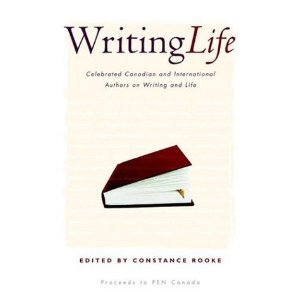
—Anne Michaels, Writing Life, McClelland & Stewart (2006).
“What is autobiography but everything written around what has been left out?”
—Anne Michaels, Writing Life, McClelland & Stewart (2006).
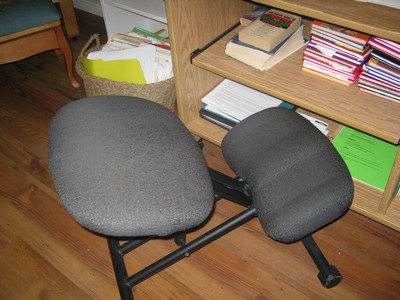
I’m kneeling on a kneeling chair as I write, but I keep sliding off. The chair was recommended to me 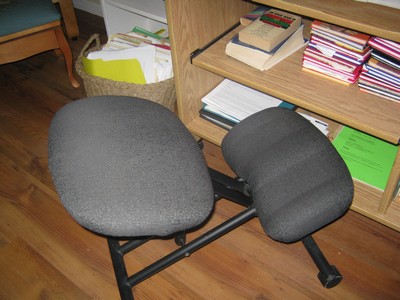 by my massage therapist, Beth, whom I haven’t seen in almost a year—ever since I got the chair, which I got because I slightly screwed up my hip and back from bad sitting habits in my previous chair whose pricey, ergodynamically correct engineering is completely wasted on me given that I sit cross-legged, or with alternating feet tucked under my bottom.
I remember the instructions for the kneeling chair said something like… this chair is not made for extensive kneeling; try to keep most of your weight off your knees and on your butt. Maybe it said derierre.
In any case I’ve never really understood how to work it and am pretty sure I’m doing it wrong because my back and hip still hurt. Also my knees now. Makes me long for the days when my only complaint was excruciatingly tight shoulder and neck muscles that even Beth found shocking.
I’m guessing that a certain amount of ache is part of the territory, that anyone who sits for long periods obsessing about semi colons or whether to use the word ‘car’ or ‘vehicle’ is eventually the beneficiary of a few sore parts and maybe also the owner of a few gadgets to help ease the soreness (heat packs, massage thingies, roller wotsits, cedar blocks for yoga stretches, Theraband bands for other stretches—all of which only work, I’ve discovered, if you use them).
Or maybe it’s just me. Maybe I’m a wimp, or have some unique structural problems. (Actually, least said about structural problems right now the better…)
So I got the kneeling chair and what I’ve been doing is alternating between it, the original chair, and a medium sized Theraband ball, which, when I told a physiotherapist I sat on while working, she laughed, called an associate into the room and had me repeat the story so they could share a professional chuckle.
Despite its apparent effect on physiotherapists, the ball works rather well for me. Furthermore, my chiropractor, whom I also haven’t seen since winter, said it should be fine.
Anyway, moving between these three seats I’ve noticed that—in addition to giving me much needed breaks in my position (because it rarely occurs to me to do anything as simple as stand up and stretch)—I’ve developed a preference for sitting differently for different tasks. For instance, revising is best done on the bouncy Theraband and almost impossible to do effectively on the kneeling chair (which I prefer for composing). Emails are more cheerfully answered, and less often misunderstood, if I write from one of various contortions on the ergo chair, whereas, for on-line reading, I go back to the Theraband. And so on.
Here’s what worries me: at some point will I need a fourth chair?
If so, I’m thinking lawn chair (one of the most brilliantly designed chairs of all time). I’m also thinking spiral notebook instead of screen, pen instead of keyboard… seagull voice, negative ions, beach glass, stones for skipping. Lunch in a paper sack.
In fact that may be exactly what my achy self needs. Not ergo wotsits.
And it just occurred to me—that’s twice in less than two weeks my rambling has led to the same place.
Right. Enough kneeling and bouncing and moaning. I’m off.

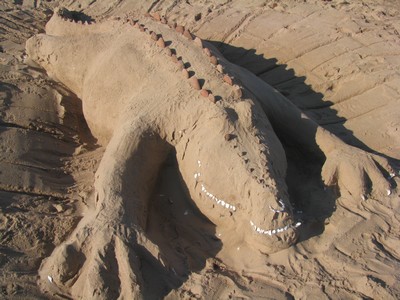
Before the whole summer gets away from me and people start talking about how it’s over the minute the #&@*ing CNE opens, I am printing this and taping it above my desk where its job will be to inspire me often to stand up, find a bucket and spade, head outside in any direction and—for much longer than I think reasonable—let my toes and mind wander where they may.
Thanks for the reminder, Carol…
Coming along, thanks.
However—
 —am hoping it doesn’t have this effect on everyone…
~
Okay, I’m not depressed, I’m glum. Or do I mean gloomy? Or is it just that I’m pissed off that I can’t go to Charlottetown next month to attend what I believe may be one of the best-kept-secret writing retreats in the whole blinking country (and why am I even telling you this ‘secret’??).
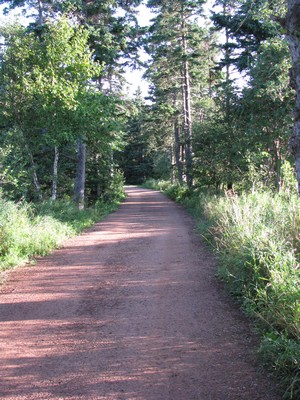
Two years ago I went to the first ever ‘Seawords’ on lovely red- earthed, bucolic, gorgeously peaceful and truly inspiring Prince Edward Island. A province we don’t think nearly enough about, and probably the islanders like it that way.
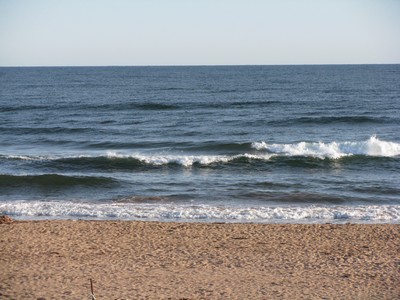
The retreat that year was held at Shaw’s Hotel on Brackley Beach where my days began with a short walk from hotel to ocean—an ocean which I was the only person visiting at that time of day. I mean, I had a whole ocean to myself. Sort of.
 If the waves were big and the surf noisy, I simply sat and stared, took pictures, wrote I-like-it-even-if-no-one-else-ever-will poetry, made notes on the novel, collected flat red stones in geometric shapes.
If the waves were small, or non-existent, I swam and marvelled at the buoyancy of salt water vs the lake brine I’m used to.
After that it was breakfast in a sunny, large-windowed dining room, sometimes with other ‘retreaters’, sometimes alone with a copy of Geist, or TNQ and a large pot of tea.
The workshop facilitators were two writers I didn’t know: Anne Simpson and Carol Bruneau. What an idiot I must have been for not having known them. Anne is a poet who also writes extraordinary fiction and has won or been shortlisted for too many prizes to mention here. Carol (also of the multiple awards) writes extraordinary fiction, as well as a fabulous blog (in the most poetic of ways). Apart from all that, they are lovely lovely people — something you can’t pretend for a whole week in fairly close quarters. That’s the thing about retreats: if you’re not lovely, everyone soon knows it.
Also present was Jackie Kaiser. Yes, that Jackie Kaiser. From Westwood Creative Artists. (It’s like everyone was screened for loveliness and only the genuinely lovely were allowed.) So generous was she with her industry info and her time, whether in a session or when bumping into one another over dinner, readings, on the way back from the beach.  Casual conversations, questions, everything simple and easy. No pressure. No scary stuff.
Ann-Marie MacDonald was also there. As was Lynn Henry (at the time, still with Anansi).
It rained once, maybe twice. Who cares? It was perfect. The beach, the hotel, the workshops, the seminars, the one-on-one time with Anne and Carol. The time alone to think and write in my tiny flowery-papered room; my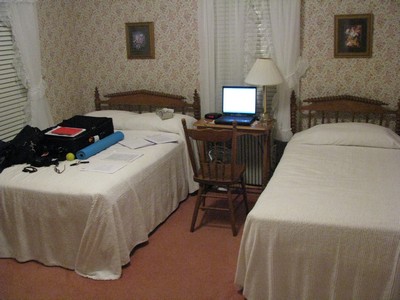 makeshift desk set up in front of a tiny window overlooking the lawns, where I wrote and re-wrote whole chapters I’d been stuck on for ages, and then later, spending time with some terrific people who’d spent their time thinking and writing and re-writing too.
So, yeah. I’m a little cranky that I can’t go this year. Obligations at home prevent hopping a plane or, even better, a car, and heading east for what I know will be one grand week.
I haven’t even mentioned the oysters. 
Fortunately, I do know someone who’ll be attending– so I have at least the vicarious thing to look forward to.
Are you listening, Steve?
Please take notes.
I don’t know why Rona Maynard’s post on pilates and writing should make me think of something I read the other day about Marina Abramovic—the performance artist who recently closed what sounded like a most bizarre and amazing show in NYC, and is known for her ‘experiments’ in art through human nature—but it did. It reminded me of how she said: “We don’t change when we do things we like…”
I love that. I love the idea of how change works and how inherently resistant we are to it and how maybe that’s why it’s so difficult to do what’s good for us. Because change will follow, growth of the right kind. And maybe—what?—we’re a little nervous about the right kind? Maybe we prefer the kind that insulates us and keeps us where we are—gormlessly and endlessly questioning the whole why of exactly that.
Just wondering.
The New Quarterly’s List Issue has arrived on my doorstep and it’s completely gorgeous. (True, my own listy piece is included, but even so, and even if it weren’t, it has to be said: the thing is a work of art—the cover, layout, design.)
And, yes, the contents. Who knew (Diane Schoemperlen, that’s who) that lists could evoke so much and in so many ways?
There are found poems from lists, lists written on the backs of things—regrets on a black and white snapshot from the 50’s—and on a Good & Fruity box, the contents of a pocket enroute to jail. There’s a list of things taken to a nursing home to visit a mother (so simple and stark and perfect it made my eyes water).
A collection of lists found in a large purse; drawings and random jottings; glossy pages of collage, photographs, observations— things that otherwise get missed because they’re tiny and ordinary, seemingly insignificant and therefore don’t merit a whole story—but fashion them into a list and you realize they are a whole story.
The cover art and collage pages inside are done by Diane Schoemperlen (who also guest edited the issue), as is a piece titled ‘A Nervous Race: 22 Brief Notes on the Study of Nature, Human and Otherwise’— which begins:
“This is not exactly a story. It is a construction or a deconstruction or a reconstruction (or maybe all three). I did not exactly write these lines. I discovered them (like a continent), mined them (like gold or coal or potash), unearthed them (like bones), excavated them (like archaeological artifacts), solved them (like a crossword puzzle), deciphered them (like a secret code), erected them (like a building or a flag), organized them (like a filing cabinet or a clothes closet), choreographed them (like a ballet or maybe a barn dance), arranged them (like a symphony or a bouquet of flowers). Let me explain.”
And then she does. And, frankly, if there were nothing else between the covers but this and the collage, it would still be an amazing and beautiful issue.
The launch is tomorrow in Kingston. (Oh to be in Kingston in the Spring!)
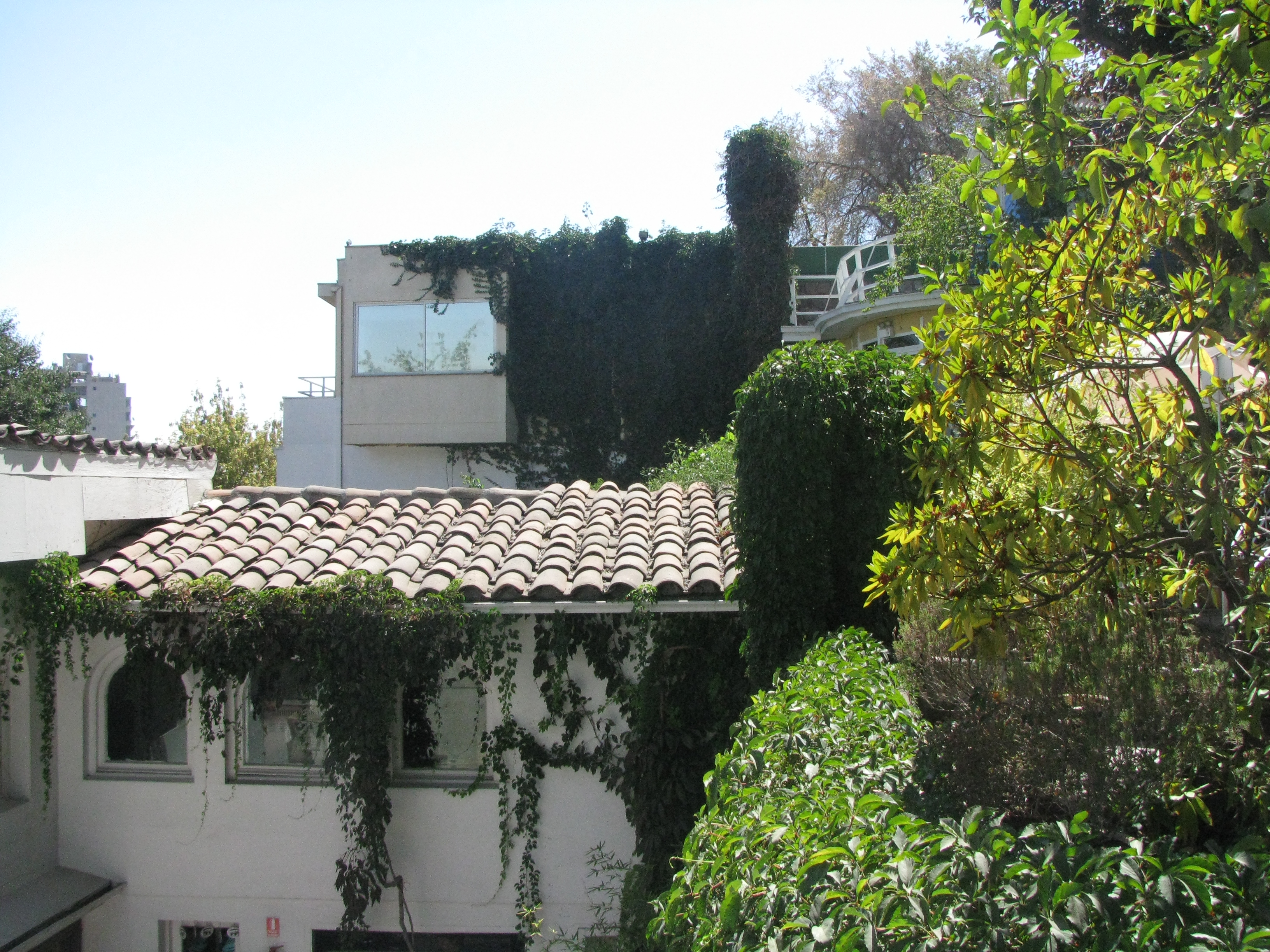
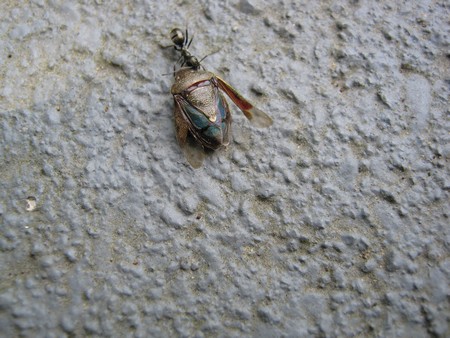
It’s just about noticing, isn’t it? Sunrise, food, insects on a windowsill; temperature, skin before lovemaking, and after. Cloud shapes, stones, the texture of floor, sheets, wine glass against lips. Neruda says something or other is “abandoned like a wharf at dawn”—and maybe because I’m standing in his house when for some reason I think of it, I realize this is how it starts—seeing the wharf, abandoned, or just imagining, finding, comparing, word painting; noticing the shade of blue in the centre of an iris and giving that to a part of the body, a vein maybe; now I look for eyes and hollows in throats among twists of driftwood at certain times of day, in light, then in shadow.
It’s like the the A-Z of butterfly wings; seeing what’s there and naming it something that until that moment doesn’t exist—all of that, in order to see it.
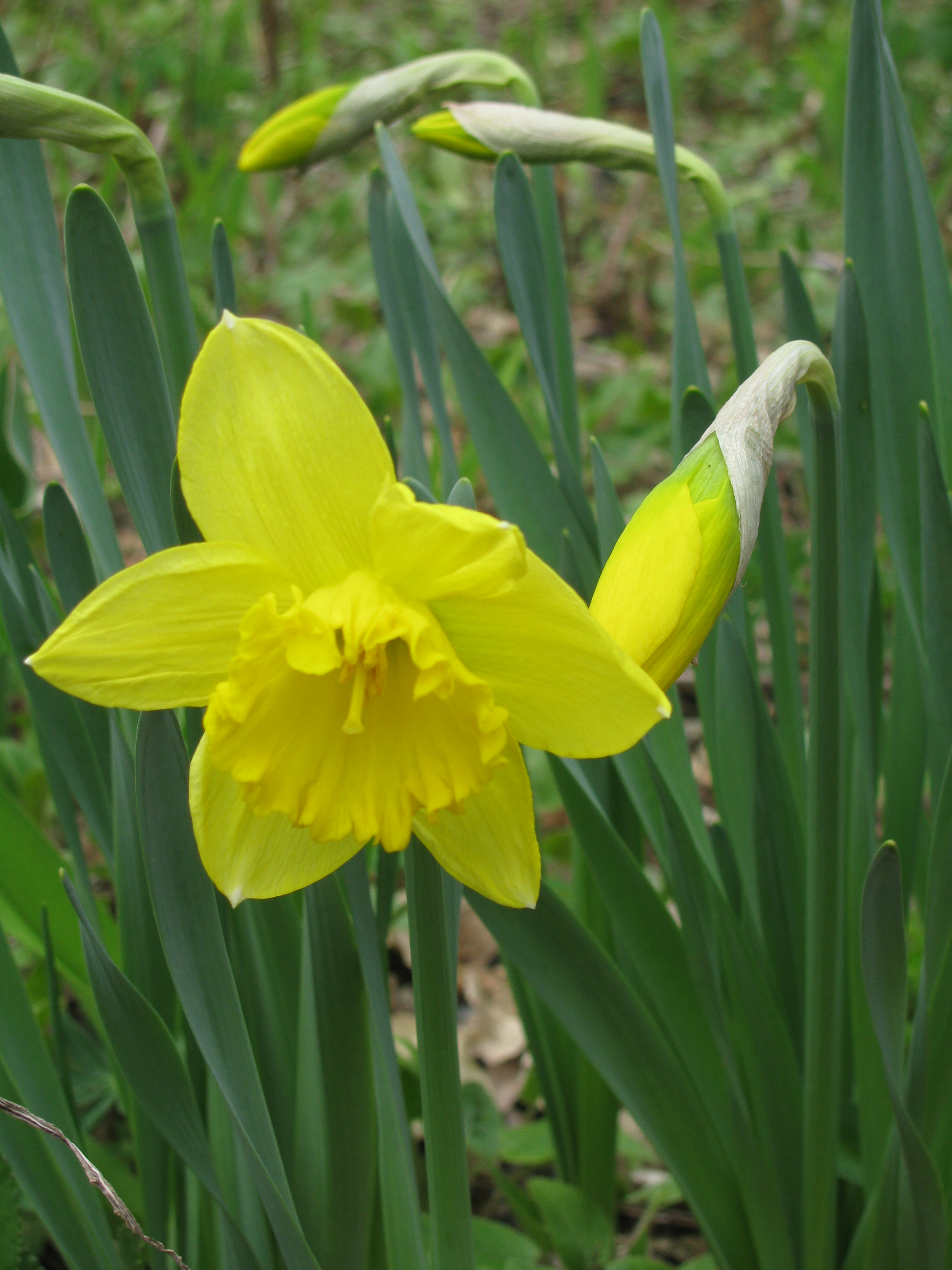
I’ve been reading things recently about not writing as a tool for better writing, which, to me, makes perfect sense given that I believe procrastination (when handled with care) has a valuable (necessary) place in a writerly toolbox. Walks, cups of tea, headstands in the garden, rarely fail to loosen a brain (and a loose brain is a thing of envy indeed).
It’s no wonder then that I so completely enjoyed Nicholson Baker’s The Anthologist where procrastination is the art form.
The narrator, poet Paul Chowder, has been asked to write the introduction to a poetry anthology and for 243 pages he lets us in on every distraction and digression that flits through his head as he avoids doing so.
Or so it appears. In fact, writing the anthology is exactly what he’s doing for 243 pages. The breakup of his relationship, badminton games next door, the comings and goings of a kitchen mouse, are merely forms of life he notices from another plane where he lives and breathes beats and rhyme and the mathematical precision of rhythm. Where everything is light and shadow. Pauses. Enjambment.
What the narrator is actually doing is tearing open the whole world of poetry as he feels it, and staring it down; this takes time. He doesn’t do it on purpose, but still it requires the kind of courage that allows you to stand back from a project, do nothing, all the while hoping to god you’ll do it in exactly the right way for exactly the right amount of time.
The end result is a delicious ‘conversation’ with the reader, full of passion and brilliance, easy humour and cheeky digs (Baker is either really good friends with Billy Collins or he hates him); it made me want to read and re-read a number of known and unknown (to me) poets, including Swinburne to see how he ruined things.
None of it is dull.
Of the Elizabethans, he says: “They really understand short words. Each one syllable word becomes a heavy, blunt chunk of butter that is melted and baked into the pound cake of the line.”
Of Sara Teasdale: “One day she hit her head on the ceiling of a taxi while it was driving over a pothole in New York, and afterward she said her brain hurt and she dropped into a funk and eventually she took morphine in the bath and died.”
When he sees endoplasm on the first page of a twenty page poem submitted by a student he says “I went cold, like I’d eaten a huge plate of calamari.”
(Chowder eventually gives up teaching as a source of income because it depresses him and drains him; he takes up house painting instead, which he finds much more agreeable.)
He talks about the link between weeping and meter, how as babies we cry in a rhythmic way we lose as we grow up. “Poetry is a controlled refinement of sobbing.”
And this about truth: “…you can choose to tell the truth or not to. And the difficulty is that sometimes it’s hard to tell the truth because you think that the truth is too personal, or too boring, to tell. Or both. And sometimes it’s hard to tell the truth because the truth is hard to see, because it exists in a misty, grey non-space between two strongly charged falsehoods that sound true but aren’t.
“I have no one. I want someone. I don’t want the summer to go by and to have no one. It is turning out to be the most beautiful, most quiet, largest, most generous, sky-vaulted summer I’ve ever seen or know—inordinately blue, with greener leaves and taller trees than I can remember, and the sound of the lawnmowers all over this valley is a sound I could hum to forever. I want Roz.”
I love the poetry lesson throughout, the musings on life, the soul baring honesty mixed with just the right amount of sarcasm, but mostly I love the message inherent in the structure: that sometimes procrastination, distraction and a particular kind of diddling about are the only way to loosen our brains enough to let the good stuff come through.
(~Read on the weekend in the company of sweet woodruff tea.)
(~Discovered through this post at Carol Bruneau’s Blog.)
____________________________________________
— The Anthologist is available online at Blue Heron Books. Support indies!
 Matilda Magtree