

Not that this is in any way important or even interesting to anyone other than me, I still feel the need to say it once a year: I don’t eat a lot of fruit out of season.
And being from the heart of all things grapey that is Niagara I’m not even allowed to eat grapes outside of late summer/early Fall.
Certainly not grapes from ‘away’.
Except for once a year.
Beginning sometime in February and through March, I hire teams to continuously peel individual Chilean grapes for me as I sit on a tuffet and remember our trip to Chile and Argentina during the earthquake.
Remember also the street dogs of Santiago, the view from our window, Pablo Neruda’s shabby chic home, melons in a truck, the outdoor market, Los Elefantes in moonlight, the Andes, the bread sellers at highway toll boths, the betterthanpesto-like dip [whose ingredients I’ve forgotten], bottles of Carmenere on warm evenings and vineyards… and one stunningly beautiful train station where a man named Mauricio talked of Puerto Montt and the Lake District in such a way that we decided we would have to make the journey back to Chile one day, just to take that train.
That’s it.
That’s everything I wanted to say.
Happy [Chilean] ‘table grape’ season to one and all.

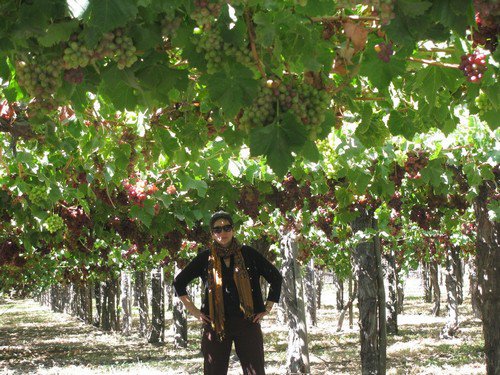 BTW, when fruit falls in a table grape forest and there’s no one there to hear…
does it make a sound?

Two years ago on this day I was feeding my mother breakfast. I was sitting beside her bed tearing toast into bite size pieces and wondering how it was possible for anyone to chew so long on a miniscule bit of scrambled egg. Watching as she reached for her coffee or juice, her fingers shaking and the whole thing taking so long I just wanted to grab the cup, hand it to her… but I resisted. Reaching for her own drink was one of the few things she could still do.
I remember that the radio was on and they were talking about it being International Women’s Day. I expected my head to fill with thoughts of strength and achievement in this celebration of voices, past and present, loud and clear against the best efforts of those who’d prefer they remain silent. Suffragettes. Women who climbed various mountains to change the world.
But on this morning, two years ago, I found myself considering a different aspect of womankind—I thought about all those women everywhere who are caring for women, and how that’s often the way it goes… how the women so often outlive their men and how it’s the daughters, sisters, granddaughters, nieces, friends, that you see in the hallways of nursing homes, arriving with fresh nighties or flowers, a case of Ensure, a toilet frame… visiting, care-giving, and then I thought how it’s my mother’s hand I recall on my five-year old, eight year old, fourteen year old forehead when I had a fever, bringing me something for an upset tummy, a sore throat—my mother’s hand that comes to mind whenever I smell Vicks VapoRub. I remember my dad’s part in things too, how he’d thunder in at the end of the day and I’d hear his voice, anxious, asking how The Little One was, then a few minutes later appearing at my door trying to look casual, smiling, telling me I’d be up and at ’em soon. He’d cough, say Okay, get some sleep now! then escape to kitchen for a smoke—god bless him and all that, but it’s my mother that slept on the floor beside me one year when I was so young I can’t remember why.
And so there in my mother’s room on International Women’s Day two years ago, instead of thinking about a century or more of feminists who paved the road so that we could all walk more easily, I was thinking about the time I saw my mother-in-law leave the hairdresser with a friend. Both of them in silver perms, frail, careful of every step, helping each other to the car, and how I knew that to have intervened, to have offered my arm, would have taken away what they still needed to know they could give each other.
I thought of the woman who came to the nursing home every day and on Wednesdays took her mother’s laundry home in a basket to wash and hang on the line, even in winter, for the fresh smell.
And as I helped my ninety year-old mother with her breakfast and waited as it took forever in the washroom and got her back to bed, I glanced occasionally at a picture by the window where she no longer sat because even sitting took too much out of her. The picture is of her and my dad in the alps, at the top of a mountain they’d just hiked. They’re all smiles and twenty-something gorgeous against an endless sky.
Both my mum and my mother-in-law have since died. I don’t know about the woman with the fresh laundry.
I want to celebrate strength on International Women’s Day but I find myself celebrating love instead.
Then again, maybe they’re one and the same.

I mean many of you (not all, see p.s.) but especially you, dear CBC Radio, because you are the media people I often pay attention to and lately I’ve heard you mention a little too often, a certain store about to open in the Toronto area. Soft openings. Grand openings. Why and when and what and oh golly!— each time I switch off the radio and mutter bad words in frustration.
Worse, I fear there’s more of it to come as soft openings and grand openings approach.
I don’t know much, but I do know this: this [yet another] big American store doesn’t need our help although I’m sure it’s grateful for all the attention it’s getting. Free and regular promos. From our public broadcaster no less. And so, as someone who happily and proudly supports you in many ways, I have a question:
Why are you doing this??
I mean it’s not like big American stores opening up in Canada and selling loads of cheap stuff made under questionable conditions in countries far, far away is news. And if you’re worried that they might open and no one will notice and you feel duty bound to inform us of such goings-on, may you rest assured that word will spread even if you utter not another syllable about it.
Surely a store opening is not news, nor are the stages of its development worthy of monitoring. At least not this kind of store. Unfortunately, this store will do just fine without one bit of media interest.
Who might benefit from your attention, however, are the smaller, local indies that will suffer in the shadow of this most recent behemoth. Why not save your air time for THAT kind of news? News of butchers and bakers and candlestick makers that, despite being largely ignored by the media, and against the odds, continue in their Sisyphean task of slowing the rate of the world’s devolution to soulless Big Box status.
It’s the candlestick makers that keep us human.
Here’s the thing… No one will build communities for us. Builders only build profits. It’s up to us to build communities. And we build them by being informed of what’s out there and then supporting it. And I don’t mean only the new or funky patios in certain neighbourhoods but all manner of businesses across the city, the GTA, the province, the country—stores, restaurants, markets, manufacturers, service providers—real people who make a living despite the Goliaths, and who make those livings in real ways, and deserve real support.
If the Big Store Opening must be mentioned on your airwaves, although I have NO IDEA why it must be… then please leave it for the top of the hour news on the day of the opening. That’s more than enough ‘information’.
There’s worthier out there, and the power you wield is no small potatoes.
Please use that power wisely.
Yours sincerely,
carin makuz.
p.s. Thank you to THIS Magazine for continuing to be you, with *this*… WTF, indeed.
♦◊♦



Hans Fallada, it seems, was a complicated chap. An alcoholic addicted to morphine [these were but a few of his issues], he didn’t live to see publication of Every Man Dies Alone , a book it took him twenty-four days to write. A remarkable feat for this rendering of the German Resistance during WWII—even taking into account the feel of the thing, which comes off as more a compelling need to present little known information, to set records straight or offer a tribute via truth/exposure, than story well crafted. Makes me wonder why he chose the fiction route given how very closely the story hinges on real events [actual notes and documents are displayed at the end]. Published in 1947, it was one of few books on the German Resistance and while it was translated throughout Europe and re-issued in 1994, it wasn’t until its first English translation in 2009 that it received serious attention and achieved best seller status.
In a Nutshell: The Quangels are quiet, simple Germans. After the wife loses her brother in the war the couple set out to create an anti-nazi propaganda mission by writing and distributing postcards throughout Berlin that essentially suggest Herr Hitler is not all he’s cracked up to be and people need to wake up and smell the coffee. The cards, with various and simple messages—“Mother! The Führer has murdered my son. Mother! The Führer will murder your sons too; he will not stop till he has brought sorrow to every home in the world.”—are left in stairwells, restaurants, shops, on the street, buses, parks; the city is littered with these crudely penned warnings against Nazism and yet no one, not the police nor the Gestapo, knows who’s behind it. For a while at least. Then they find out and the Quangels are caught and executed.
I was fascinated by this aspect of events so rarely heard about. However, despite the book’s more than 500 pages, I never really felt as caught up by those events as I’d have liked. I wanted to enter this world much more than I was allowed, to see those cards being written, experience a view rarely depicted. It was a time of confusion and uncertainty; people like the Quangles, ordinary Germans, saw the benefits of Hitler’s regime in the form of jobs, etc., but couldn’t shake the sense that, despite what appeared to be improving, much wasn’t right, that people of every class, race and culture were being arrested for simple disagreement. Spies were everywhere and it soon became obvious that you couldn’t entirely trust anyone—not your neighbours, friends, not even your family. This is a side of the story little known outside of Germany, and even there, only recently has it begun to be discussed among younger generations.
The problem with this kind of re-telling of truth is that because we already know the outcome the fictional version must have some fresh angle—further developement of the story or characters, or even one interior journey that the reader feels privy to. As it is, Every Man Dies Alone is written in an overly simplistic style with long passages of expository dialogue and zip character development, leaving the reader well outside the ‘world of the story’ and privy to little more than the author’s need to opine on the subject while purging his own emotions.
Better, maybe, in that case to have done it as a work of non-fiction. In any case, not the world’s best slice of literature, but if you can get over that, it’s absolutely a story worth reading.
And all that in twenty-four days… hats off, mate, I say.
My faith is not a formal dress
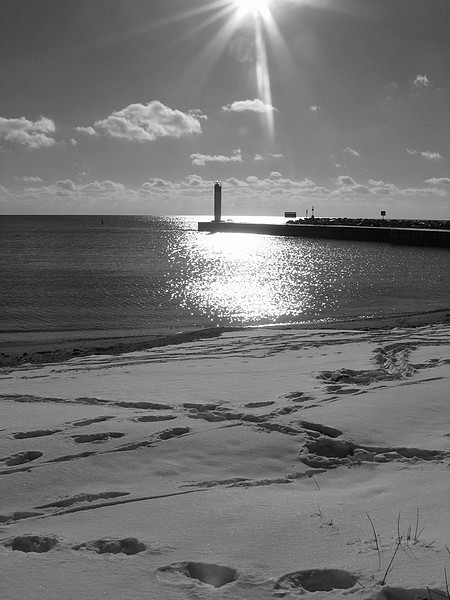
but rags and stones and feathers,
shells hidden in its hem
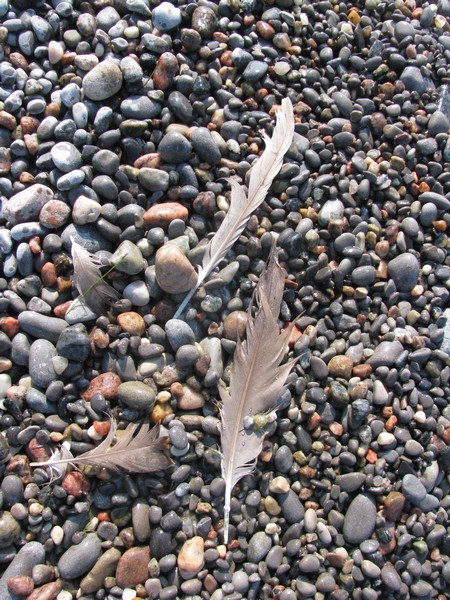
—best worn with sky-lighted cape
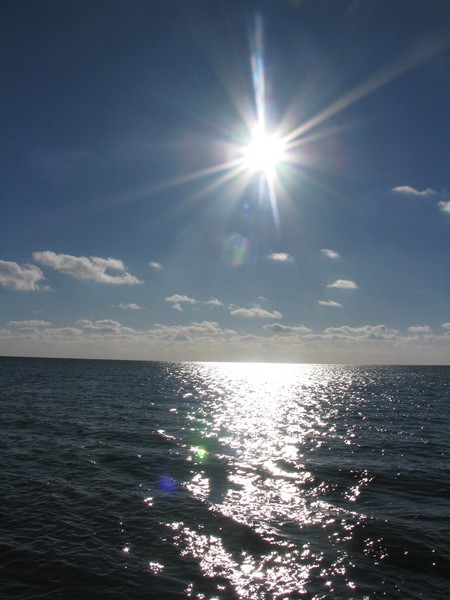
and bird voice chapeau.