notes from a summer holiday — Part 1


Vancouver: arrive. Rain

Who cares, there are mountains!

We have a drink while waiting for our flight to Victoria. The flight turns out to be delightfully short and pleasant and the Victoria airport is one of those charming places where you get off the plane and walk across the tarmac to the building–a civilized approach, makes me feel very Ingrid Bergman.

Victoria: arrive. Rain.

Who cares, we’re on Vancouver Island!

We grab our rental car and head up the Malahat and then up some long, winding road to a restaurant I’ve read about, an isolated place nestled high in the hills, rumoured to have a breath-taking view and an excellent cheese platter. First, however, we sit in the parking lot eating the cold chicken I’d packed in case they didn’t feed us on the plane. Very romantic this, in a Clampetts kind of way, rain pounding the windshield as we tear at chicken legs with greasy, ravenous fingers. Finally, we make a run for it to the restaurant and hope for a good table. Something with a view please since we haven’t seen much of that so far. The waiter chuckles, ha ha, apparently today is not the day for view-seeing, it is the day for fog-seeing, although if there were no fog he assures us the view would be right there… he points, and gives us the perfect table overlooking the view, if there was one.

We order the infamous cheese platter which turns out to be only okay. Local cheeses, nice, not mind blowing. Also local wine. $14 for a glass of unspecial chardonnay. We’re glad we had the chicken. This impromptu ‘snack’ turns out to be stupid expensive but you can’t think money at a place like this.
It’s all about the view.

[Part 2. Onward: up the island.]

the first time

It really doesn’t matter how good or not the first time is—it’s usually memorable and that’s enough. My first was James Michener. Well, not technically the first. There were plenty before him if you want to go back to Dr. Seuss. Then Lucy Maud and those Grimm Brothers, Heidi and Black Beauty, E.B. White, and Nancy Drew—who I used to think actually wrote the books; I was somehow oblivious to Carolyn Keene’s name prominently placed on all the covers. I’d love to know who I thought she was.

There were others, obscure names and stories I’ve long forgotten, picked up at the library or found among the slim pickings on my family’s shelves. But it was James that was the real first, the one I found myself opening and not being able to shut until it was done. The first time I went all the way in one fell swoop.

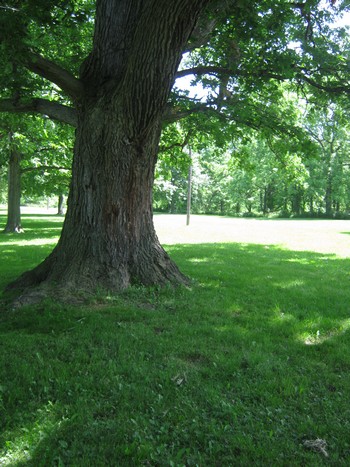
It happened under a tree.

It was summer. I was twelve. I had a bike. This was in the days before people got driven anywhere; when your parents could have cared less where you were as long as your room was clean, the dishes done, laundry hung, house vacuumed, garbage taken out and you were back in time for supper [‘cuz that table ain’t gonna set itself].

It was also in the days before the invention of plastic. At least in the shape of water bottles. People, everyone really, used to go places, everyplace, without water. It’s a miracle we all survived when you think about it now.

In any case, there I was on my bike in summer and it was hot. Very very hot. I rode across the canal into the country where the orchards lived and swiped a few peaches. And then I took those peaches to a small park—no, it wasn’t a park, more like a place for cars to pull over and check what the hell is making that rattling sound in the trunk. It was a small grassy space; there were trees, shade. Peaches. And James between the covers.

The book was The Fires of Spring. I remember the beginning best, how a little boy and his grandfather lived in a poorhouse, happy but poor, you know the type. The old man, beloved by all, died, leaving the little boy on his own. So he joined the circus, the way you do when your poor, beloved grandfather dies, and saw unspeakably exciting and horrifying things and possibly fell in love or lust or confusion. It gets foggy at this point. In fact, I remember very little and what I do recall may or may not even exist in the book. 

Who cares. The story isn’t the point. The feeling is the point and no one and nothing, including the actual plot, can erase the feeling of laying on that small slice of cool grass on that hot day, illicit peach juice dribbling down my chin onto James’ pages as I turned them one after the other after the next… all afternoon.

It was the book that showed me, in ways I can’t recall, the power and the magic of words. It wasn’t necessarily the best I’d ever read, I just remember it that way.

Recently, when Peter and I spend a weekend in Niagara, we find ourselves near the grassy place. I ask him to pull over, tell him about James…I spare him the details.

He finds my nostalgia quaint, smiles, stays in the car while I walk around. Which tree was it? This one, that one? I study branch formation, proximity to the road, until it occurs to me that where matters as little as the storyline. What matters is I”m suddenly breathing deeply, smiling, shoulders drop and I’m twelve, in yellow denim cutoffs—because I’m the only kid I know who doesn’t own blue jeans—lying tummy down on grass, surrounded by peach pits and so engrossed in a book a whole day goes by without me noticing. Best of all, I am not even slightly aware of how I will remember this day, for possibly ever.

this is not a review: no guff vegetable gardening by donna balzer and steven biggs

Seems I’ve outgrown many of my old gardening books. Not because I’ve learned so very much [mostly what I’ve learned is how much I don’t know] but because my style has changed. Used to be I liked a cacophony of colour from March to November, which meant endless planning and revising, wandering the crowded aisles of garden centres in a confused fog, pushing about a giant trolly, only to find all that consideration of height and spread and bloom time amounted to zip when somehow all the tall yellow stuff ended up together—not to mention the expense of annuals to fill in gaps and baskets and pots everywhere.

Worse, at the end of a day of ‘garden management’, I’d kick back on the patio with a glass of wine, look at the lovely vista in front of me and say: oh crap, the phlox is three inches too close to the Echinacea… and they’re both pink!!

And then one day, I’m not sure when or how, I changed.

Now my pots are filled with food: peppers and eggplant and basil, and what I like best is green with splashes of colour wherever colour chooses to appear. I like surprises better than control. There are few annuals and all the perennials are either native or very hearty. No wimps allowed.

And nothing is ever in the wrong place. Sometimes I move stuff, sometimes I don’t.

So goodbye fancy formal books that describe how to do Vita Sackville West’s white garden, or Hugh Johnson’s idea of simplicity—something along the lines of casual Versailles—and hello No Guff Vegetable Gardening, by Donna Balzer and Steven Biggs.

That is where I’m at today. Food and simplicity.

And that, thank god, is where Balzer and Biggs are at.

Not only do they get the joy of gardening and, specifically, the pleasures of growing food, they’re able to share that enthusiasm—along with the wisdom of their experience—in a way that doesn’t feel like it’s coming from a book.

Written from slightly varying points of view—their differing opinions centre around gadgets, fertilizer, cauliflower coddling…[and getting both sides is part of the fun]—but overall there is agreement on the basics of organic and do-able gardens. The pages are a mix of beautiful photos, colourful illustrations by Mariko McCrae, charts, lists, refreshingly straightforward advice from starting a garden to succession crops to harvesting tips to composting—essentially everything any home veggie gardener needs to know or be reminded of, and then some.

With that much info coming at you it’s easy to slide into a cluttered look but they’ve avoided that with good page layouts—multi-coloured fonts and backgrounds and a balance of graphics and pics—making for easy to read bite sized chatty chunks… and [so clever] both the cover and the pages are a smooth glossy finish as if made to be delved into straight from the garden with mucky in-the-middle-of-a-situation-that-needs-an-answer-NOW  hands.

Which is exactly how I approached the book the other day when I noticed my zucchini are all flower and no veggies and found out why in a small blurb on p.146 under the title: ‘Gender Roles Affect Squash Harvest’… wherein it was very simply explained [I’m paraphrasing here] that the bees haven’t done their job and hand-pollinating is in order. Male flowers have a long stem; females, a short stubby one. Get a tiny paintbrush and go to it. Directions are supplied of course, as is an aside by Biggs saying he’s never hand-pollinated and feasts on the blossoms instead. Which is what I chose to do. And may I say they’re delicious. (Dip blooms in egg wash, then bread crumbs, and sauté lightly in butter with a drop of olive oil so they don’t burn. If you want to stuff the blooms, do that before dipping. This is so good that I’m not even sad about no zucchini this year. I go out every day and pick the flowers instead.)

For me this book is a little like having that neighbour at your beck and call [the one who grows the best tomatoes and beans], dispensing not only answers but pearls of garden wisdom, anecdotes, recipes, back and forth exchanges and incidentals. You just want to hang around and hear more, ask questions.

Having said that, should you ever find yourself in the mood for the intricate details of herbal knots, Latin binomials or how to maintain French lavender topiaries in the shape of the Eiffel Tower—there are better books on the subject. What I like about the No Guff concept is its smart idle chat feel; you don’t read it so much as open it and find a conversation [or debate] that welcomes you right in, practically pours you a drink and never says a word about conflicting colours.

This one’s going straight onto the gifts-to-give list.

no, i’m not reading hemingway

…Just clearing shelves.

HOW TO DEAL WITH A CHARGING BULL

1. Do not antagonize the bull, and do not move.

2. Look around for a safe haven—an escape route, cover, or high ground.

3. If a safe haven is not available, remove your shirt, hat, or another article of clothing. (This is to distract the bull.) 

4. If the bull charges, remain still and then throw your shirt or hat away from you. (The bull should head toward the object you’ve thrown.)

**NOTE: IF YOU ENCOUNTER A STAMPEDE of bulls or cattle, do not try to distract them. Try to determine where they are headed, and then get out of the way. If you cannot escape, your only option is to run alongside the stampede to avoid getting trampled. Bulls are not like horses, and will not avoid you if you lie down—so keep moving.

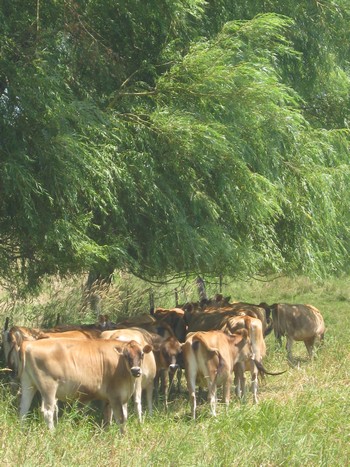
~ from The Worst-Case Scenario Survival Handbook by Joshua Piven and David BrogenichtAnd then there are cows.
No instructions needed.

thinking green

So I’m sitting around on the weekend the way you do, wondering how many shades of green there are in the garden. Peter points out there’s at least ten in a single hosta leaf, suggesting I may be wasting my time if I want real numbers.

“Imagine trying to paint them all,” I say as he quickly opens The Globe’s sports pages. “I mean, how in god’s name do you capture all those shades, how would you paint it, how would you know which green needs a dab of blue or orange or red or yellow or brown or black or—”

“I get it,” he says.

“And then there’s the light. How do you do the light, the dappled bits on the tops of spruce boughs, the dark bits underneath—I mean what colour is the spruce bough??”

He’s entrenched in his reading by now but I ignore that, continue sharing my amazement at green, the magic of painting, of nature, and then I start thinking about ‘doing’ green in other forms. What if, as an exercise, you asked someone to write it—in poetry, or represent shades of green through a short story, a novel, in music, or asked a dancer to interpret green in movement or an architect in design. Translate all that green to a blueprint.

Peter looks up from whatever the Jays are doing. “You’re going a little over the top aren’t you? Architects?”

“Why not?” I say. “Why not interpretation from every corner? Why not convey ‘green’ in meals and wine and quilts—”

“Wine would work.”

Seems I’ve struck a note with his inner sommelier. He glances at the garden, starts listing wines, describing them, throwing words around: pine needle, pepper, herbaceous, crisp, damp woodland floor, grassy, stalky, vegetal, sun shower over Miami. Okay, I made the last one up.

“See?” I say. “Now imagine a festival.”

“Excuse me?”

“A festival celebrating the Art of Green. Green the colour and green the concept. You get funding, sponsorship from the corporates, they like to appear green friendly—get chefs involved, restaurants, galleries, the whole arts community, painters, dancers, photographers, wineries, farmers, writers, sculptors, potters, and, yes, architects. Different expressions of green in different venues: schools, theatres, cafes, vineyards, street corners, studios and—if there’s any still open—libraries. It would last a week in…hmm… maybe late Spring. There’d be posters of greenness and tee-shirts and book bags and the proceeds would go to some form of conservation—a save the bees fund or field trips for kids to learn about the environment, something…I haven’t worked that bit out yet.”

[Rustle of paper as he gets back to reading.]

“And the following year, the Festival of Green could do the same thing in another colour: the Festival of Green celebrates blue or yellow or purple or—”

“You’re doing it again.”

He says he likes the idea, he’s just worried I’m about to organize a festival. I take a breath, sigh, assure him I’m not. I’d like to but it’s all a bit daunting and the fact is there are days I can barely figure out where to begin a new paragraph. Priorities. What I need to do is complete my novel before paper becomes obsolete. I know that. So, yup, for now, I tell him, festivals will have to wait.

“Unless of course someone else wants to organize it…” I say. “In which case I’m in.”

[Silence. Followed by more rustling of paper, followed by silence.]

More green…

green-0051

Be Reasonably Considerate

Swiped from the divine pages of Geist’s summer issue:

From “Eleven Tips on Getting More Efficiency Out of Women Employees,” written for male supervisors during World War II and published in Transportation Magazine in 1943.

PICK young married women. They usually have more of a sense of responsibility than their unmarried sisters, they’re less likely to be flirtatious, they need the work or they wouldn’t be doing it, they still have the pep and interest to work hard and to deal with the public efficiently.
     When you have to use older women, try to get the ones who have worked outside the home at some time in their lives. Older women who have never contacted the public have a hard time adapting themselves and are inclined to be cantankerous and fussy. It’s always well to impress upon older women the importance of friendliness and courtesy.
     General experience indicates that “husky” girls—those who are just a little on the heavy side—are more even-tempered and efficient than their underweight sisters.
     Whenever possible, let the inside employee change from one job to another at some time during the day. Women are inclined to be less nervous and happier with change.
     Be tactful when issuing instructions or in making criticism. Women are often sensitive; they can’t shrug off harsh words the way men do. Never ridicule a woman—it breaks her spirit and cuts off her efficiency.
     Be reasonably considerate about using strong language around women. Even though a girl’s husband or father may swear vociferously, she’ll grow to dislike a place of business where she hears too much of this.
     Get enough size variety in operators’ uniforms so that each girl can have a proper fit. This point can’t be stressed too much in keeping women happy.