i’m nobody’s gardener

 
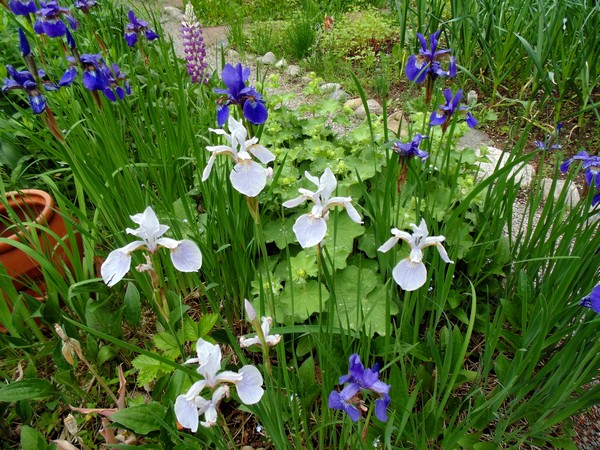
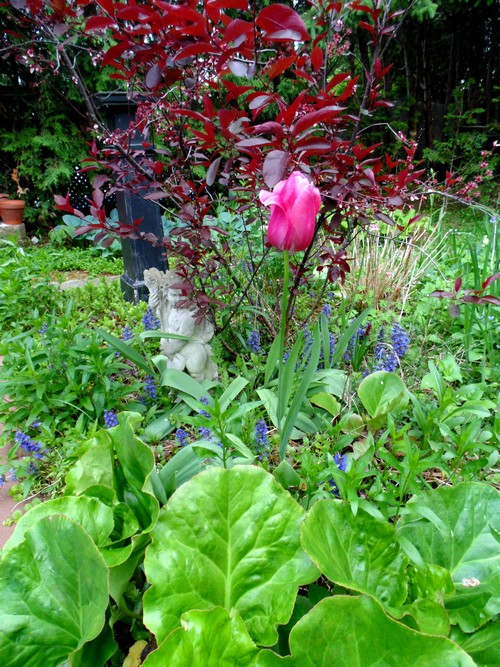
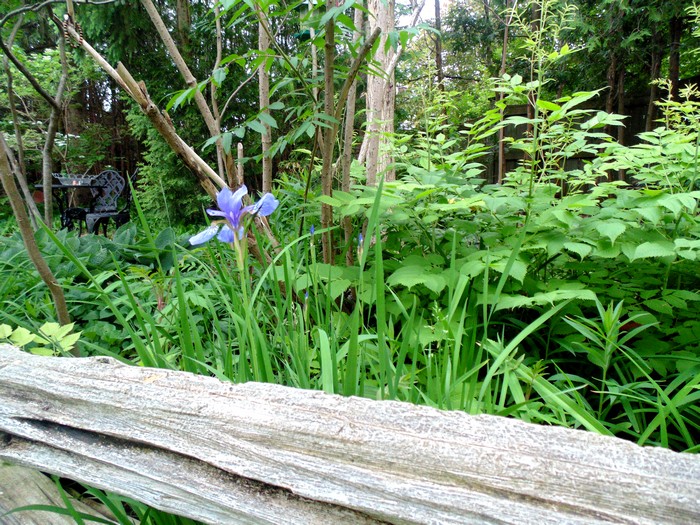
I don’t garden.DSC02839I plant things and do what I can to keep the weeds at bay. DSC02844But the weeds usually win.
DSC02848I used to care. Used to fret about weeds winning. It used to be that I couldn’t sit on the patio after working for hours in the garden, fretting and fussing and weeding, couldn’t sit down at last and just say, “Well, that looks good.”
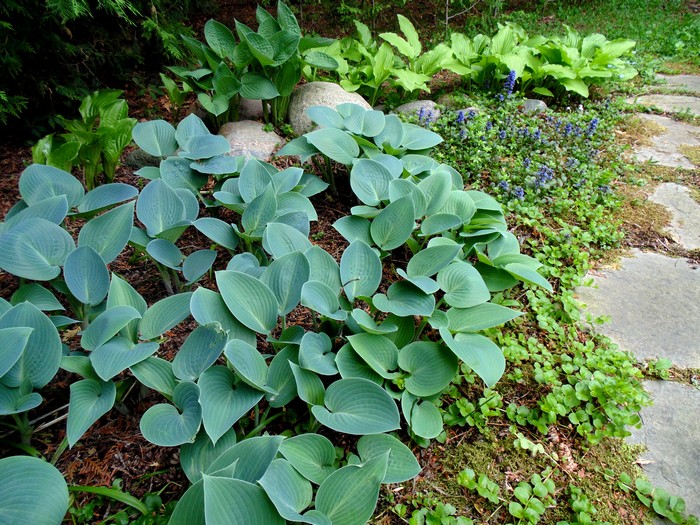
DSC02849Because I’d notice something askew. Or how the tall blue things were in front of the short yellow things.DSC02850I used to care that delphiniums fell over in the rain.DSC02851Then one day I got rid of the delphiniums.DSC02853And anything else that was a bit precious. Or incapable of weathering the weather.DSC02854The yard became less garden and more Place Where Things Grow or Don’t Grow; It’s Up To Them.DSC02857Oh, what a happy day when I stopped being a gardener and started being someone who could sit on the patio at the end of the day and say, well isn’t that a lovely sight.
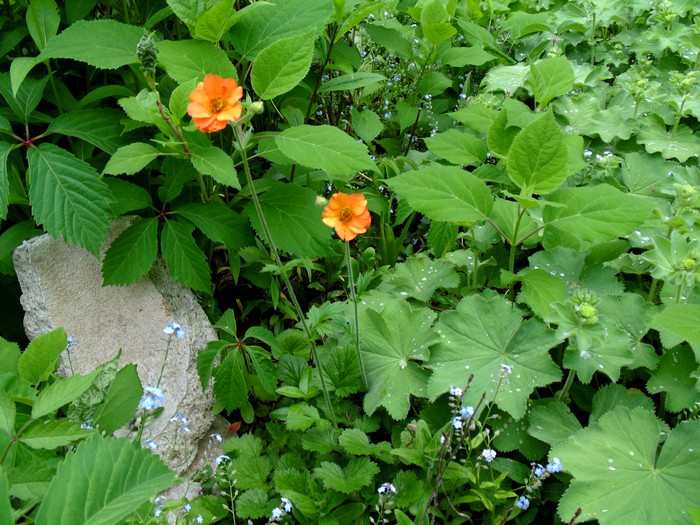
DSC02858Without fretting about colour combinations and bloom time and height and things keeling over untidily.DSC02861Untidy is hardly noticeable in my ungardenly garden. DSC02862So if things are lovely, it has nothing to do with me.
DSC02845After I stopped being a gardener, I sat on the patio one night and said out loud, “Well, doesn’t everything look wonderful”, and a young girl who was on the patio with me said what a funny thing for an adult to say. “Usually adults complain about things,” she said.DSC02846So true.

Because we think we’re in charge.

how myrl coulter and me are both the same and different when it comes to birthdays

 
Myrl Coulter’s ‘Those Pesky Natal Days’ (one of the essays in her lovely collection A Year of Days)  begins like this:untitled

“The human ritual of marking individual birthdays started with the advent of the calendar, when people began to track time according to the sky, to notice when it got dark, when it got light, when the moon appeared, and when it didn’t.”

She continues with some background to the origins of birthday celebrations, considers the idea of birth and what, exactly, we’re celebrating, then moves into her own personal likes and dislikes about the occasion.

This just happens to be one of my favourite things to discuss and so instead of responding out loud to the pages from a park bench, which only frightens passersby, I decided to bring the conversation here.

Warning: the following might not be suitable reading for traditionalists, or anyone who shops at The Party Store.

How We’re Slightly Different:

Coulter says she doesn’t like the Happy Birthday song. Calls it grating and trivial with only five words to the lyrics, and a sixth to be added by the singer. “The sentiment is a tedious repetitive demand to be happy.”

Hard to argue. It’s not the greatest piece of music ever written (she tells us the copyright is worth five million dollars), yet I sing it loud and proud to a circle of lucky souls each year. And they do the same for me. And I kind of love it. When I was a kid the song made me cry. I think that had more to do with how my parents liked to go through the whole day pretending they’d forgotten what day it was and then after dinner a cake would come out, a few gifts would appear, and the song would be sung. Tears of relief followed. To be honest I still weep a little, though for different reasons now.

How We’re Very Different:

Coulter enjoys planning parties for friends and family. I don’t like parties. (Could I plan the party and not attend? Because then I could get into it.)

How We’re the Same:

She describes how kids’ parties have changed, how today they have themes and décor and tapenade and rules about everything. She says it used to be simpler and I get the feeling she prefers the simpler.

Me too. Pin the Tail on the Donkey; pound cake with rosettes and a misspelled name; (what’s a loot bag?? kids go home with extra piece of pound cake)

How We’re Different:

Preference for simplicity aside, she says she’s actually impressed with these parties but relieved that her kids are grown and she doesn’t have to throw them.

Me: I am less impressed than cringey at the very idea. I once organized a birthday party for a nine-year old in a bowling alley. Lunch was included. Plus bowling. Plus a few jokes from my repertoire. And  I pretended to enjoy myself. (There was lunch, I mentioned that, right?) When the parents arrived to pick up the little darlings, they asked where was the loot bag… I had no idea what they were talking about. Can’t even remember how I answered. But there was a distinct ‘attitude’ as they left. (Hey, there was lunch!!)

How We’re Really Really the Same:

She says she likes other people’s birthdays but not her own, that the thought of it approaching actually tightens her throat.

I know just what she means. And it’s not an age thing. It’s an expectation thing.

She writes:

“To distract myself after that initial birthday thought wanders in, I start thinking about how I want to spend my day. My first idea is always the same: I just want to disappear. No obligations, no hanging around to receive birthday wishes, no smiling when I really fell like roaring into the wind”

I get that. I hate handing my birthday over to someone else (shades of childhood trauma, i.e. late-in-the-day cake?)… I think that’s a lot of pressure on the other person and anyway, it’s my day and I want to be responsible for it. I’ll make the dinner or the reservation or run away somewhere, or take a friend… I’ll give the gifts, I’ll bring home a cake, I’ll light the candles. You can sing if you like…

And Here, More Same than Different:

About gifts, she says:

“I don’t like opening birthday presents, especially in front of the people who have given them to me, who sit in my line of vision smiling with eager anticipation.”

For me, it depends on the circumstance, because some people are a delight to share these moments with. But then there are those others, the ones who have pretty much given the gift for what they get out of your reaction, which better be what they expect.

“When I open gifts in front a large group of people, what falls into my hands is secondary, because I’m hoping that my smile is big enough, that I’m not over-reacting or under-rewarding my donor, that I’m appropriately grateful without resorting to an ‘I’ve always wanted one of these’ gusher statements. I wince when I recall times I have gushed.”

Agree. I would love it if birthdays were a time to give rather than receive.

We’re Different:

She says birthdays ending in zero or five are toughest.

They make no difference to me. Numbers are not my thing.

Yet We’re the Same (Is anyone Different on this one?):

“The frenzy exhausted me. Surrounded by people I love, I looked forward to the moment they all left.”

And this:

“What I do know is that the day after my birthday will be a good day. I will feel normal again, relieved, and somehow refreshed.”

It’s that kind of essay. Sits you down and says, so what about you?

—So what about you?

A Year of Days  is available online at Blue Heron Books.  Shop indies! ♥

this is not a review: ‘magnificat’, by k.d. miller

One of my annual pleasures is Steven Beattie’s, 31 Days of Stories, a tribute to the short story form by way of highlighting and reviewing a wide variety of work, from current to classic. I try to make a point of reading the daily posts (printed out on paper even) with tea each morning. I’m a little behind.

Just got to ‘Magnificat’ from K.D. Miller’s gorgeous collection All Saints.9781927428634_Cover_
It’s been a while since I read it but I didn’t remember it quite as described.

So I read it again.

And this is the most wonderful part about art of any kind, that there are several takes to be taken. The artist’s. Yours. Mine. And the millions of yours and mine’s out there reading/hearing /seeing/experiencing the same thing.

This never fails to fascinate me.

As a writer I enjoy hearing various takes on my own work, the way something I thought so obvious is missed or, conversely, something I hadn’t even seen appears to someone else as THE WHOLE POINT.

Who’s to say what’s right? The artist’s version, in my world anyway, merely counts as one opinion, one vote for ‘what it is’. It may appear to carry more weight because it has all that intention attached, but what it becomes when it flies through the atmosphere of our individual experience, can’t be denied.

And so, with ‘Magnificat’, for instance, my take is a little different from the one I read this morning…

In a nutshell–

Julia, an unattached, never married, middle-aged woman with blisters on her feet and a pretty ordinary life notices a young couple, Cathy and Gabe, having it off in the park. Only something’s not right about the scene and it makes Julia remember an incident of sexual abuse at the hands of a man who recited religious passages, which caused her to sing the Magnificat … essentially, a  survival technique.

“She remembers lying in bed, imagining herself the Virgin Mary.     Imagining the eyes of the angel on her. And his next words, the ones that would change her life forever, giving her cause to sing the Magnificat. My soul doth magnify the Lord…”

Beattie saw Julia as someone who has not experienced sex on any level and who witnesses the rough play in the park between Cathy and Gabe with a kind of lust. Whereas I see her watching with a sense of helplessness. Because of her own experience, she senses Cathy’s complicity in the situation and knows there’s no point in intervening and no crime to ‘report’. That for whatever reason people, often women, feel they deserve abuse of various kinds and, in order to survive it, are able to find a twisted sort of pleasure therein.

This experience of abuse may be the very thing (coupled with her parents’ cold relationship) that put her off the idea of marriage. Oddly, it may also serve as one of the reasons she’s drawn to the church… a convoluted means of putting things right that were made so wrong in *god’s* name.

That she sees not taking a husband as a “choice”, I think is a reference to burying the memory of the abuse. Anything that triggers it, is a source of discomfort.

And yet… she follows this strange couple, Cathy and Gabe, into a remote area of the park. She is afraid as she does so,  “… In a queer, thirsting way.”  The way she takes off her shoes, puts them on her hands to relieve her blisters, daring herself to continue past the pain… mirrors, in a way, what Cathy is doing, allowing herself to be drawn into the relationship with Gabe, hating it, fearing it, yet fearing it might end.

I see this as Julia wanting, at last, to confront her demons.

And yet… another reference to angels, this time from Cathy’s perspective in the middle of the aggressive and degrading sexual act:

“The grass is chafing her knees. Her fingers dig into the dirt… But she is surrounded by angels… Gabe. And Owen. And now this lady who is watching her… She is in a blue robe and a kind of white headdress, like a nun’s. Her feet are bare. She is wearing shoes on her hands.”

Julia watches the scene unfold as Cathy (also dressed in virginal blue and white) is undressed.

“When she saw the blue tunic come off, she pressed her palms flat to her heart. Prayed through dry lips… Then when the white T-shirt and the flesh coloured bra were shed, she wrapped her arms around herself to stop the swaying of the freed breasts.”

Julia begins to sing the Magnificat, and Cathy receives it with gratitude while her fingers dig into the dirt during the sexual act. This brief and unspoken connection, this understanding between the women is powerful, transporting Julia back to her childhood and when she comes back to reality, she finds herself checking to see her clothes are intact, “clutching at herself” as if to protect Cathy from the hands of this man, and herself from the hands of the abuser in her past.

Note: The Magnificat is a hymn of praise to god, in which god recognizes “the lowliness of his handmaid”. A song, no doubt, written by a bloke.

UPDATE: Was gob-smacked to find Steven Beattie’s re-visit to Miller’s story; even more gs’d to know my interpretation resonated. Because, well, what do I know?? Anyway, this is CanLit at its best: stories, discussion, open-minds.

I doff my cap.

All Saints  is available for purchase online at Blue Heron Books. 
Show indies some love.

things found

 
maggy and milly and molly and may
went down to the beach(to play one day)
DSC00355 - Copy
and maggy discovered a shell that sang
so sweetly she couldn’t remember her troubles,and

milly befriended a stranded star
whose rays five languid fingers were;

and molly was chased by a horrible thing
which raced sideways while blowing bubbles:and
DSC02311 - Copy
may came home with a smooth round stone
as small as a world and as large as alone.
DSC02322
For whatever we lose(like a you or a me)
it’s always ourselves we find in the sea
IMG_4304

‘maggy and milly and molly and may’, by e.e. cummings

this is not a review: slow curve out, by maureen scott harris

 
I’ve read Maureen Scott Harris’ beautiful Slow Curve Out  twice so far—once in a skimming summertime kind of way on the patio where I am prone to being distracted by butterflies and motes of dust and pitchers of watermelon juice. And the second time on a Sunday morning in bed (fortunately motes of dust are so common in my house they are not distracting).

The book, a collection of poems, is divided into three sections.

Well, five, actually, if you consider the opening poem, ‘Walking in Saskatchewan with Rilke’ in which we are being prepared for what’s ahead, i.e. walking in the world with Maureen Scott Harris.

                                                                           —the way
things surge into being, here, claim eyes, claim
mind, claim my very heart, beating and beating,
bird in the breast, this longing for sound—

And the closing piece, ‘Homecoming’, that ends with warning and a powerful two word punch.

In between is Part One: ‘Back Up, Begin Again’, a paean to nature. The rhythm of recurring themes… birds, trees, light, wind, earth, the colour white, flight, dreams, walking and silence, begin in such a way that you don’t even notice the tapestry that’s being woven until you’re right there in the middle of that deeply textured landscape.

If I can get it right
my arms will sprout feathers, and I’ll bring home
the taste of poplars surprised by pale sun.

I read Part Two, ‘The Ten Thousand Things’, as a meditation on sound. The birds,untitled more visual in the earlier section, are now singing, calling, crying; voices enter, cacophonous, raucous, there is holler, hum and mutter; subtle references to songs; bleat and mourn; ghosts are a choir, slippers tap; yodelling fiddle, guitar, the thump of thunder, a siren, Rain and longing—what a racket on the roof!  Even the foliage makes a sound and sound canopies the street.

One day slides into another, sunshine
dissolving clouds which reassemble
overnight, and a whole week has drifted
past in birdsong and silences. Like
the tide going out, then coming in again.

By now we’re immersed in place. We know what’s around us, but do we know our place in  this place?

In Part Three — ‘Another Animal’ – the tapestry is plenty rich, but there’s an additional element: us. Or at least the focus is on us. How we change things, how we  change, how we interpret our  world vs the  world. Some hard truths are revealed and they’re not always the prettiest, but may be the most important.

Remember when we weren’t our own
gods but lived by the grace of animals?

I love this book for its energy, the way it takes me by the hand and, like the narrator in the opening poem, points out the sound, the silence, the colours, the textures and movement of the world around us.

It asks us to consider what it is we see, versus what we want to see.

And this thing, this motion I thought to show you,
tell you, is for the moment only
a smear across the view obstructing and obstructing
like the sheep dog that turns the sheep
in a slow curve out toward the stony pasture, their little hoofed
feet lifting and descending on the rocky path, slippery
in the aftermath of deep snow, a stutter,
like this  this    this    thing

Slow Curve Out, available online at Blue Heron Books. Support indies!


may be

 
I’ve written before about my relationship with May. I love it for all it’s taught me, through the best of times and the worst… until it’s no longer possible to take this month for granted, or not acknowledge it in some way.

This year I’d like to celebrate May by saying yes.

I’ve decided to play that game where you open up to things that normally cause much consternation followed by umm, I don’t think so, thanks, and a hasty retreat to the cave.

In this game there’s no thinking allowed.

Merely, yeses. (In response to requests within reason, I might add; I mean, there have to be some rules  because I can tell you right now that I am NOT going to accept an invite to go to, say, Mars. No matter how great the in-flight movie is or who’s paying. It’s just not my thing.)

Ah, but, you see? There I go again, talking about my thing. And as much as I adore my thing and am already looking forward to climbing back into its perfectly shaped embrace… for one month, I will not give it priority.

I will be open to whatever is on the other side of no.

In fact I’ve already begun. Instead of pretending my ankle isn’t sprained and that it will miraculously heal on its own even though it’s only gotten worse in the past couple of weeks, I said yes to seeing someone who knows about these things.

Imagine.

It’s almost like the possibilities are truly endless…

So off I go, with a limp in my step and a yes on my lips.

(Is it just me or is weirdly bright outside the cave?)

Will keep you posted via smoke signals.

Or carrier pigeon.

Symbol_thumbs_up_svg