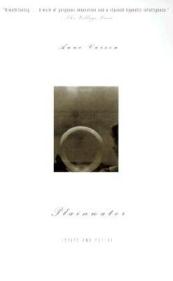
this is not a review: ‘plainwater’ by anne carson


While each of my Not A Review pieces are distinctly not reviews to varying degrees… this one is REALLY not   a review. I haven’t even finished the book. Which is part of this particular Not a Review’s angle.

It seems I have a sort of love/huh?? affair with Anne Carson’s work, of which  I’m only beginning to know. I’m drawn to it, get angry around it, leave it, then I come back and make tea and snuggle up with it again, blissfully content in my confusion until it all becomes too much. And the cycle continues. The addictive element appears to be the occasional bouts of holycrapletmereadthatpartagain! that come over me. In a good way, I mean. (Because there are plenty of moments when I have almost exactly the same reaction in a bad way, as in holycrapwhatthe#@*#isshesayinghere??? )

Is it just me or is there a certain type of poetry that feels like it comes with a fence and a Keep Out sign? Stupidly you stand there thinking it can’t mean you and so you holler let me in!!  Leaping up and down, you try to see over it, try for even the tiniest glimpse but you’re sweating and your feet hurt and you start to wonder: is it supposed to be this complicated?  Is maybe the fence greased?? So it’s in all seriousness when I ask: is there an actual category of poetry designed to make it seem more pleasant to gnaw off your own hand than to turn one more page?

Not that I’m saying I feel this way about Anne Carson. No no no. True, there is the huh?  part of things, but there is also love. (I’m here aren’t I?)

And what I’m happily not reviewing today is Plainwater, published in 2000, and whose entire first section (called ‘Mimnermos: The Brainsex Paintings’)
I skipped because of things like this… “Yes lovely one it’s today forever now what’s that shadow/ unzipping/ your every childfingered wherefrom?

I just wasn’t in the mood for all the leaping.

9780375708428What I did instead was zip ahead to the last section, ‘The Anthropology of Water’, which consists of various pieces, essays… to which I’ve been happily returning each morning for the past few days, champing at the bit to pick up where I left off in ‘Kinds of Water: an essay on the Road to Compostela’, wherein Carson and her travelling companion, identified only as My Cid, walk the Camino, musing on what it is to be a pilgrim, to thirst, to question, to live with faith, or not. To live among people. Or not.

“You come to understand travel because of conversations, not vice versa.”

It’s said, she tells us, that a traveller becomes addicted to the horizon. She tells us that she is a pilgrim, not a novelist, “and the only story I have to tell is the road itself.”  She compares this with telling a story through a character, the difference being that a character moves. “He changes according to the company he keeps…”

I’ve read other writing from the Camino. This is different. Less about the experience, more about the questions posed by the experience.

“… it is an endeavour as old as civilization to set out on a road that is supposed to take you to the very end of things… What do you find there?… Who would you be if you knew the answer?”

She’s writing about the Camino. Or is she? The layers are uncountable.

I was sad when the road ended. But then, it doesn’t really. That’s kind of the point.

So, I approached the fence again. I dipped back into that first section and I’m glad I did but thank god for google because I didn’t know Mimnermos was a Greek elegiac poet from 600 something BC and while I normally wouldn’t care, Carson makes me care.

And all the sections in between… The one that contains miniature essays on orchids and rain and Sylvia Plath. On walking backwards and Ovid. And the section that is a long poem, which seems impossible, and the one after that—poems on various kinds of towns.

I care.

Could it be that we come to understand because of caring, not vice versa?

After all, the writer’s job, the poet’s job, is not to clarify, but simply to make us care.

The copy I’m reading is from the library. This won’t do. Where once I thought I might not even read the whole book, it now seems I’ll be calling my bookseller and ordering my own Plainwater. To love and to huh?  my way through as the moods take me. But then this is the way of love and huh?…

Love always wins.

Plainwater is available on-line at Blue Heron Books. Support indies!


story of a recipe


Once upon a time there was a folk dance group that required its female dancers to wear a dirdnl’ish costume with a corset over a cotton blouse and sometimes real, sometimes fake, carnations stuffed down the front of said corset. This effectively rendered the girls dancing flower pots. Boy dancers were encouraged to ‘smell’ the carnations while the girl dancers twirled coquettishly from one to the other. When they weren’t sniffing carnations, the boys danced ‘figure’ dances, pretending to chop wood or other acts of physical prowess meant to attract the hapless flower pots.

I was a member of such a folk dance group.

For the record, it wasn’t my idea to join. I was fourteen and shy and my parents thought it would be just the ticket to bring me out of my shell.

I suppose in a way it did. It was also where I learned to drink beer.

And it’s where I met Laura, from whom I received the recipe mentioned in the title. Laura wisely left both the dance group and town at the first opportunity, stuffing everything she owned into a small car and driving west until she got to Calgary.

A few years later I followed. Not to Calgary, but to Edmonton. Close enough. Only 300 km away, it made Alberta a place where I knew someone. We’d visit each other on occasional weekends, mostly me going to her place, the main floor of a big old ramshackle house with no yard but access to a back stoop, room enough for a Hibachi.

The kitchen smelled of meatloaf, coffee and Joy dishwashing liquid.

Laura was the first person I knew (my age) who not only liked to cook but talked about food, grew herbs on windowsills, owned actual cookbooks and shopped for food with all kinds of serious enthusiasm. Even more amazingly to me, almost ten out ten times she preferred inviting people to her place for a meal over meeting at a restaurant. She was interesting in different ways (she once moved into an apartment with a bright red fridge and spaghetti on the ceiling; beyond enviable when the rest of us were still living in bungalows) but this cooking thing struck me as a little over-the-top… remember, this was eons ago, when food as a ‘thing’ hadn’t been invented yet. When only five people in the whole world read Gourmet.

In that ramshackle Calgary kitchen Laura served me my first Caesar salad, and I remember thinking it was pretty groovy that she made the dressing by throwing ingredients into a jar and shaking it like maracas.

I came across the recipe recently—the original paper version I wrote out while she dictated precise instructuions all those decades ago. More than slightly splattered and used (though not for some time now as I’ve since discovered other recipes. Julia Child’s and Ina Garten’s, for two).

But they don’t come with a story.

(Actually, the Julia Child one does… it can be found in the book From Julia Child’s Kitchen — a tradition in this house is to have someone read the passage while someone else makes the salad…)

But that’s another story entirely.

DSC01314

(All recipes with stories welcome. In fact that would be exceedingly groovy…)


in this tiny space was everything


Years ago I lived in a tiny furnished apartment on the second floor of an old Toronto house — and in this tiny space was everything I needed.

DSC01232

A single closet the size of a phone booth in which I managed to hang all my clothes and all my coats, as well as store my shoes and winter boots.

DSC01242

A bathroom in the hall, shared with the woman in the apartment next door.
I heard her come and go but we never once, in all the time I lived there, met face to face.

DSC01252

At the end of the street, a fruit and veggie monger. In winter I would sometimes buy expensive tomatoes from some faraway place where tomatoes were grown to be luscious. I ate them with basil and listened to Joan Armatrading and Van Morrison and had a white cat and a bedroom made almost entirely of windows.

DSC01244

I once called a friend to come and eat tomatoes and basil with me and she came, expecting, I think, a whole lunch but it was just those perfect tomatoes.

DSC01275

Basil.

Oil and salt.

DSC01263

Joan Armatrading, and Van.

DSC01266

And it was enough.


gone fishin’

Please don’t tell me this season of light isn’t filled with magic…

DSC01049

How else to explain finding a perfect piece of beach glass in the dark?

The very best to all for love, laughter, and time to breathe…

See you in the new year.

this is not a review: ‘what we see when we read’, by peter mendelsund

That I can’t decide if I like this book best for its visuals or its text is, I think, a big part of the point. After all, the author is associate art director at Alfred A. Knopf, whose designs (according to his bio) have been described… “as being the most instantly recognizable and iconic book covers in contemporary fiction.”

It makes sense then that What We See When We Read  comes across as a crafted, multi-sensory experience.What+We+See+When+We+Read

The subject matter is ‘narrative’… both from a reading and a having-been-written perspective—how narrative is displayed, how it enters our eyes and our minds, what stays with us and why; what we look for, what we find, what we can expect from the writer, and what’s down to the reader.

The paragraphs are bite-sized and pages often contain acres of white space (or, alternatively, are almost entirely black), with only a few bullet points or a single word.

The style is ‘essay-in-fragments mixed with graphics mixed with illustrations mixed with photos, mixed with something like the memoir of a passionate reader’. (May I add that pages have a wonderful satiny feel, serving as a reminder that the physical experience is part of reading.)

In about the middle of the book (pp. 152/53) all is black, and in tiny white print, in an arch from bottom left to bottom right, this quote from Italo Calvino’s Invisible Cites:

“Marco Polo describes a bridge, stone by stone. ‘But which is the stone that supports the bridge?’ Kublai Kahn asks. ‘The bridge is not supported by one stone or another,’ Marco Polo answers, ‘but by the line of the arch that they form.’”

Mendelsund’s use of a visual arch, with reference to an actual arch, to show the theory of narrative arc… is typical of how this book is constructed: he not only explains how we read and what we see while we do it, but he has us walking through the experience at the same time. An obvious move of course, but it takes a minute to realize exactly how it all works and to just relax with it.

In places the book feels almost chatty, as when the author shares his distaste for elaborate descriptions, which he sees as nothing more than ‘misdirection’… “They seem to tell us something specific and meaningful (about a character, a setting, the world itself), but perhaps such description delights in inverse proportion to what it reveals.”

While both aspects of What We See When We Read are equal and both can be seen as simplistic or as layered as you like, I found myself becoming frustrated with the choice, as if I was being asked to read/experience two different books. This may be part of the overall plan to illustrate the reading/visual experience but I find it a tad too much of a muchness, a few too many graphics and ‘design’ elements that begin to have the opposite effect of what they’re intended for—they become less illustrative and more overload of the same multi-senses (which then begin to tune out simultaneously). For that reason best consumed, perhaps, by dipping into now and again, enjoying bits at a time instead of reading straight through.

Bottom line: despite its pleasures, at 417 pages, it feels a little over-done.

That aside, I can see this as a good book club choice. In which case, some knowledge of Anna Karenina and a few other classics would be helpful (various narrative devices are highlighted with examples from a number of books you thought you’d read but actually never have). Helpful but not necessary.

In fact, a book club might be the ideal way to savour it. Whereas the pleasure of some books is not enhanced through sharing, especially with people who see it very differently (read: one person’s exhileration is another person’s sleeping pill), What We See When We Read purports to be neither; it simply wants to be seen and discussed by as many and varying perspectives as possible. And if not everyone reads the whole thing, it matters not one whit. The whole thing can still be discussed, and enjoyment multiplied.

Because, you see, it’s not exactly a book, it’s merely about them. And therefore about us too.

Purchase What We See When We Read, online, from Blue Heron Books.