when a tree falls…

There are no pictures.

Well, yes, there are, actually, pictures. The morning before we cut down the ancient juniper, I took a few. They’re not great—not meant to be great—and say far less than the expected thousand words. They certainly don’t say that the tree and I spent the better part of twenty years together.

It was already here when we moved in. Already quite mature with a slight tilt, which, a few years later, turned into a near fatal lean that required the installation of a serious rope and pulley system to keep it from keeling right over. The system worked well, but as the tree grew it continued to totter ever more precariously. Eventually branches began to sag and turn brown and the whole thing just seemed to be struggling.

It might even have been considered an eyesore.

Though not by us.

Its only real flaw in our view was the increasing potential for toppling over on the dearest and newest addition to the neighbourhood, a furry Mr. Reilly, who likes to play with chew toys on his lawn in almost the exact spot the behemoth juniper would land if the rope ever gave way.

It was time to think about taking it down.

The truth is it should have come down years ago.

But what year should that have been?

Not the year the cardinals had a nest there. And not the one when the blue jays did. And not in winter when robins [who for some reason no longer fly south] swarm the tree for its berries, which is interesting because there’s no other time I can recall seeing robins do anything en masse. The serviceberries are devoured by one bird at a time. Worms too… one, maybe two robins at the most, wait while I dig over the vegetable bed. But with winter juniper berries, swarms. Maybe because there’s less food to choose from in winter? or maybe because the berries, when fermented in their bellies make a fine schnapps… whatever the reason, they arrive at the juniper tree by the dozens. Thirty, forty birds, easily, at times.

I’ve never managed to capture it on film. You’ll have to trust me.

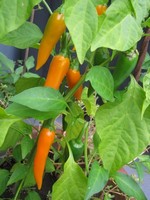
So now this source of winter food is gone. I didn’t watch the sawing. I said goodbye and thank you and hey, remember all those crazy robins… good times, eh?  And then I went inside and pickled some peppers and made zucchini soup.

I’m glad they left the stump. There was some talk of renting a stump grinder. I counted the rings. Thirty five. Google tells me this is admirable for a tree of its kind.

In a different world, a wilder one, for instance, in a house surrounded by woods or fields instead of sweet furry neighbours, I would have left this tree to die a natural death, to continue keeping the robins drunk and happy all winter, to be the ancestral home to many more feathery generations, to keel over whenever it pleased.

As it is, I miss the view of its gnarly branches from my window. We’ve planted new junipers in its place, smaller ones, young and cute and strong and straight, but as yet, without character. The birds fly right past. I wouldn’t blame them if they stopped and lodged a complaint… but they’re already adapting to the new landscape. And so, I guess, will I.

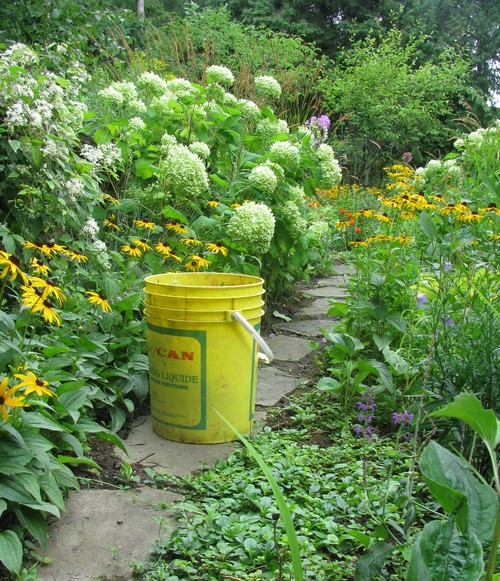
bucket list

Creeping Charlie
Garlic Mustard
Bindweed
Chickweed
Pigweed
Over-exuberant vines
Dead-headed daisies
Various other clippings
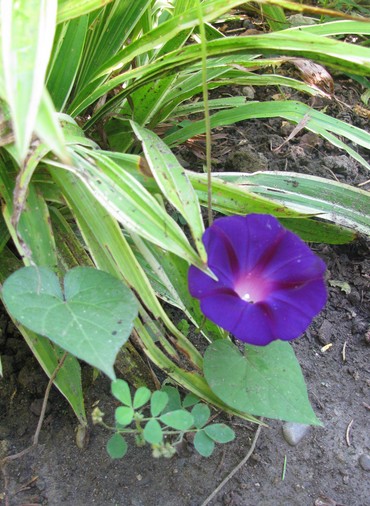
And one especially nasty ground cover that’s trying to take over the world
—and thinks it’s fooling everybody with its lovely purple blooms

So… what’s in your bucket?

♣♣♣
You might also like:
 

bird brain

All monkey minded during yoga in this morning’s mugginess.

Cardinal sings at the very top of a skinny birch; it’s hard to focus on my Om so I focus on his.

But my mind is slippery today and the moment it wanders, the bird is gone.

compass

A strange goldy light in the garden this morning; the kind that sometimes comes before storms or in those moments just before sunset—always fleeting and rarely at dawn. A little eerie but entirely beautiful. It comes from the east, over the roof to catch the tops of the spruce. A train clatters past in the south and to the north is the smell of toast. Meanwhile, at the most westerly edge of the yard, a cardinal points out the ripening blackberries by swishing about the bushes and probably stealing a few.

These are the things that tell me where I am.

beginings and endings and beginings again

For weeks now I’ve been dipping in and out of Beth Powning’s book—Seeds of Another Summer, a gorgeous thing of full page photos and essays, and I think the first book she published (1995), some twenty-five years after having moved to the wilds of New Brunswick.

I can’t seem to help myself—no sooner do I say ah, yes, that was nice, and set the book aside thinking I’m done with it, than I find myself opening it again (and it’s a library copy that must go back which is terrible and makes me think I need to place a call to my bookseller to find me a good used copy so I can continue dipping at leisure).

What I can’t get enough of, I realize, is the feeling of having a very pleasant walk with someone who loves nature and knows enough about it to know she has a lot to learn—and having this person point out the million things you don’t see along the way because you’re too caught up in looking at the whole.

Powning is great to walk with. She notices spider webs at dawn. And the hieroglyphics of bird tracks in fresh snow. The shadows trees cast. But she’s honest about the journey from city to country and how she didn’t see these things at first.

From the section on ‘Gardens’, she writes about the veggies just starting to grow in June when “…it’s so easy to nick the shallow-rooted weeds from their tenuous holds…. For a while, the garden grows just as I imagined it would, just the way I sketched it on paper, last February….Quickly, though, it passes this quiet stage and moves on to a startling urgency of growth….Thistles with roots like parsnips erupt through the straw in the cabbage bed. Mint creeps slyly amongst the broccoli. My fingers fly like a typist’s around the corn stalks, scrabbling away weeds which spring up nightly.…[By] late July, early August; the garden pressures me with its heedless and chaotic production. Keeping up with it is like trying to prepare dinner with guests in the kitchen, children underfoot, the phone ringing, and unexpected visitors pulling into the driveway and honking their horn.”

And I love her honesty and think: oh how very nice to know I’m not the only one who starts each year’s garden believing that this time I’ll keep things manageable—no bolted lettuce, no overripe cucumbers with seeds the size of foreign currency or woody zucchini because I forgot to pick it. 

Blackberry Patch

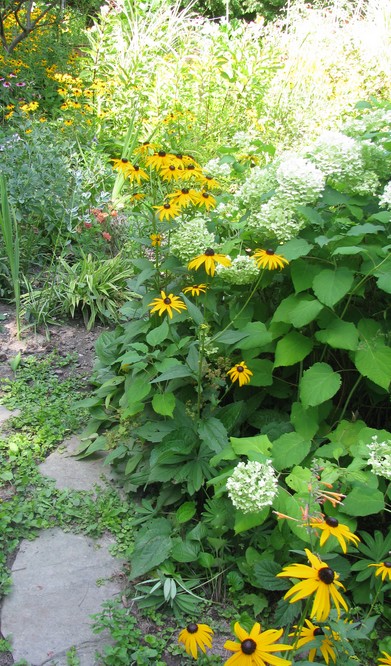
 Ha! Powning says to that, and suddenly I feel okay about the fact that my blackberries are overrun with Black-Eyed Susans and instead of beating myself up over it, I decide to take a picture and send it to a gardening friend in England, one of those people who you assume would never allow anything as slovenly as bolted lettuce in her garden…

—or maybe it will delight and reassure her.

Powning makes me want to celebrate my lovely crop of errant flowers.

In the section called ‘Boundaries’ she talks about the idea of home at the edge of wilderness and the misconception that nature is somehow separate from civilization and how that view changed as she began to understand and ‘know’ the fields around her, and stopped imposing on her expectations and assumptions of what it was.

     “Boundaries: between the geese and me, between the crickets and me. Yet the longer I listen, the more I hear.”

The photographs are of things we’ve all seen a thousand times: hillsides of freshly mown hay, a single buttercup, a spider’s burrow (okay, a few things we’ve never seen), but completely stunning in that way that can sometimes leave you in awe at the magnificence of ‘ordinary’. There’s also a sense of integration, of us and them, how the presence of one affects the other. A brilliant shot of footprints through a dewy morning field says it well.

It all seems so obvious when seen through her lens.

There is a section on ‘Trees’, another on ‘Wild Plants’ and, finally, ‘Home’. The last picture in the book is barn roofs at dawn. How perfect.

      “…Then, like a well-lived life, comes the quiet. I pull up the plants that have finished their cycle. Into the wheelbarrow I toss bolted lettuce, bush beans whose leaves are brown and crunch, and exhausted zucchini.
     “…There is a different kind of peace in the garden, now. It is not the serenity born of potency, and affirmation, but the quiet of fulfilment, and endings.
     “…At the end of the season, my garden plan is all but forgotten, and my illusion of stewardship long gone. Instead, like another harvest, there is another year’s memory of the voyage I have taken, swept, like a leaf, away from my own small visions and into the vast, potent current of regeneration.
     “…Autumn is like a long, deep breath drawn after some endeavour of great intensity.
     “Nasturtium leaves rot, quietly, into the soft mould between the raspberry canes.
     “In the end is the beginning.
     “In the garden is the whole universe.”

—from ‘Gardens’, in Seeds of Another Summer.

~

From the Re-Run Series: originally posted in September, 2010.

spring fever

There’s nothing to explain why I’d make public this merry bit of drivel composed while drinking lapacho bark tea on the patio one morning, other than the kind of confused thinking brought about by elevated temperatures. Although, really, I’m fine, thank you.

But it’s spring and things can sometimes get silly.

So here’s my contribution…

I call it ‘Springing Forward and Back’, because, really, what else could it be called other than, perhaps, ‘Ode to Those [and you know who you are] Who are Each Year Surprised When Wildlife Returns to Their Prized Lawns and Gardens and Whose Noses Wrinkle at the Sight of Droppings Near the Hydrangeas as They Wonder Aloud Whatever to do About the Rabbits and Squirrels and Ducks Who Refuse to Stay Tucked Away in the Wilderness Where They Belong but Stubbornly Hang About Instead in Respectable Neighbourhoods That Were Fashionably Carved out of the Wilderness and are now NOT Wilderness and Who are Not Impressed with People Like Me Who Welcome Said Wildlife to our Un-Manicured and Un-Lawned Garden Because I Figure There is Enough at the Buffet for All of Us’.

But that seemed on the long side.

So, ‘Springing Forward and Back’ it is—

The garden has become a couples retreat
cardinals first, become regular guests
then the rabbit starts bring a date
(it looks serious)

now Ethel and Norman arrive
swim in the snow melt of tarp covered pool
(it looks serious)
preening wings, paddling feet

swim in the snow melt of tarp-covered pool
“over here!” rabbit calls to his date
preening wings, paddling feet
and the cardinals dine on black seed

“over here!” rabbit calls to his date
withered greens, water, feed, put to good purpose
and the cardinals dine on black seed
if not allowed to eat here they’d kill the prize orchids

withered greens, water, feed, put to good purpose
god forbid they bathe nude in the fountains!
if not allowed to eat here they’d kill the prize orchids
a retreat from the lawns, manicured, clipped

god forbid they bathe nude in the fountains!
yes, bring them, we say, your friends and your lovers
retreat from the lawns, manicured, clipped
spread your wings, fluff your fur and relax

The garden has become a couples retreat
cardinals first, become regular guests
then the rabbit starts bringing a date
(it looks serious)

mad weather soup stock

Includes snow-covered celery.

This, thanks to erratic temps. Plus ten one day, minus twenty the next. Rain, snow, heatwave, snow. The poor plants haven’t known quite what to do. Up, down, die, live?  It’s been all happy confusion. In fact, until recently I was still [amazingly] snipping the odd bit of greenery—arugula, parsley, thyme, celery leaf.

Alas, I think the foraging party may be over. Seems the gardening season has finally, officially, and abruptly, come to some sort of pause.