this is not a review: ‘what milly did’, by elise moser

 
Milly Zantow falls into the category of People You’ve Never Heard of Who Have Changed the World. In this case, the world of recycling. Because Milly Zantow is the person who created a tiny thing called the global recycling standard for plastic,  more commonly known as the-numbers-inside-those-little-triangles-on-your-water-bottles-and-stuff.

It’s what made plastic recycling possible.

But it’s the HOW this all came about that’s jaw dropping. What Milly Did  (a childrens’ book for all ages, including adults in my opinion) by Elise Moser, is an extraordinary story about a woman who, at age sixty or so, decides to do something about the growing problem of plastic in landfills.

9781554988938_1024x1024Turns out that plastic wasn’t recycled because no one thought it could be done.

Enter Milly, an ordinary woman, raised on a farm, who has no experience in anything even remotely related to anything to do with recycling but who just really believes that something can be done.

So she says pfffft  to the naysayers and starts reading about plastic; she studies it, takes courses, learns everything she can then cashes in her life insurance policy, buys a gigantic grinding machine and opens a company called E-Z Recycling where she and a few others do much of the grunt work by hand, seven days a week.

“She called the Borden Dairy Company in Milwaukee and asked them how they manufactured their plastic milk jugs. What did they do when they made a mistake? she asked. They told her they just melted the deformed jug down and reblew it. That was an ‘Aha!’ moment for Milly.”

Moser captures Milly’s spirit as a woman who is in no way ego driven. Nor is becoming rich her motivation; she simply wants to make sense of trash and to that end she does whatever she can to help people recycle, including establishing programs in nearby towns.

Eventually her vision catches on. Various community groups form, tipping fees for landfill sites are established and in 1988 her system for grading plastic is adopted by the Society of Plastics Industry, which means a standardized recycling practice across North America.

The story, of course, isn’t quite that simple. There are many hurdles along the way, people who laugh, who say that what she’s proposing is impossible, and then there are the times themselves, the 1970’s and early 80’s, which aren’t overly receptive, or even friendly, to the idea of recycling. Moser has done an excellent job of telling Milly’s story against this back drop of time and place.

A clever addition to the story are sidebars throughout the book, telling about bridges and boats made of plastic bottles, stats on current plastic usage and where it all goes, yo-yo trivia!, the ABCs of modern recycling, innovations in biodegradable plastic… all bite-sized, very readable for any age, and all to the accompaniment of sweet b&w illustrations by Scott Ritchie.

That this is such an unknown story is mind-boggling. I’m grateful to Elise Moser for telling it. It needs to be shared. I hope the book will find its ways to schools and to homes, not only as an eye-opener to an important piece of history, but to open at least two kinds of conversation… One,  about the problem of a planet full of garbage and, two, the power we have as individuals  to make the world better.

Finally, what maybe I love most about this story is what Milly didn’t  do… she didn’t complain, blame, whinge or whine or suggest that this problem to solve was someone else’s job… 

Or that the difficulties she faced were someone else’s fault.

She just got on with it.

The world could use more Milly.

every party needs a pooper, that’s why you invited *me*…

 
Here’s the thing.

The Blue Jays.

Winning.

How great. I mean, it’s really great. I get that. Even though, in the spirit of full disclosure, I don’t give much of a rat’s back-end about sports.

I do, however, like happy people, I like the excitement, the joie de vivre all over the place (on game days), the way revellers make room for traffic. I love us. We deserve this, the winning, the mad happiness. Who wouldn’t love it?

They say this kind of thing brings people together. On game days. And the economy gets a boost. Liquor and beer stores, junk food purveyors. Hotels, TV networks, airlines. You know, the people who need a boost.

Oh, and Rogers Communications. Owners of the Blue Jays dynasty. Apparently their shares have gone up rather noticeably during this period of frenzied winning/not winning/winning. The TSX, on the other hand, went down during the same period. But let us not concern ourselves with negatives.

The Jays are winning!

And we are being brought together as a community.

On game days.

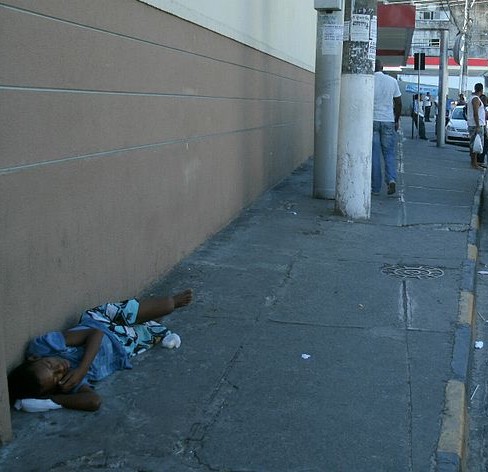
However, in between and especially after the game days are over … it is, sadly, business as usual. That’s to say the homeless (‘boosted’ too by all the Blue Jay excitement) will still be homeless. Children will go to school hungry. If they go at all. Women will be beaten by spouses, some of them sports *stars* high-on-winning  adrenaline, some just assholes, others on welfare, most somewhere in the middle. Old people will still die alone and prisons will continue to fill and the rest of us will still hate and judge and hate some more. No matter how big, how grand or how much money is thrown at sporting events, no matter how exciting or how often we are told these things bring people together… there are no games that have brought the world, or even a city, or even a community, together in a way that sticks beyond the game days. As far as I know, no Olympics or World Series has erased persecution, corruption or any manner of ‘isms’. After the winning, a handful of men will wander off into the horizon with truckloads of gold while the rest of us are scraping cold pizza off our couches. Nothing will be any different. Aboriginal communities will still have undrinkable water and mould on their paper thin walls and the oceans will still be clogged with the debris of our need to turn away, to be distracted by something more pleasant than reality, like the easy god of sports and winning. (Remind me…winning for the sake of what again?)

Oh yeah. Because winning is fun.

Right.

I get that. I do.

It just seems so trivial. The players and owners, I understand why they want to win. (And it’s not for the joie de vivre.) But what do we get?

(I know that certain players and individuals contribute privately to various organizations with their time and money… it’s not about individuals. This really is about the owners, the corporate aspect of sports.)

So I was thinking, what if we got something too… what if the corporate aspect, the people that make the ten trillion dollars from our love of the game celebrated each win by donating some of their gold to the community. To feed those kids or build some housing or offer opportunities to people who’d otherwise have none. There are agencies in every city that would gratefully accept a few thousand bucks. A few hundred  thousand, for every game won during playoffs… well, that could change  a city.

Now that would be worth cheering for, winning  for, no?

“Big Sports” (and it’s always ‘male sporting events’) are a powerful vehicle. By adding this element we lose none of the fun. All we do is add ‘goodness’. It stuns me that we don’t demand it.

800px-Enfant_sans_abri

Just an idea.

From your neighbourhood party pooper.

xo

(p.s. go jays.)

in fairness to men

 
There’s so much inequality. For men, I mean.

For example, a couple of weeks ago, on International Women’s Day, a few chaps harhar’d about why isn’t there an International Men’s Day??

Turns out there is one.

But the sentiment remains: the women’s version gets more attention.

And that begs a few questions. Beginning with why?

Because if you look around, you’ll soon realize it’s all about the women. And I can see how men might be feeling left out.

Even something as simple as a title… women luck out. They’ve got so many to choose from. Miss (status: available), Mrs. (status: unavailable), Ms. (status: pain in the ass feminist who refuses to say if available or not). While men only get one. Mr. (status: male).  Fine, we know they’re male, but how are we expected to know their status??

It gets worse.

Consider the TV show, ‘Toddlers and Tiaras’. Where’s the boy version? One that features spray tanned four-year old lads in speedos and fake facial hair who are encouraged to pat their butts in saucy ways while winking and blowing kisses to strangers?

The moms on the show say this gives their girls confidence and boosts their self-esteem. Hello!  Boys need self esteem too. How else to prepare our sons for teen and young adulthood when, instead of being relegated to host or judge, they should be entering  beauty pageants.

Where are the beauty pageants for men??

And what about fashion? Why do designers hate men so much? It’s almost impossible to find skin-tight clothing in the lad’s department, never mind shoes with heels high enough to flatter the calves. And what about pushing things up? Couldn’t men benefit from a little under-wire support… somewhere?

While we’re at it where is there a Victor’s Secrets?

And the media, shame on them. Always focussing on what Angela Merkel is wearing. What about what Vladimir is wearing???  Sure, he pretends he doesn’t care, but all that attention to what he does rather than how he looks must get to him at some point.

And magazines. I can’t imagine being a man walking past a magazine stand in a corner shop, drug store, grocery store, newsstand, airport, well, everywhere really… they just can’t get away from the humiliation that is the outright boycott (let’s call it what it is) of men’s pretty smiles and perky buttocks on covers. After all, they have just as much right to air-brushing and ‘visibility’ as anyone else. Damn straight they do.

Then there’s what’s in  those magazines. And, as can be expected, it’s NOT men’s issues. Which begs the question:  where are the ads and articles and 10 Top Tips featuring Mens Problems? How are men supposed to know how much is desperately wrong with their eyes, neck, ear lobes, teeth, cheekbones, jaw line, hips… well, you know, things that are messed up. How are they supposed to become perfect if they don’t have instructions???

And where are the age-defying creams for men? It’s a travesty that the entire cosmetic industry appears to give less than a rat’s ass about the condition of a man’s pores or the depth of his wrinkles.

And his hair? Is it supposed to just go grey??? Is he supposed to walk around with grey hair??

Where are the instructions?

Men are right. Women get all  the attention.

And men do all the work.

Just watch any film. They’re doing all the work. Behind the scenes as well. And look at history. Men, men, men. They did it all. Women mostly knit while the universe was carved out by the fellas. And the space program and sports (yes, women do trouble themselves to play sports and get into rockets but who cares, they don’t do it right, or something). Look at science (it’s not hard to avoid the women)… it’s mostly frazzle-haired men we know the names of. The faces on our money. Painters, playwrights, protagonists, sculptors.

Consider what’s happening in any corporation, any religion, any government, any board of directors. Look at the military, any military. Hells bells, almost any industry you can name is run by men. Essentially, the entire world is run by men. Does anyone even begin to think how exhausting this must be? Obviously not or there would be a few more ads for spas featuring our menfolk in sexy robes and towel turbans sipping cellulite busting guava juice, legs crossed (also waxed), and chatting about non-essential, stress-free issues.

That we have an International Men’s Day is good news, but in fairness to men, that shouldn’t be where we leave things, with a simple token gesture. No, let’s give men a better start in life by treating them equally right from toddlerhood. Teach boys to cry and play coy and let other people ‘go first’. And let’s lobby the cosmetic and fashion industries to take into consideration the feelings of young males and how they, too, would like to know what’s wrong with them and that they, too, would like to think about this constantly and to have goals such as pectoral implants and hair extensions and striving to have an ass that looks good in skinny jeans.

Let us encourage our sons to be the go-go dancers in music videos.

And let’s explain how winning isn’t everything, it’s how you look and that maybe, if they look really, really good, they might find the right person one day and then what will winning matter anyway…

Let us tell our sons that if they must work, they should become nurses not doctors; waiters not chefs; receptionists not lawyers.

And please, let us for once and for all stop assuming that only men should do all the work.

Let us allow them fulltime child care, to assume the role of homemaker and caregiver to the elderly; baker for fundraisers, cafeteria monitor at Susie’s school, anything that will give them more time to just chill at home. To get their nails done.

Surely, this is the least of what they deserve.

Damn straight.

You go, boy!

501px-Maes_Portrait_of_a_man_in_a_wig

the art of nothing


I was googling the title to see if there were already a hundred things called this and it seems there are not. In the process I found a short film made by an actor posing as one Hans Freeberling, an artist installing a show about nothing. The gallery is empty. People come. They think it’s real, that the artist is real, and so they try not to scratch their wee wannabecultured noggins until, eventually, they make up Their Own Point for the point of the nothingness. Because there must be one, right??

As a satire, it’s gorgeous. Says so much about us. Most of which is questionable, but there’s this too: that faced with a blank canvas, real or metaphoric, we can choose to impose our own thoughts. This is a kind of art form in itself. Getting People To Think From Ground Zero, we might call it.

The lack of ‘something’ might also be compared to a one word poem. Or a single toilet cemented to a wall. I mean, we can have real discussions about these things. (I recently had a strangely satisfying time discussing the ‘poem’ balloon. One word. Discussion went along the lines of who says it has to have only two L’s and where’s the law about the emphasis remaining on the second syllable… and so on.)

There’s always the chance these chats will lead to… oh, something interesting or important even. Possibilities are always endless where conversation is concerned and, really, anything at all can be a prompt.

But because something serves as a prompt, or because it causes us to think in possibly new ways… is it art? And who gets to say?

And what isn’t  art?

And who gets to say?

I’m not looking for a definition. Or even an answer. Is there even an answer? Tons of opinions. And all manner of conversation and argument and (most sadly of all) very little light-heartedness about things, including toilets, so I’ve decided to stop asking. In fact this whole ramble is a digression.

**

What I meant to write about is nothing, the art of it.

Which leads me directly to my dad, a chap who would not have called himself an artist though he played with paint, on both canvas and walls. He built our first house then spent decades renovating the second. The garden too. Rockeries and rose beds. Our hedge was almost a topiary. If he wanted a fence, he’d go down to the beach, find some driftwood and make one. Then he’d make a driftwood coffee table, an end table, a floor lamp. He made bookshelves. A fireplace, a BBQ and a bird bath out of stone and in the rec room he painted a wall to wall, floor to ceiling mural of a favourite spot under a tree on a beach in Barbados. He included my mother’s striped beach bag hanging from a branch. (The people who bought the house after my parents died, said the mural was a selling point.) He built two patios and a car port, refashioned our front door, and the back one too, to look more Spanish, a style he liked. And then he began making the inside look more Spanish too. To his mind anyway.

He did all this after his day job, and on weekends. Mostly in Hawaiian shirts, paint splattered pants and shoes with no laces.

This was his thing, this making.

I used to wonder how he thought up all this stuff. How could a wall that looked perfectly fine to me in its bareness or with a few holiday pennants hammered on, to him scream: paint a beach scene!!! don’t forget the bag.

He did a lot of sitting in-between the making. This was all before busy-ness was invented, when people really were   busy, doing real things without an abundance of appliances and before nannies and dog-walkers. These ancient busy people, it seems, made time to sit, have a coffee, light a pipe, and if you were to join them, say, at the picnic table on the handmade patio, they wouldn’t talk about being busy, they would say something about squirrels or sedimentary rocks or have you noticed how many buds are on the apricot tree this year? You might be wearing pedal pushers and drinking Koolaid when you ask if there’s such as thing as UFOs and they might draw a few times on their pipe, think for a minute, let the smoke out nice and slow as they say could be, who the hell knows…

My dad would be surprised to learn that the most important thing he taught me was not to make sure the vice on my workbench was closed at night or how properly to wash a car, but how to love what you do, to do it as well as you can and, most importantly, to take time for the nothing. In fact, he’d be surprised to know he even did it.

Some of my favourite moments, those nothing ones. Still are. I realize in my own nothings that that’s where we re-fuel, where we find our next mural.

A whole different kind of art.

DSC02051 DSC02055


lines and circles


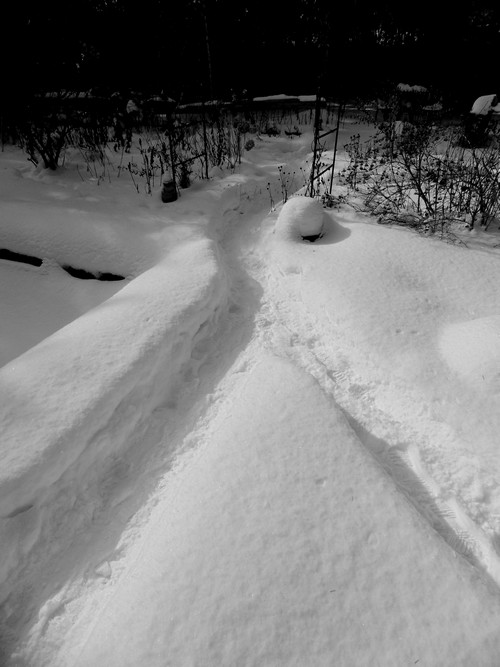
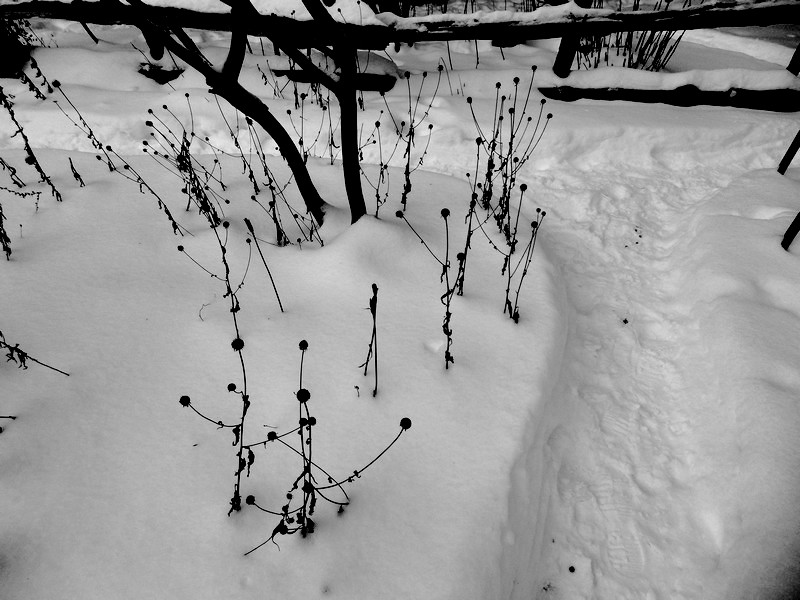
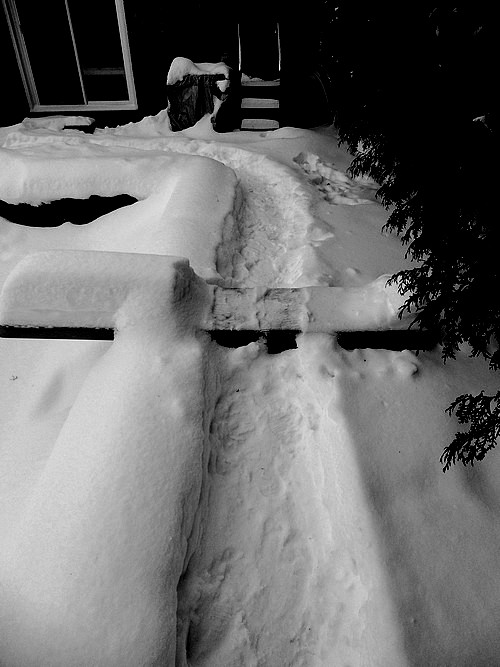
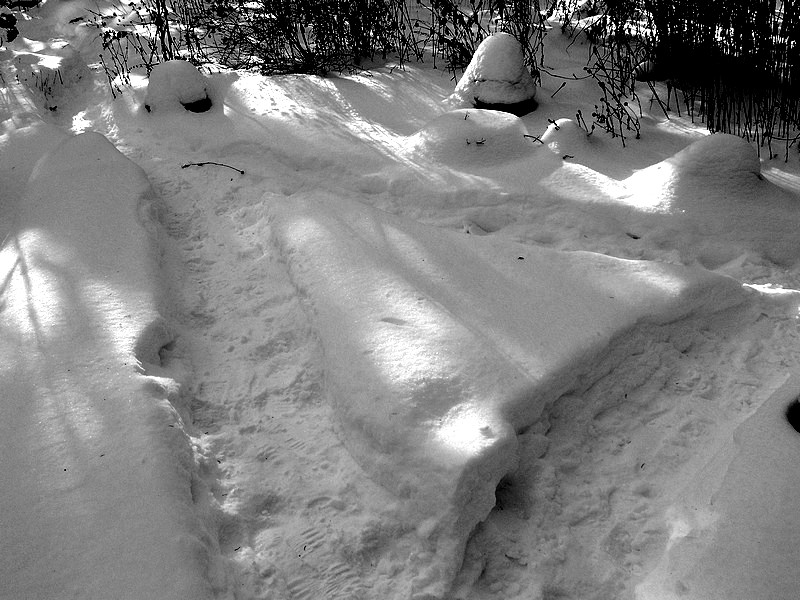
I have a labyrinth.DSC02015I made it out of snow.DSC02017It runs past all the stuff I didn’t cut down because the birds like the Rudbeckia seeds… and I didn’t get around to the tall grasses or the hydrangea.DSC01932_1DSC01927A trained eye will see that it’s technically more “snowy paths in my yard”… but it works exactly the way a labyrinth does.DSC01922That is, you walk and walk and walk in a more or less circular way, turning left or right without thinking because the goal is not to think — once you begin thinking you’re toast. At that point it becomes less meditative labyrinth walking and more I wonder if the neighbours are frightened yet  walking.DSC01921If you’re doing it right, you’re not thinking a single thing except maybe about the crunch, crunch, crunch of the snow under your steps. The zen of crunch.DSC01946It’s occurred to me to wonder how many steps long the labyrinth is but I’ve never paced it out. There are angles to be considered and the whole process would require a certain amount of addition.

And who needs the math…

DSC02020

On the subject of labyrinths…

bikeless in ontario

I’ve been thinking about bikes more than usual lately. I haven’t had one in over a year and everywhere I look it seems there are places to cycle or things to gather and bring home in a basket between handlebars. I love my old car and where it takes me that I would never go by pedal power alone but there are just so many places between walkable and driveable that perfectly suit two wheels.

And maybe because I’ve been thinking about them, I happen to see more of them, and not just the usual sort either. The other day I saw a tricycle built for two; this large three-wheeler with two seats and two sets of handle-bars, one behind the other. The couple driving were seniors and it was just the most wonderful thing.

I saw a teen-aged lad on a unicycle a few weeks ago. I wanted so much to stop (my car) and take a picture but I felt it might unsettle him and I didn’t like how that possibility played out in my mind. (How does one even stop a unicycle?)

And there’s a guy, maybe in his fifties, maybe older, who rides/pedals/powers a bike that has steps rather than pedals. Like a step machine in a gym. It’s a standing bike that the rider/pedlar powers by stepping one foot at a time, so that one’s whole body moves up and down. I love this thing. The idea of standing instead of sitting seems vastly more comfortable and, given how much sitting we already do, maybe better for the hip joints.

I think about hip joints more and more every year.

The bikes I’ve had in the past are not the bike I want now. For instance, I do not want the red and white tricycle I loved at age six or seven or eight, which I drove at top speeds, fancying myself the envy of both peers and adults. I’m no longer interested in speed or style.

The one after that was green and huge and originally belonged to my much older and much, much taller sister. I don’t remember ever being able to sit on the seat and pedal at the same time.

Then there was the gift of a brand new golden three speed during my teen years. I rode it but never loved it. I didn’t like the colour and instead of a funky banana seat it had the standard issue kind, seriously uncomfortable. And only three speeds? It served me well though. Spent lots of time riding along country roads looking for places to steal fruit and trees under which to read. It had a utilitarian pack above the rear wheel which I could stuff with peaches and paperbacks.

When I moved to Toronto I bought a rust-coloured bike at Canadian Tire, called it Rusty. When I moved to Edmonton, I took Rusty with me. We had some good times and I wouldn’t have wanted to be there without her. But then I moved to England and left Rusty behind. Sold her, gave her away, I can’t remember and if you don’t mind I’d rather not talk about it… [sniff]

In England I had a big black Oxford bike that I rode through a field to get to Waitrose, and down a cobbled hill to get to the corner shop.

Back in Toronto I had a bike that I can barely remember and when I first moved to the town where I now live I had a ten-speed that was entirely wrong. Ergonomically wrong. For me anyway. For one thing it required me to sit hunched forward, grasping those twisted-under handlebars, which I don’t like. I like normal handlebars and to sit upright like old schoolmarms.

The last bike I had,  a hand-me-down from my mother-in-law, was sky blue and had the right kind of handlebars. I got a wicker basket for it and quite liked it, but the dear old thing was ancient and eventually toast.

All of this to say: I’m in the market for an addition to my list.

Suggestions, anyone?

Makes, models, testimonials welcome…
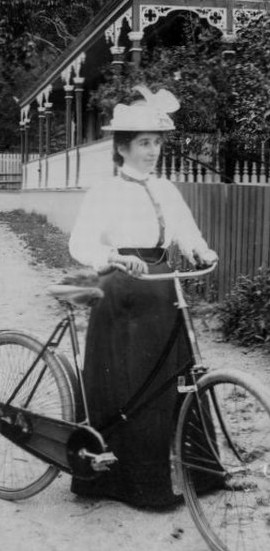
Cyclists_In_Thames_New_Zealand_Ca_1895

WikiCommons knows bikes.


welcome to my dream(s)

One of my favourite new discoveries—The Sketchbook Project.

Such a clever idea by the people at the Art House to share and promote various forms of art—and have fun doing it. Imagine.

Anyone can join for the price of a blank book, which is then ‘arted up’, sent to New York, digitalized, and then sent on a tour across North America with some very nice stops in the process, including both the MOCA and the LACMA in Los Angeles, Toronto’s Distillery District, Vancouver, Portland, Houston, Chicago, Philadelphia, Santa Fe, and others, before returning to its permanent home on the shelves of the Brooklyn Art Library, where anyone can visit at any time.

Here’s a great little write up by Ashville BookWorks, in North Carolina, where the exhibit rolled through (in a custom built bookmobile) in March.

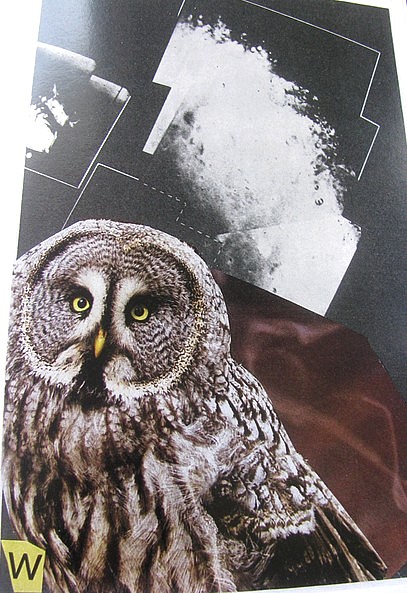
My contribution — I am Somewhere  — a collection of dreams (yes, mine) with illustrations in collage. (What else does one do with dreams?? And am I the only one who, when explaining a dream to a friend, begins with that vague sense of being “somewhere…” and if I am [the only such one], what do other people begin their dream-telling with? And if you don’t tell dreams, why not? And if you don’t dream… um, Freud has something to say about that; can’t remember what.)

Anyway, it was a great lark and I thoroughly enjoyed the two winter afternoons devoted to it. Nice to exercise a different muscle. And thank you, dear local library for your abundance of cast off magazines.

Here’s a sample of the madness:

**
I’m somewhere,
reading about owls
and how their wings
make no sound
(there is down involved in this magic)
and then I fall asleep and in my dream I dream about
owls flying in a line across
the sky… but my double dream state
doesn’t believe that they are really owls
even though their chubby cigar shape
is unmistakable.
They fly to the west (my left)
and then disappear bit by bit
in puffs of smoke
or clouds
or swirled air.
IMG_6594
More somewheres here.

take a city

Take a city. Any city.

Take one that despite its city status has a crazy small town vibe where people still say “Oh, you mean where the Boychyns used to live?” of a house where the Boychyns have not lived for decades. Where everybody seems to have gone to school with somebody that somebody else knows and where possibly one of the best chip trucks in the country is parked on a distinctly unglamorous corner.

And where, because it’s a city, terrible things happen—women and children end up in shelters and young men are sometimes shot. There are daily lineups outside the St. Vincent de Paul soup kitchen and a crowd of smokers huddle outside the Timmy’s. There’s sadness on the streets, insanity too, but if you stop someone for directions chances are you’ll be surprised by kindness, by the thoughtfulness of the answer.

Take a city where you are stuck behind a woman at the corner shop whose husband has a new hip and the cashier wants to know how things are going with Ted. Be prepared to shift about, to be on the verge of muttering unpleasantries when you’re overcome with relief to hear that things are on the mend, that Ted is doing okay. And just as you consider taking up peevishness again, the silver-haired woman turns to you and says “Men, eh! The old farts don’t know how good they’ve got it!”  When she snaps her purse shut with a happy cackle, you can see her kitchen, the apron on a chrome chair, a kettle that’s always just boiled, her whole house smelling of pie and Hamburger Helper… and as she leaves you almost want to shout “Say hello to Ted for me!”

Take this city and its factories, its history of lunch pails, shift work and layoffs, picnics at the lake, fights at the bar, a gallery of fine art. A city where people who live there wouldn’t live anywhere else and those who’ve never visited have crystal clear misconceptions.

Where economic nose dives hit extremely hard. Hard enough to close down small businesses. But not all… people are loyal to old favourites.

And new favourites emerge from the rubble.

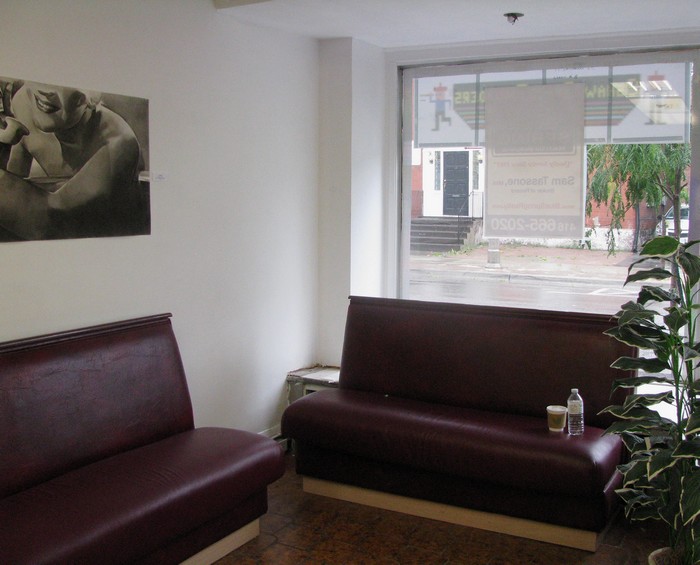
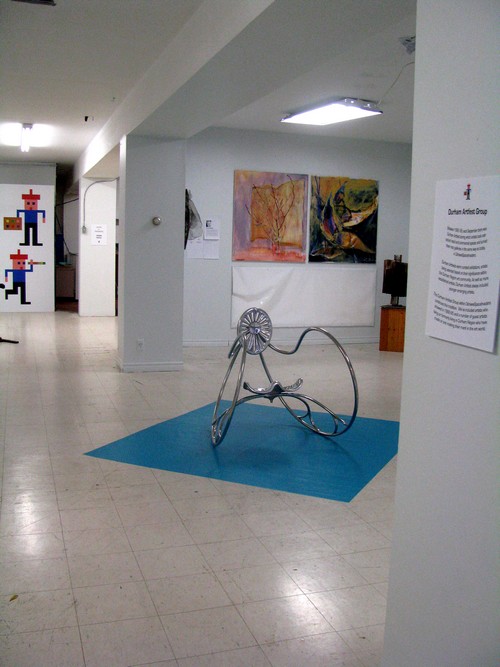
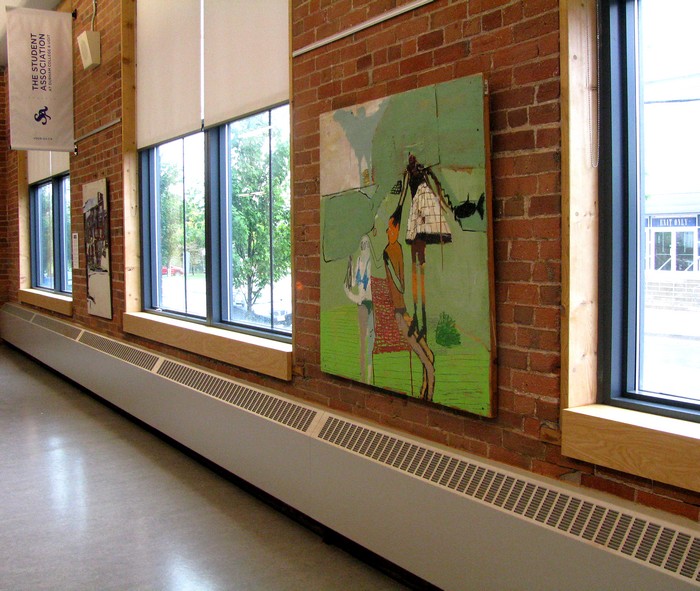
Take a city where, among the alleys and row houses, brick bungalows, flats over tattoo parlours, funky cafes, restaurants and thrift shops, among empty storefronts… a group of local artists have invadedfilling spaces behind doors that are normally locked with ‘For Lease’ signs in their windows… filling those spaces with people, art and music.

At least for a short while.
IMG_3584 - CopyIMG_3585 - CopyIMG_3586 - CopyIMG_3587 - CopyIMG_3588 - CopyIMG_3591 - CopyIMG_3592 - CopyIMG_3594 - CopyIMG_3595 - CopyIMG_3597 - CopyIMG_3598 - CopyIMG_3599 - CopyIMG_3617 - CopyIMG_3618 - CopyIMG_3619 - CopyIMG_3621 - CopyIMG_3629 - CopyIMG_3630 - CopyIMG_3632

Take a city that can’t be broke.