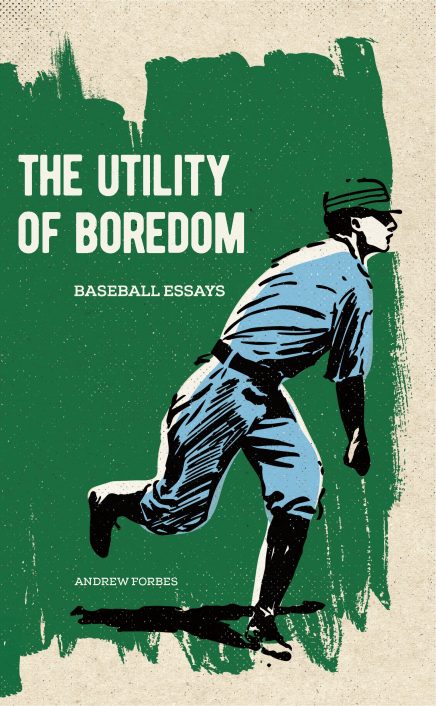
this is not a review: ‘the utility of boredom’, by andrew forbes

 
Here is my entire lifelong experience of baseball:

In gym class, being the last person to be chosen for the team, always.

Nieces and nephew who played baseball.  (Oh, did they? I only recall attending one game and being totally confused by everything including why all the parents were yelling.)

Children of nieces and nephew who currently play baseball.  (If they’re happy I’m happy for them… yawn.. It’s still not my favourite outing but I bring my camera these days and that makes it better. Here’s a pic I took at a recent game. I call it: things I’d rather be doing than watching baseball.)

The World Series, 1992(Even I contributed to that decibel level.)

The one Jays’ game I’ve attended.  (We had excellent seats apparently but it didn’t help the tedium. Have blocked out the details. Nothing to report.)

Two friends and one house painter who rhapsodize about the religion of baseball. (The earnestness of their comments has stayed with me for years and keeps me oddly curious about the WHY of whatever is the game’s draw.)

And then into my life falls The Utility of Boredom, a collection of essays, which (to my complete surprise), explain so much, not the least being that boredom is integral  to the game—it’s an actual thing,  like the space between notes played on a piano, that part of the beauty of baseball is that there is time for climbing trees. The theory is Forbes’… the analogies, mine.

Forbes’ style is casual, anecdotal, written with a wide knowledge and deep passion for the game yet readable on different levels, depending where you are on the baseball knowledge continuum. For neophyte me, it was all pleasure of discovery and details that will forever stick, like how baseball is made for radio in a way that doesn’t work as perfectly for other sports, how the rhythm of it allows you to have a game on in the background as you go about your day and you don’t miss a thing.

I like that image.

It’s an oddly comforting book. And I’m not even sure why I’m choosing this word, but it’s the right word. I enjoyed the reading, enjoyed having my eyes opened to the ‘comforts’ this game seems to offer its fans.
In ‘Sanctuary’, the opening essay, Andrew Forbes explains his own introduction to baseball and that feeling of safety and the-world-suddenly-makes-sense  vibe inside a ballpark. ‘Jim Eisenreich’s Eyes’ is about finding a morality trigger from a baseball card. ‘Ballparks of America’ is a surprisingly beautiful tribute not to the stadiums and their legends but to the towns and the people that define them, delivered in bite-sized morsels.


“In Sanford, Maine, a woman tells you what the mill closures have done to the town and how there are no tourist dollars because Sanford is so far inland. Orchard Beach catches all the tourists. But Sanford has its little ballpark proudly bearing a ‘Babe Ruth was here’ plaque…”

“In Seattle, from your seat high up in the Safeco Field stands, you can see Mt. Rainier as well as Felix Hernandez. Both are astonishing…”

“In Los Angeles they beat a man into a coma for wearing a Giants jersey…”

I very much doubt I’ll ever be a seamhead (baseball fan) or even enjoy watching a game, but neither will I ever again doubt the sincerity with which those who love the game love it. Also, I believe it’s important to understand The Other… and though sports remains a weird thing to me, The Utility of Boredom has gone a long way to explaining its appeal on a deeper level.

“Boredom, in the baseball sense, is a synonym for lackadaisical; it’s the only proper response to all that green grass and blue sky. Slouchy in the Viera stands, the beery patrons were in no hurry to shake the peanut shells from their hair and return to real life. They wanted to sprawl over those sticky plastic seats for which they’d paid. And the players—the unknown pitcher on the mound palming the ball mindlessly, the batter stepping in, stepping out, stepping back in, adjusting his cup, a batting glove, his helmet—were happy to oblige.

“This is where good radio announcers truly shine: filling the space. I once heard Vin Scully…. describing a cloud over Dodger Stadium and it was the most riveting and moving 30 seconds of the the entire broadcast. It’s for this reason too that baseball became a game of such minute statistical detail: that folks at microphones should have something to say when there was nothing to discuss and nothing happening on the field.”

So glad I stumbled upon this.

I wasn’t disappointed in the least.

Nor bored for even a moment.

(&, honestly, no one could be more surprised about that than me.)


this is not a review: ‘in this house are many women’, by sheree fitch

When you hear the name Sheree Fitch, you may think children’s books, Mable Murple’s creator or simply one of CanLit’s most beloved player of words.

You’d be right, of course, on all counts, but there is also her adult fiction and poetry and if you’ve missed that, you’re missing a lot.

In This House are Many Women  came to me in a most magical way (what I call the Sheree Fitch effect) and I’ve been reading and re-reading it for months so that it’s pretty much found a permanent spot on my coffee table and sometimes bedside table. Poetry combined with story in poetic form, about and from the perspective of women in both difficult and joy-filled situations… motherhood as a homeless woman, daily rituals, escaping domestic violence, finding connection in friendship, and learning to trust oneself. There aren’t enough books from these perspectives, that of women in shelters, and women ultimately helping women.

It’s the kind of thing, thankfully, most women will never know first hand, but … if you’ve ever wondered what it might be like to leave your house in the dead of night while someone is threatening to kill you if you leave and you keep leaving anyway, keep running out the door because it’s become apparent to you that your chances of living are much slimmer if you stay (chances of living happily are nil), so you keep running, not sure to where or to what, all you know for now is why...

… if you’ve ever wondered what happens next, then this is the book to read.

It’s Milk and Honey  for grown ups. Only better, and in a league of its own.

First published in 1993 and reissued in 2004 by Goose Lane, In This House are Many Women is a collection of poems that read like prose, a journey through the life of women. Women in peril. Women as community. Women as resilient survivors. While there is plenty of gritty reality, there is much humour, love, hope and, ultimately, the message that women helping women is how it’s always been, and that  is no small potatoes.

In other words, it’s a gem of a book and I’m stunned that I haven’t come across it before. Since discovering it I’ve made a list of people I want to give it to, not the least of which are women staying in shelters.

The first of four sections opens with a suite of poems following the journey of escape, beginning with ‘The Runner’—

She runs:
past women with drawstring mouths
women with wombs puckered out
from plum to grape to raisin
women who have never known
what wetness means

In ‘What Rhonda Remembers About the First Five Minutes’ there is arrival at the shelter, the sound of a buzzer, strangers, lights, attention, the imagined chorus of:

someone new is coming

— giving the sense of entering a prison. That this house of many women is safe and nourishing takes time to discover. At first it’s only not home. The windows are bullet proof, there are security cameras everywhere. The doors are locked, everyone is a stranger, the police are on speed dial. At first there is the matter of safety, then how to simply function, how to deal with the impossibility of emotions running through you while, at the same time, you are numb to all feeling.

In ‘Edna’, the narrator looks at her swollen face in a mirror “wishing I could see the wrinkles”.

Each poem is another woman’s story. You can almost imagine the conversations as women feed their children or sit in communal areas, drinking coffee, smoking, biting their nails as they listen to one another.

In ‘Valerie Listens…’, the narrator explains how the leaving went for her:

I did not leave because of his violence
I left because of mine
I got another phone call
from another woman
I went in and watched him sleeping
saliva like dried chalk
made a rim around his open
mouth
a perfect target

I had a gun
I placed it on his pillow
then I left.

There are poems about the NIMBYness toward shelters, revelations about the homeless, the roles women play when they share a space, who mothers the others, who is most in need of what and who will provide the whats. Unsurprisingly, from a writer who understands the child mind, there are meditations and revelations from a child’s perspective too (as in god wears flannel shirts).

One of my favourites is ‘Advice’, which is a list of exactly that, beginning with:

Read everything Gloria Steinem ever wrote
her last book first

and ending with:

The best answers will always be questions
You can always call your aunt.

Another, ‘Grand LaPierre, Newfoundland’ tells in pure Fitchean style, the essentials of writing a poem as if one’s life depended on it:

...it doesn’t have to rhyme
but it must always have a beat
a finger-snap
a toe-tap

Fitch is writing here from the inside and the outside. One has the feeling she is both part of this world and an observer at the same time.

The thread running through the book is that words are a lifeline, the writing of our lives, the sharing of our stories, that through kindness and connection with others (including Peter Gzowski’s voice), all kinds of hurdles can be overcome, that we are not alone. It’s not only about women in dire straits, but about women being strong in the way of women…

So you can understand why I can’t bear to shelve it. When a book like this crosses your path it’s good to keep it close, to open it often.

♦♦♦

On any given night in Canada, 3,491 women and their 2,724 children sleep in shelters because it isn’t safe at home.
On any given night, about 300 women and children are turned away because shelters are already full.
‘Why She Stays’

this is not a review — ‘our souls at night’, by kent haruf


I’ve said this before… my favourite books are those where nothing much happens other than whole worlds change.

Oh my lord did I love this book of nothing and everything.

In a nutshell:

Louis Waters and Addie Moore are widowed, long time neighbours, who really only have a passing knowledge of each other’s lives, in the way of neighbours who have shared a street for decades. Aware but not involved.

They’re both good people. And, now, perhaps, also lonely.

The book opens with Addie knocking on Louis’ door and asking if he would be at all interested in sleeping with her. She means it literally. No funny business, just pj’s and slumber. Oh, and talking. That’s really what she’s looking for, that special kind of conversation that only happens when you’re lying in bed next to someone.

He accepts.

He continues to live in his own house in the same way he’s been doing for years, but at night he goes over to Addie’s for a single beer while she has a glass of wine and then they brush their teeth and hit the hay.

(The tooth-brushing is not incidental. Remember this is a story where nothing and everything happens. The details of life are beautifully wrought.)

Once in bed they talk.

At first, of course, it’s all awkwardness, but it evolves into something so essential to their well-being that neither of them can imagine living any other way. They’re not a couple but they’re more than friends. They come to reveal everything to each other in ways they never did in their marriages.

But people being people soon begin to pass judgments, especially those people unhappy in their own lives. Louis and Addie don’t give a fig. If anything the judgements only cause them to judge themselves (which is such a healthy reaction) and when they don’t find anything sinister about themselves they take it up a notch and begin hanging out together in public. Not necessarily an easy decision given how the elderly are made to feel they don’t count, that they hardly have a thought in their heads worth hearing.

Addie and Louis know this is the way old people are seen but they don’t see themselves or others this way. They have such wonderful, admirable balls.

A really charming part of the book is when Addie’s six year old grandson Jamie comes to live with her while Addie’s son Gene and his wife try to fix their marriage. Louis and Addie and the boy become a kind of family unit (along with Ruth, a friend of Addie’s) and Jamie is nourished in a way he’s never experienced. He stops crying, he’s able to sleep at night. Life is good.

“They ate a supper of macaroni and cheese casserole and iceberg lettuce with Thousand Island dressing and canned green beans and bread and butter and iced tea poured from an old heavy glass pitcher and there was Neapolitan ice cream for dessert. The dog lay at Jamie’s feet.” 

All of which royally pisses off Addie’s son when he hears about all that happiness. He decides to pay a visit, assumes (the truly wonderful) Louis has nefarious intentions, chastises his mother for her lifestyle and takes Jamie back home well before his marriage is anywhere near fixed. Then he forces Addie to choose between her relationship with Louis and her relationship with her grandson.

This is one of those deliciously slender books, easily read in a day, spare writing yet saying all that needs to be said, in the way of the best conversations. Satisfying to the core. I would read this one again and again for the layers it reveals and the questions it asks us to consider about family, friendship, intimacy, community, loyalty and aging. For starters.

Haruf is new to me but I’m already looking for more of his earlier work.

Available online at two of my favourite indies — Hunter Street Books and Blue Heron Books.

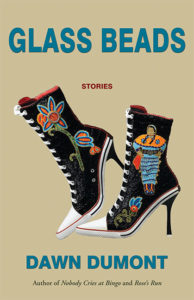
this is not a review: ‘glass beads’ by dawn dumont

 
Classed as ‘stories’ on the cover, I began reading Dawn Dumont’s Glass Beads  in tiny slivers, a page here, an opening paragraph there, trying to find a story that hooked me, a place to begin since for some reason I didn’t choose to begin at the beginning. The truth is I almost stopped reading because these little snippets of things weren’t grabbing me. All I gleaned was that each story was about very young people and various kinds of young people angst.

But something about Dumont’s writing style kept me reading… just one more snippet, and then another. The rawness of the characters (they felt like people I knew, maybe in some cases people I once was), the way she captures voice and her superb handling of dialogue (which soon begins to feel less like reading and more like eavesdropping), all of it coming across so true… and before I know it I’m flipping to the beginning of the book and starting again from there.

In a nutshell:  the stories follow four friends over the course of fifteen years, through the angst of teenhood to the angst of young adulthood.

So what makes it special?

Dumont’s writing. It’s as simple as that.

Also, she taps into a universal feeling right off the bat in the opening story, “Kokum’s House”… with a line about how if you’re told something often enough, no matter how sad….“tears don’t come after a while.”.

The tone of the book is….. let me tell you a story about people.

That the characters are indigenous isn’t incidental.

Not for one moment do we forget these are Native kids growing into Native adulthood and that there are issues, events and problems that are specific to them and to no other culture (starlight tours). But neither do we forget for a single moment that there are issues, events and problems these characters experience that are universal (the floundering of youth, drugs, alcohol and parties), and it’s the way she blends things that gives the book its power.

Dumont has written what might be one of the hardest stories to write, one that features a specific culture (it could as easily be a specific race or religion, a sexual orientation… anything that isn’t WASP and cis-gendered) without shining a light on that ‘difference’ or making the difference  the story.

It’s not about   being indigenous any more than a story with white characters is a story about whiteness.

It’s about Nellie who is level-headed and wise and not especially the popular one, the one who “… had never worked as a waitress but she had delivered beers to her dad in the big chair.” And Everett, who womanizes and drinks too much and to whom she’s emotionally drawn.

It’s about Julie, whose attractiveness is part of the reason she succeeds and part of the reason she fails.

“What other people wanted came naturally to Julie and they weren’t complimenting her so much as expressing their desire to have it.”

It’s about these indigenous kids looking at Cosmo and Chatelaine, reading about diets and fung shui, just like everyone else.

It’s about Taz who strives to climb the ladder of Native politics and lands a job with the federal government, in land claims. He calls himself a hired gun. “I come in and bury the Natives in paperwork.” He says it pays well but a comment puts it into perspective. “Enjoy that blood money.”

It’s about what works and doesn’t work on reserves. The band that neglects to send tuition, resulting in a student being unable to register for college.

It’s about how there’s a perception that being in the city will be different than being on the reserve, “… he won’t drink in the city because being away from the reserve will allow him to make connections…  he would be building things, not tearing them apart. Crow’s Nest was behind him along with all of his sad eyed friends and their growing guts and whining that the chief and council sucked but never doing anything about it.”

And it’s about reality.

“But the people in the city turned out to be exactly like the people on the rez. There was always another party, another reason to turn it up.”

Dumont doesn’t put a glossy sheen on anything. She admits there are problems on reservations, with Native governments, people with all kinds of differing views. There isn’t one Native Culture. But neither does she shy away from softness. The sense of community is strong and comes through.

Toward the end of the book, when the characters are young adults, a more adult focus on what’s happening within communities comes to light. In one scene, men just shooting the shit, eating Chinese food, the tone becomes serious when talk centres around how the Assembly of Chiefs has lost connection to what’s important.

“I see that our people are getting arrested, locked up, committing violence or getting dumped by the side of the road – I see the young kids on the streets wandering – where are their parents? Why aren’t they at home? – like how I was at home at their age, doing my homework, watching TV with my family… that’s where kids should be… because pretty soon they’re not kids anymore, they’re adults and then we’ve lost them.”

Native youth…. youth is what’s important.

“That’s what those fuckers should be focusing on.”

The title, Glass Beads,   doesn’t have a corresponding story, leaving me to wonder what the reference is. My interpretation is the idea of trading… what we trade, what anyone trades, for what they hope will be a good life.

And how we forge ahead when that trade turns out not be an entirely a fair deal.

While the stories are stand alone quality, they’re so much more when standing together. For that reason I prefer to think of the book as a novel.

And I would absolutely recommend starting at the beginning.

Glass Beads is available at Hunter Street Books and Blue Heron Books.

Support indies! (These are two of my faves.)

♦♦

Thanks to one of the comments I picked up a copy of Nobody Cries at Bingo,  and not only loved it, I think it ought to be essential *Canada150*  reading. What a brilliant way she has of presenting modern indigenous life so that it feels simply like life, no labels, yet we feel the difference. Such subtleness, and that humour….

“Auntie and Mom looked at one another and shook their heads. What had happened to kids these days? Back in their day, a kid was lucky to get to go anywhere. Growing up in a family of twelve, you were lucky if your mom remembered your face, never mind took you to bingo. And if you did want to go to bingo, it wasn’t just a quick five-minute drive, it was a two-day journey involving a horse, a wagon and three portages. Now those were days when people appreciated bingo…”


this is not a review: ‘when we were alone’, by david a. robertson (pics, julie flett)

 
A little girl and her grandmother tend a garden and as they do the girl asks simple questions about the beautiful clothing the grandmother wears, the luxurious style of her hair, the language she whispers as she feeds a bird…

The grandmother tells what life was like when she was the child’s age and still lived at home, in her “community”. She talks about friends and traditions and then refers to the school she went to, described only as being “far away from home” where things were very different. The child asks why they cut her hair, why Cree was a forbidden language and each time the grandmother offers a gentle sliver of truth, ending with some version of: “They wanted us to be like everybody else.”

The title is a reference to the instinct for their sense (and survival) of ‘self’, the small pleasures they found in things like the colour of leaves and braiding grass into their shorn hair.

I love this book for its story of courage and strength, but also for its structure, the rhythm of the questions and answers, the repetition of certain lines, especially the reference to a school that was “far away from home”… (which surely begs the question from any young reader/listener as to why  it was so far away). I love the beautiful illustrations by Julie Flett (the colour palette, all rich earth tones and vivid brights alternating with the institutional monotones of muted greys and brown). But mostly I love this book because it invites children who know nothing about the history of residential schools to ask questions of their own, and so maybe, and gently, we can begin a conversation long overdue.

When We Were Alone  can be purchased on-line from Blue Heron Books and Hunter Street Books, which I only mention because they’re two of my faves.

Support indies!

this is not a review: ‘mitzi bytes’, by kerry clare

 
Whether reading her blog Pickle Me This, her essays or short fiction, The M Word  or trash writing... I’m never disappointed with Kerry Clare’s style… that kind of literary voice that feels conversational, as if what you’re reading is something you could also be hearing over lunch with a friend.

Mitzi Bytes  is no exception. You lean forward into the pages, waiting for the next thing, the next laugh (Oh my god, the No Angle tatoo!), the yes yes, I get that!,  or the next bit of outrage and when it comes you lean back, take a breath and wonder how you’ll figure it out, this problem, this mess of a situation, whatever it happens to be, because by this point you are totally signed on.

Pass the bread.

Order some wine.

Keep talking.

Clare excels at writing about the ordinary, which happens to be one of my favourite subjects. She draws the reader in with wide open, honest emotions and isn’t afraid to say this is the truth as I see it  in exactly the way you hope the best of your friends will always say things.

In Mitzi Bytes  she writes about blogging, which is really about noticing.

Sarah Lundy is someone who notices. She’s the person behind a popular blog called Mitzi Bytes. She’s also the author of some very successful books, compilations of her “domestic tales”. But it’s the blog where her notoriety lives, along with her candid, often bitchy posts, which she writes anonymously and which mostly centre around the people in her life, none of whom, including her husband, have any idea that Sarah and Mitzi are one and the same.

Until a comment comes through the site saying she’s been found out.

This is where we meet Sarah, on the verge of her world imploding. She has no idea who would want to do such a vile thing… no idea mainly because the options are many. After all, she’s made a career, literally, of mocking and judging others. (But to be fair, she has also mocked and judged herself in the process.) The *who* of this threat is only one part of the mystery the book sets out to solve. The other is how Sarah’s world became this vulnerable to attack in the first place… not to mention what, exactly, she’s hiding, protecting, and afraid of losing.

But, really, it’s about so much more. It’s about living online, the need to share every thought through a keyboard, the way of virtual friendship and the reality of remaining angry, afraid and alone IRL.

It’s about children and marriage and the effort of not losing oneself (or one’s melon baller). It’s about the history of blogging and the way history is recorded.

“She was thinking of the mother of the baby in the bathtub… Of all the men in towers supposing they were conducting the business of the world, imagining themselves to be the foundation civilization was resting upon–financial markets, circuit boards, and machine guns. Systems to which libraries of multi-volume encyclopedias had been devoted…. while women’s real lives, the stuff of life itself–blood, milk, sweat, tears, and the burn of fevered foreheads–was deemed inconsequential, or even worse, these stories weren’t acknowledged, weren’t even written down, let alone read, reviewed, history continuing on as it had ever been, delivered by the pens of men.”

And it’s about the kind of insecurity society breeds and the way the internet is a place to pretend we’re someone other than we are. Sarah Lundy represents all of us in a way, the part of us that’s just trying to clunk its way through life. What Clare does so well is show us this process in a way that we see Sarah and also see ourselves in  Sarah. We recognize the insecurity in her railing, know that it’s the frustration of powerlessness. The question then becomes: why do we give our power away?

A lovely read. And so discussable. Book club or lunch, you choose.

Mitzi Bytes is available online

at Blue Heron Books and at Hunter Street Books.

Two of my favourites. (Support indies!)


this is not a review: ‘why shouldn’t i drop litter’? by mj knight

 
I’ve recently set out on a quest for trashy reading and have been happily led to what appears to be not only a most wonderful book on the subject of litter but to a whole line of (very smart) books being published by Smart Apple Media, primarily for schools as far as I can make out, but they’re such excellent things it would be a shame not to flaunt them more broadly.

Formatted as one of those hardcover, mini encyclopedia for kids, Why Shouldn’t I Drop Litter?  opens with a colour photo of autumn leaves on the ground and the reminder that this, too, is called ‘litter’, leaf litter.  The difference being that “Nature has ways of dealing with things that are no longer wanted…”

And with that perfectly passive aggressive irony, we enter the book by addressing a few facts about ourselves and how much we throw away every year (about five pounds per person  EVERY DAY). That *you*, personally, don’t throw that much away doesn’t matter. It’s not a problem that’s searching for someone to blame. It’s a problem that requires everyone to take responsibility. At least everyone who lives on the planet.

The pages, 32 of them, are beautifully laid out and not crowded with information in the way this style of book can sometimes be. Nor is its intention to scold or even shock. Rather, it seems only to want to remind us of the consequences of litter, that something which seems so trivial and innocuous has all kinds of horrible consequences.

Hedgehogs, for example, tend to get stuck in yoghurt containers because their quills make it impossible to back out.

Used or tangled fishing lines are often cut and left in the water (because we’re such geniuses). And if you can’t understand how this is dangerous for birds, fish, turtles, dolphins, etc…. google fishing lines/wildlife  sometime. Meanwhile, here’s a two minute story with a happy ending.

And those plastic holders that six-packs come in? If you haven’t yet heard, all kinds of birds and animals, fish too, get them wrapped around their beaks, bodies or necks and die that way. If you see one laying around, please pick it up. You may save a life, and you won’t die of cooties.

Oh, but if it’s germs you’re worried about, consider the gum that’s all over pavement everywhere. It costs between $2 and $3.50  PER PIECE to scrape off. Apparently no one has yet figured out a better way to remove it. Probably because all the money and brainpower is working on how to inhabit Mars (which will only remain gum free until we get there).

One of the biggest problems in the matter of waste is that which comes from fast food restaurants. Our convenience is apparently nature’s problem. It’s no small potatoes what we choose to support with our dollars. When we give all the money and power to fast food places we shouldn’t be asking ourselves why standards are slipping everywhere we look.

(Of note: interesting how people will throw money at the burger joint that happily pollutes the world for profit, but the same person resents paying a few extra bucks to keep a community well supplied with garbage cans.)

The problem is always us.

The solutions too.

It’s about the choices we make.

Anyway, the book is part of Smart Apple Media’s ‘One Small Step’  imprint, which seems designed to inspire engagement in our individual slivers of the world, to encourage us to understand that problems like litter are not someone else’s problem, but something we can work together to improve.

I think it would make dandy reading for families that give a hoot.

~

Also, if you come across books that deal effectively with the subject of litter, garbage, recycling, you get the idea… please let me know. I’m compiling a list for The Litter I See Project.

A million thanks.


this is not a review: ‘the year of living danishly’, by helen russell


I shot through this on the weekend. A delightful read that had me google searching the author, Helen Russell, for more Helen Russell pov. Turns out she writes for The Guardian and, according to her website, has a new book coming out in December, also a sort of how to find happiness  type 9781848318120-289x450thing. It’s a genre I don’t read a lot because I’m already pretty jolly most of the time. The book was mentioned in an article about hygge, the Danish word for coziness or comfort, although it’s more than that… it’s a state of mind, a state of being, a lifestyle, a homestyle, an all-encompassing thing  that has no equivalent word in English.

I wanted to know more.

Hygge  sounded awfully appealing.

Enter The Year of Living Danishly  which is written in a very breezy, but not too annoyingly (although it gets a little close at times) conversational tone, in monthly chapters that cover the year the author lives in rural Denmark. She decides to use the time to write a book on what makes this supposedly happiest country in the world tick. To that end she talks to people in various fields and presents some stats. As well, she asks people to rate their happiness out of ten. Turns out no one she spoke with is less than eight. Pretty much every agrees the secret is  equality, that everyone is equally  well off.

Equality is big in Denmark. And it appears to be the key to finding hygge…. and happiness. Everyone is equal, regardless of age, status, job. There is no hierarchy. Jante’s Law is gospel.

For instance, everyone earns a fair wage and a doctor or lawyer or banker is not seen as a higher status job or more important than a grocery clerk or garbage collector or teacher. Especially not a teacher. There is apparently such an extraordinary focus on learning that it makes your eyes water to think how brilliant schools can be when people take it seriously.

And it starts from the get-go. And the children learn more than finger-painting. They are, apparently, encouraged to think, to question authority even. A tendency that may have its roots in the German occupation of Denmark in WWII, after which it was seen as essential to teach children to go against authority if they didn’t agree with what they were being told.

…We wanted citizens who were democratic and could have their own ideas, so self-development is a big part of learning in Denmark.”

Almost 90 percent of packaging is recycled and people take recycling very seriously to the point of neighbours knocking on a newcomer’s door to explain if they’re not separating things correctly.

There is extraordinary healthcare and assistance in caring for children.

There is a refreshing absence of blue for boys and pink for girls. Russell cites advertising that shows boys playing with Barbies and girls with tractors and suggests it’s not a nation of girly girls and tiaras on toddlers. Independent thinking is valued not feared.

Sex education begins early and is matter-of-factly inclusive of all manner of sexually relevant subjects. Gender in all its forms is not a hot button topic or reason for shock or under-the-breath muttering, judgments or bullying. She points out Denmark was the first European country to allow changes of gender without sterilisation.

Private schools aren’t popular as it goes against the idea of equality.

Danish pastry is as good as rumour makes out.

Unemployment is low.

As with all northern latitudes, the winters are dark with some months averaging an hour and a half of daylight. This leads to a high number of SAD cases, as well as depression, and suicide.

Taxes are high but apparently put to good use to equalize earnings so that all are well compensated. Russell does not mention striking sanitation workers, teachers or nurses. Instead we see an absence of class system, or at least the social inequities are small and because everyone has what they need, resentments and judgments are fewer. Back to equality, which might be the simple math of happiness.

Also, Russell says, there is trust. And this is huge, an essential value to Danish life. People trust one another.  They have faith in their government and their administrative bodies. Things work…  Because it’s easier that way, for everyone. And everyone knows that the good of all is pretty much the collective mantra of all. There is an absence of one-upmanship culture; to have more than someone else doesn’t sit right with Danes.

Back to Jante’s Law. Which basically means that no one is better than another, and which was referred to in almost every interview the author conducted.

Equality and trust.

Imagine!

Russell writes with humour and for the most part it’s welcome, though a little less would also have been good. On missing the noise of London, she notes:
“I now hear birdsong, tractors or, worse, nothing. The place is so still and silent that the soundtrack to my day is often the ringing of long-forgotten tinnitus…”

She does not mention senior care, nor does she indicate how diverse the population is, except to say that diversity is increasing.

Ultimately, she and her husband fall in love with the place and decide to stay on a second year.

“…it’s no wonder Danes are so happy. They have an obscenely good quality of life. Yes, it’s expensive here. But it’s Denmark – it’s worth it. I don’t mind paying more for a coffee here because I know that it means the person serving me doesn’t a) hate me or b) have a crappy life. Everyone is paid a decent wage, everyone is looked after, and everyone pays their taxes, just as I pay mine. And if we all have marginally less money to buy more stuff that we don’t really need anyway as a result, well I’m starting to think it’s a deal worth making”

At the end of the book she summarizes in ten elements How to Live Danishly, which is a little gimicky, but makes its point nonetheless. The greatest interest in the book, for me, was knowing that it’s possible for a country to put happiness right up there on the agenda, in seriously practical ways.

And to better understand the magical powers of hygge.

It’s the kind of book I’d like to send to a few world leaders…

**


this is not a review: ‘what milly did’, by elise moser

 
Milly Zantow falls into the category of People You’ve Never Heard of Who Have Changed the World. In this case, the world of recycling. Because Milly Zantow is the person who created a tiny thing called the global recycling standard for plastic,  more commonly known as the-numbers-inside-those-little-triangles-on-your-water-bottles-and-stuff.

It’s what made plastic recycling possible.

But it’s the HOW this all came about that’s jaw dropping. What Milly Did  (a childrens’ book for all ages, including adults in my opinion) by Elise Moser, is an extraordinary story about a woman who, at age sixty or so, decides to do something about the growing problem of plastic in landfills.

9781554988938_1024x1024Turns out that plastic wasn’t recycled because no one thought it could be done.

Enter Milly, an ordinary woman, raised on a farm, who has no experience in anything even remotely related to anything to do with recycling but who just really believes that something can be done.

So she says pfffft  to the naysayers and starts reading about plastic; she studies it, takes courses, learns everything she can then cashes in her life insurance policy, buys a gigantic grinding machine and opens a company called E-Z Recycling where she and a few others do much of the grunt work by hand, seven days a week.

“She called the Borden Dairy Company in Milwaukee and asked them how they manufactured their plastic milk jugs. What did they do when they made a mistake? she asked. They told her they just melted the deformed jug down and reblew it. That was an ‘Aha!’ moment for Milly.”

Moser captures Milly’s spirit as a woman who is in no way ego driven. Nor is becoming rich her motivation; she simply wants to make sense of trash and to that end she does whatever she can to help people recycle, including establishing programs in nearby towns.

Eventually her vision catches on. Various community groups form, tipping fees for landfill sites are established and in 1988 her system for grading plastic is adopted by the Society of Plastics Industry, which means a standardized recycling practice across North America.

The story, of course, isn’t quite that simple. There are many hurdles along the way, people who laugh, who say that what she’s proposing is impossible, and then there are the times themselves, the 1970’s and early 80’s, which aren’t overly receptive, or even friendly, to the idea of recycling. Moser has done an excellent job of telling Milly’s story against this back drop of time and place.

A clever addition to the story are sidebars throughout the book, telling about bridges and boats made of plastic bottles, stats on current plastic usage and where it all goes, yo-yo trivia!, the ABCs of modern recycling, innovations in biodegradable plastic… all bite-sized, very readable for any age, and all to the accompaniment of sweet b&w illustrations by Scott Ritchie.

That this is such an unknown story is mind-boggling. I’m grateful to Elise Moser for telling it. It needs to be shared. I hope the book will find its ways to schools and to homes, not only as an eye-opener to an important piece of history, but to open at least two kinds of conversation… One,  about the problem of a planet full of garbage and, two, the power we have as individuals  to make the world better.

Finally, what maybe I love most about this story is what Milly didn’t  do… she didn’t complain, blame, whinge or whine or suggest that this problem to solve was someone else’s job… 

Or that the difficulties she faced were someone else’s fault.

She just got on with it.

The world could use more Milly.

this is not a review: ‘five roses’, by alice zorn

 
So much of how life feels lies in the phrasing,
in the way a thought starts, then turns back upon itself
until its question hangs unanswered in the breeze.”
— from ‘North Point North’, by John Koethe

When I read these lines in Koethe’s poem I immediately thought of Alice Zorn. It’s such a perfect description of how her new novel, Five Roses, is written… all rhythms and patterns, loops, questions and connections that satisfy in surprising ways while leaving us with yet another question we’re only too happy to contemplate until the loops and connections bring us to the next answer. And so on.

It’s a delightful ride.

The story is set in Montreal, in the working class neighbourhood of Pointe-Ste-Charles where Zorn has lived for close to fifteen years. (In the spirit of disclosure may I say that I have the pleasure of calling Alice Zorn a friend, which allows me to confirm that she knows well, and loves, this part of the world. And her humour is delicious.)

“The women in tight skirts standing at the corner of Wellington, leering at the traffic, weren’t waiting for the bus.”

Not only is the story set on her home turf, but this funky ‘hood is pretty much one of the characters—a neglected and, in many ways, unknown part of town. Apparently bus service didn’t even arrive until 1992. A place of historic but crumbling townhouses once home to the workers that built the Lachine Canal, Pointe-Ste-Charles has only in recent years been ‘discovered’ and is still being gentrified. But Zorn has not written about the now. Her interest is in that sliver of time between the 1970’s when the hippies were still there, to the early 2000’s, when life in these increasingly derelict houses just trundled along, when police avoided the area and “People… knew to ignore what didn’t concern them.”9781459734241

And the people are as richly drawn as the ‘character’ of place. One man “…chewed gum with his front teeth.”  In another case “A comma of shaving foam hung from one earlobe.”

In a tiny but telling scene, a woman rides her bike to a corner shop, outside of which sits an eccentric old man in a battered kitchen chair. “She said hello so he would know she knew he was there and expected him to watch her bike, which she leaned against the storefront.”

No words are exchanged yet the moment says so much about the community that exists here and the importance of knowing how to navigate it.

Of course not everyone knows the rules of navigation and part of the happy trip of reading Five Roses  is being privy to the learning process, watching the naifs and the newbies try to ‘get it’.

Fara and her husband are two such newbies. They’ve purchased their first home, thrilled with the bargain price. The catch is that a former resident hung himself in the front room. Not a detail easy for anyone to overlook but, for Fara, it serves as a constant reminder that her sister also killed herself several years before, something she has yet to come to terms with, the guilt of the survivor. “… it wasn’t ghosts that haunted people. It was memories.”

There is Maddy, who we first meet in the 70’s when, as a naïve teenager, she finds herself living with hippies in a Pointe-Ste-Charles flophouse where “…They weren’t homes but steps toward homelessness.”  The hippies ultimately leave but Maddy stays, eventually owning the house and working as a *baker at the nearby Atwater Market. It all sounds nice enough but survival, unlike so much in The Pointe, doesn’t come cheaply and she’s made some hard choices over the years.

Last, is Rose. Named for the iconic Farine Five Roses sign. A young woman raised in a cabin in the woods north of Montreal. (Who even imagines woods north of Montreal?) She comes to the city, a complete innocent, totally unfamiliar with ‘society’, hardly able to converse; her greatest comfort being time spent weaving on a loom back at the cabin (a loom she eventually moves to an empty factory she uses as a studio; squatting is big here). One of my favourite lines, a playful adaptation of Woolf: “A loom needs a room of its own.” (And there is a stunningly beautiful description of weaving that I can not now find… but will add when I do.)

The women well represent the burden of secrets and private lives that each of us carries. Meanwhile the neighbourhood, The Pointe, where it’s assumed there are secrets (what’s life without secrets?) is a mecca of mash ups and messed up lives within which a unique community is formed. Both the women and the neighbourhood share a history of harshness, yet there’s forgiveness at the same time. Whatever you call it, there’s comfort there once you accept it, and it accepts you.

The book reminds me that every kind of neighbourhood, no matter how unassuming, has its own vibe and perhaps even draws a certain kind of person to it for whatever reason. Sometimes it’s so the person can give something to that particular place, other times it’s because they need to receive something that could come from nowhere else.

I like walking around neighbourhoods, seeing how they’re laid out, where do people buy bread, how far is it to the library? I like getting a glimpse of life through the windows and wondering who lives there and who lived there before. It’s less the way a place looks that strikes me as how it feels. And this is what Alice Zorn does she takes the reader by the hand and says see this house, this street? Let me tell you the story of it. And it’s not a story you hear or even read so much as feel.

You know an author has done her job when you close the book and for a while you continue to wonder what the characters are getting up to, you miss them a little, that guy in the kitchen chair (is he still watching bikes?)…

So, yes, if there’s ever a Five Roses  walking tour, sign me up.


Not incidental that before moving to Montreal, Zorn worked at a Toronto bakery where, among other things, she learned to make creampuffs. In a  promotional postcard for the book she shares a recipe that must not be missed. (I don’t even bake and they were flawless.)


Support Indies!

Five Roses  can be ordered on-line from Blue Heron Books.