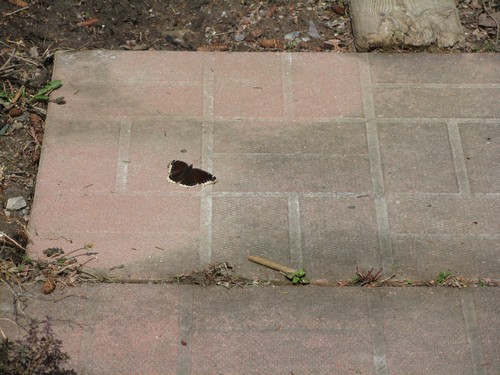
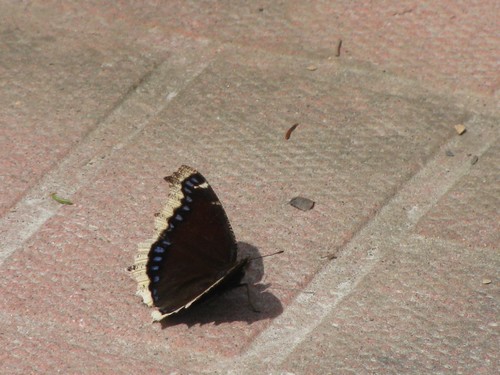
first flutter-by of the season

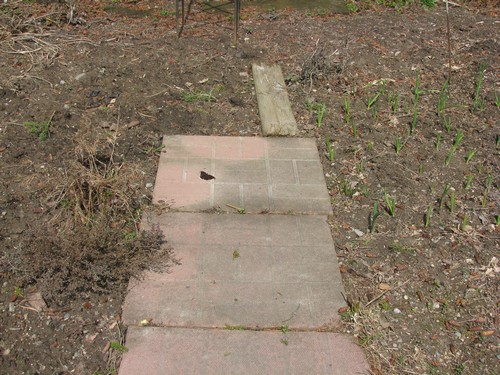
Not sure I’ve seen one of these before. Certainly not in March. No idea what kind it is. Behavioural clues: tendency to flap about rather absent-mindedly, nearly crashing into my head before settling (indicates possible bad eyesight?)…narcissistic attention to improving tan…unable to find a comfortable resting pose; ADHD??
…Eventually fluttering right on by without so much as a nod to the other insects.

Note: In my effort to make an identification I googled “clumsy, vain, hyperactive, short-sighted, anti-social, black and yellow flutterby with blue dots” and got a seamstress in Winnipeg named Ted…

in the neighbourhood

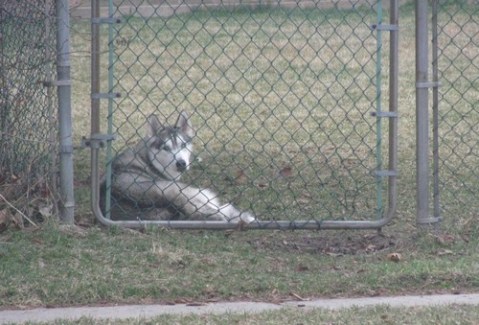
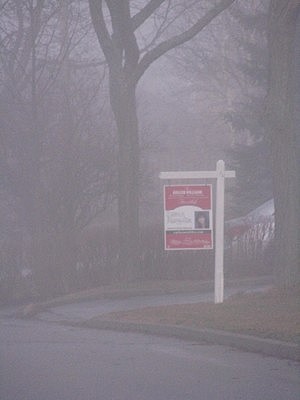
A guy walking his dog doesn’t normally get my attention. I can’t say why this one does except that I’m pretty sure it’s the guy from around the corner who lives alone since his wife moved out, whose dog is always howling because it never gets walked, at least not on this street. And the way he’s walking. One foot in front of the other at a regular pace, sometimes looking up, sometimes not—all very ordinary. Yet. There’s something. It doesn’t feel like an ordinary walk, it feels like something has changed, or is is about to change, like he’s walking at this end of the street because he’s lived around the corner for ten years and is kind of sorry he’s never talked to anyone, or walked his poor howling dog more often. Like he wants to see what he’s been stupidly ignoring all this time. Maybe he’s decided to change his ways and this is the beginning of a new habit; maybe he’s looking for someone to say hello to.
But it doesn’t feel like a beginning.
It feels like a goodbye walk.
I forget about it for the rest of the day.
I go out.
And when I come home, as I turn the corner, I see a For Sale sign on his lawn.
Whatever the circumstance, whatever his deal, I can’t help feeling a little sorry I didn’t go out to say hello when he passed by…

*

Grandchildren visit next door and the grandma (a dear woman who feeds the neighbourhood stray and whose husband built it a beautiful shelter on their deck, complete with sheepskin blankets and insulation done to code) shouts her happiness across the front lawn. Later the youngest plays basketball on the driveway, bouncing the ball more than shooting, while a girl does cartwheels on the grass.

*

The lad across the road is all grown up now. Must be nearing thirty. He lives elsewhere but comes home often and today he and a few pals bring out the nets and sticks and play some ball hockey, just like they’ve been doing for the past twenty years. Just like no time at all has passed.

*

The new people next to the ball hockey crowd have kids so young they ride bikes with bright orange training wheels and in the morning the boy stands at the edge of his lawn, facing the street and chirps loudly like a blue-toqued, green-sneakered rare bird and I’m reminded again of the genius of kids. And wonder when we lose the impulse to greet the day with a song only the wildlife will understand.

the illusion of a forest…

“The natural disaster of a forest fire returns carbon to the soil, enriching it for the new forest to come. A clear-cut removes the trees that are the source of that carbon. To walk there is to see a landscape devastated as if by bombs. Reforestation? It seems that real care is taken only for the hills and mountains that border highways where tourists and people from the cities can see them. Those are the clear-cuts where the corporations put up signs to tell the passing cars when the forest was replanted and how well it is doing today.

“The corporations rarely harvest their trees right up to a highway. If you stop your car and walk 300 metres into a forest, you will often stumble across a clear-cut hidden from the cars that pass. The trees you see by the side of the road are the illusion of a forest left there to salve your conscience. Back out of sight, on the plateaus and hills and mountains, the forests are doing poorly. The variety of species is reduced to one of fir, pine, hemlock, spruce, tamarack, or whatever, depending on which of one or two species is likely to return the greatest profit.

“Diversity of species is anathema to the managers of the new forest. Monoculture is king. It is precisely what happened on the vast prairie, where rich and diverse grasslands were replaced with fields of grain. The landowner’s system of fallowing fields on alternate years allowed for massive evaporation from the bare earth. The moisture rising from the subsoils brought with it salts from the ancient seas that once covered the land, and when the moisture evaporated, it left the salt behind. Vast areas of the Great Plains are pocked with crystal deserts where nothing grows.”

~ excerpted from ‘The Forest’s Edge’, by Patrick Lane (The Walrus, May 2005)

here is a day

It begins with the light.

Different this morning, although not really anything you can single out. The sun comes up, shines; the sky is blue, the trees are naked.

The grass still shivers and the only blooms are the brave-hearted snowdrops. But something has changed.

It’s spring.

No matter what the calendar says, no matter if there’s a blizzard tomorrow—a corner has been turned. The squirrels know it and so do the doves, the neighbourhood stray and the fly that landed on my arm today as I sat reading on the patio. It’s like hair. One day it’s perfectly fine, like it’s been for weeks or months, and the next [and you will never know how this can happen] it’s changed and it needs a cut and it will not be fine again until you cut it.

Spring arrives like that. Overnight. And suddenly everything is different. Regardless of weather, it will not be winter again until the last month of the year.

So we go for a walk on this beautiful spring day, Peter and I.

We walk to the grocery store to buy some baby food for Jake The Cat who’s a bit plugged up with shedding-his-winter-coat hairballs; my cat book recommends a recipe involving a veggie/meat blend along with melted butter, psyllium husks and water.

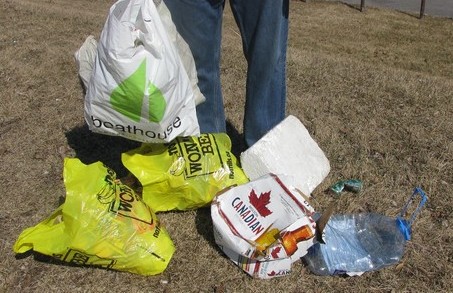
It’s about twenty minutes, if that, through a ravine and a park where, amongst all that loveliness, somehow people decide to just drop things and carry on.

We carry bags to scoop up the debris.
Back home again, I bake what could be my favourite thing in the world— today I use (local, frozen from summer) cherries.

And while I do, the sun shines in on my beach glass [and sunshine on my beach glass makes me happy…]
I read outside.

And I read inside.

I vacuum downstairs, but not upstairs.

I write a little. Not a lot.
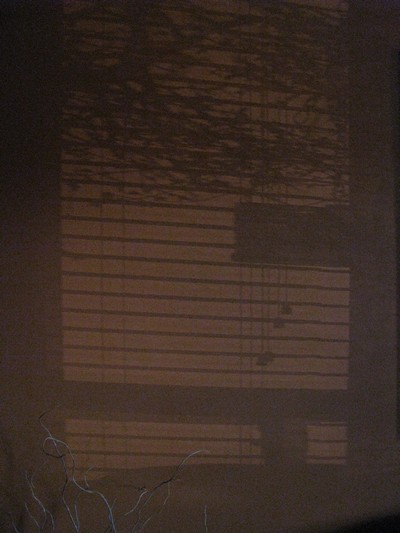
And too soon the sun is on the other side of the house and making those end of day shadows on the guy across the street’s garage door and the wall in the living room and I put chicken wings in the oven and shrimps on the barbie…
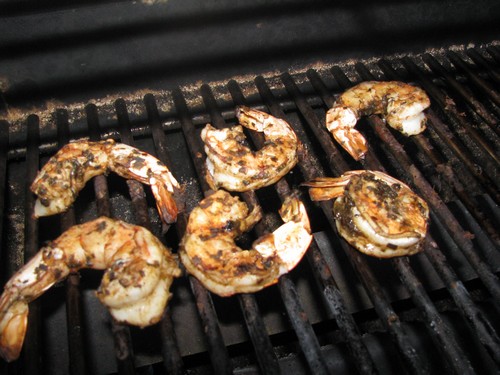
— and Peter pours glasses of wine and today’s light will soon be gone but it was here and it was spring light, and before it fades and turns suddenly too cold to sit outside comfortably…

…I sit comfortably.
Happy spring.

Note:  Jake The Cat ate his ‘recipe’ and, later, things cleared up nicely. [In case you were wondering.]

blame it on the cheese

Last night was a blast.

Went to the fabulous annual Trafalgar 24 event hosted by Driftwood Theatre Group. A night of plays. Six of them. Each no more than fifteen minutes long and each staged in a different part of a local castle [once a private home, now a private girls’ school]. The plays run concurrently and continuously as the audience [divided into six groups] makes its way from venue to venue [venues being the landing of a grand staircase, library, science lab, locker room, chapel, and auditorium].

Here’s the best part: the plays have all been written and rehearsed in the 24 hours preceding the event.

Each playwright [there are six] arrives at the castle the night before the show, where they’re given a venue, a theme and some actors, after which they spend the night locked in the castle, writing. In the morning they rewrite and rehearse until showtime at 7:30 p.m.

The whole thing sounds mad and, really, there should be chaos at every turn, anxiety in the corridors, voices, flushed faces, crossed eyes. But the reality is the exact opposite. The thing is brilliantly organized and every year comes off smooth as silk. In fact [and I don’t know how this is possible] everyone involved—from volunteers, organizers, actors, writers—appears to be in complete control, mellow even. Surely drugs are involved. Herbs, at least… [aromatherapy?]

There is also food. And drink. And a silent auction.

But it’s all about the plays and when all six audience groups have completed the circuit and seen all six plays, they’re asked to submit a vote for their favourite.

At the same time a jury is sequestered in a very comfy lounge on very comfy large sofas to discuss the whys and hows and wherefores of each play and to determine the overall winner [said winner receives a commission and subsequent workshop with director, actors and dramaturge, to develop their play].

Now then… the astute reader may, at this point, wonder how it is I know the sofas of the jury room are large and comfy…

To which I would reply: I bought myself a seat.

It’s true.

It cost a bit, but was worth it. There was a bidding war, you see.

It started the way these things do. I was just standing around eating cheese when the emcee announced that the highest bidder would get a seat on the jury along with D. Jeremey Smith, C. Derrick Chua, Toby Malone, Lynn Slotkin and Kathryn Westoll. He started at two million dollars.  Ha ha, I thought, What a card.  I continued nibbling my cheddar, sort of listening, sort of not. At some point he lowered the opening bid to a hundred. A few people bandied numbers back and forth. At something like two fifty it was about to end with a guy at the front trying to impress his date.

Coincidentally, it was at that moment I’d finished the last of my cheese. My hands were empty. One of them shot up.

Two hundred and eighty!  the emcee shouted. He appeared to be pointing at me.

It went on from there.

Long story short. I won.

So, later that night, after the plays were done, I sat with the five judges in a private room and listened with rapt attention to the chat about each performance, loving the passion that every single juror put forward. Remember, these were plays written and rehearsed in less than a day. Didn’t matter. They were treated with a respect for the form that almost made my eyes water. What I loved most was that I’m pretty sure the conversation would have had the same intensity had it been about plays staged at Stratford or Shaw—the focus was on the work not the marquee. It was an honour to be privy to this behind the scenes banter, to be in that room with these people who adore the art of theatre. Period.

Also a privilege to be able to donate dollars to something I believe in. A tiny drop in the bucket of hope that it will continue it’s good work. Which, if it does, ends up in a way being a gift to myself.

Congratulations to the playwrights, actors and directors. And to Driftwood for setting the stage so perfectly— Bravo! You do amazing things.

Trafalgar-Castle-SchoolClick for castle tour.

a rough cove…

“I heard me grandmother say that when the first of our family came here, the French settlement was abandoned. They said it was too rough a cove for fishing out of. It just suited our people….”

“Those old midwives that were here then, they were only trying to do the best they could, the best they knew how. Didn’t know very much, but they’d try to born the babies and do whatever they could. I often heard my mother telling about it. When the baby’d be born, you’d be put to bed for nine days; and what clothes you had on you when you went to bed, that’s what’d be on you when you’d get up. She said you’d be so sore you wouldn’t be able to walk; you’d be chafed to death with the clothes. That was their belief. If you took off the clothes you had on—all the warm clothes—you’d get cold then. Die then.”

— from Outport: The Soul of Newfoundland, by Candace Cochrane (Flanker Press, 2008)

things missing something

Twinkle lights on front yard bushes. Pretty but they seem out of place without a reason, xmas for instance, to attach themselves to—a purpose other than simple loveliness during these still dark early evenings. My, how narrow we are. I am.

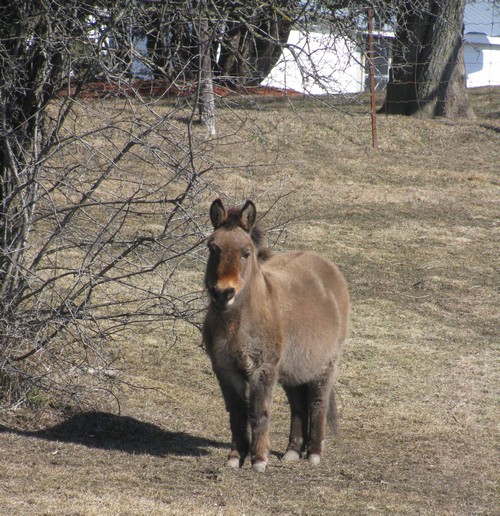
A horse trailer without a horse. And in a neigh(pun not intended, but I like it)bourhood that can in no way accommodate a horse, secretly, in a backyard. Or in any way otherwise.

A bright orange wrist thingy with a whistle attached. I don’t like seeing this. Makes me wonder how it got detached from its wrist. And if it belonged to a child, when did we start making children wear whistles? And did wearing it [or worse, the need to wear it] make him/her [I suspect it was a her] feel safer or more afraid?