assumptions and aspirations

I first read this definition of  ‘critique’ in a gallery catalogue for an installation that included, among other things, a deconstructed piano. What I love best is how it might apply to anything—painting, writing, dance—and how it reminds me that all art is shaped with, essentially, the same basic tools.

“… Taking a thing apart is a critique—a way of honouring the thing, a way of admiring its construction and the many decisions of its designers and makers. It exposes the assumptions and aspirations upon which the thing is made and it reveals the author’s inventions and limitations….

“….Rebuilding the thing is a form of love and respect. Adding to a thing—decorating it, manipulating it, customizing it—is to enter into a dialogue, to talk to the thing and to engage its maker’s spirit, to speculate on its history, to revel in its possibility and to indulge in creative anarchy.”

…the confines of the mediocre

“… At that time I was sharing two rooms and a hip bath with the actress Vicky Licorish. She had no money, I had no money, we could not afford the luxury of a separate whites wash and so were thankful of the fashion of coloured knickers which allowed those garments most closely associated with our self-esteem, not to be grey. Dinginess is death to a writer. Filth, discomfort, hunger, cold, trauma and drama, don’t matter a bit. I have had plenty of each and they have only encouraged me, but dinginess, the damp small confines of the mediocre and the gradual corrosion of beauty and light, the compromising and the settling; these things make good work impossible. When Keats was depressed he put on a clean shirt. When Radclyffe Hall was oppressed she ordered new sets of silk underwear from Jermyn Street. Byron, as we all know, allowed only the softest, purest and whitest next to his heroic skin, and I am a great admirer of Byron. So it seemed to me in those days of no money, no job, no prospects and a determined dinginess creeping up from the lower floors of our rooming house, that there had to a be a centre, a talisman, a fetish even, that secured order where there seemed to be none; dressing for dinner every night in the jungle, or the men who polished their boots to a hard shine before wading the waters of Gallipoli. To do something large and to do it well demands such observances, personal and peculiar, laughable as they often are, because they stave off that dinginess of soul that says that everything is small and grubby and nothing is really wroth the effort.”  —from the Introduction to Oranges are not the Only Fruit, by Jeanette Winterson.

happy new year from the tropics

—Otherwise known as southern Ontario where, yesterday, I raked leaves, chatted with my niece in the States while sitting on our patio, and wasn’t a bit cold in the backyard in my pjs at midnight listening to neighbourhood fireworks.

Today it’s foggy, tropical temps falling and snowshoes tapping their merry little aluminium toes in the hall. Though no sign of flakes.

Piles of books and magazines and a pot of green tea make the waiting more than bearable.

~

the year as ‘found’


In the spirit of reflection… (and following a prompt from The Indextrious Reader) I’ve rounded up the first sentences of the first post from *each of the past twelve months to create… uh, well, a document of first sentences, which I then rearranged slightly—in the spirit of amusing myself…

Et Voila! 


2010 as Found

Snowing gently this morning as I sit outside with a cup of rooibos tea and watch geese, hundreds of geese, fly over the backyard—so quiet is the world I can almost hear each one of their wings. Over at Front Door Back Door—I note the moment we felt the earthquake, the sismo. I don’t know why Rona Maynard’s post on pilates and writing should make me think of something I read the other day about Marina Abramovic—the performance artist who recently closed what sounded like a most bizarre and amazing show in NYC, and is known for her ‘experiments’ in art through human nature—but it does. Find a lonely tree that needs some love.

“Man has no body distinct from his soul, for that called body is a portion of the soul discerned by the five senses.”  (Wm. Blake)

Depending on who you listen to—either today, yesterday, or tomorrow is the Feast of St. Mary of Egypt, patron saint of penitent women who formerly lived in sin. Am celebrating the 143rd birthday of our grand beau pays with my favourite things: words and food. Parsley, sage, rosemary and thyme. And I don’t mean cheerio as in ‘goodbye’, but as in cereal…of course.

“Tea should be taken in solitude.” (C.S. Lewis)
Writing from a garret in London, Ontario. Coming along just swimmingly thanks.
~
Hoping everyone has a safe and happy one…
 
Amusez vous bien!
~
 
*From whence they came… 

January  Snowing gently this morning as I sit outside with a cup of rooibos tea and watch geese, hundreds of geese, fly over the backyard—so quiet is the world I can almost hear each one of their wings.

February  “Man has no body distinct from his soul, for that called body is a portion of the soul discerned by the five senses.”  (Wm. Blake)

March  Over at Front Door Back Door—I note the moment we felt the earthquake, the seismo.

April  Depending on who you listen to—either today, yesterday, or tomorrow is the Feast of St. Mary of Egypt, patron saint of penitent women who formerly lived in sin.

May  “Tea should be taken in solitude.” (C.S. Lewis)

June  I don’t know why Rona Maynard’s post on pilates and writing should make me think of something I read the other day about Marina Abramovic—the performance artist who recently closed what sounded like a most bizarre and amazing show in NYC, and is known for her ‘experiments’ in art through human nature—but it did.

July  Am celebrating the 143rd birthday of our grand beau pays with my favourite things: words and food.

August  And I don’t mean cheerio as in ‘goodbye’, but as in cereal…of course.

September  Coming along just swimmingly thanks.

October  Writing from a garret in London, Ontario.

November  Parsley, sage, rosemary and thyme.

December  Find a lonely tree that needs some love.

~

this is not a review: comfort me with apples, by joe fiorito


Love.

Go ahead. I dare you. Just try to read Joe Fiorito’s Comfort Me With Apples and see if you don’t end up in love. Because it’s not possible. Chap or chapette, you’ll be in love with him. I guarantee it. (Okay, I don’t guarantee it, but there’s a strong possibility…)
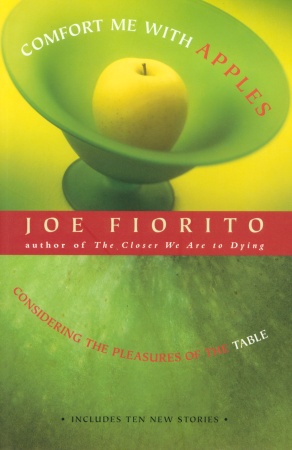
It’s not a new book, just newly discovered—also not exactly a cook book, nor exactly anything else; the man simply writes about food. And in such a way that I haven’t stopped cooking or eating since discovering it.

Yes, alright, another exaggeration. But it’s true that I can no longer cook or eat the same way. I mean, when in a simple essay on oranges he tells you—

“…You can put orange peel into beef stew along with your bouquet garni. You can squeeze a little juice in your fresh tomato soup; add a little orange zest while you’re at it. Or try this…peel two oranges, finely slice the peel, blanche it in boiling water for two minutes, and drain. Sautee a finely chopped onion in four tablespoons of olive oil. Add the drained peel to the oil, along with a cup-and-a-half of pitted black olives. Remove from the heat. Cook a pound of spaghetti in a pot of salted boiling water until it’s al dente. Dress the spaghetti with the olive oil mixture, add four more tablespoons of oil, and be grateful the Moors invaded Italy.”

—how can you not immediately want to put on your coat and walk to the nearest orange purveyor, purchase a dozen, make stew and soup and boil up some spaghetti, and when that just happens to change your outlook on life and entire DNA for the better…well, how can you not fall in love?

In another essay he reveals how a nun’s peculiar answer to his childhood question: What does my soul look like? led him to hate all cereal except oatmeal (and only then in the form of cookies). And then he gives you the instructions to make a batch. No recipes in this book and few precise measurements—mostly he just tells you how to do things the way he would if you were in the kitchen with him, chatting and sipping wine. And somehow things work out beautifully, the way they always do in happy kitchens.

I’ve been waiting for the perfect Sunday morning to make the popovers he describes in ‘Breakfast in Bed’—

“…Wake early one Sunday and smell the person sleeping next to you. Do it. Lean over. The side of the neck will do, just below the ear. Take a deep breath. The knowledge of this scent is lodged in the deepest part of your brain.

“…Now go to the kitchen. Throw two eggs into a bowl…”

And the perfect Friday night to re-enact his piece titled ‘A Plate of Spaghetti’, which begins:

“Today you’re going to eat, drink, sing, read—and act—Italian. I want you to start by going to the film store to rent Fellini’s ‘Nights of Cabiria’…” And ends with: “Whisper the last words of Puccini’s ‘Nessun Dorma’ as you fall asleep…all’alba vincero—at dawn I will win. And you will. You’ll have leftovers. Spaghetti arrabbiata is wonderful for breakfast.”

He writes about sushi and Halloween apples, the importance of the right knife, the woman who hummed while she ate and how he married her, how to make the best potato salad, chicken soup, pork chops (I’ve tried the chops, they’re truly amazing); he compares chili dogs to alligator shoes, discusses food myths and food in movies, considers his last meal, his worst meal, and the piece that confirmed my adoration for this man’s work, ‘Museum Food’—which is too long to transcribe but, trust me, it’s a gorgeous piece of writing and a gorgeous testament to food.

Impossible to read this book and not come away with a deeper appreciation for the connection between what we eat and how we live, between food and people, music, sights, art, books, sound, neighbourhoods, joy, sadness, seasons. (And we all know the connections are there; I can’t rub a piece of thyme between my fingers and not be transported to my mother’s kitchen where a roast is the oven on a Saturday afternoon in winter, juices heavily infused with thyme from her garden, picked fresh from under the snow.)

All of which leaves me deeply in love—okay, maybe just deeply grateful for the reminder that food isn’t so much about eating, but about everything around the eating, everything that precedes it.

And everything that follows.

_______________________________________

Purchase Comfort Me with Apples online at Blue Heron Books.