this is not a review: ‘a crowbar in the buddhist garden’, by stephen reid


I’m mystified at how, collectively, and for a very long time, society has had the idea that to lock someone up and treat them like garbage, will help them blossom. From what I understand, there’s little within the prison system designed to achieve that outcome. Nor do the stats support the theory.

Yet we continue this charade of ‘punishment’ which we prefer to call rehabilitation even though there are fewer and fewer funds to make it so.
I wonder at the why of it and can only come up with Because we’re idiots. And lazy and what’s tucked away out of our sight is someone else’s problem. The problem is that the people whose problem it is have too many problems to fix the real problem.

So we console ourselves with being better than other countries at this prison thing as if that’s the only marker and in some camps the answer now lies in MORE prisons—and ever bigger—where inmates can be treated even less as individuals with individual needs and emerge even more isolated—emotionally or otherwise—to try and live within a society that stands on its moralistic pedestals clucking its giant tongue.

The anthropological side of this absurdity fascinates me.

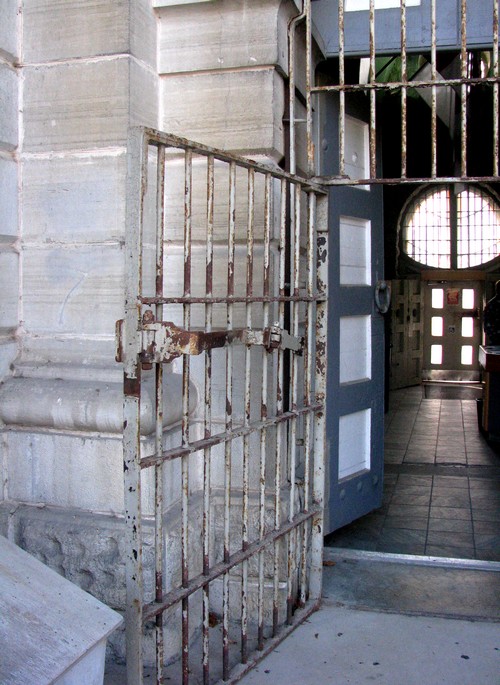
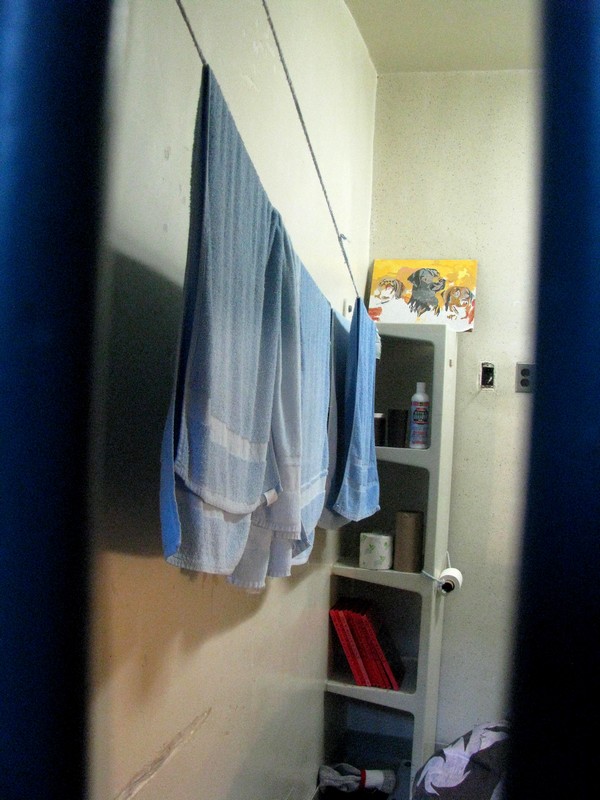
It’s a big subject and I certainly don’t know what to do about it. I’m not even qualified to rattle on about it. All I know comes from what little I’ve read, a few conversations and a stunning tour through Kingston Penitentiary a mere week after the last inmate left, an eye-opener as to some of what’s wrong with our prison system. [all photos taken on said tour]
IMG_3819
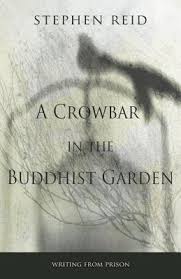
In his book, A Crowbar in the Buddhist Garden, Stephen Reid talks about the lack of ‘prison literature’ while writing (from prison) one of the best of that genre I’ve read. Despite spending the better part of his sixty something years dealing with the effects of abuse, drugs, rehabilitation and incarceration, Reid is able to share his stories objectively and without sentiment. Also without gratuitous asides of the horrors of a system he knows too well. Reid doesn’t name any monsters or over-describe details or try to persuade you to feel this way or that; he’s wise enough to let us be all the more dumbfounded by the monster that emerges rather naturally.
IMG_3869
Most surprising of all, he writes without a shred of anger or self-pity but with the wisdom of a seasoned prison sage when he says it would be a fine thing to be a ‘metaphysical butcher’ so that we could slice away the 1% of the personality that uses and offends, suggesting that the greater part of the most hardened criminal is decent and kind. Unfortunately, it doesn’t work that way, he says. “In criminal law, and much of life, we are our behaviour.”
IMG_3912
In the essay ‘The Last Score’ he details the circumstances that landed him most recently in jail after thirteen years of living on the ‘outside’, drug free.

In ‘A Man they Loved’ he is remorseful beyond measure. “I’m forty-nine years old, married to one of the most interesting and beautiful women on the planet, and parent to two incredible pieces of magic… The forfeiture is unbearable. I see a clear plastic laundry bag lying in one corner of my cell. If I could only get it over my head, wind it tight, airtight, at the neck….

“I am determined to go where I have to go, to take it as deep as it is deep, to do whatever it is I have to do to become whole, to never commit another offence, to never again get addicted. To become finally and forever, the man my many friends and family described…”
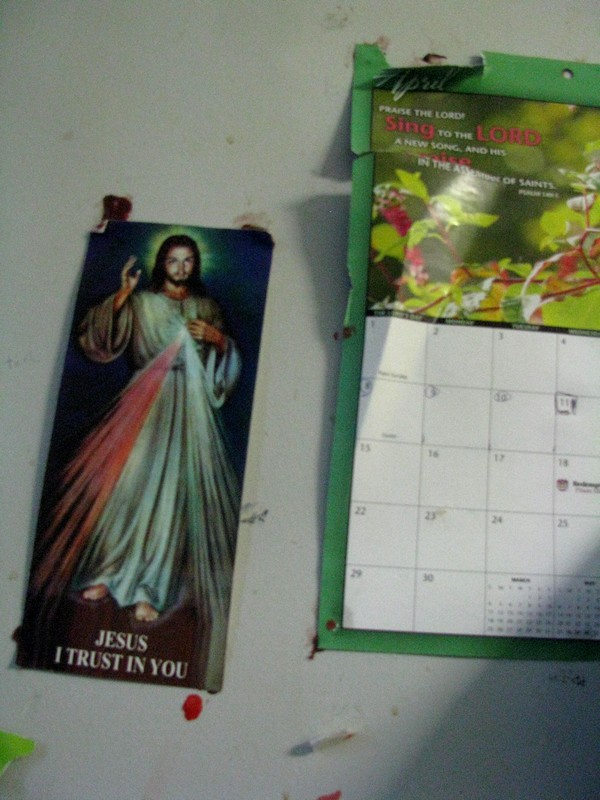
IMG_3864
‘The Last Jesus I Know Of’ is about the Intensive Therapy Violent Offender Program… “a gruelling horror show in which sixteen of the most dangerous offenders are culled from seven regional prisons and forced to endure a year of masochistic and humiliating psychodynamic therapy.” He does this because it will at least break the monotony.

“No one has to be Sigmund Freud to figure out these were men who grew so tired of being wounded, they went out and wounded something else.”

They write autobiography for therapy. And read aloud during sessions. And discover the humanity inside those broken shells.

“… I have learned… that for a lot of people in this room, their first bad choice was their parents.”
IMG_3860
“Christmas Eve [a guard] shows up with his crew for a surprise shakedown on the tier. They toss our cells, making a mess, then depart going, ‘Ho Ho Ho.’ The rest of the holiday season passes with Sally Ann Sunshine Bags, attempted suicides, and dark chocolate.”
IMG_3974
“Prisons are about addictions. Most prisoners are casualties of their own habits. They have all created victims—some in cruel and callous ways—but almost to a man they have first practised that cruelty on themselves. Prison provides the loneliness that fuels addiction. It is the slaughterhouse for addicts, and all are eventually delivered to its gates.”
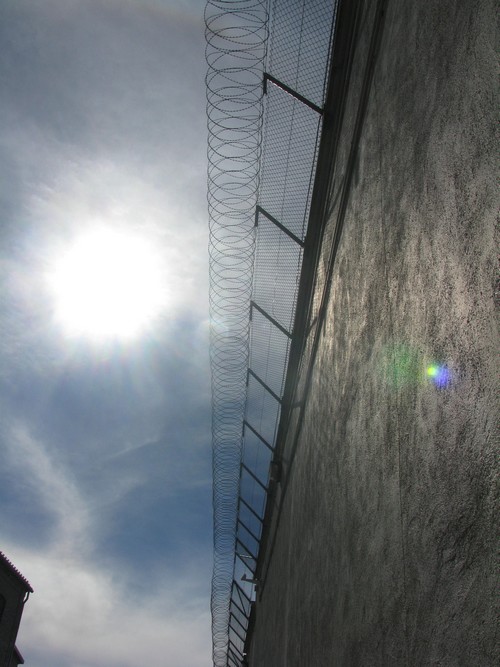
IMG_3919
“Perhaps the days of prison literature have passed… our culture doesn’t encourage those locked up as criminals to learn to engage with their experience on any intellectual level…. We are a society impatient with its misfits.”

He then offers a list of books worth reading.
IMG_3904
In ‘The Zen of the Chain’ he writes about being transferred from one prison to another. He breaks down the indignities, the realities, the heartbreak and fear like a 12 step program. By #11 you are holding your breath and by #12 you realize you’ve just read pure poetry.

 “…To survive you must find the zen of the chain. For instance, if you’re unfortunate enough to have a black box designation and you have to wear that uncomfortable contraption over your handcuffs all day, don’t dwell on the cramps and pain it causes, flow with it, become your black box. Don’t be a new wave crack baby criminal, don’t go sissy on yourself. Suck up them fumes, concentrate on your breathing, find your mantra. Diesel in, diesel out. Let that which doesn’t kill you make you stranger. Transform yourself and your busload of fellow maniacs into an edgy version of Ken Kesey and his band of merry pranksters. Be patient in all things, let the seasons come and go, and one day fortune will smile. The bus will rumble to a stop at some front gate and you will walk in, passing by enough piles of coiled razor wire to make a knife, fork, and spoon for every man, woman and child on the subcontinent of India. You will step into the induction area, they’ll take off the chains and do the strip fan. You’ll get dressed again but this time the bulls will direct you to the right. And just like that you’re walking down a corridor towards a mainline. You feel weightless. You have survived. Life is grand. Until next time.”
IMG_3866 - Copy

About native justice, healing circles and the sweat lodge [versus incarceration], he writes: “A hundred years ago [an offender] would have faced his victim and his village in a longhouse. Restitution would have been part of the determination. [The offender] would have been punished and the circle would have been damaged but it would not have been broken.”

“Prison is, simply put, the bottom rung of the welfare ladder.”

“…if a native prisoner recovers his culture, he recovers himself.”

IMG_3940
Whether he intended it or not, Reid’s opinion of what prison literature should be, describes his own work perfectly:images
“…writing from an experience, not about it.”

Should be required reading in high schools.

_________________________________________

Crowbar in the Buddhist Garden is available online at Blue Heron Bookssupport indies!!


one tin soldier

A repeat post from 2010 when my mother was in a nursing home.
It was her last Remembrance Day and one I’ll never forget.

**

I only went in to see Phyllis, to get her dressed and give her breakfast. I always leave at 10. But when we walk to the common room for a bit of exercise, the chairs, each with a photocopy of ‘O Canada’ on its seat, are lined up in rows facing a podium. There’s a large screen at the front and poppies everywhere.

I consider staying the extra hour or so but Phyllis isn’t interested in ceremonies. Me neither. I prefer observing my two minutes of silence, alone and in my own way. We find a sunny spot at the back of the room and I read a piece by Barbara Kingsolver in the National Geographic, about water, while Phyllis sleeps in the chair beside me.

It’s nine thirty. I’ll take her back to her room at quarter to ten.

But at twenty to ten they start arriving.

Soon there’s a row of four men and one woman seated beside the podium, facing the rows of chairs. “Residents who served” I overhear someone say. One, in a wheelchair, sleeps with his head back and mouth wide open. The woman sits quietly confused with her ankles crossed, and a happy man with a British dialect tells everyone who passes “you’re wonderful”, and to the man with dementia beside him who’s beginning to nod off and fall sideways, the happy man says Are you alright, Tom?

Someone straightens Tom out and asks what it was he did during the war but Tom just looks straight ahead. The happy guy answers for him, says: What we all did… sink or swim.

More residents are wheeled in. A few come with aluminium walkers or a nurse. None come unassisted. The room is filling up with bodies and sounds. Phlemgy coughs, orphaned words, mumbles. The woman who yells all day I want to go home, somebody help me, what am I going to do?  arrives, pushed in her wheelchair by a nurse and placed at the front of the room. Where am I? Where are you taking me? she yells. She has terrible teeth and long thin hair. I’ve never seen her family; she may be one of the many abandoned to the system, completely dependent on the mood of staff and Ministry guidelines, at the mercy of Long Term Care politics and rubbery cream of wheat.

‘One Tin Soldier’ plays in the background. By The Original Caste. I remember hearing it when I was very young and didn’t really understand what it was about. Listening to it now, surrounded by so many drooling tin soldiers of yore, it takes on even deeper meaning and I realize I’m staying for the ceremony… and for these men and women who did what they did, and for others who continue to do in this mad world because it’s, sadly, still the only way any of us knows to say thank you. I stay because we’re all a product of our past and because we’re all connected whether we like it or not.

I stay for my dad whose only comments about the war had to do with unexpected kindnesses from all sides. He didn’t speak of heroics.

The German man down the hall from Phyllis is brought in to sit with former enemies and it makes me wonder at the word ‘enemy’. Circumstantial at best. They all sit quietly confused together now, eating the same gruel, wondering perhaps what it was all about anyway.

Oh, yes. A madman. There’s always a madman.

Tom keeps falling over so his son moves him off to the side where he can keep him upright. He’s brought his dad’s beret and medals and pins them on a slightly stained beige pullover. The son takes pictures of Tom, asks Tom to salute. Tom just stares straight ahead.

It would be easy to leave. Wake Phyllis and go. I don’t want to hear ‘In Flanders Fields’ and cry with strangers. But I stay because it’s such an honour to sit among the muddle of their confusion, their dignity and continued bravery in this forgotten place of forgotten people where the beauty of old age is seen as ugliness, as something to pity.

During the ceremony I watch a daughter put a pink sweatered arm around her mother, pull her close and kiss her face. Another daughter is her mother, thirty or forty years earlier, so striking is the resemblance. A man in a motorized wheelchair wipes his eyes with a facecloth, says it bugs him that he can’t stand up to pay his respects. The happy man occasionally blurts out: Too much talking, too much talking and he’s right of course; there’s always too much talking. I notice his breathing is difficult, like my dad’s the year he died.

I notice the woman who yells all day is quiet.

And when eleven o’clock comes the whole room is suddenly hushed except for the sleeping veteran who snores loudly beside the podium and the happy man who says Hallelujah. But the muttering and coughing and shuffling stop. It’s like these people, who aren’t sure of much, can still sense what’s important. Maybe that’s what makes us human.

As the ‘The Last Post’ is played, and while I blow my nose, Phyllis wakes, looks at the rows of silent backs in front of us and says: Wow, it must be a good movie.

The ‘residents who served’ are recognized and the anthem is sung and then later a video clip is shown, based on a true story about a guy in a Shoppers Drug Mart who was outraged that the store observed two minutes of silence, causing him to wait—two minutes—to pay for his purchases.

The happy man is saying Too much talking, too much talking, and when the video and the ceremony end, and we’re thanked for being there and all is done, the happy man, breathing hard in his veterans’ seat, says: Peace at last, peace at last.

On our way out, I stop and ask Tom’s son if I might shake his dad’s hand. He beams, says Sure! and explains to Tom what I want. Tom in his beret and strip of medals pinned to his sloppy sweater, stares back, silent. His son helps him extend a hand. It feels soft and weak, the kind of hand that hasn’t worked in years except maybe to scratch an ear, adjust a bib at lunch. I hope that on some level he might still understand what a handshake is. And even if he doesn’t, I do.

I try to find something in his eyes to connect with but they stare in a kind of trance; I wonder what they’ve seen and whether I’d have the stomach for knowing.

Thank you, sir, I say, and Tom’s son tells him: Dad, say you’re welcome!

And ever so quietly, Tom does.
541px-Poppy-closeup

this is not a review — nature’s little wonders: bees, by candace savage

“The life of a bee is like a magic well. The more you draw from it, the more there is to draw.” ~ Karl von Frisch

—A beautifully made book of satiny semi-gloss pages, colour photos, drawings, side-bars rife with fascinating facts, bee lore and poetry. Co-published (2008) by D&M Publishers (Greystone Books) and David Suzuki Foundation.  A joy to read. And important too. [Excellent gift idea. The bees will thank you. Which, in turn, is good for us human bee’ns.]

Here’s but a few things I learned from its delightful pages

Bees evolved from wasps.

They are herbivores, sting only in defence; raise young on protein rich pollen while wasps are carnivores, sting for food; eat other insects; also like people food [especially mine].

There are currently 16,000+ species of bees, ranging in size from that of a fruit fly to half the size of a human palm. (4,000 species in N. America)

A colony is about 300-400 bees of which most of those are worker bees.9781553655312

All worker bees are female; they live 60 days or so, except for those born late in season, which will spend a winter in the hive.

Only a few males are produced in late summer for one purpose: to mate and thereby produce fresh queens for the following year.

After the once-in-a-lifetime mating spree, the queen has enough sperm stored in her body to fertilize each egg she lays. Fertilized eggs become female (worker bees). Unfertilized become male (drones).

A Queen bee lays eggs (1,500 each summer day/ half a million in a lifespan of two years) while worker bees help raise successive broods of females.

The eggs are fed and raised by the female worker bees. Only a very few are reared in special areas of colony and fed the ultra-nutritious royal jelly, which allows them to grow into queens, i.e. egg layers.

Worker bees know that it’s time to raise a new queen (i.e. feed the royal jelly) when the current queen’s pheromones no longer predominate in the hive.

Drones die immediately after mating, or are killed. [I’ll spare you the gruesome details.]

Bee stingers don’t get stuck in bee flesh the way they do in human flesh. So they ‘can’ sting one another to death. [see above… but this is merely one method of getting rid of unwanted drones]

Honeybees can see colour.  [The book outlines how this was first shown by placing a bowl of sugar water on a square of blue paper. The bees, of course, were attracted to the sugar. Then the bowl was removed and the blue square moved to a different position among several grey squares. Didn’t matter. The bees still went to the blue square.]

The book cites the work of Karl von Frisch, A Nobel Prize winner for his research on the honeybee, and Martin Lindauer, a student of von Frisch, and a renowned bee expert in his own right. Of Lindauer, Savage writes:

“Through the glass walls of his observation hive, Lindauer could watch the workers as they scurried around performing their household tasks. Here, bees were cleaning out vacant cells in preparation for reuse, by removing old cocoons and re-coating the walls with wax. Over there, others were poking their heads into occupied cells, the ones with grubs in them, to check on the larvae and see if they needed to be fed. (According to Lindauer’s data, nurse bees inspect each larva, on average, 1,926 times during the five or six days before it makes its cocoon but feed it on only 143 of those visits.) Elsewhere in the hive, bees were busy building comb, capping comb, packing comb with pollen. Tucked away in a quiet corner, an individual might be flicking a droplet of nectar in and out on her tongue, waiting for the honeyed glob to thicken. At the same time, others were fanning their wings near the entrance, for cooling or ventilation, or standing guard in the doorway, with their forelegs raised and their antennae up, at attention.”

Lindauer noted that bees are hyper aware of various stimuli, changes in temperature, texture, taste, and instinctively know how to respond or communicate direction to others. When he inadvertently put a heat lamp too close to the hive he noticed the bees stopped foraging for pollen and collected water droplets instead to flick into the hive for a cooling effect.

Savage addresses the issue of colony collapse and other problems we’ve contributed to, while noting that “Bees [bring] sweetness out of chaos. Humans, on the other hand, [seem] to have an instinct for devastation. Could it be that these insects have something to teach us?”

And this, perhaps my most favourite morsel of all:

“Unlike human groups, which often seem less intelligent than the individuals who make them up, a swarm of bees is always smarter than the sum of its parts.”

American_foulbrood_honeycomb_drawing

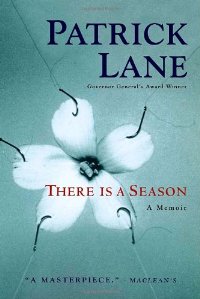
this is not a review: there is a season, by patrick lane

 
I can’t lie. Nor do I think I ought to. On reading the first chapter of Patrick Lane’s There is a Season I felt mostly annoyed. I didn’t think I’d make it to page fifty, which is my official limit…[page 100 is my un-official limit]. If I haven’t engaged in a book by then I close it and move along.

I can’t say what it was that bothered me, I just couldn’t get with the rhythm, I wasn’t paying attention.

When this happens, and despite the accompanying crankiness, something about the book occasionally compels me onward and prevents me from slamming it shut. This was not the case here. I walked away muttering about how I wasn’t in the mood for epiphanies in the form of raindrops. But the next day I picked it up again. It was a library copy so nothing would have been simpler than to take it back from whence it came—but those raindrops had gotten into my head and when I opened it up the second time to some random page, I read this:

“I don’t know why I confuse myself in the world when all I need to do is spend a few moments in this gentle space.”

I kept reading, pages and passages in no particular order.

“I measure friendship by those who are the friends of spiders and those who are not.”

“The drenched garden glows like the womb must to an unborn child.”

“What I call silence is not the absence of sound but the presence of the garden when it is not weighted down by traffic noise and talk.”

“My quest has always been to find what I could not leave.”

“A green frog does not sit on a red geranium unless he’s gone a little mad.”

“There are times I want to be in the second or third person… It’s simpler to be a fiction.”

“We break our path when fear tells us to live.”

** 

And then I started again, at the beginning.

—It’s springtime in the Okanagan and the author is a boy. We meet him as he stands “… among yellow glacier lilies and…windflowers…the western anemone, their petals frail disks of trembling clotted cream.”

This is the opening. What, exactly, about that is cranky-making?? I’ll tell you what: nothing. Whatever my initial reading mood was, I’m thrilled it passed.

It’s a book about a garden in flux and the man who is putting it [and his life] to rights; about the connection of man to nature. Of an ornamental tree, he says “Their leaves funnel the rain, and the water runs down one leaf, falls to the next and the next, miniature waterfalls in a stream until the last and outer leaf drops the water where the feeder roots drink.”

It’s a book of poetry in the form of prose. Or vice versa. It’s a meditation. You read it slowly, and maybe that’s what was wrong on my first attempt. My speed setting was off.

“That is beauty, to stop a moment and watch the endless play of light on water and stone and see how the living things of the garden come to drink or just to gaze as I do now at the surface of the pond.”

The book is also about sobriety although drinking is rarely mentioned. It’s Lane’s senses that are sober for the first time in forty-five years and so the reader is privy to the perspective of not only a great poet, but of someone who’s been issued a set of fresh eyes, ears, skin and taste buds.

“The drenched garden glows like the womb must to an unborn child.”

51aac9pD90L__SX200_There are many references to rain and mist and dew, pools of water, as if the booze has been replaced by more useful forms of liquid, ones that help him think—and remember—more clearly.

The book is divided between the present day Victoria garden and the past: childhood, parents, marriage, failures, joy, sadness and one especially incredible scene where he returns with his now elderly, unemotional and extremely reluctant mother to the old homestead; it’s near the end of the book and is one of the best passages I’ve read anywhere for its power to convey, essentially, a whole world, the now and the then, in a few sentences. Perfectly placed.

I’ve since returned the library copy.
And purchased one of my own.

today’s walk

Uneventful.

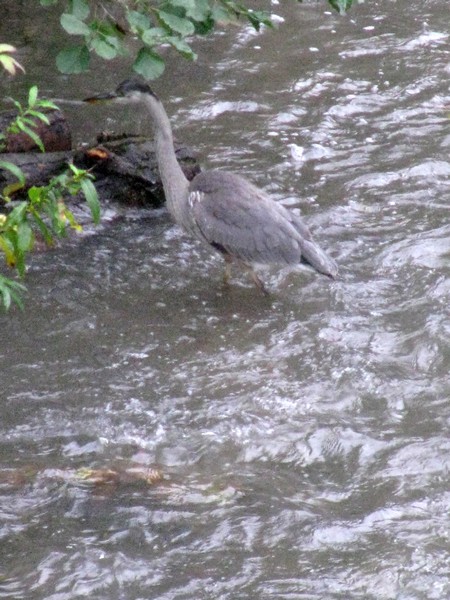
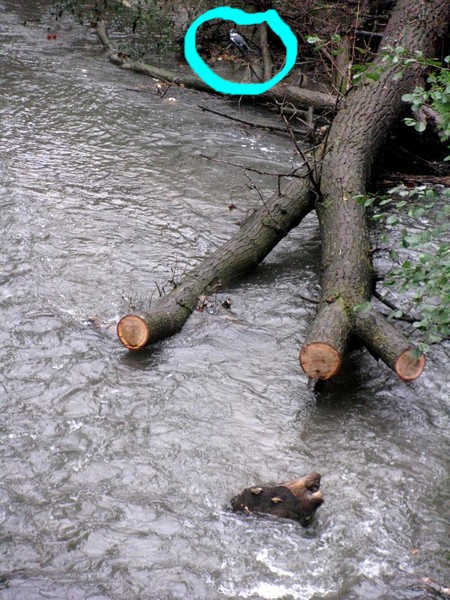
Except for the daring blue heron that wades in the creek up to its icy blue thighs, and the black and white bird that watches from an overhead branch. No idea what it is. Magpie?  But we don’t get those here… I haven’t seen one since Edmonton in the eighties when everything was a revelation. I had a friend there who grew up on a dairy farm so we spent a lot of time in the country. That’s where I learned that magpies aren’t exactly the most beloved birds. Also, that you can drink directly from a cow. No middleman or cartons required. This was big. I didn’t believe it at first. Could not fathom that a tin bucket in the kitchen was what I was meant to ladle milk from for my Cheerios. One afternoon I took a walk in the back forty, picked some flowers, brought them inside, found a jar and filled it with water, a gift for the dinner table. When my friend’s mother came in she said Where did those stink weeks come from? It’s true that there was a very distinct and un-gift-like odour in the room… I’d assumed it was the fermenting milk.
IMG_4152IMG_4154
But today’s walk.

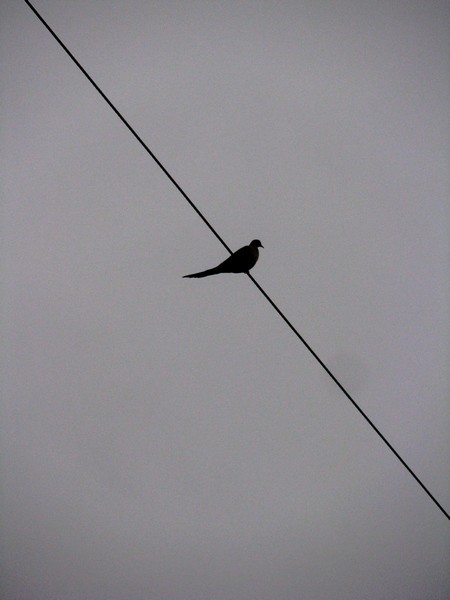
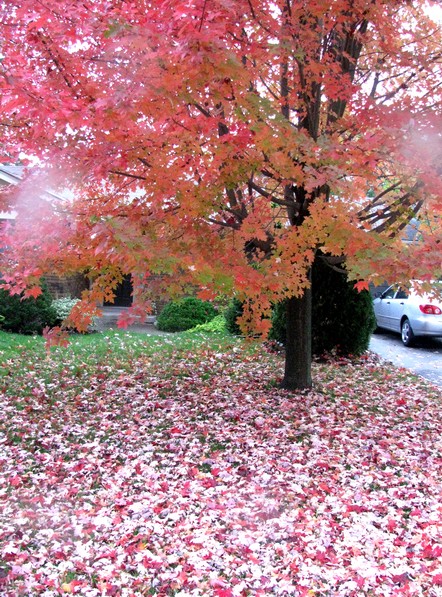
Uneventful, except for the above and a dove too— just because the sight of them always makes me happy. They needn’t be doing anything and they usually aren’t; something about their shape pleases me, the way they look to the left, the right, left again, as if always curious, forever surprised at the sameness of things. And a blackbird soaring above yellow and crimson leaves, circling and dipping and dipping some more, just because it can. A sparrow hiding under a Toyota Camry, or maybe just keeping out of the rain.
IMG_4156IMG_4158
And a man in his eighties, wrinkled from laughter, bright-eyed and sprightly, carrying two logs from the back of a house where I hear a chain saw working. He tells me he’s looking for volunteers to help… I tell him I’ll help him look, send them all his way. I circle the block and when I pass his house again, he’s there carrying more logs. He laughs, calls out, says in a wink-wink tone, “You haven’t forgotten where you’re going have you??” I realize the fact that I’m carrying a full shopping bag makes it look as though I should be heading home with my groceries, not strolling about the neighbourhood. I don’t tell him the bag is full of litter… I’m simply pleased that I’m finally worthy of insider status to an octogenarian’s joke…
IMG_4160