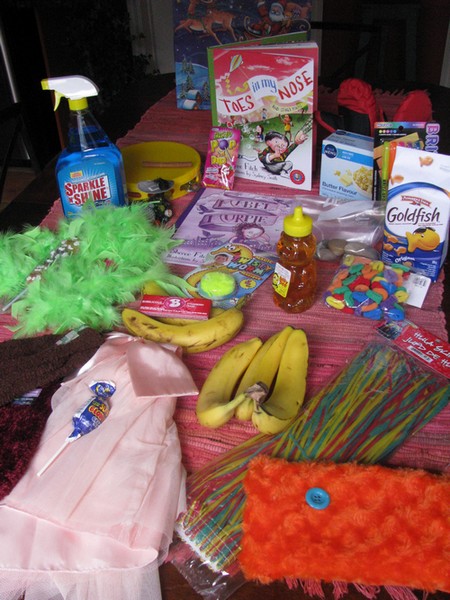
yes i did, i gave a child glass cleaner for xmas


The gift I most loved giving this year—

A treasure hunt bag of things that are found among the poems in Sheree Fitch’s Toes in My Nose.

Also included, a ‘discovery form’ for noting which poems and which items correspond (creative interpretation encouraged so there are many options and connections… as I quickly discovered by watching a tiny mind at work—and I don’t mean mine).

When completed the form may be handed in for a prize.

Prize to be determined (but very likely another book… shhh).
IMG_0155

i am the interruption of assumptions: who am i?

“…I’m actually more interested in how our minds use language as a way to organize the world—that is, the way the mind searches for stability by creating categories and classifications, and the way it makes meaning. I’m quite serious in saying that the study of riddles—their long history, their presence in nearly every culture of the world in every age, their subversive nature—affects our mode of thinking. Riddles interrupt our human inclination to stash things in well-defined cubby holes, to insist upon order and to find ‘solutions’ to things that puzzle us. Riddles ask us sometimes to live comfortably without firm solutions. At their best they can each us to think metaphorically, to find fresh ways to say things, to think about indirection as a writing strategy, to build a tolerance for alternative meanings and contradictory truths, to turn away from infallibility and learn to live with our own stupidities, and to question assumptions—something every writer, not to mention every good citizen in a participatory democracy, should know how to do. For example, here’s a riddle, which is not poetry but which I do like:

A bus driver was heading down a street in Colorado. He went right past a stop sign without stopping, he turned left where there was a ‘Not left Turn’ sign and he went the wrong way on a one-way street past a cop car. Still—he didn’t break any traffic laws and didn’t get a ticket. Why not?

(Because he was walking.)

“Our assumptions are wrong from the beginning, and the person who framed this riddle understood how to manipulate the reader into believing one thing (a bus driver only drives) while many alternative things about a bus driver are true—for example, a bus driver can walk. Riddles obstruct our desire to pigeon-hole people, objects and events, and to keep things neatly organized in categories. They make us rethink our assumptions.

“I’m interested in that. I’m interested in the interruption of assumptions. as a technique of fiction. We lead people to believe something, based on the preconceptions they come into the story with. Then we turn those preconceptions on their head, and we take our readers someplace unexpected.”

— an excerpt from Who Am I ?  What the Lowly Riddle Reveals, by Julie Larios.

800px-1909_Tyee_-_Sphinx_cartoon


double hockey sticks

At the Mexican restaurant I’m struck by the word molletes— I’ve never seen it before and for a moment cannot imagine how to pronounce it. I get it wrong then am reminded that the double L’s, as in French, are like Y’s.

Molletes is not MOLEETEZ but MOYEETEZ. And comes with pico de gallo (GAH-YO).

I think I’m getting it.

Not fluent yet, not conversational, but I get the L thing.

It’s a start.

[For the record, I had quesadillas.]

Here’s to family, good friends and good food. May we eat, drink and be merry together in many languages, and in many ways. Or at least may that be the greater goal…

Joyeux Navidad.

xmas stockings


So I’m in the men’s sock department at Winners and this elderly woman keeps bumping into me and leaning across whatever I’m looking at until I say: sorry, am I in your way?  And she says “What do you think about these?” She holds up a three-pack. “I like the argyle,” she says, “but why do they have to put in the others?”  The others are big bold stripes and she’s not sure her neighbour who takes out the garbage for her will wear them. She gets him a little something every year. “It’s so hard to know what kind of socks someone will like,” she says.

She’s the picture of Santa’s wife. White hair, wire-rimmed glasses. Rosy cheeks. A beige anorak. Navy slacks.

She shows me a single pair she’s also considering, black with a tiny red line at the top, asks what I think and I tell her they’re classic, that no one would have a problem with them. She agrees, but keeps looking. I continue looking too. I say the bold patterns make the most sense, easier to match them up. She laughs, says yes, but easier still is to buy all the same kind, which is what she did for her husband. Dozens of the same plain black, she says. Never a problem making pairs. She tells me she’d wait until he was down to one or two then fill the washer with only socks, every one of them turned inside out.

“That way they don’t get fuzzy from other things, or all pilly.”

It all seems a bit too much work, I say, all that turning inside out and back again and she says pooh, it’s no trouble, you just pile them on the chesterfield and sit down and go at it for a few minutes.

I tell her I’m not actually very fond of socks, the sheer number of them and the way they take it upon themselves to disappear one day, turn up weeks later or not at all. But mostly I really hate sorting them.

Something changes in her face, she goes quiet. Her eyes are blue. She looks at me through her Mrs. Claus glasses and I have an idea of what’s coming.

“I’d give anything to sort my husband’s socks again,” she says, then turns her head.

She tries to smile, shrugs, ruffles through the display as she tells me he died three months ago, that the family’s coming together and she can’t let herself get sad because they’re coming from Nova Scotia and Kingston and there’s the grandchildren to think of. She stops, looks up again. “But…” she says, and her sweet blue eyes are suddenly red-rimmed and we’re standing there in the socks and her lips are trembling—and I put my hand on her arm and I say, “But it’ll be hard.”

And she nods. Composes herself and we each say this and that and eventually laugh a little and then goodbye and the whole time I want to hug her but we’re in the socks at Winners and I have the feeling she’d rather not make a big thing of this, that she’s doing the best she can.

When I leave her she’s still debating about the argyle/stripes combo or the single classic black.

I buy a couple of three-packs.

Count my blessings.
450px-Socks_III

treasure among my stacks

Stumbled over during a recent bout of perusing…

“He says, slowly, that there is an island in Grand Lake called Glover Island. And Glover is the largest island on the island of Newfoundland. And on Glover there is a pond. And on that pond there is a smaller island. I want, he says, to paddle up Grand Lake and portage over Glover Island. Get to that pond and cross to the island and spend a night. He says there’s only one other island in the world with a lake holding an island, and a pond on that island with an island in that pond, and that place is Sumatra. And if you took a globe and put a finger on Newfoundland and another finger on Sumatra you’d see they’re pretty much on opposite sides of the earth.”   —Excerpt from a story by Michael Winter, as found in the essay: The Ends of the Earth, by Lisa Moore (The Walrus, July/August, 2006).

But what Michael Winter story is it from??

“Oh, Mrs. Turner is a sight cutting the grass on a hot afternoon in June! She climbs into an ancient pair of shorts and ties on her halter top and wedges her feet into crepe-soled sandals and covers her red-gray frizz with Gord’s old golf cap—Gord is dead now, ten years ago, a seizure on a Saturday night while winding the mantel clock.” —Opening paragraph, ‘Mrs. Turner Cutting the Grass’ by Carol Shields

“God, this is what literature is supposed to sound like—one man simply telling another man the simple humiliations and agonies and always-too-late epiphanies that add up to his and everybody else’s life—and not a sack of tricky tropes to be toted out and professionally employed in order to expertly con the reader into imagining a pretty little Book Club-approved daydream.”from What Happened Later, by Ray Robertson

“I grew up cynical, married an optimist. A field biologist who held the legs of songbirds pinched between thumb and fingers and described their plumage to me. We hiked through boreal forest, scrambled above alpine meadows, strolled the banks of the North Saskatchewan River. We walked beneath the ten thousand rustling wings of crows bedding down for the night on the electrical wires beside a remnant stand of trees. As we walked, beneath our feet we found the torn feathers of a grouse, the long shadow of a hawk. Death, I saw, is part of the beauty of this world, as painful as it is. And so, I learned to balance here. Walking with my optimist, I found I could stay standing even if the world would not stay still.”from the essay ‘A Container of Light’ by Lisa Martin-Demor, The New Quarterly #120.

“Everyone wants in on it. Everyone! Not just the cat, the pig and the dog. The horse too, the cow, the rhinoceros, the orang-outang, the horn-toad, the wombat, the duck-billed platypus, you name it. There’s no peace any more and all because of that goddamn loaf of bread… It’s not easy being a hen.” —from ‘The Little Red Hen Tells All’, in the collection Good Bones, by Margaret Atwood

“I remember a story my father once told me. A boy is playing in the sandbox in the schoolyard, and darkness falls. He hears the voice of his mother calling him in for supper. On his way home, he loses his way in the shadows and walks until his feet are sore. He curls up against the side of a stranger’s house and falls asleep. In the morning, the sun pries open his eyelids. He is back in the schoolyard. He realizes he is not the boy at all, but the sandbox, and so he is already home.” — from ‘Bouncing’, in the collection Buying Cigarettes for the Dog, by Stuart Ross

120px-Rhode_island_red_1915_lithograph


this

I keep trying to stuff my meditation into a time slot. On a zen tuffet. While decked out in pristine white yoga-wear.

I don’t even own yoga-wear.

No wonder it’s been so difficult.

Then this morning, as a nineteen year-old cat stretched on the rug and I in my bathrobe rubbed her tummy while Gregorian monks chanted on the stereo and a beeswax candle flickered on the mantle and the darkness outside was so dark I couldn’t even see the BBQ… I thought: this is meditation.

And so is making soup. Or spaghetti sauce. Curry. Anything with much chopping and stirring.

Even toast. There’s an art to it… it’s about the butter and jam ratio, honey if you’ve got it. It’s about thinking where that honey came from.

Changing the sheets, smelling that fresh-off-the-line smell in your bedroom [or fresh from anywhere smell is good too]. That crisp feeling when you get in under them. With a book. Early enough so you don’t fall asleep in five minutes. This is meditation.

Walking. With a letter to mail, or just to get a paper, a few lemons. Around the block. With a dog or alone. There’s ways of doing it like a chore, but what’s the point in that?

Walking through an art gallery.

Stopping.

Staring just a moment longer than usual at a painting, a squirrel, a plane passing by.

Cleaning. Chucking out the bits that no longer serve a purpose.

Conversation. Snow shovelling, weeding, sketching, collecting beach glass. Doing a crossword. Drinking tea, really drinking it, tasting it; doing nothing else for a moment but drinking tea… [I wouldn’t know, but this may also work with coffee]

Writing a letter, with a pen. Or a crayon.

Breathing. Just that, done well… this is meditation.

Looking up.

Paying attention.

Eyes open, or closed.
IMG_9875

“The more I read, the more I meditate, and the more knowledge I acquire, the more I am enabled to affirm that I know nothing.” – Voltaire

You might also like Time Lapse
img_9481

And maybe even A Seagull Post
img_9139

pink toys R girls + blue R boys = *sigh*

 
Against my better judgement I ventured into a toy store recently. Toys aren’t what I love giving the kids in my world. I prefer the idea of books and clay and donkeys and paint a whole lot more. But I wondered if maybe I was missing out on something, so off I went on a toy hunt. My first reaction was to be stunned with the enormity of choice so I asked a sales clerk if they might be able to help, to offer some ideas for children of various ages. I started with a toddler.

Is it a boy or a girl? the clerk asked.

Does it matter? I said. They can barely walk.

I was assured that, yes, it does indeed matter and once I’d identified the recipient as a girl child, was whisked to the pink side of the room where the shelves were so shockingly bright I momentarily lost focus, barely heard what the clerk said. Something about unicorns. When I asked what she would recommend for a boy the same age she directed me to the opposite wall, said trains were popular.

I was fascinated yet disheartened by this girl/boy division and considered taking solace in the world’s softest snowy white owl—for myself—but the lines were too long. Instead, I decided to to undertake an informal survey of area toy stores, popping into various ones over the next few days, asking for gift ideas for different ages. Result of survey: whether it was a small independent shop, a medium-sized chain or a huge honking warehouse, in every single case but one, the first question, regardless of age, was: is it a boy or a girl?

When I said I’d rather not be limited by gender specific toys, and that I’d prefer if they could just go by age appropriateness instead, sales clerks were flummoxed. It was clearly so ingrained that this stuff is for boys and this stuff is for girls, that it actually took them a moment to consider what to give an individual “kid”.

I kept expecting the first question to be what interests the child had, but no one asked that, at least not until they determined how said child peed.

In one case I was asked if the girl was a girly girl or a tomboy… with a distinct negative tone on the word ‘tomboy’, as if offering condolences. Message received: girly girl = good; tomboy = possibly cute, but slightly off the mark.

In another instance, when I said I was shopping for both a girl and a boy, of approximately the same age, I was shown a fabulous MegaBlocks set complete with helicopter, police station, cars, bulldozer, roads, cruisers—more than 1700 pieces in all.  I said that the girl would love this. The owner of the shop, a man, informed me it would be better for the boy and then, pointing to a small shelf behind me said, This is for girls… it’s pink. He actually said It’s pink. It was also MegaBlocks, but in a plastic storage bin. The label showed that inside were the ingredients to build a domestic scene:  a small house, a cat, a bush, a few flowers and a tiny car. I said it looked a bit dull, not much to do here but drive up to the house and back out again, maybe water your tree. It hardly compared with the helicopter and police station possibilities for saving the world. The guy shrugged, said, yeah, but… it’s for girls…

I began to realize how limiting and subliminally ‘shaping’ is this world of toys. For example, if your boy child likes gardening, I hope you [and he] have the chops to deal with the fact that  ‘gardening’ kits are pink and/or have a girl on the cover. Ditto foodie/cooking type stuff.

In one store the boy’s side had signs indicating “Science Books”, “Science & Discovery”, “Brio”, “Thomas Railway”, “LEGO & Duplo”, “K’Nex” and “Chugginton”.

The girl’s side signage listed: “Dress-Up”, “Fashion & Bling”, “Arts & Crafts” [all pink], “Doll Houses”, “Corolle Dolls” and “Calico”.

The boy’s side included toboggans, table hockey and all manner of balls and racquets and sports things as well as kites, cars, walkie-talkies, wagons, sci-fi material and science projects.

The girl’s side: tiaras, wings, pink and silver slippers, life-size doll heads for practicing hair styles [age 3+], Princess Castle, Sparkle Kittens, glitter art, Bling Bracelets, button making, finger-nail art, costumes, My Sweet Diary, dolls and a whole line of Project Runway merchandise including a makeup and hair design sketch portfolio [age 8+].

In another store, a whole section of pink was devoted to merchandise of an early motherhood training variety. Not that there’s anything wrong with dolls and dolly car seats and other domestic paraphernalia… it’s that it’s all pink.

One can go pink mad.

And I think I did.

Which is why I’ve given up on the toy shops. Am sticking to books and paint and things that allow kids to think, not to mention donkeys and bears
450px-Pink_girls_section_of_toy_store