♣
Other wordless friends—
Cheryl Andrews
Christy Ann Conlin
Kristen den Hartog
Allyson Latta
♣
Other wordless friends—
Cheryl Andrews
Christy Ann Conlin
Kristen den Hartog
Allyson Latta
So I’m in bed Sunday morning reading and loving the stories, the reminiscences of various Canadians in Everybody’s Favourites as they recall special books from their childhood. I make a list of titles to get—for me, for friends, nieces and nephews, ones to browse through at the library. I note that many of the books mentioned I haven’t read and I begin to wonder what kind of childhood did I have…??
Then a title jumps out at me: Island of the Blue Dolphins.
I know this book.
I can see the cover, a darkish blue, the illustration of a girl on the grassy edge of a cliff by the sea, a cradle floating in the water. I remember that it’s a slim hardcover and suddenly I’m overwhelmed with a whim to see it, maybe even crack it open again. I go down to the basement, sort through my sadly unsorted kid collection.
I find it.
And I’m right about the cover; it’s exactly as I remember. Only it’s not Island of the Blue Dolphins. It’s a completely different book— Child of the Western Isles, by Rosalie Fry.
No dolphins.
Familiar as I am with the cover, I don’t remember ever reading it but it has drawings [by the author] and so I take it upstairs and snuggle back under the covers and after a page or two… I do remember… and I’m eight or nine or ten again and it’s summer and I’m not sitting on my front porch amongst pots of wax begonias but am right there on one of those wind-swept, wildflowery all-cliffs-and-rocks-and-sea islands off the coast of Scotland wherever Scotland is, and I’m tearing around with Fiona, who was born in the Western Isles, lucky bugger, but left as a child with her family to live in a city where a few years later she became unwell and the doctor ordered her back to the health-giving properties of life by the sea with her grandparents where she adventures about, rows boats, plays with oyster shells, befriends seals and finds a lonely cabin to live in before eventually uncovering the mystery of a long-lost baby brother.
Spoiler alert: there’s a happy ending.
How could I have forgotten this story? I used to want to be Fiona (that is, when I wasn’t wanting to be Nancy Drew). In fact, I think it may be Fiona, Child of the Western Isles, that’s responsible, at least in part, for my love and fascination of watery environs, of gulls and oysters and wind-swept hills. Not to mention lonely cabins and row-boats.
It may even be this story that led me to invent a baby brother one year. When my teacher asked if my parents would be coming to the parent/teacher night, I replied that no, they wouldn’t be going because my mother was in the hospital having a baby, a boy, I said. I’m not sure if I gave him a name. I only remember my mum and dad coming home from the event and telling me how surprised Mrs. Thingy was to see them…
This book, I notice, is one of the handful I own that is stamped with the name of my elementary school and that I possibly forgot-to-return, aka pilfered. So ancient is it that it has a strip of foolscap glued onto the back inside cover with the word Due handwritten at the top and a list of dates written below it in a variety of ink and handwriting styles. March 1st [no year] is the last date. I really can’t give it back [by that I mean I really don’t want to], but I’m thinking I’d almost like to write to the school and pay for the book. [But not the late fines!]
Then again, I wonder… is owning up a noble and good idea or am I just inviting the very-late-and-possibly-pilfered-book-patrol to show up at my door with a warrant?
I’ve said it before and I’ll say it again: my favourite books are the ones in which nothing happens, except that whole worlds change.
Anakana Schofield’s Malarky fits the bill perfectly.
The world in question belongs to a middle-aged widow as she speaks to a counsellor, this after having become ‘confused’ or possibly temporarily off her nut [though she strikes me as saner than most] following her husband’s death. Between what she tells the counsellor, who she refers to as Grief, and what she tells us and what is told us via third person narration, we learn that she, Philomena, aka Our Woman, some years previous, and quite by chance, meets the mistress of her cattle farming husband, known as Himself. Turns out said mistress [The Red Twit] feels compelled to share details of the dalliance that Our Woman would be happier not to know.
And it’s not as if her head isn’t already full up with images of her son and another lad having it off in the pasture, after which he joins the military and she, Our Woman, knows, 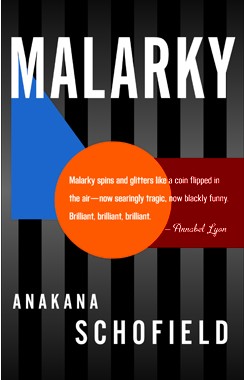 just knows, he won’t be coming back in one piece. And there’s no consolation to be found in her husband. Even if he weren’t indulging himself with The Red Twit, she cannot discuss the simplest things with him, much less anything of an emotional nature. Certainly not anything beyond cows.
In fact, he blames her for the son being ‘soft’.
So she keeps much inside herself, does Our Woman. Or, I should say, she keeps much from the people in her life. With us, the reader, she’s very good at sharing.
“The thing people don’t realize about patchwork women like me is how given to exasperation we are. On the surface, we fuss over the cleanliness of a work surface, or kitchen counter top, we notice the scum around the bath, we may, the most desperate amongst us, brasso the door handles each week, but do not for a millisecond misbelieve that as we are doing this undulating task we are not awash with rage and salty sentiment the likes of which would sting the eyes of out of the most coarse rumped pig.”
Soon enough she meets a man who is driven by strange curiosities about the mechanics of reproduction from a woman’s point of view, and, although he is slightly younger than would have been ideal, his interest in practicalities, in the anthropology of sex rather than the emotions, suits her in many ways, not the least of which for its quality of distraction. She begins an affair with him, partly to even the score but mostly to understand her son.
“Jimmy’s absence taking all of it, more than I wanted gone. No sooner is something gone than we must know more of it. Why’s that? I often felt this same way when a cow leaves to the factory. I’ve no interest in the animal, but once missing, a hole forms for her. I look for her. I miss her in a whole new way.”
It should be said the book is not about sex.
Not in the slightest.
It’s about language. The way we speak, the way we hear, what we communicate and why and how and how we pick our moments to reveal the things we do. And to whom. And then we’re back to why.
Why do we marry, love, befriend, hate? Are these even choices? What do we accept, what do we hope to change? And then we’re back to the how.
“Everything about widowhood is exhausting because you’re trying to recall, unable to recall and then expected to explain why you cannot recall. It is not as simple as living. It is not as simple as being irritated. Being alive and married is like sanding a windowsill. Maybe it is dusty, it may get in your eyes or knick your fingers but you can look at it and see there’s a windowsill. You can look at your husband and feel no need to say anything to him.
“The curse of the widow is the non-stop chatter outside and around your head. Like a television talk show where you loathe the questions, but cannot turn it off.”
I adore the way Our Woman notices the details of life even as its biggest boulders are falling on her head, the way a character “…ponders how it all went wrong, while her biro did a word search.”
Schofield’s use of language, the playfulness of it, including local dialect and turns of phrase [the story is set in the countryside outside Dublin], as well as clever stylistic choices, all conspires to convey the message of how we communicate—and is pitch perfect. Gorgeous in fact. And even though I’ll admit the sometimes unusual sentence structure and occasional [intentional] missing punctuation annoyed me at first, I couldn’t stop reading. Much like meeting up with someone who rattles on and on and you think, god, how do I get out of this, but then, something in their eyes, some gesture, some honest inflection in their voice makes you hear, really hear, what they’re saying and it’s so real and they’re sharing it with you and you realize that’s no small thing and so you listen and before you know it you’re leaning forward across the table, yes, yes, go on, you’re saying… and when it’s time to leave you make a date to meet again soon and as you walk away in separate directions, you notice not much is different except a shift in the world… by just the tiniest degree.
Reading Malarky is like that.

♣
Other wordless friends—
Cheryl Andrews
Christy Ann Conlin
Kristen den Hartog
Allyson Latta
Was recently in a lovely hotel. One I’ve been in before, lucky me. On that previous occasion there was a folder that contained stationery, i.e. a few sheets of hotel letterhead, a couple of envelopes, a comment card, a pen, a Things to Do in the Area brochure. I like that welcomey sort of touch. Immediately after unpacking I like nothing better than plonking myself down in an armchair, feet on the coffee table and reading a letter from hotel management that says things along the lines of we’re so glad you’re here, and give us a dingle if you need anything, anything at all and please take your feet off the coffee table.
Makes me feel at home.
Plus, I love free pens.
And I adore hotel stationery.
I have a small collection of pages that goes back years and years, a decade or more some of it. Every now and then I’ll send a letter to someone on one of those precious sheets, sometimes recalling a moment from way back then, or making no reference at all to the place but merely using it as my personal stationery.
I think it’s damn funky.
However, it seems, at this hotel anyway, stationery has been done away with for reasons of “everyone uses email now”. And the ‘welcome’ letter is now a video, because no one watches enough TV already or is in any way tired of looking at screens. That is, after all, why we go on holiday, is it not? To look at different screens or, at the very least, our own screens in a different light, against mountain backdrops, to text in sultry salted air…
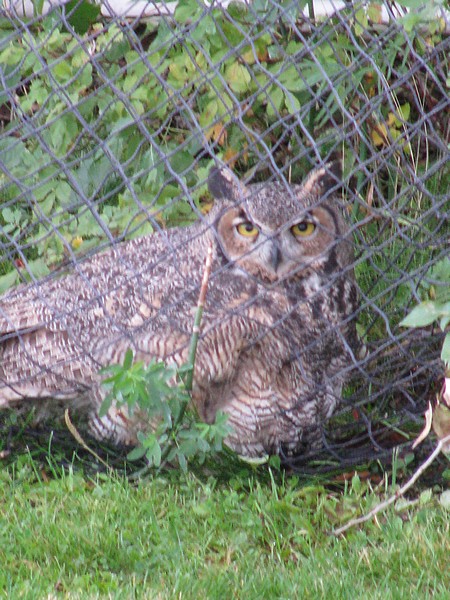
Well then, I thought, what to do in that hour before dinner, about three days into the holiday, when the sun is just thinking of lowering itself behind the lake and the patio is still all warm with it and I have a glass of cool sauvignon blanc and a bag of chips in front of me… Seems like the perfect time to write a letter and comment on morning rambles collecting walnuts and stones and finding an owl with its leg stuck in the net of a volleyball court and contacting the local and very wonderful SPCA who contacted one of their staff in the area who was at home and who was only too happy to trade slippers for shoes and come right over to help said owl.
Stationery would have been nice, but we’ve gone over that. Instead, I tore pages from a notebook and that worked well enough, even better because of the lines—saves the recipient having to turn the paper at an angle to read. And when I asked the front desk for an envelope, they had one, a hotel one even. The young woman apologized for the logo and I said, no, that was great, that was perfect! I don’t think she quite understood my euphoria given how she was not yet born when the art of familiar letter writing was in its heyday. It occurred to me only much later that they probably also had sheets of paper with the hotel logo, although not offered because no one knew what they were for.
Sigh.
So I’m writing this lovely hotel, where I spent a lovely few days. I’m writing them on my own stationery. With a pen. A stamp will be involved. Feet will take me to a nearby mailbox. I will breathe en route. I will ask if they foresee a time when the art of letter writing, if only from hotel stationery, might be revived. I will mention a very exquisite spot in Newfoundland where I had the privilege of staying a few years ago and where I was mightily impressed with many things, not the least of which was a postcard (or two), pre-stamped and featuring a nice shot of the inn and environs. Smart marketing, that. And they’ll mail it for you too.
I’ll update this post with said hotel’s response. Which, with a bit of luck, will come on hotel stationery.
◊
More handwritten thoughts:
♣
Other wordless friends—
Cheryl Andrews
Christy Ann Conlin
Kristen den Hartog
Allyson Latta
“A single moment, a day, can shift into something profound by the reading of a single perfect sentence at the perfect time.” ~ Matilda Magtree, aka me
♦
“The boy was said to be a cousin of Kathleen Burnham and was up from New Hampshire, working at the sawmill, though he was no bigger and looked no older than an adolescent sugar maple.” ~ from Olive Kitteridge, by Elizabeth Strout (Random House. 2008)
“Physical pain, like a poultice, has a way of drawing out what is hidden in the heart.” ~ from the essay ‘A Container of Light’, by Lisa Martin-Demoor, TNQ, Fall 2011
“What passes for identity in America is a series of myths about one’s heroic ancestors.” ~ from Lies My Teacher Told Me, by James W. Loewen (The New Press, 1995)
“She sits at the edge of the narrow cot, neatly made and covered tautly with a white embroidered blanket, the kind that, if you run your hand over it with your eyes closed, feels like a skin disease, tiny white embroidered circles that pop up like pimples.” ~ from ‘A Well-Imagined Life’, in the collection Can You Wave Bye Bye, Baby?, by Elyse Gasco (McClelland & Stewart, 2001)
“It was the kind of party where no one ate the chicken skin.” ~ from The Forgotten Waltz, by Anne Enright (McClelland & Stewart, 2011)
“Because she is ten years old under an open blue sky, because there is not reason ever to arrive anywhere, because she has never felt exactly this way before—this loose in the world, this capable of escape.” ~ from The Juliet Stories, by Carrie Snyder (House of Anansi, 2012)
“Jake and I grew up without a mother, which wasn’t that bad, although we ate a lot of boiled peas.” ~ from the story ‘After Summer’, by Alice Peterson (The Journey Prize Stories, 2007)
“It was no more than a peep, the sound you might make if a butterfly lands on your hand.” ~ from the story ‘A Bolt of White Cloth’, by Leon Rooke
“There’s aggression even in the way they kiss each other so flagrantly, like they’re trying to suck the other’s gums out, like an old horse chasing a lost scrap of ginger nut biscuit down the palm of your hand and up your sleeve.” ~ from Malarky, by Anakana Schofield, (Biblioasis, 2012)
♦
A woman dashing, that is, walking swiftly and with purpose, from front door to car, but not without glancing up at a strolling passerby. That would be me. And then glancing away without so much a s Hale Fellow Well Met! I’m all set to say good morning but it’s clear she has no time for such nonsense.
A chap, in his thirties, looking smart in a purple tie, approaches his smart silver car, starts the engine then returns to his house, leaving the car in idle, spewing unpleasantness into his smart neighbourhood while he’s back inside his smart house possibly positioning his tie so as not to get anything on it as he slurps the dregs of his coffee, very possibly made with the very smartest of coffee makers.
I consider how early the poor soul will have to rise in order to warm his vehicular interior once the morning temperatures fall below 15 celsius.
Something about the pillows on the porch chairs, the shade of green, the fact that bird silhouettes are stenciled on them in a sort of pale burlap colour, the way they look recently leaned against, makes me warm to the strangers living inside this house.
The very day after someone asks: why is it you never see two people walking a dog?—and at the exact moment I’m pondering this almost-koan—I see coming toward me two people walking a lovely rust-coloured pooch of indeterminate breeding.
I notice a bottle of Listerine in a neighbour’s blue box. This feels an oddly personal thing to know about them.
A bottle and can man in a red and black lumberjacket pulls a trolley along the street. I know it’s bottles and cans, it’s recycling day and I can hear them clatter. I respect this form of earning a few bob. In fact, I’d like to see those plastic bottle return depots they have in Calgary. Keeps the streets cleaner, folk make a little dough and there’s less for the landfill. What don’t I know about this seemingly good idea? Why aren’t they in every city and town?
I’m pleased and proud to see Giant Tiger yard waste bags, also President’s Choice, Canadian Tire and ‘Life’ brand in my neighbourhood. I think maybe we’re actually, collectively, getting how every tiny choice matters, support local! choose wisely where you spend your dollars or you will soon be surrounded by big box stores! Maybe the 100 monkey thing is kicking in at last. Hooray! Then I turn a corner and just like that it’s all Costco and Home Depot, Loews. A different crowd entirely, and it occurs to me that you can probably judge someone’s politics by their yard waste bag as easily as a sign on the lawn.
Yet another man in red and black lumberjacket, this time a bathrobe. He sneezes as he walks to his garbage bag already on the street, opens it, adds something, then catches my eye as he turns and we say good morning, good morning. He looks like Peter Gzowski.


♣
Other wordless friends—
Cheryl Andrews
Christy Ann Conlin
Kristen den Hartog
Allyson Latta