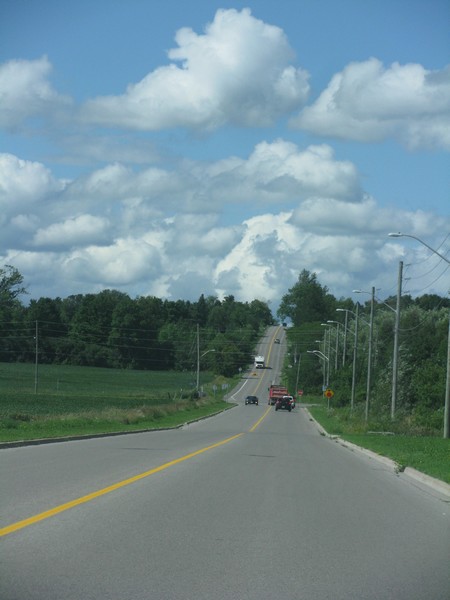
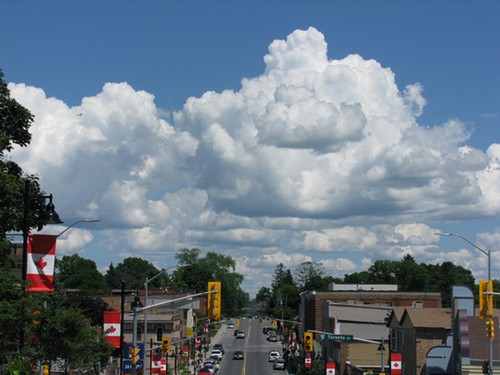
the long and worthwhile road…

—That leads to my bookseller’s door.

Please understand.

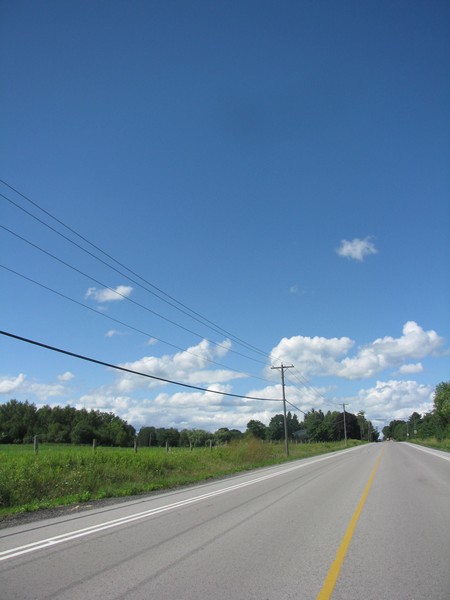
I don’t have to drive. I can call the store, phone in my order [and have, often], or place it online through the shop’s website. I can have it delivered to my doorstep—but I prefer the thirty minute drive to pick up the books in person, see how the shelves are stacked, see what’s in the windows, chat with staff about new favourites, gift ideas, book club picks, the best food in town, the latest author reading or event being held in Blue Heron’s studio space [where among this summer’s inaugural events was a Neil Flambe camp for kids with Kevin Sylvester], or just wander about neighbouring shops. It’s the kind of town where you feel encouraged to wander, discover things, where you end up getting back in your car with not only books but goat cheese, olives, pastries, fresh bread—the fixings for a perfect rest of the day.

The bookshop is merely the town’s heart. Stuart McLean named it among his ten favourites in the country.

Recently ordered, collected, or waiting for me, are Joe Brainard’s I Remember, Alice Zorn’s Ruins & Relics, Brenda Schmidt’s Grid, Jon Klassen’s This is Not My Hat, Alice Peterson’s All the Voices CryLorri Neilsen Glenn’s essays on poetry, Threading Light, the re-release of Sheree Fitch’s classic, Toes in My Nose, and the short story anthologies Riptides  and Bridges. 

All of which has arrived, or will, without a glitch. The phone will ring and I’ll pick a day when I need goat cheese and good bread and head out.

Lucky us for having all that.

And congratulations to Shelley Macbeth, the creative genius and owner of Blue Heron Books, who, this year, [so well deservedly] received the CBA Libris Award for Canadian Bookseller of the Year.

Congratulations.
And thanks.

drawing from humble springs

“Mechanically we have gained, in the last generation, but spiritually we have, I think, unwittingly lost. In other times, women had in their lives more forces which centered them whether or not they realized it; sources which nourished them whether or not they consciously went to these springs. Their very seclusion in the home gave them time alone. Many of their duties were conducive to a quiet contemplative drawing together of the self. They had more creative tasks to perform. Nothing feeds the center so much as creative work, even humble kinds like cooking and sewing. Baking bread, weaving cloth, putting up preserves, teaching and singing to children, must have been far more nourishing than being the family chauffeur or shopping at super-markets, or doing housework with mechanical aids. The art and craft of housework has diminished; much of the time-consuming drudgery—despite modern advertising to the contrary—remains. In housework, as in the rest of life, the curtain of mechanization has come down between the mind and the hand….

“….The answer is not in going back, in putting woman in the home and giving her the broom and the needle again. A number of mechanical aids save us time and energy. But neither is the answer in dissipating our time and energy in more purposeless occupations, more accumulations which supposedly simply life but actually burden it, more possessions which we have not time to use or appreciate, more diversions to fill up the void.”

~from Gift from the Sea, by Anne Morrow Lindbergh (pub. 1955)

You might also like:
planting solitude

take a letter…

Dear Girls in Pretty Dresses in the Purple Car in the Parking Spot on St. Patrick Street:

—Which as we know is right around the corner from the Art Gallery of Ontario, which is where I’m heading to see Picasso and which is why I covet your spot and am beyond thrilled when, as I’m circling the block, I see you and a friend get into your car. Oh joy!  I think as I slow down, pull over behind you and wait a few moments for you to pull out.

But, dear girls, you don’t pull out, do you?

No.

What you do is put the top down on your purple car which turns out to be a convertible so that now I have a clear view of the back of your pony-tailed heads as you sit… SIT!! there.

Minutes and minutes go by. And you continue to sit.

Doing what????

[deep breath]

Dear girls, I’m writing for two reasons. One, to tell you that it’s just about this time that I find myself saying some very bad words in your direction. Out loud. But you can’t hear. Unlike you, I don’t drive a shiny new purple convertible, but a well-loved tan Toyota with an Obus form in the driver’s seat and a bit of rust around the wheel wells. On top of that, my windows are closed. But rest assured the words are said.

Because, dear girls, what kind of idiot sits in a parked car when someone is clearly waiting behind you for that spot. I mean, for god’s sake, if you’re leaving, leave!

After a few more minutes it occurs to me that there might be some problem that prevents you from leaving so I get out of my car and approach yours and see that the problem is that you and your friend are having lunch. Pad Thai by the looks of it.

Hello, I say.

Hello, you say.

I don’t mean to rush you, but after you eat, will you be leaving?

We?

(At this point I detect an accent, can’t quite place it… central Europe somewhere.)

Yes, I say, you, your car.

You say yes, after you eat, you will be leaving.

I can’t believe I ask, but I do. How long do you think that might be?

You consider this quite seriously and say, ten minutes?  like it’s a question.

I say, great, I’ll wait. (Does this give you some idea of how precious a parking spot is in this neck of the woods?)

I try to read but I keep looking up. I feel the need to stay alert in case you start the engine and someone else sidles up, expecting to move in. I have to stay vigilant.

I can tell by the way your heads are moving that you aren’t rushing. You’re chatting and having a splendid time and why shouldn’t you in your dresses and hair and youth and noodles and European accents? You’ve paid for the space, why not have a picnic?

I say more bad words about out of towners and Central Europe. [Which is ironic given that I, myself, live out of town and my parents are from Central Europe.]

Almost exactly ten minutes later you open your door, walk over to my car and in your accent, which I now recognize as something like German or Swiss, you tell me you have an unused ticket for Picasso if I’d like it. I say I’ve already got a ticket, but thank you. I don’t mention it but the ticket you have isn’t valid anyway, as it was only good for entry between one and two p.m. We discuss the exhibit and your Pad Thai and I say I hope you didn’t eat quickly on my account and you say no, you didn’t. I’m oddly relieved. You tell me you’re off to somewhere-somewhere next; I have no idea what you’ve said and don’t ask for clarification… the point being you require sustenance, which, you explain, is why you had to eat before setting out. You laugh as though any fool would agree one must never go to somewhere-somewhere on an empty stomach. And of course I laugh too.

We bid one another a fond farewell. Really quite fond.

And then you are off at last in your purple convertible and pony-tails to somewhere-somewhere. I hope, dear girls, it’s all that you hoped it would be.

I just wanted you to know how the story ended.

ethanol on the beach: one story, three versions, with pictures

Version I

The city didn’t want it. Another city did. Some shady dealing went on. The city that doesn’t want it is getting it anyway. And they’re upset. And the city that wanted it is upset too. And please don’t ask if an environmental assessment was done because that’s just silly. Of course it was NOT done. The new rules say we don’t need such fluff and nonsense.

So there.

End of story.

VERSION II

Cronyism has won the right to build an ethanol plant in Durham Township, right on Oshawa’s busy and environmentally sensitive waterfront, much to the dismay of everyone except the cronies. Meanwhile, nearby Brock Township has a site they’d love to dedicate for just such a purpose but the cronies wrinkled their noses and said no, they want to play at the beach instead. It’s rumoured that one stamped his foot and threatened to hold his breath until he turned blue(r).

VERSION III

In Search of Gifford Hill—my take on visiting the site.

And pictures too.

little things (the big stuff always is)

“If you are like me, learning about bees will change your life. I’m not suggesting that you’ll drop everything and devote yourself to studying insects (though that is possible). What I have in mind is more subtle: a new alertness, a quickening of wonder. Little things that, in the past, have slipped by almost without notice will now demand that you stop and pay attention to them. The hum of wings: whose wings? An insect darting among the flowers: is it a bee or a beefly, a bumblebee or a wasp? What is it doing? Where is it headed? True, it may take you a bit longer to water the petunias or pick the beans, but in those few stolen minutes, you will have been on safari. Gradually, you will begin to sense that a garden is not just a bunch of plants set out in pots and rows: it is a world within a world, a half-tamed ecosystem, full of some of the most exotic and astonishing creatures on the planet.”

—from Bees: nature’s little wonders, by Candace Savage (Greystone Books, 2008)