no, i’m not reading hemingway

…Just clearing shelves.

HOW TO DEAL WITH A CHARGING BULL

1. Do not antagonize the bull, and do not move.

2. Look around for a safe haven—an escape route, cover, or high ground.

3. If a safe haven is not available, remove your shirt, hat, or another article of clothing. (This is to distract the bull.) 

4. If the bull charges, remain still and then throw your shirt or hat away from you. (The bull should head toward the object you’ve thrown.)

**NOTE: IF YOU ENCOUNTER A STAMPEDE of bulls or cattle, do not try to distract them. Try to determine where they are headed, and then get out of the way. If you cannot escape, your only option is to run alongside the stampede to avoid getting trampled. Bulls are not like horses, and will not avoid you if you lie down—so keep moving.

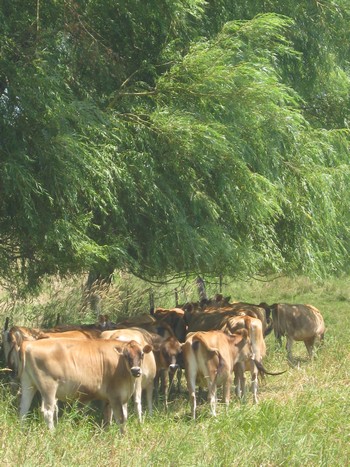
~ from The Worst-Case Scenario Survival Handbook by Joshua Piven and David BrogenichtAnd then there are cows.
No instructions needed.

thinking green

So I’m sitting around on the weekend the way you do, wondering how many shades of green there are in the garden. Peter points out there’s at least ten in a single hosta leaf, suggesting I may be wasting my time if I want real numbers.

“Imagine trying to paint them all,” I say as he quickly opens The Globe’s sports pages. “I mean, how in god’s name do you capture all those shades, how would you paint it, how would you know which green needs a dab of blue or orange or red or yellow or brown or black or—”

“I get it,” he says.

“And then there’s the light. How do you do the light, the dappled bits on the tops of spruce boughs, the dark bits underneath—I mean what colour is the spruce bough??”

He’s entrenched in his reading by now but I ignore that, continue sharing my amazement at green, the magic of painting, of nature, and then I start thinking about ‘doing’ green in other forms. What if, as an exercise, you asked someone to write it—in poetry, or represent shades of green through a short story, a novel, in music, or asked a dancer to interpret green in movement or an architect in design. Translate all that green to a blueprint.

Peter looks up from whatever the Jays are doing. “You’re going a little over the top aren’t you? Architects?”

“Why not?” I say. “Why not interpretation from every corner? Why not convey ‘green’ in meals and wine and quilts—”

“Wine would work.”

Seems I’ve struck a note with his inner sommelier. He glances at the garden, starts listing wines, describing them, throwing words around: pine needle, pepper, herbaceous, crisp, damp woodland floor, grassy, stalky, vegetal, sun shower over Miami. Okay, I made the last one up.

“See?” I say. “Now imagine a festival.”

“Excuse me?”

“A festival celebrating the Art of Green. Green the colour and green the concept. You get funding, sponsorship from the corporates, they like to appear green friendly—get chefs involved, restaurants, galleries, the whole arts community, painters, dancers, photographers, wineries, farmers, writers, sculptors, potters, and, yes, architects. Different expressions of green in different venues: schools, theatres, cafes, vineyards, street corners, studios and—if there’s any still open—libraries. It would last a week in…hmm… maybe late Spring. There’d be posters of greenness and tee-shirts and book bags and the proceeds would go to some form of conservation—a save the bees fund or field trips for kids to learn about the environment, something…I haven’t worked that bit out yet.”

[Rustle of paper as he gets back to reading.]

“And the following year, the Festival of Green could do the same thing in another colour: the Festival of Green celebrates blue or yellow or purple or—”

“You’re doing it again.”

He says he likes the idea, he’s just worried I’m about to organize a festival. I take a breath, sigh, assure him I’m not. I’d like to but it’s all a bit daunting and the fact is there are days I can barely figure out where to begin a new paragraph. Priorities. What I need to do is complete my novel before paper becomes obsolete. I know that. So, yup, for now, I tell him, festivals will have to wait.

“Unless of course someone else wants to organize it…” I say. “In which case I’m in.”

[Silence. Followed by more rustling of paper, followed by silence.]

More green…

green-0051

Be Reasonably Considerate

Swiped from the divine pages of Geist’s summer issue:

From “Eleven Tips on Getting More Efficiency Out of Women Employees,” written for male supervisors during World War II and published in Transportation Magazine in 1943.

PICK young married women. They usually have more of a sense of responsibility than their unmarried sisters, they’re less likely to be flirtatious, they need the work or they wouldn’t be doing it, they still have the pep and interest to work hard and to deal with the public efficiently.
     When you have to use older women, try to get the ones who have worked outside the home at some time in their lives. Older women who have never contacted the public have a hard time adapting themselves and are inclined to be cantankerous and fussy. It’s always well to impress upon older women the importance of friendliness and courtesy.
     General experience indicates that “husky” girls—those who are just a little on the heavy side—are more even-tempered and efficient than their underweight sisters.
     Whenever possible, let the inside employee change from one job to another at some time during the day. Women are inclined to be less nervous and happier with change.
     Be tactful when issuing instructions or in making criticism. Women are often sensitive; they can’t shrug off harsh words the way men do. Never ridicule a woman—it breaks her spirit and cuts off her efficiency.
     Be reasonably considerate about using strong language around women. Even though a girl’s husband or father may swear vociferously, she’ll grow to dislike a place of business where she hears too much of this.
     Get enough size variety in operators’ uniforms so that each girl can have a proper fit. This point can’t be stressed too much in keeping women happy.

cool(ing) thoughts

Every year I cut a basketful of hydrangea for the neighbour lady who dries them to use on her xmas tree. And every year I think: what a lovely idea, and then don’t do it myself… being stuck as I am on the ancient Elmo and Fozzie Bear I gave single Peter a hundred years ago and which he still loves, and the battered white dove that used to be the top of my own tiny singlehood tree—and how could we not hang the hideous Starship Enterprise that no one knows where it came from but if encouraged will tell you to live long and prosper. Ugliest thing you’ve ever seen but it is a nice message.

You should be warned there’s no point to this post except to say the heat wave’s getting to me and thinking about winter has a pleasing effect. Frankly, I’m about one step away from doing a whole pointless wintery riff that could easily morph from tree decor to ice-fishing to memories of snow forts and pretending icicles are freezies and having my face washed on the way to school while wearing big brown rubber boots with buckles, boots so big you put your whole big shoe inside them, and homemade mittens and a scratchy wool hat with pompoms—and didn’t there used to be more snow when we were little? and wasn’t everything uphill? and five miles away?—and how our parents let us go toboganning on our own, at dusk, on Suicide Hill (which, if you didn’t hit a tree, landed you in a parking lot, screaming and laughing hysterically as you swerved past cars)… anything to forget for a single minute that it’s 248 humid degrees out there…

Alas, it’s too late. My fingers are already sliding off the keys and my brain is a fried plantain chip. (in which case may I simply say this: let it snow, let it snow, let it snow! if only for five minutes…)

this is not a review: practical jean by trevor cole

Among the definitions of insanity are…
i) doing the same thing over and over and expecting different results, ii) deviating from social norms or iii) becoming a danger to one’s self and others (although it’s generally agreed that being a deviant or a danger does not always stem from being insane).

It may also be agreed that Jean Vale Horemarsh, the protagonist in Trevor Cole’s Practical Jean—given her quest to kill her four closest friends—falls bang into the second category.

Please don’t misunderstand; she’s doing it out of love. She’s doing it because she doesn’t want them to suffer old age and disease the way her mother did; she wants them to go out in a moment of bliss. Which brings us to the second part of her quest: determining what would constitute a unique moment of bliss for each of the women, then making that moment happen. Then knocking them off.

I love what this book makes you think about: what is friendship? what is kindness? what is nuts? (I also love the cover.)

Trevor Cole has done two remarkable things: he’s written from the perspective of a woman in a way that if you didn’t know, you would insist a woman had written the book. Inner monologues, dialogue, neuroses, petty grievances, vanity—sounds bad, I know, but it’s satire and satire is best done from a negative place—all gorgeously identifiable from a feminine point of view—albeit, admittedly, a little ‘trop’ in the name of art…

Or maybe not.

Which brings me to an interesting, possibly worthwhile, point of digression: can men ‘write women’ effectively, and vice versa? I think: yes, they can. Not all, but those who do it well (Richard B. Wright’s Clara Callan comes to mind), can be enlightening if only for the insight ‘the other’ receives in the reading. In fact, if handled with a deft and sensitive hand, the result is a little like looking into a mirror, being slightly startled and immediately wanting to blame the lighting, but then realizing that, yes, that is indeed us, with our dark circles and bad haircut.

One of my favourite scenes is Jean’s recollection of sitting on the porch eating Peek Freans Digestives (“…even though they were cookies it seemed like they were almost good for you…”) with her friend Cheryl. They’re both teenagers, newly aware of sex but in agreement about wanting nothing to do with it. Life is still wonderfully simple (as Cole illustrates with a lovely example of the ‘facetious’ he does so well) but there’s an ominous sense of adulthood creeping round the corner…

“…Cheryl was acting as if she wasn’t hungry… [she] was just fiddling with the cookie on her plate and crumbling little bits off the edge, and Jean had to ask:
Cheryl, is something wrong?
She said nothing, didn’t even look up, so Jean knew something was wrong and thought maybe Cheryl was mad at her. For what she couldn’t imagine, unless it was forgetting to say something nice about the turquoise barrette in Cheryl’s hair. That seemed like such a petty thing to be mad about, but Jean thought that was probably it. Cheryl could be a little sensitive sometimes; it was one of the few things about Cheryl that wasn’t so great.
I forgot to say, began Jean, that’s a really nice
Before she could finish Cheryl covered her face with her hands and started sobbing. Sitting across from her Jean was thinking Oh, for Heaven’s sake. It’s just a barrette! But she leaned over and put her hand on her friend’s shoulder and said, Cheryl, I’m really sorry. It’s such a pretty—
Cheryl lifted her glistening face from her hands and bawled out, I’m pregnant!
Jean yanked her hand away as if it had been bitten. Even as she did it she wasn’t proud of herself…”

This simple moment carries a lot of weight, not only as a turning point in their lives, but as a through line in the book. Jean immediately drops Cheryl as a friend; soon after, Cheryl and her family disappear. Decades later, Jean’s guilt resurfaces and she’s desperate to find Cheryl, to atone for her lack of compassion.

By killing her of course.

The other remarkable thing in this book so focused on death is that Cole manages, without cliché, to maintain a very high, very subtle, level of humour via spot-on takes of various relationships, letting us in on the power of memories, the dynamics created by conflicting emotions, things said and unsaid—all of the sad mad truth of everyday lives. And all of it perfectly placed against an insane backdrop of benevolent murder.

Somehow the suspension of disbelief is complete.

Dark, delicious and very discussable; best read with a few good (but not too good) friends and a little good (very good) dark chocolate.

This post first appeared in July, 2011.

if you’re looking for love…

…there is no better place than your local Humane Society.

Stopped by mine the other day to deliver a duvet cover for the duvet I dropped off last week. (After it suddenly occurred to me that a duvet minus a cover plus claws equals feathers everywhere.)  Fortunately we had an old one that would do nicely.

A few years ago the original shelter burned down, there were many casualties, horrific it was. After that they found temporary housing in a shoe box; I hear it was beyond awful. No real facilities, no space, no air-conditioning. At least one of those summers, as I recall, was deadly hot and humid. I have no doubt they did their best but it doesn’t bear thinking about.

Thank god a new place has finally been built. And it’s a dream. After just a couple of visits I’m as enchanted as it’s possible to be by it and by the good work these people do. And stunned at how they accomplish it with zero funding. ZERO.

Despite an average annual vet bill of $250,000, plus a long list of other expenses, they manage solely through donations, fund-raising, sponsors and a dedicated volunteer base who do everything from feeding to brushing to walking to cleaning litter boxes to scrubbing out carriers—
—and laundry. At the moment they get by with a small washing machine and dryer, which isn’t nearly enough for the amount they go through. Three laundry lines are set up out back to help out. They live in hope of one day having two industrial size machines.
And, it seems, they do it cheerfully. Very happy vibes inside these walls and that includes from the animals—as happy, anyway, as homeless waifs can be.

I’d like to think this is how all shelters will be built in future: cages only for the anti-social or newcomers or segregation for health reasons, otherwise the population lives and plays in large communal areas and, best of all, have free access to the great outdoors.
Despite the lovely vibes, leaving this place without a fluff-filled carrier or something on a leash is as hard as leaving any shelter, but here at least you can take some small consolation in knowing these beautiful faces are, for the most part, really and truly at the very best place possible, next to a loving home. 

That said, and no matter how you look at it… they’re still looking back…