A new anthology, called GUSH: Menstrual Manifestos For Our Times, is 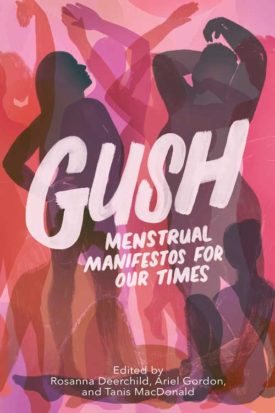 making some people uncomfortable… why must these things be spoken of??
And making others relieved… thank god we can finally speak.
Because I have a short piece in the book (about the perils of attending a pool party in the 1970’s), and because I believe in saying the word menstruation out loud,
I recently sat outside Blue Heron Books with a little sign that said Menstrual Memories? — And waited to see what would happen.
Young children were rushed past.
Men looked uncomfortable. Women too. One woman actually sneered.
But after a while, I noticed people coming back, and some of them stopped. Then many more stopped. It was as if they’d been initially blindsided by the question… but… now that you mention it, yeah, I do have some memories I’d like to share.
And so they shared.
Menstrual memories.
And why not?
A man asked if he could take a picture of the table. I asked if he had any menstrual memories. He said no. We laughed and I liked that the word was spoken between genders. It’s hard enough sometimes just between women.
And that of course IS the whole point of the book, i.e.Why are women made to feel awkward and embarrassed about a basic function of biology?
The first to stop was an 83 year old woman from Cape Breton who whispered about shame and flannel cloths worn like diapers, about the horror of washing them and hanging them to dry. After a few minutes she stopped whispering as one memory twigged another and her friends got into it, all of them swapping stories, and I could tell they’d never had this conversation or anything like it before. As she began to leave, she stopped, smiled and said thank you, this has been fun. She seemed slightly surprised that it turned out that way. And I have no doubt that part of the fun was the relief of speaking the words… at last.
 Following are memories so many women shared with me… on a sidewalk, outside a bookstore, on a beautiful summer night… in their own words:
♥
My aunt was on holiday in Austria and her ankles got so swollen she went to see a doctor and discovered she was eight months pregnant. She’d gained some weight but still had her period and so it was a complete shock. My cousin was born the next month and my aunt and uncle quickly got married and moved in together.
♥
When I got my cycle at age thirteen my mum told me I had to carry a purse for “my stuff”. The way she said it was like it was the worst thing on earth.
♥
My dad worked in a factory that made menstrual products and got an employee discount but was too embarrassed to bring them home in the company box, which ‘advertised’ what was inside and so made a whole production out of wrapping the box in brown paper so that neighbours wouldn’t be any the wiser as he brought it into the house from the car. It was treated like contraband.
♥
I was an immigrant and there was a questionnaire at school. One of the questions had the word “menstrual” in it and I didn’t understand, exactly. But I didn’t ask what it meant. It was like I had an idea it shouldn’t be said out loud.
♥
My mom left a booklet about “being a woman” on my dresser one day. In my closet, that same day, on the top shelf, was a box that had a lovely picture on it of a lovely woman in a long white gown. I was very excited about my new dress (which I assumed was inside!!).
♥
My period started on the way home from school on the #28 Davisville bus. Me in my school uniform: white blouse, kilt, knee socks, blazer. I felt the ‘gush’ and when I stood up I was mortified. I tied the blazer around myself as I exited the bus.
♥
I can’t remember what I said, nothing big, I’d simply mentioned my period in conversation to my boyfriend, who became (immediately) enraged. The details are a blur. All I remember is how angry he was that I said whatever I said out loud, like blasphemy or something. I have never, not once, spoken a word about my period to any guy since. Including my husband.
♥
Boys made jokes about girls who were on their periods. (On the rag & worse.)
♥
Try using an outhouse when you have your period.
♥
When I got my period my mother took me aside and said I was to avoid boys now. She didn’t clarify why or which boys so I avoided them all, including my brothers, to the point that I was afraid if our elbows touched as we passed on the stairs. It completely changed our relationship.
♥
Got my period at eleven. I was on a toboggan with two boys.
♥
My favourite menstrual thought: I look forward to menopause!
♥
A menstrual memory for me is when I was in my twenties and playing softball. I was either pitching or shortstop, and I felt something. Uh oh…
♥
My periods were heavy and I didn’t carry a purse. I worked as an auctioneer.
I used to keep extra pads down the sides of my cowboy boots.
♥
I remember watching TV with my dad and my brothers and running from the room in embarrassment when Kotex ads came on.
♥
My periods stopped the day my mother died. I could feel it starting as I sat with her in the hospital. She died that night, and my period proceeded normally for the rest of week. And that was it. I never had another. I was only in my forties.
♥
We didn’t have products. We used flannel cloths, like diapers, and they had to be washed and dried and re-used. It was an embarrassment when it was your time because people would see the bulge of the pin through your skirt.
♥
My periods were so bad I had to take three days off school most months.
♥
I lived near the ocean and it was a real concern, people would tell you not to swim, to be careful of sharks, and they weren’t kidding.
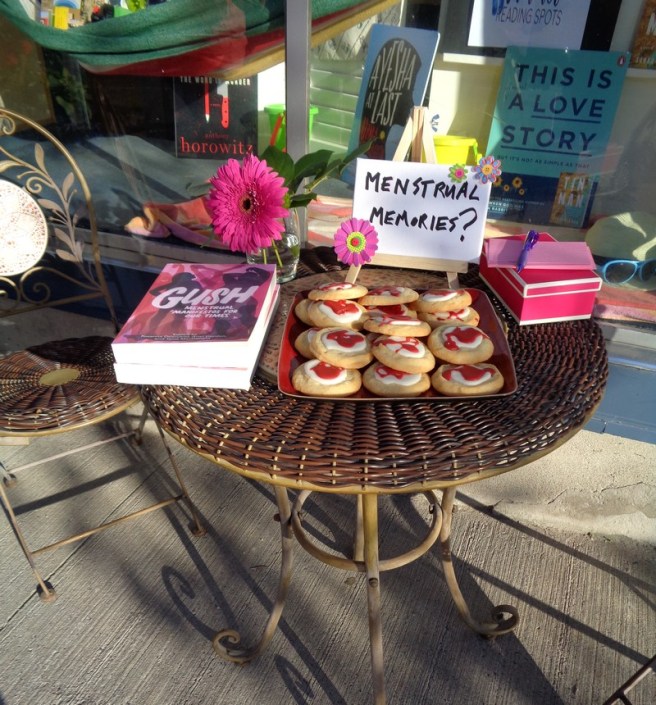
GUSH: Menstrual Manifestos For Our Times available from Blue Heron Books
♥
Support indies!
CBC Books
 But I’m compelled to read on, to savour the next bite-sized morsel, one more beautifully presented, poetic prosey observation about something I’ve never thought of in quite the way I’m reading it here. I make my way through the book like it’s a bar of 85% chocolate.











 Matilda Magtree