
♦
Other Wordless Friends—
Cheryl Andrews
Allison Howard
Barbara Lambert
Allyson Latta
Elizabeth Yeoman
♦
Other Wordless Friends—
Cheryl Andrews
Allison Howard
Barbara Lambert
Allyson Latta
Elizabeth Yeoman
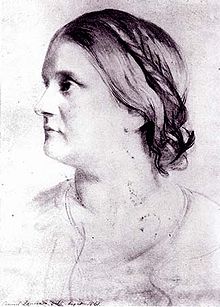
In 1854, Barbara Leigh Smith Bodichon published a pamphlet, “A Brief Summary in Plain Language of the Most Important Laws Concerning Women; Together with a Few Observations Thereon” ; this is an excerpt:
“A man and wife are one person in law; the wife loses all her rights as a single woman, and her existence is entirely absorbed in that of her husband. He is civilly responsibly for her acts; she lives under his protection or cover, and her condition is called coverture.
A woman’s body belongs to her husband; she is in his custody and he can enforce his right by a writ of habeas corpus.
What was her personal property before marriage, such as money, becomes absolutely her husband’s, and he may assign or dispose of them at his pleasure whether he and his wife live together or not.
A wife’s chattels real (i.e., estates) become her husband’s.
Neither the Courts of Common law nor Equity have any direct power to oblige a man to support his wife….
The legal custody of children belongs to the father. During the life-time of a sane father, the mother has no rights over her children, except a limited power over infants, and the father may take them from her and dispose of them as he thinks fit.
A married woman cannot sue or be sued for contracts—nor can she enter into a contracts except as the agent of her husband; that is to say, her word alone is not binding in law….
A wife cannot bring actions unless the husband’s name is joined.
A husband and wife cannot be found guilty of conspiracy, as that offence cannot be committed unless there are two persons.”
—
* In 2007, the British equal rights campaigner and feminist Lesley Abdela came across the grave of Barbara Bodichon. The grave lay in the tiny churchyard in Brightling, East Sussex, about 50 miles (80 km) from London, in a state of disrepair, its railings rusted and breaking away and the inscription on the tomb almost illegible.[ About £1,000 has since been raised to restore the site.
Dog like an angry fox at the bottom of a driveway. Possessive of its tarmac.
As I pass it watches me, positions itself as something much larger… I buy the ruse, walk faster.
But it’s not the only scary thing at this intersection of seasons.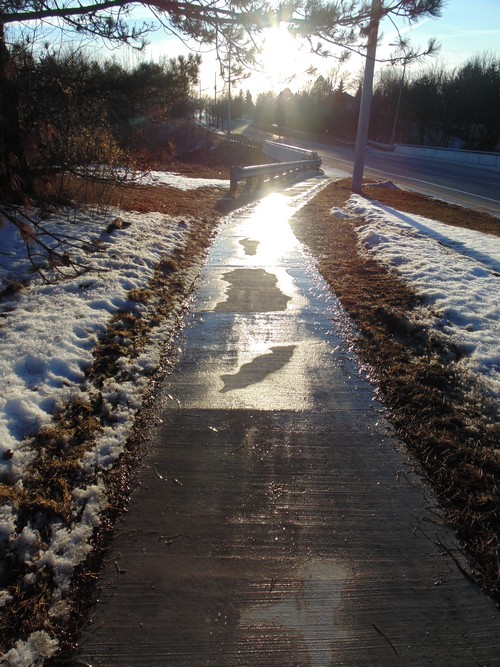 Ice too.
And then another dog. Black and small and growly, companion to a small woman in black. She does not say hello, speaks only to the dog. Perhaps winter has been long and hard for her…
A teenaged lad approaches, staring at his hand. I veer out of his way.
And then a puddle in the shape of a hawk in flight.
And this. Always this.
Smell of cigarette smoke on the other side of a cedar hedge.
Third dog—a very young puppy, gambolling through the snow, followed by two gamboling young girls.
Things are getting better.
Signs of spring.

Also, the sun. Still high at 6:30 p.m.
Another puppy, a sand coloured one, unremarkable and content it seems.
And then, because there haven’t been enough dogs, a beautiful but seemingly unfriendly Lassie, walked by a chap in designated walking apparel and with his perky young daughter outfitted in pinks and purples. He reluctantly returns my hello with a lemon sucking face. (No disrespect to lemons.)
As I turn toward home, a dove. Creaky garden gate sound of its wings as it flies from tree to overhead wire, sits, watches in that non-judgmental dove-like way… and I wonder what the view is like from there.
♦
 Am breaking from my usual silence to say that I chose this shot with the hope of inspiring some chatter, or at least an expression of preferences. I’m guessing there are at least two camps at this *almost spring* time of year—those who can’t stand it one more minute and and are fleeing the last of the snowdrops (or in the case of eastern provinces, snowdumps)… and those who are all a-twitter waiting for them to bloom.
So, at the end of winter, are you a flee or a-twitter??
__
Other Wordless Friends—
Cheryl Andrews
Allison Howard
Barbara Lambert
Allyson Latta
Elizabeth Yeoman
♦
I haven’t the foggiest as to why fat books are so popular. Is it because there’s more to wade around in, that the reading will last longer? A double cheeseburger vs a cup of soup?
Yes, but, I say.
Skinny books, being pared down to their sweet essence, have a tendency to stay with you long after the yummy saga of a fat book has slid into the oblivion of a happy gamorph. (After which you’re hit with the craving for another fat book.) A skinny book, on the other hand, often begs to be read again. And the re-reading gets sweeter (and more nourishing) every time.
And the Birds Rained Down is a skinny book of the most delicious kind, one of five Canada Reads selections, for which I am truly grateful.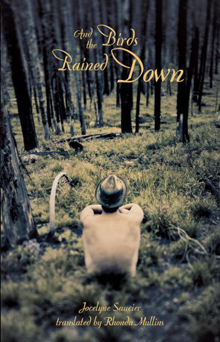
I’ll be honest though. It took me few beats to relax into it and I wondered why this was… because I liked the story. Then it occurred to me: I was reading at the wrong speed; I was looking for something rather than letting the something contained within the pages find me.
Also, the ‘something contained’ wasn’t what I thought. So I’d never have found it by looking.
For instance, what it’s NOT about is a few feisty and elderly men who have chosen to live in the woods where they rely on their wits and each other and occasional supplies from town courtesy of a couple of pot growers. Neither is it about the two women who arrive, one a photographer, working on a project about survivors of an infamous fire; the other, a former inmate of a lunatic asylum.
Neither is it about a small Northern Ontario community that was devastated by fire, or the way the fire’s effect has touched various unconnected people in the decades since.
It’s not about dogs named Drink and Chummey, or a cat named Monseigneur.
And it’s certainly not about the worry of death, though it’s mentioned a lot and figures prominently. And, well, there is strychnine.
It is… however, about dignity. How we see people, how we expect or allow them to live. How we can choose to help or hinder or judge. It’s about the kind of communities we want and the kind we build. (A roadside hotel—a rather old and often overlooked shell of a place with an interesting past that still serves a real purpose to those with an appreciation for authenticity—offers a powerful metaphor for aging.)
“I like places that have given up any pretence of stylishness, any affectation, and that cling to an idea waiting for time to prove them right: prosperity, the railroad, old friends… I’m not sure what they’re waiting for. The region has a number of these sorts of places that stand the test of time as they revel in their own dilapidated solitude.”
It’s about respect for generations that have lived lives we can’t possibly understand; it’s about breaking down age barriers.
“The eyes are what are most important in old people. The flesh is hanging, sagging, gathered in wrinkled knots around the mouth, eyes, nose and ears. The face is ravaged, illegible. You can’t know anything about an old person unless you look into their eyes—their eyes tell the story of their lives.”
It’s about friendship and the surprising places it’s found. In one case, in an asylum where one inmate (who had her own baby taken from her) helped another mourn the loss of her child.
“I rocked her baby. That’s how we became friends. I asked if I could rock her baby. She passed him to me very carefully and I took him just as carefully, and I rocked the baby too, for a long time, singing songs to him. And that’s how, taking turns rocking a baby that didn’t exist, we figured out how not to be where we were.”
It is about love and sex in old age and the latter not working quite as it used to. Never mind. There are other ways. Saucier doesn’t shy away from this subject but treats it with exactly the right amount of ‘natural’. We might ask ourselves why this isn’t talked about more… is it just so terribly shocking to know that the elderly feel passion?
It’s about creativity.
The way these men have built their lives, and an unknown stash of paintings in which more is revealed about the artist than ever could be shared in friendship.
And, yes, it’s about death. Not in any maudlin or sentimental way but in the way it’s connected to both life and independence and the choices we make. Not only how we live, but how we die…
“Too many deaths,… Too many bodies, too much black coiled at the bottom of his paintings, never any light, or, if there is any, it’s to illuminate blacked bodies, cries of horror, hands out stretched where death surprised them. No one can live with that deep within. Ted tried to free himself from it, to hurl all of that horror onto the canvas. Maybe he succeeded in a sense. His final painting, the one on his easel, had light—very little a faint glimmer, but enough to created a space from which he could slip away gently. That’s what I hope for him, it’s what I hope for all of us. To slip away gently.”
It’s a book that celebrates the realities of life in its not always perfect perfection. And it does so quite perfectly.
All that in 155 pages.
♦
And the Birds Rained Down, available online at Blue Heron Books.


Other Wordless Friends—
Cheryl Andrews
Allison Howard
Barbara Lambert
Allyson Latta
Elizabeth Yeoman
♦
I believe the correct term is ‘re-blogging’.
I’ve never done it before so I feel the need to make it very clear that
They belong to the clever minds over at Telling the Flesh and rockstar dinosaur pirate princess but they are so very wonderful and so perfectly address the issue of ‘consent’, which for some reason seems to baffle certain folk to the point of collapsing empires…
And worse.
Anyway, they deserve to be shared.
______________
From Telling the Flesh—
The news is full of stories about sexual assault, rape, and rape culture. Jian Ghomeshi. Steubenville. Rehtaeh Parsons. Dalhousie Dental School. Etc. Every day, almost, there’s another story. Rape culture is now on the agenda, people say. And sure, it’s great that people are talking. It’s great that the idea of rape culture is actually showing up in the mainstream media.
But it’s clear that a.) this conversation shouldn’t have had to happen on the backs of those who have suffered – in some cases, died; and b.) the whole notion of consent still seems to be a particular sticking point for many.
I can’t, for the life of me, figure out why people have such a hard time with consent. To me, it’s simple. It’s straightforward. But for others it isn’t. And that’s where a handy analogy developed by rockstar dinosaur pirate princess comes in.
RDPP (for short) compares sex to tea, with brilliant results. Here’s just a sampling:
You say “hey, would you like a cup of tea?” and they go “omg fuck yes, I would fucking LOVE a cup of tea! Thank you!*” then you know they want a cup of tea.
If you say “hey, would you like a cup of tea?” and they um and ahh and say, “I’m not really sure…” then you can make them a cup of tea or not, but be aware that they might not drink it, and if they don’t drink it then – this is the important bit – don’t make them drink it. You can’t blame them for you going to the effort of making the tea on the off-chance they wanted it; you just have to deal with them not drinking it. Just because you made it doesn’t mean you are entitled to watch them drink it.
If they say “No thank you” then don’t make them tea. At all. Don’t make them tea, don’t make them drink tea, don’t get annoyed at them for not wanting tea. They just don’t want tea, ok?
They might say “Yes please, that’s kind of you” and then when the tea arrives they actually don’t want the tea at all. Sure, that’s kind of annoying as you’ve gone to the effort of making the tea, but they remain under no obligation to drink the tea. They did want tea, now they don’t. Sometimes people change their mind in the time it takes to boil that kettle, brew the tea and add the milk. And it’s ok for people to change their mind, and you are still not entitled to watch them drink it even though you went to the trouble of making it.
If they are unconscious, don’t make them tea. Unconscious people don’t want tea and can’t answer the question “do you want tea” because they are unconscious.
Now, go read the rest, which you can find here.
___________
The above, with thanks, to Sonja Boon.
Other Wordless Friends—
Cheryl Andrews
Allison Howard
Barbara Lambert
Allyson Latta
Elizabeth Yeoman
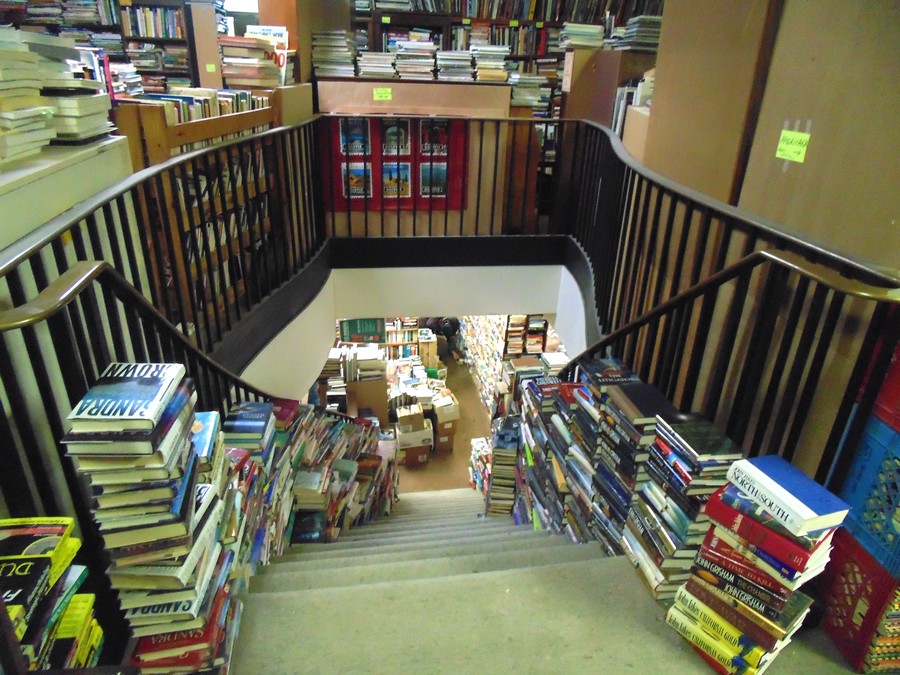
A strange conversation, recently overheard…
In a book store yet.

One woman to the other: I get fidgety if I sit too long.
The other agrees, says, yes, that she has friends who can read for hours;
she has no idea how they do it.
Exactly! says the first. l mean, I Iike to read… but not for hours.
Another exchange, in the same shop, one that made more sense—
I ask the owner how many books he guesses he has in here. 
His answer: not enough.
Every day, he says, someone comes in and asks for something he doesn’t have.
We get that, right?
♦
“Literature is my Utopia.” ~ Helen Keller
Other Wordless Friends—
Cheryl Andrews
Allison Howard
Barbara Lambert
Allyson Latta
Elizabeth Yeoman

