this morning, the smell of chrysanthymums

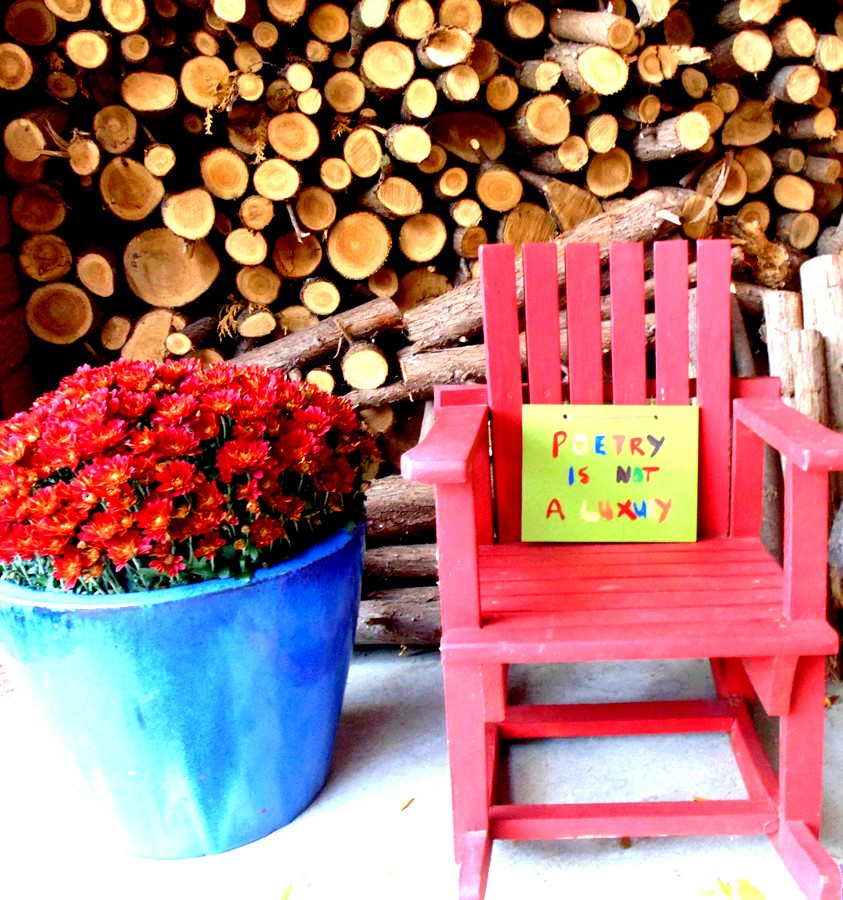
When they were still fresh, a month or two ago, my single pot of blooms took me directly to a wooden fence made by my dad from driftwood gathered at the beach. Planted alongside was a row of perennial chrysanths. Burgundy. Still the only shade I consider ‘real’ and their smell, decades later, is still about summer winding down, jackets, the grass feeling cooler, street lights coming on sooner.
DSC01598

This morning I notice how they’ve faded, they look more bronze than burgundy.

I lean down, inhale, expecting to be on that fence again but it’s a different smell, earthier, a pile of raked leaves from the pear tree (burgundy and bronze!) and some going brown. Leaves I’d raked myself, a few more every day, the pile growing until my dad said it was time to haul them away. (What did he do with them? Burn them? Bag them? Dig them into the garden?)

I only remember the raking and the leaping and the laying, starfish-like on top, staring up through a canopy of bare branches. I remember tossing handfuls in the air and the dewy wetness of the middle of the pile.

That’s the smell this morning. The middle of that sweet pile.
DSC01777


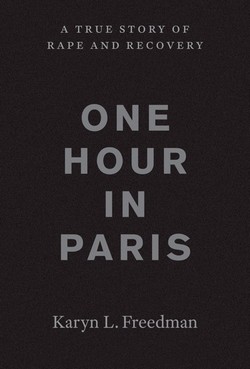
this is not a review: one hour in paris, by karyn l. freedman


Academic approaches to writing are never my favourite way to tell a story, but in the case of Karyn L. Freedman, Professor of Philosophy at the University of Guelph, it works. Indeed, she may be exactly the right person to have written this-book-that-needed-to-be-written. While it surely must have been tempting to veer too much in one direction or the other, in One Hour in Paris. Freedman has managed, for the most part, to balance facts and eye-opening statistics with what feels like heart on her sleeve honesty about the extreme emotions following a brutal event.

The book is about rape.

OneHourInParisCoverFinalBut that’s merely the grit, the sand in the shell that gets things going. The pearl that emerges is a story about trauma and how it can be experienced in as many ways as there are people experiencing it. Freedman’s analytical take on the subject works insofar as presenting a case for PTSD through her rape experience and showing us how society’s focus on the rape, or indeed any ‘incident of violence’, instead of the resulting trauma, diminishes the understanding of violence, undermines the victim and slows or even prevents healing.

In other words, we don’t tend to take these things seriously enough. Especially the lingering and messy aftermath of trauma. We give it an acronym, attach it vaguely to returning soldiers or first responders in newsworthy events. We sincerely hope they ‘get over it’, ‘get better’. But acronyms and hope don’t help. Trauma is hard enough to understand for those who are living with its effects without having to deal with the assumptions and judgements of those who have not experienced it, or who may have experienced it differently.

I’m not sure I would have been able to write that last paragraph before reading Freedman’s book. The way she explains the clinical aspects of trauma has given me a deeper and more practical understanding, not a more emotional one, and for that I’m grateful.

Freedman was raped in Paris on August 1st, 1990. The date is repeated throughout the book, to a degree that becomes slightly irritating, until one realizes that’s the point. She can no longer approach August 1st without remembering what happened. The date is embedded in her memory. She doesn’t need reminding. But reminders are there. Every year. And so by virtue of this repetition she shares with us the ‘irritation’ of not being able to forget something she can’t bear to think about.

She writes about the rape, what happened after, emotionally, professionally, how her father was instrumental in helping her case in ways that many other victims would never experience. For instance, the French government flew her back to Paris (from Winnipeg) at their expense in order to proceed with the case… a case which ultimately saw her compensated financially. While the benefit of such privilege tends to suggest that her trauma has been ‘resolved’, what it actually does is ask the question: what about the women that are raped and/or abused every day, citizens and visitors alike, for whom nothing is ever done, many of whom don’t even know who to tell or how to be heard or believed, much less be compensated and see the perpetrator sent to prison. It’s easy to start thinking that for women who receive this kind of privilege, it’s done. But Freedman is quick to point out that it’s not done. She knows she’s privileged, that this is not how it is for everyone. But all that is almost beside the point. The money, while substantial, is a token, the incarceration is merely fair. None of it is closure.

What’s needed is understanding, by society, a change in how we discuss issues of sexual violence against women, and how we understand the very real effects of trauma on the body, mind and spirit.

“… the sense of responsibility held by many rape survivors is at least partly driven by a dominant worldview regarding personal safety and harm. Although this picture is slowly changing, historically, at least in the West, girls have been taught from a young age that the world is basically a safe place and that so long as you are sufficiently careful and intelligent, you can protect yourself from any serious harm.

“Underscoring this narrative is the fact that in our entertainment-saturated media culture, the everday-ness of sexual violence against women is overlooked in favour of sensationalized stories of extreme violence. And because rape is typically experienced in private… the clear evidence of its pervasiveness is obscured from our collective vision….

“So how does the rape survivor reconcile this dominant worldview with what has happened to her? After all, it cannot be true both that the world is a safe place and that you were raped, unless, of course, the rape was your fault.” 
 
**

Any quibbles with the book are insignificant to the larger message.

__________________________________________

One Hour in Paris is available online at Blue Heron Books. Support indies!


it is not saying yes to a dream or illusion

[Our] ‘yes’ to life may initially be a passive ‘yes’, born of lassitude and of regrets, but it can eventually become a ‘yes’ of openness, of acceptance, a ‘yes’ of joy. This ‘yes’ to life, which springs from the deepest part of us, is not a naïve or idealistic ‘yes’’; it is not saying yes to a dream or illusion. It is a ‘yes’ to our deepest self, a ‘yes’ to our past, to our body, to our family, a ‘yes’ to our inner storms, our winters, our pain; a ‘yes’ also to the beauty of life, to sunshine, to fresh air, to running water, to children’s faces, to the song of birds. It is the ‘yes’, to our destiny and our growth. It is the ‘yes’ to our own true beauty, even if, at certain times, we cannot see it. 

~ from the beautiful spirit of Jean Vanier
DSC01705


in the absence of unicorns

Eight years ago a tiny mess of a kitten entered our lives. Five or six weeks old, sickly and so small my middle finger and thumb easily met around his middle. He was one of the saddest rescue kittens the vet had ever seen; she said we should prepare ourselves, that he might not make it.

For the first few months he hardly ate or even moved, mostly just stared at walls while his nose dripped. Eventually dust motes became interesting and he began to chase them; he got stronger and bigger and ever more eventually he became a healthy young lad with excellent teeth and a good appetite. He had a ton of energy that didn’t lessen as he got older, forever racing up and down stairs, boiiiinging off walls and jumping, cartoon-cat style, a metre straight up into the air, four legs splayed, whenever the mood struck and for no apparent reason. He played fetch and herded his toys. We called him our border collie, our puppy cat.

He was smart, unusually trusting and obedient, more clingy and needy than independent, funny, loving. He has been my yoga buddy, my writing buddy, my constant companion. A good boy.

This morning he died.

More accurately, we had him euthanized.

Our good boy also had a seriously loose chip. Something in his brain was not properly connected, never had been, and it was getting worse. He’d been a danger to our elderly girl cat (we thought he’d be a pal to her after her pal of 17 years had died; but as it turned out, the new lad was no pal and after three years, he and our older cat had to live in separate parts of the house; to her credit, she remained her lovely mellow self and lived to the beautiful age of 20). The boy’s triggers continued and caused him to launch violent attacks—and not the hissing, scratching, meowing, warning kind of attack, but all-out, take no prisoners cat fight in an alley kind. The fight to the death kind. I’ve never seen anything like it and I’ve had cats all my life.

We’ve since been told this can happen to kittens separated from their mothers at too young an age. Not only are they denied the healthy aspects of normal bonding, but they may also be deficient in the nutrients necessary for proper brain development.

Some of the triggers were known to us. The strongest one was if I made that sound you make when you stub a toe or slam a finger in a drawer, a sharp intake of breath… it flipped him out, as if he perceived this as a distress signal and he had to attack whatever threatened me, i.e. whatever or whoever happened to be around. Which usually meant me and my stubbed toe. Logic played no part in things.

I learned to sustain injuries in silence. Once I even poured a pot of scalding water over my leg without uttering a peep because I knew that the smallest sound of surprise or pain would mean teeth and claws in my already forming second degree blisters.

This is what I called ‘managing’. All I had to do was never say ‘ouch’ or make that sharp intake of breath sound… If I could just manage that, forever, there’d be peace in the valley.

But of course I slipped occasionally, and was duly punished with a mauling. Twice he went for my face; once he gave me a black eye.

Sometimes, when it seemed he might be on the verge of an episode from some other, unknown trigger, I’d walk around the house all day with a sheet to throw over him in case he flipped out… buy myself a few seconds to get to another room. Looking back, it strikes me as all but mad, this behaviour. Mine, I mean. Yet I’d come to see it as normal.

We tried meds but they weren’t the answer; he didn’t have an anxiety problem, he had a trigger problem and the meds didn’t change his response. Plus we worried that a lifetime of drugs would create other issues with his heart, his kidneys, etc.

On a Friday morning a few weeks ago, I knocked over a glass in the dark. It surprised me and I uttered a tiny gasp, an intake of breath… Moments earlier, I’d been doing yoga on the bedroom floor with him snuggling up beside my half lotus. Now the glass was tipped over and I knew mid-breath that I was in for it. He was already on his feet and there was no going back. He lunged at my legs, I struggled to get to the bathroom, he fought against the door so that I couldn’t close it and he pushed his way in. It goes on from there. Not a pretty story. My legs were shredded.

He usually ‘comes down’ within an hour or so after these ‘seizures’, but this time he stayed wired for most of the weekend. Amazingly (and despite some lingering buzzing on his part), I was able to pretend all was well; we cuddled on the couch Saturday, he curled up on the bed Sunday morning, almost  as if nothing had happened. Meanwhile I had bandages on my legs. I’d become so used to these attacks, or the threat of them, so used to the tension of constant fear that I might breathe incorrectly and set him off, that I was just so very grateful whenever he was ‘himself’.

Because he was beautiful then.

By Monday I thought he was almost back to normal and by Tuesday morning he seemed perfectly fine. I had a doctor’s appointment, a follow-up to look at my wounds from Friday. While I was out I bought the Bach Rescue Remedy spray; I figured that’s all we needed. Maybe a set of ‘soft paws’ (a brand of click-on nails to soften the blow). I came home from my appointment, said hello to the boy as he slept on his chair in the family room. I went up to my office. A half hour later he was behind me, wanting lunch I thought, but then I saw his face, his body language. Long story short, he attacked, this time without a discernible trigger.

I can’t even describe what happened. He was literally out of his mind.

It’s true that the attacks had become progressively worse over the years, and Friday’s was the worst yet. But this… this attack ‘out of the blue’ was something new. It seemed a switch had flipped and it wasn’t flipping back. I made it to the kitchen, where the attack continued. Blood splattered everywhere, furniture turned over. Finally, I got a door closed between us and called a neighbour who took me to the doctor, who sent me to the hospital for what has amounted to two weeks of IV antibiotics, followed by oral antibiotics. And stitches.

The Health Department got involved and our boy had to be put into quarantine. It was merely a protocol. He was an indoor cat and didn’t have rabies. The options for placement during this 10 day period were grim but, fortunately, we found a beautiful place, a country kennel where cats and dogs spend time being well looked after while their families are on holiday. It gave us time to think.

Euthanasia was discussed. We’d been down this road before with our vet, but in the past we could never go through with it. This time something was different. The attack was different. A line had been crossed and I knew I’d never feel safe with him again. Nor could anyone else.

Whatever was going on with his brain, it was getting worse. Friday’s attack was a lulu. But Tuesday’s was beyond imagination. I’ve come to think it was his way of making it clear to me what had to happen… as if he knew, even though I was still in denial.

And so the talk of euthanasia started again. More earnestly this time. Awful.

It came down to not being able to bear the thought of him hurting someone else (I tell myself that I, of course, can take it; what’s a few antibiotics, a handful of stitches?). We considered giving him away, to a farm, the way you do… or maybe we could find an island where unicorns and sweet but deranged felines live in communal bliss. Turns out there are problems with both scenarios, including how he might meet his end with the next person he attacked. That next person might not be so considerate of his feelings. Especially if he were to hurt a child.

I asked the vet about the island.

Nothing.

And so, in the absence of unicorns… it seemed that euthanasia was the kindest route. I’m still struggling with having made that decision; I keep playing the video over in my head, wanting so very much to be able to edit it.

There are those that will read this and be astonished that I said nothing all these years. Others, who won’t understand, who might think I’m exaggerating. It’s been a wild ride, all of it, an experience that has left me reeling, but also thinking… about denial, about how hard decisions are made, or not, and why. I feel like an ostrich for having put up with it for so long, for having put myself and others at risk. I also feel conflicted, as if I betrayed him by making the ultimate decision…

How’s that for confusion?

I suppose confusion is the least of it. Emotions have been all over the place. Today has been surreal. This has been so different to putting down an aging or ailing pet. A variety of wounds are still healing…

But enough.

I write this for a number of reasons, not the least of which to share with anyone who has been in this position, that I may offer my deepest regret, and to say that I know you did your best, and what you thought was best, and that you did it with all the love a heart can hold.
IMG_3426 - Copy (2)

what i saw

A young Bob Dylan, carrying a backpack and wearing winter boots on a summer day in October.

A girl in a Halloween costume though I don’t know what she was supposed to be.

A girl with purple hair, but that’s nothing.

I saw a guy in a yellow X’d, orange city-worker jacket driving a brand new silver Cougar convertible.

And a  woman of about sixty wearing all lime green who sat herself down on the sidewalk of a downtown street, back against a brick wall, big smile as if she was about to open a picnic basket, and just along a bit, a young lad with lip piercings minding a baby in a stroller. He held his phone in one hand but was transfixed by the woman in green.

I saw a woman of thirty-something in a pink sweatshirt, and a beautiful girl child, maybe five or six years old, with curly yellow hair and a pink toy stroller that kept getting caught in the wind and being blown about whenever the girl let go, which she found so funny. “Look, mummy!” she yelled, laughing as the stroller kept moving by itself on the sidewalk. But the mummy was looking at her phone. For a good five minutes she stared at her phone while the beautiful girl child played with her stroller and the wind. Finally, mummy stopped looking at her phone and took a picture of the girl child before herding her into the car (minivan). That photo is probably up on FB or Twitter by now, looking for all the world like she spent even a moment with the kid.

A line of people waiting for the soup kitchen to open.

I saw a guy in a long fur coat like something out of the 60’s.

And a young woman with shaking hands and unfocussed eyes who asked politely for some change. I said yes. She said thank you.

And that was that.
DSC01602

**
More things I saw.


jungian writing prompt

The instructions were simple. Describe—

My Ideal Dwelling:

Here is where I would not  want to live: in a dark narrow tunnel or cave with small windows and doors, the kind you get stuck in in dreams. I would not want to live in a desert or on the side of a very tall mountain, as in the alps. I would not want to live on a distant island or in a place with broadloom wall to wall. I would not want to live where the inside smelled unfresh, stale, dog-like.

A Walk:

I’m on a beach and in the distance a boat has dropped anchor and with binoculars I see the skipper, alone, eating a sandwich made of pumpernickel bread. I sit on the sand and the tide comes in as the boat leaves and then, jeans sandy and feet wet, I stand and leave to find the nearest deli and on my way there is a dog.

A Bear:

No, it’s not a dog, but a bear. I meet a bear. Black. And as usual I can’t remember whether to play dead or run so I decide to do neither. Instead, I engage the bear in conversation. I say Hello. And the bear grunts, shuffles its feet. I say about the boat and the skipper and how I’m off to find a deli and would he or she like to come along? It’s a she I realize and when she agrees I think how safe I feel to have the company of a friendly bear because for all I know the deli may be in a dicey part of town.

A River:

At the river the bear wades across and then turns and stands on its hind legs and one paw reaches out toward me. I start swimming and the bear smiles and I notice that the river isn’t so very deep and this makes me feel at ease with the whole situation. Once on the other side the bear walks through a forest of aspens and into a town and I follow.

A Cup:

On the ground, red and chipped and stained with tea and blueberries.

A Key:

Also on the ground. Under a clear plastic bag held down with a rock. I pick it up and wait for it to speak to me, to tell me what it unlocks. The bear, I notice, has found the deli, but the sign in the window says closed. Hmm….

A Door:

The key opens the door but inside is another door that says Keep Out. An elk kicks it down and inside that, a storage area where a party is being held. There are balloons and raccoon food. The walls are apple green and a guy—the guy from the boat—is there slicing bologna and rye and a line begins to form…

**

Written in Susan Musgrave’s workshop at the Kingston Lit Festival last month. 
The prompts were given one at a time, with a few minutes for writing, then the next prompt, and so on. According to Jung, done this way, each item represents
a different aspect.

House = how we see ourselves

The Walk = direction in life

The Bear = how you react to trouble

The River = sex

The Cup = love

The Key = knowledge

The Door = death

Gee thanks, Carl.
Man_on_a_boat_between_Reni_and_Ismail_(60-ies)__(6193892221)courtesy of wiki commons