pinning, pining and penning

So the other day I was repairing clothespins.

Because, yes, I hang my clothes on a line. Two lines, actually. In good weather, outside, on a circular thingy. And in bad weather, or in winter [for everything but sheets, which go outside year-round], a line in the basement. The clothespins I use are wooden, held together with an ingenious metal squiggly [there may be an even more technical name for it that I’m unaware of]. It delights me to what is probably an unusual degree that somewhere there is a factory making these tiny works of art, that they are still necessary and that [while they’re also made in plastic] for the most part they haven’t become scientifically enhanced, engineered or in some other way ‘improved’.

There are the dolly peg kind as well but I never got the hang of using them. As a child I was taught the art of laundry, using the wooden/metal squiggly kind and it would be like breaking rank… plus, to be honest, they annoy me because once they break it’s finito la musica… They can’t be repaired.

Unlike the avec metal-squiggly version.

Which brings me back to my point.

I was sitting at the kitchen table, fixing a basket of broken clothespins and thinking: well, this is pathetic. Shouldn’t I be doing something grander than this?? Shouldn’t I be at work on that next great novel, the one that will allow the world to continue turning? Shouldn’t I be penning brilliance of a poetic or opinionated nature, blazing trails in form and incomprehensible voices with short fiction, or hammering away at something entirely made up, like creative non? Shouldn’t I be painting? Or compiling something? At the very least, shouldn’t I move that bag of leaves to the compost?

And as much as logic wanted to say damn right, another part, much brighter than logic, kept insisting that, no, these clothespins were where it was at right now and that these few moments of tending to something so mundane were to be relished, that there was a gift in the seemingly ‘backwardness’ of this kind of work. I thought of my dad, a master of fixing things; he’d prefer that route any day to buying new, and it had nothing to do with saving money. It just pleased him to take the time to repair something. There was the satisfaction with the end product of course, but it occurred to me as I mended those pins that part of what he enjoyed may well have been the meditative quality of mindless but worthwhile tasks… the sort of thing we’ve gotten out of the habit of doing in our never-ending search for faster, better, easier, more—as we get sucked into thinking we don’t have time for this sort of thing in our clever-clever Jetson world—but if we’re honest we waste more than mere minutes doing a lot less of value… it’s just that we do it with things shinier than clothespins.

Anyway, the point [at last] is this: what a difference I felt once I allowed myself the luxury—a sliver of time to do this wee job—once I allowed myself the odd and simple pleasure of it rather than feeling I must always and forever be getting on to something more important…

Important being decidedly relative.
IMG_4795

two days, one night, prince edward county (how to)

Begin in Kingston.

Go to the Agnes Etherington Art Centre in the middle of beautiful Queens University campus. [Outside, marvel at those fresh faces and wonder what the lucky buggers will aspire to.] Inside marvel at the opening installations by Fastwurms and then continue marvelling as you enter the Ruth Soloway collection
IMG_4660
—which itself is worth the trip. If you pick as your favourite, Jean Paul Lemieux’s Beautiful People, you won’t be alone. Prepare to zip through the sombre colours and dead pheasants of the Old Masters room, then be slowed down by the intricacy of lace, the Rembrandts, et al. Be grateful for the brains behind the short histories and various other details posted beside each painting, which increase enjoyment levels immensely. There is a room of African treasures, another of letters written in code and yet another of French street scenes.

Take a walk. Preferably by the water.

Have lunch at Dianne’s Fish Bar. Order the seafood poutine.
IMG_4673

Also the ‘Jar of Yummy Stuff’: brown butter apple rice pudding and cinnamon whip cream.
IMG_4672 - Copy

Avoid the 401 at all costs. Get on the scenic #33 and make your way toward the Glenora Ferry, a free service for cars, bikes, and pedestrians that runs every half hour off season [and every 15 minutes during the season]. Enjoy watching the fishing boats launch or just stretch your legs—the scenery’s delightful and the waiting time goes all too fast. The trip itself is five minutes, landing you, as if by magic, in Prince Edward County.

Make mental notes to come back and visit a thousand and one places you pass but don’t have time to visit today.

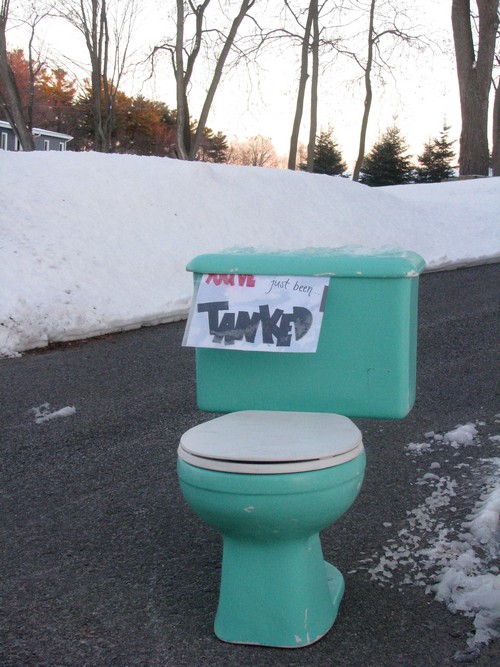
Stop to take a photograph of a toilet on someone’s driveway and discover the owner of the driveway also taking photos. She tells you that the thing appeared overnight with a note explaining how “You’ve Just Been Tanked” is part of a fund-raising campaign. Laugh merrily but know you will be thankful for every day you wake up and find there is not a toilet on your driveway. Ask for directions to Milford and realize you are on the right road.
IMG_4690

Stop at the County Farm Centre where you can get anything you like: appetizers, socks, winches, neon orange road crew uniforms, helmets, strawberries, steaks, slippers, train sets, bird seed, clothes lines, sweaters, boots, apples, cheese, a garden hose, note paper, sunglasses, eyeglasses, frozen shrimp, hammers…

Also catnip. Get some.
IMG_4685

Stop at the general store. Buy some chips.

Stop at the library. Play in the sandbox.
IMG_4738

Be sad that a shop full of curious things isn’t open.
IMG_4751

Arrive at Jackson’s Falls Country Inn and be welcomed by Lee and Paul and a dog named Shelby. Have a glass of wine, beer or cider in the front room. Or by the fireplace. Or on the porch. Or in colourful chairs overlooking fields and forest. Listen for the sound of the falls…
IMG_4707

Drive a few minutes down the road to the Milford Bistro for dinner… or, on a fine evening, walk. When the Chef asks if, instead of ordering from the menu, you’d like him to just bring you food… say yes, yes, YES!! He will bring you wondrous things in exactly the right amounts at precisely the correct moments, including a dollop of chocolate ice cream, cherries and slices of roasted marshmallow between courses. You will wonder how it’s possible to enjoy marshmallow. You will be amazed and delighted.

When you return to the Inn, look up. You’ll see a sky that doesn’t exist where you live.

Sleep well in the absolute silence of your perfect room.

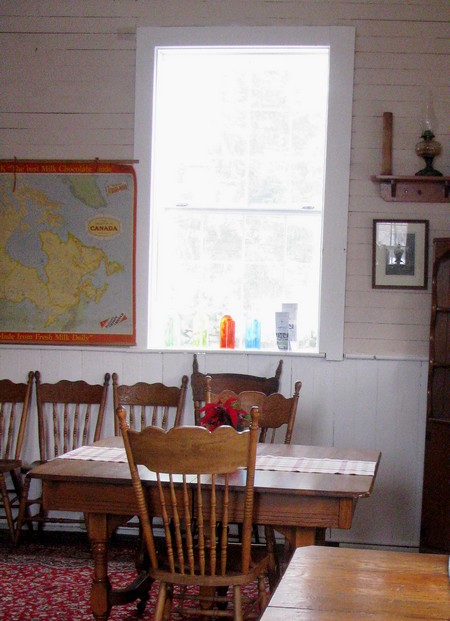
Awake to fresh tea and yogurt with pomegranate and walnuts; a mushroom omelette; toast and jam at a sunny table in what was once a one-room schoolhouse.
IMG_4722

Talk to Lee about start of The County’s food, wine and arts culture. She grew up there. She’s one of the original food, wine and arts movers, shakers and founders. She is also Mohawk and enthusiastically shares plans for putting up a few tepees on a separate piece of property for those that might like that experience [although she adds that longhouses are traditionally Mohawk, not tepees, but they’re tougher logistically]. More enthusiasm as she explains the various themes, group events and dinners she loves to cater. Notice the art in every room. Notice the energy, the calm that presides even when the place is bustling with diners.
IMG_4708

Take many photos around the Inn and know you will come back because where else do things line up this way…
IMG_4699IMG_4698IMG_4730IMG_4728IMG_4718IMG_4713IMG_4715IMG_4716IMG_4731

On the way home, stop at Long Dog Winery; stock up on some excellent chardonnay and pinot noir.
IMG_4754

Stop also at Keint-He Winery where you will kick yourself for not purchasing a book on Frances Anne Hopkins, a wonderful 19th century painter of Canadian history who more or less got overlooked in favour of all the boy painters of that era. Hard to believe, I know. Order a copy from your bookseller on your return home and send Thomas Schultze and Penumbra Press a note of thanks for publishing something so clever.

Have lunch at a little place on the water just outside Wellington whose name you now forget. Watch the swans and geese and otters while you eat a chicken Caesar.
IMG_4776

Rue the flaw in humans that allows only one lunch per day as you pass some good-looking eateries. East and Main, and The Tall Poppy to name but two.
IMG_4777

Head home before the sun gets too low and blinds you.

But first, one last thing en route… because you need gas, and also because you feel like doing something corny—stop by The Big Apple for the first time in your life. Ask about the bunny paraphernalia everywhere and find out the place used to be over-run with wild rabbits. Buy a pie for the neighbour that’s scooping kitty litter while you’re away.
IMG_4789

And one for yourself.

♦◊♦

More Travel:

Montreal
Stratford
Prince Edward Island
Miami
Niagara Region
Peterborough
Chile
Vancouver

baskervilles, part two: never relax your precautions


“As you value your life or your reason keep away from the moor.”

So reads a note received by Sir Henry, heir to the estate [worth millions] called Baskerville Hall. He’s arrived back in England after spending most of his adult life in North America. If all goes well he aims to take up residence at his new digs on the more than usually weird moors. However Mortimer [the friend who introduced him to Holmes] is worried about a big black dog suspected of killing the uncle from whom Henry inherited this delightful country home. It’s rumoured he died of fright from simply having ‘seen’ this beast. Once dead the thing began chomping on his remains. Nice neighbourhood. Who wouldn’t want to live there?

Part One can be read here.

Onward with Part Two…

“What in thunder is the meaning of that?”

This is Sir Henry asking about the above-mentioned note, which, it’s worth mentioning, is made up of words cut out from The Times. Sherlock has of course not only determined it’s from The Times but which edition of the paper… and has had waste bins in all twenty-three area hotels searched for remnants. To no avail. The only word not cut from newsprint is moor. This is in the villain’s handwriting… and will be his downfall. If indeed it is a villain at work. Or, for that matter, a he. There’s some thought to it being a do-gooder who knows of evil lurking and doesn’t want dear Sir Henry to come to harm.

Yeah, right.

More clues are the paper it’s written on [although Sherlock is pretending this is insignificant]. Ditto Sir Henry’s missing boots. One brown, one black, on consecutive days. Then the brown one is returned. Not the black. Again, Sherlock is playing casual but, being sharp as a tack, I’m taking note of all this. As for Sir Henry—he appears to be a bit of a dolt and possibly materialistic. His greatest concern is that the tan boots were new. And he can’t figure out why the thief would want only one. Oh, Henry…

Still, he’s smart enough to at least worry a little about showing up at Baskerville Hall.

Here’s how he puts it:  “It’s a big thing for a man to have to understand and to decide at one sitting. I should like to have a quiet hour by myself to make up my mind. Now, look here, Mr. Holmes, it’s half-past eleven now and I am going back right away to my hotel. Suppose you and your friend, Dr. Watson, come round and lunch with us at two. I’ll be able to tell you more clearly then how this thing strikes me.”

Now isn’t that a civilized way to come to a decision? Take a quiet hour, meet for lunch, have a chat over a chicken Caesar and fries…  So much better than I’ll text you.

In the end, Henry decides to risk it if Watson will go with him [Sherlock’s too busy at the moment; he is Sherlock Holmes after all]. Plus, Henry’s friend, Mortimer, lives nearby somewhere on the moor. And there’s staff at the estate, Barrymore and his wife. So it’s not like he’ll be alone.

Instead of taking a cab back to the hotel, Sir Henry says… “I’d prefer to walk, for this affair has flurried me rather.”

Naturally, a cab follows Henry and Mortimer [Sherlock notices this because he is secretly following them also]. The passenger of the cab has a big black beard, which Watson sees as a clue but Sherlock says it’s probably a fake beard “… a clever man upon so delicate an errand has no use for a beard save to conceal his features.”

As Watson sets off to accompany Sir Henry, Sherlock advises: “Keep your revolver near you night and day, and never relax your precautions.”

Watson and Henry take the train, during which journey Watson notices that Sir Henry has “sensitive nostrils”. Once on the moor they travel by wagonette and are advised by police in the area that the Notting Hill murderer has escaped prison and is suspected to be somewhere on the moor. Oh crap [or the genteel equivalent]… just what they need.

Turns out that Barrymore, the butler at Baskerville Hall, has a black beard. And he’s acting weird. And his wife keeps crying in the night. And the local naturalist with a very pretty unmarried sister takes Watson out on the moor where they hear a “low, long moan, indescribably sad… the peasants say it is the hound of the Baskervilles calling for its prey.” The naturalist, Stapleton, says it could also be a bird, or maybe be the bog. “…the mud settling, or the water rising, or something.” Those naturalists, eh? Takes a lot to ruffle their feathers. The bog, by the way, is called Grimpen Mire… a dangerous place, filled with something like mossy quicksand. Horses are forever getting sucked into oblivion there.

Beryl Stapleton, beautiful sister of the naturalist, mistakes Watson for Henry and begs him to leave Baskerville Hall for his own safety. When she realizes her mistake she pretty much says oh, well, then, never mind. There’s a weird tension between brother and sister. He’s clearly pissed off that she’s ‘said something’ and even more pissed off that he didn’t hear what it was.

A problem of inbreeding… or are these two actually in the know?

Next up: Watson reports to Sherlock by letter. And the big question: Will this prompt a visit to nutsville by the great one himself??

Smoking_pipe_drawing.svg

what we talk about when we talk about fog


The Hounds of the Baskervilles, right?

At least that’s what I think of every single time it’s foggy. But don’t go by me. Having never read a word of Sherlock Holmes, all I know of the sleuth and Conan Doyle’s stories, generally, are bits I’ve gleaned through… I’m not sure what means… eavesdropping? It’s how I learn most things. And somewhere along the line the Baskervilles and fog got united in my mind.

This may be a sad admission but it’s a happy day for today I am reading my first Sherlockian tale and the reason is, yes, fog, which, for years I’ve referred to as being Hounds of the Baskerville weather without knowing what I’m talking about. So this foggy morning when, once again I said: Whoa, it’s all Hounds of the Baskervilles out there… I decided it was time to find out if indeed there is in fact any fog at all among these mythic puppies.

Though never cracked open, I have a The Complete Sherlock Holmes in two volumes and—on cracking it open today—the first thing I learn is that the story in question is not a story. It’s a book. News to me. There are fifteen chapters. Of which I have so far read four. I will read the rest over the weekend and report accordingly. I do this sort of thing rarely, report a reading in real time… the last being from a garret.

Right then. Off we go.

[By the way, the first thing I learn is that it’s Hound not Hounds as I’ve been saying for eons like a great pillock. Although in the context of weather, I still prefer the plural.]

Hound begins, as most doggish things do, with a stick. In this case a walking stick. And because this is a mystery, there are questions about said stick. Watson makes a few good guesses but Sherlock pooh-poohs them for reasons he makes obvious. Watson, the ideal straight man, likes to flatter Sherlock, which begs the question: does he do this because he [being DR. Watson to Sherlock’s MR. status] is privately convinced he’s the smarter of the two, or is he just a merry old soul who doesn’t like to keep score? I’m hoping it’s a combination of both.

“Some people, without possessing genius, have a remarkable power of stimulating it.”

This is Sherlock to Watson. I submit it as Exhibit ‘A’ in my case that Watson is indeed a pretty decent pal to take stuff like that on the chin.

The owner of the stick, Mortimer, has a problem. He’s to pick up Henry Baskerville, last of the [seemingly] doomed Baskervilles, and doesn’t know how to tell him the grounds of the swanky family home he’s inherited are possibly under siege by a giant black dog that renders those who see it catatonic. And then it tears your throat out. [The stick, it is worth mentioning I think, has tooth marks along its middle, as if carried by some sort of pup. Sherlock feels it’s larger than a terrier but smaller than a mastiff.]

Once again, Sherlock is flattered. This time by Mortimer who says: “It is not my intention to be fulsome but I admit that I covet your skull.”

Which goes to show how our conversational skills have changed and, I daresay, declined in the last century or so… Go ahead and covet a stranger’s skull today and see where it gets you.

Another line that wouldn’t make you super popular today:

“I observe from your forefinger that you make your own cigarettes.” [Sherlock to Mortimer]

Later, once Sherlock has agreed to help Mortimer with the Baskerville problem but not yet sure how… and Mortimer has set off to pick up the clueless heir… Sherlock settles down to work out the situation, but first shuts the window to create a “concentration of atmosphere” which he believes “helps a concentration of thought”.

So that’s his secret. I always keep my windows open.

To be continued…
IMG_9951

this is not a review: ‘a crowbar in the buddhist garden’, by stephen reid


I’m mystified at how, collectively, and for a very long time, society has had the idea that to lock someone up and treat them like garbage, will help them blossom. From what I understand, there’s little within the prison system designed to achieve that outcome. Nor do the stats support the theory.

Yet we continue this charade of ‘punishment’ which we prefer to call rehabilitation even though there are fewer and fewer funds to make it so.
I wonder at the why of it and can only come up with Because we’re idiots. And lazy and what’s tucked away out of our sight is someone else’s problem. The problem is that the people whose problem it is have too many problems to fix the real problem.

So we console ourselves with being better than other countries at this prison thing as if that’s the only marker and in some camps the answer now lies in MORE prisons—and ever bigger—where inmates can be treated even less as individuals with individual needs and emerge even more isolated—emotionally or otherwise—to try and live within a society that stands on its moralistic pedestals clucking its giant tongue.

The anthropological side of this absurdity fascinates me.

It’s a big subject and I certainly don’t know what to do about it. I’m not even qualified to rattle on about it. All I know comes from what little I’ve read, a few conversations and a stunning tour through Kingston Penitentiary a mere week after the last inmate left, an eye-opener as to some of what’s wrong with our prison system. [all photos taken on said tour]
IMG_3819
In his book, A Crowbar in the Buddhist Garden, Stephen Reid talks about the lack of ‘prison literature’ while writing (from prison) one of the best of that genre I’ve read. Despite spending the better part of his sixty something years dealing with the effects of abuse, drugs, rehabilitation and incarceration, Reid is able to share his stories objectively and without sentiment. Also without gratuitous asides of the horrors of a system he knows too well. Reid doesn’t name any monsters or over-describe details or try to persuade you to feel this way or that; he’s wise enough to let us be all the more dumbfounded by the monster that emerges rather naturally.
IMG_3869
Most surprising of all, he writes without a shred of anger or self-pity but with the wisdom of a seasoned prison sage when he says it would be a fine thing to be a ‘metaphysical butcher’ so that we could slice away the 1% of the personality that uses and offends, suggesting that the greater part of the most hardened criminal is decent and kind. Unfortunately, it doesn’t work that way, he says. “In criminal law, and much of life, we are our behaviour.”
IMG_3912
In the essay ‘The Last Score’ he details the circumstances that landed him most recently in jail after thirteen years of living on the ‘outside’, drug free.

In ‘A Man they Loved’ he is remorseful beyond measure. “I’m forty-nine years old, married to one of the most interesting and beautiful women on the planet, and parent to two incredible pieces of magic… The forfeiture is unbearable. I see a clear plastic laundry bag lying in one corner of my cell. If I could only get it over my head, wind it tight, airtight, at the neck….

“I am determined to go where I have to go, to take it as deep as it is deep, to do whatever it is I have to do to become whole, to never commit another offence, to never again get addicted. To become finally and forever, the man my many friends and family described…”
IMG_3864
‘The Last Jesus I Know Of’ is about the Intensive Therapy Violent Offender Program… “a gruelling horror show in which sixteen of the most dangerous offenders are culled from seven regional prisons and forced to endure a year of masochistic and humiliating psychodynamic therapy.” He does this because it will at least break the monotony.

“No one has to be Sigmund Freud to figure out these were men who grew so tired of being wounded, they went out and wounded something else.”

They write autobiography for therapy. And read aloud during sessions. And discover the humanity inside those broken shells.

“… I have learned… that for a lot of people in this room, their first bad choice was their parents.”
IMG_3860
“Christmas Eve [a guard] shows up with his crew for a surprise shakedown on the tier. They toss our cells, making a mess, then depart going, ‘Ho Ho Ho.’ The rest of the holiday season passes with Sally Ann Sunshine Bags, attempted suicides, and dark chocolate.”
IMG_3974
“Prisons are about addictions. Most prisoners are casualties of their own habits. They have all created victims—some in cruel and callous ways—but almost to a man they have first practised that cruelty on themselves. Prison provides the loneliness that fuels addiction. It is the slaughterhouse for addicts, and all are eventually delivered to its gates.”
IMG_3919
“Perhaps the days of prison literature have passed… our culture doesn’t encourage those locked up as criminals to learn to engage with their experience on any intellectual level…. We are a society impatient with its misfits.”

He then offers a list of books worth reading.
IMG_3904
In ‘The Zen of the Chain’ he writes about being transferred from one prison to another. He breaks down the indignities, the realities, the heartbreak and fear like a 12 step program. By #11 you are holding your breath and by #12 you realize you’ve just read pure poetry.

 “…To survive you must find the zen of the chain. For instance, if you’re unfortunate enough to have a black box designation and you have to wear that uncomfortable contraption over your handcuffs all day, don’t dwell on the cramps and pain it causes, flow with it, become your black box. Don’t be a new wave crack baby criminal, don’t go sissy on yourself. Suck up them fumes, concentrate on your breathing, find your mantra. Diesel in, diesel out. Let that which doesn’t kill you make you stranger. Transform yourself and your busload of fellow maniacs into an edgy version of Ken Kesey and his band of merry pranksters. Be patient in all things, let the seasons come and go, and one day fortune will smile. The bus will rumble to a stop at some front gate and you will walk in, passing by enough piles of coiled razor wire to make a knife, fork, and spoon for every man, woman and child on the subcontinent of India. You will step into the induction area, they’ll take off the chains and do the strip fan. You’ll get dressed again but this time the bulls will direct you to the right. And just like that you’re walking down a corridor towards a mainline. You feel weightless. You have survived. Life is grand. Until next time.”
IMG_3866 - Copy

About native justice, healing circles and the sweat lodge [versus incarceration], he writes: “A hundred years ago [an offender] would have faced his victim and his village in a longhouse. Restitution would have been part of the determination. [The offender] would have been punished and the circle would have been damaged but it would not have been broken.”

“Prison is, simply put, the bottom rung of the welfare ladder.”

“…if a native prisoner recovers his culture, he recovers himself.”
IMG_3940
Whether he intended it or not, Reid’s opinion of what prison literature should be, describes his own work perfectly:images

“…writing from an experience, not about it.”

Should be required reading in high schools.

_________________________________________

Crowbar in the Buddhist Garden is available online at Blue Heron Bookssupport indies!!


one tin soldier

A repeat post from 2010 when my mother was in a nursing home.
It was her last Remembrance Day and one I’ll never forget.

**

I only went in to see Phyllis, to get her dressed and give her breakfast. I always leave at 10. But when we walk to the common room for a bit of exercise, the chairs, each with a photocopy of ‘O Canada’ on its seat, are lined up in rows facing a podium. There’s a large screen at the front and poppies everywhere.

I consider staying the extra hour or so but Phyllis isn’t interested in ceremonies. Me neither. I prefer observing my two minutes of silence, alone and in my own way. We find a sunny spot at the back of the room and I read a piece by Barbara Kingsolver in the National Geographic, about water, while Phyllis sleeps in the chair beside me.

It’s nine thirty. I’ll take her back to her room at quarter to ten.

But at twenty to ten they start arriving.

Soon there’s a row of four men and one woman seated beside the podium, facing the rows of chairs. “Residents who served” I overhear someone say. One, in a wheelchair, sleeps with his head back and mouth wide open. The woman sits quietly confused with her ankles crossed, and a happy man with a British dialect tells everyone who passes “you’re wonderful”, and to the man with dementia beside him who’s beginning to nod off and fall sideways, the happy man says Are you alright, Tom?

Someone straightens Tom out and asks what it was he did during the war but Tom just looks straight ahead. The happy guy answers for him, says: What we all did… sink or swim.

More residents are wheeled in. A few come with aluminium walkers or a nurse. None come unassisted. The room is filling up with bodies and sounds. Phlemgy coughs, orphaned words, mumbles. The woman who yells all day I want to go home, somebody help me, what am I going to do?  arrives, pushed in her wheelchair by a nurse and placed at the front of the room. Where am I? Where are you taking me? she yells. She has terrible teeth and long thin hair. I’ve never seen her family; she may be one of the many abandoned to the system, completely dependent on the mood of staff and Ministry guidelines, at the mercy of Long Term Care politics and rubbery cream of wheat.

‘One Tin Soldier’ plays in the background. By The Original Caste. I remember hearing it when I was very young and didn’t really understand what it was about. Listening to it now, surrounded by so many drooling tin soldiers of yore, it takes on even deeper meaning and I realize I’m staying for the ceremony… and for these men and women who did what they did, and for others who continue to do in this mad world because it’s, sadly, still the only way any of us knows to say thank you. I stay because we’re all a product of our past and because we’re all connected whether we like it or not.

I stay for my dad whose only comments about the war had to do with unexpected kindnesses from all sides. He didn’t speak of heroics.

The German man down the hall from Phyllis is brought in to sit with former enemies and it makes me wonder at the word ‘enemy’. Circumstantial at best. They all sit quietly confused together now, eating the same gruel, wondering perhaps what it was all about anyway.

Oh, yes. A madman. There’s always a madman.

Tom keeps falling over so his son moves him off to the side where he can keep him upright. He’s brought his dad’s beret and medals and pins them on a slightly stained beige pullover. The son takes pictures of Tom, asks Tom to salute. Tom just stares straight ahead.

It would be easy to leave. Wake Phyllis and go. I don’t want to hear ‘In Flanders Fields’ and cry with strangers. But I stay because it’s such an honour to sit among the muddle of their confusion, their dignity and continued bravery in this forgotten place of forgotten people where the beauty of old age is seen as ugliness, as something to pity.

During the ceremony I watch a daughter put a pink sweatered arm around her mother, pull her close and kiss her face. Another daughter is her mother, thirty or forty years earlier, so striking is the resemblance. A man in a motorized wheelchair wipes his eyes with a facecloth, says it bugs him that he can’t stand up to pay his respects. The happy man occasionally blurts out: Too much talking, too much talking and he’s right of course; there’s always too much talking. I notice his breathing is difficult, like my dad’s the year he died.

I notice the woman who yells all day is quiet.

And when eleven o’clock comes the whole room is suddenly hushed except for the sleeping veteran who snores loudly beside the podium and the happy man who says Hallelujah. But the muttering and coughing and shuffling stop. It’s like these people, who aren’t sure of much, can still sense what’s important. Maybe that’s what makes us human.

As the ‘The Last Post’ is played, and while I blow my nose, Phyllis wakes, looks at the rows of silent backs in front of us and says: Wow, it must be a good movie.

The ‘residents who served’ are recognized and the anthem is sung and then later a video clip is shown, based on a true story about a guy in a Shoppers Drug Mart who was outraged that the store observed two minutes of silence, causing him to wait—two minutes—to pay for his purchases.

The happy man is saying Too much talking, too much talking, and when the video and the ceremony end, and we’re thanked for being there and all is done, the happy man, breathing hard in his veterans’ seat, says: Peace at last, peace at last.

On our way out, I stop and ask Tom’s son if I might shake his dad’s hand. He beams, says Sure! and explains to Tom what I want. Tom in his beret and strip of medals pinned to his sloppy sweater, stares back, silent. His son helps him extend a hand. It feels soft and weak, the kind of hand that hasn’t worked in years except maybe to scratch an ear, adjust a bib at lunch. I hope that on some level he might still understand what a handshake is. And even if he doesn’t, I do.

I try to find something in his eyes to connect with but they stare in a kind of trance; I wonder what they’ve seen and whether I’d have the stomach for knowing.

Thank you, sir, I say, and Tom’s son tells him: Dad, say you’re welcome!

And ever so quietly, Tom does.
541px-Poppy-closeup