this is not a review — nature’s little wonders: bees, by candace savage

“The life of a bee is like a magic well. The more you draw from it, the more there is to draw.” ~ Karl von Frisch

—A beautifully made book of satiny semi-gloss pages, colour photos, drawings, side-bars rife with fascinating facts, bee lore and poetry. Co-published (2008) by D&M Publishers (Greystone Books) and David Suzuki Foundation.  A joy to read. And important too. [Excellent gift idea. The bees will thank you. Which, in turn, is good for us human bee’ns.]

Here’s but a few things I learned from its delightful pages

Bees evolved from wasps.

They are herbivores, sting only in defence; raise young on protein rich pollen while wasps are carnivores, sting for food; eat other insects; also like people food [especially mine].

There are currently 16,000+ species of bees, ranging in size from that of a fruit fly to half the size of a human palm. (4,000 species in N. America)

A colony is about 300-400 bees of which most of those are worker bees.9781553655312

All worker bees are female; they live 60 days or so, except for those born late in season, which will spend a winter in the hive.

Only a few males are produced in late summer for one purpose: to mate and thereby produce fresh queens for the following year.

After the once-in-a-lifetime mating spree, the queen has enough sperm stored in her body to fertilize each egg she lays. Fertilized eggs become female (worker bees). Unfertilized become male (drones).

A Queen bee lays eggs (1,500 each summer day/ half a million in a lifespan of two years) while worker bees help raise successive broods of females.

The eggs are fed and raised by the female worker bees. Only a very few are reared in special areas of colony and fed the ultra-nutritious royal jelly, which allows them to grow into queens, i.e. egg layers.

Worker bees know that it’s time to raise a new queen (i.e. feed the royal jelly) when the current queen’s pheromones no longer predominate in the hive.

Drones die immediately after mating, or are killed. [I’ll spare you the gruesome details.]

Bee stingers don’t get stuck in bee flesh the way they do in human flesh. So they ‘can’ sting one another to death. [see above… but this is merely one method of getting rid of unwanted drones]

Honeybees can see colour.  [The book outlines how this was first shown by placing a bowl of sugar water on a square of blue paper. The bees, of course, were attracted to the sugar. Then the bowl was removed and the blue square moved to a different position among several grey squares. Didn’t matter. The bees still went to the blue square.]

The book cites the work of Karl von Frisch, A Nobel Prize winner for his research on the honeybee, and Martin Lindauer, a student of von Frisch, and a renowned bee expert in his own right. Of Lindauer, Savage writes:

“Through the glass walls of his observation hive, Lindauer could watch the workers as they scurried around performing their household tasks. Here, bees were cleaning out vacant cells in preparation for reuse, by removing old cocoons and re-coating the walls with wax. Over there, others were poking their heads into occupied cells, the ones with grubs in them, to check on the larvae and see if they needed to be fed. (According to Lindauer’s data, nurse bees inspect each larva, on average, 1,926 times during the five or six days before it makes its cocoon but feed it on only 143 of those visits.) Elsewhere in the hive, bees were busy building comb, capping comb, packing comb with pollen. Tucked away in a quiet corner, an individual might be flicking a droplet of nectar in and out on her tongue, waiting for the honeyed glob to thicken. At the same time, others were fanning their wings near the entrance, for cooling or ventilation, or standing guard in the doorway, with their forelegs raised and their antennae up, at attention.”

Lindauer noted that bees are hyper aware of various stimuli, changes in temperature, texture, taste, and instinctively know how to respond or communicate direction to others. When he inadvertently put a heat lamp too close to the hive he noticed the bees stopped foraging for pollen and collected water droplets instead to flick into the hive for a cooling effect.

Savage addresses the issue of colony collapse and other problems we’ve contributed to, while noting that “Bees [bring] sweetness out of chaos. Humans, on the other hand, [seem] to have an instinct for devastation. Could it be that these insects have something to teach us?”

And this, perhaps my most favourite morsel of all:

“Unlike human groups, which often seem less intelligent than the individuals who make them up, a swarm of bees is always smarter than the sum of its parts.”

American_foulbrood_honeycomb_drawing

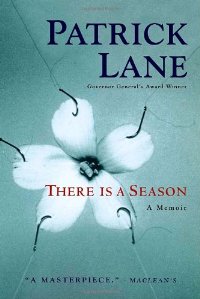
this is not a review: there is a season, by patrick lane

 
I can’t lie. Nor do I think I ought to. On reading the first chapter of Patrick Lane’s There is a Season I felt mostly annoyed. I didn’t think I’d make it to page fifty, which is my official limit…[page 100 is my un-official limit]. If I haven’t engaged in a book by then I close it and move along.

I can’t say what it was that bothered me, I just couldn’t get with the rhythm, I wasn’t paying attention.

When this happens, and despite the accompanying crankiness, something about the book occasionally compels me onward and prevents me from slamming it shut. This was not the case here. I walked away muttering about how I wasn’t in the mood for epiphanies in the form of raindrops. But the next day I picked it up again. It was a library copy so nothing would have been simpler than to take it back from whence it came—but those raindrops had gotten into my head and when I opened it up the second time to some random page, I read this:

“I don’t know why I confuse myself in the world when all I need to do is spend a few moments in this gentle space.”

I kept reading, pages and passages in no particular order.

“I measure friendship by those who are the friends of spiders and those who are not.”

“The drenched garden glows like the womb must to an unborn child.”

“What I call silence is not the absence of sound but the presence of the garden when it is not weighted down by traffic noise and talk.”

“My quest has always been to find what I could not leave.”

“A green frog does not sit on a red geranium unless he’s gone a little mad.”

“There are times I want to be in the second or third person… It’s simpler to be a fiction.”

“We break our path when fear tells us to live.”

** 

And then I started again, at the beginning.

—It’s springtime in the Okanagan and the author is a boy. We meet him as he stands “… among yellow glacier lilies and…windflowers…the western anemone, their petals frail disks of trembling clotted cream.”

This is the opening. What, exactly, about that is cranky-making?? I’ll tell you what: nothing. Whatever my initial reading mood was, I’m thrilled it passed.

It’s a book about a garden in flux and the man who is putting it [and his life] to rights; about the connection of man to nature. Of an ornamental tree, he says “Their leaves funnel the rain, and the water runs down one leaf, falls to the next and the next, miniature waterfalls in a stream until the last and outer leaf drops the water where the feeder roots drink.”

It’s a book of poetry in the form of prose. Or vice versa. It’s a meditation. You read it slowly, and maybe that’s what was wrong on my first attempt. My speed setting was off.

“That is beauty, to stop a moment and watch the endless play of light on water and stone and see how the living things of the garden come to drink or just to gaze as I do now at the surface of the pond.”

The book is also about sobriety although drinking is rarely mentioned. It’s Lane’s senses that are sober for the first time in forty-five years and so the reader is privy to the perspective of not only a great poet, but of someone who’s been issued a set of fresh eyes, ears, skin and taste buds.

“The drenched garden glows like the womb must to an unborn child.”

51aac9pD90L__SX200_There are many references to rain and mist and dew, pools of water, as if the booze has been replaced by more useful forms of liquid, ones that help him think—and remember—more clearly.

The book is divided between the present day Victoria garden and the past: childhood, parents, marriage, failures, joy, sadness and one especially incredible scene where he returns with his now elderly, unemotional and extremely reluctant mother to the old homestead; it’s near the end of the book and is one of the best passages I’ve read anywhere for its power to convey, essentially, a whole world, the now and the then, in a few sentences. Perfectly placed.

I’ve since returned the library copy.
And purchased one of my own.

today’s walk

Uneventful.

Except for the daring blue heron that wades in the creek up to its icy blue thighs, and the black and white bird that watches from an overhead branch. No idea what it is. Magpie?  But we don’t get those here… I haven’t seen one since Edmonton in the eighties when everything was a revelation. I had a friend there who grew up on a dairy farm so we spent a lot of time in the country. That’s where I learned that magpies aren’t exactly the most beloved birds. Also, that you can drink directly from a cow. No middleman or cartons required. This was big. I didn’t believe it at first. Could not fathom that a tin bucket in the kitchen was what I was meant to ladle milk from for my Cheerios. One afternoon I took a walk in the back forty, picked some flowers, brought them inside, found a jar and filled it with water, a gift for the dinner table. When my friend’s mother came in she said Where did those stink weeks come from? It’s true that there was a very distinct and un-gift-like odour in the room… I’d assumed it was the fermenting milk.
IMG_4152IMG_4154
But today’s walk.

Uneventful, except for the above and a dove too— just because the sight of them always makes me happy. They needn’t be doing anything and they usually aren’t; something about their shape pleases me, the way they look to the left, the right, left again, as if always curious, forever surprised at the sameness of things. And a blackbird soaring above yellow and crimson leaves, circling and dipping and dipping some more, just because it can. A sparrow hiding under a Toyota Camry, or maybe just keeping out of the rain.
IMG_4156IMG_4158
And a man in his eighties, wrinkled from laughter, bright-eyed and sprightly, carrying two logs from the back of a house where I hear a chain saw working. He tells me he’s looking for volunteers to help… I tell him I’ll help him look, send them all his way. I circle the block and when I pass his house again, he’s there carrying more logs. He laughs, calls out, says in a wink-wink tone, “You haven’t forgotten where you’re going have you??” I realize the fact that I’m carrying a full shopping bag makes it look as though I should be heading home with my groceries, not strolling about the neighbourhood. I don’t tell him the bag is full of litter… I’m simply pleased that I’m finally worthy of insider status to an octogenarian’s joke…
IMG_4160

stratford in nine acts

 
Act One:
—a favourite art gallery that’s in-between exhibits. Nuts.

ACT TWO: a secret path behind said gallery that leads to stairs that lead to the Avon River.
IMG_4012IMG_4013IMG_4035

ACT THREE: swans au naturel.
IMG_4038

ACT FOUR: swans who’ve inadvertently walked into a trap and are now headed for their winter digs. Much hissing when nabbed, especially among the young ones who’ve never been through this before. When asked if the birds enjoy their off season indoor camping arrangement [I asked this hopefully, by the way, with several toes crossed] the handlers said… and I quote: “Nope.”
IMG_4024IMG_4023IMG_4027IMG_4028IMG_4026
ACT FIVE: Stitch, who lost an eye to a mink last year. Seasonal shifts are child’s play to him; no hissy fits, he’s all one-eyed dignity.
IMG_4033

The last time I ordered coffee, some many years ago, I was given a cup of regular instead of decaf and I jangled something frightening. I realize the jangle is part of coffee’s charm but I didn’t care for that “HELLLOOOO!!!! I’M AWAKE NOW!!” feeling and have been a tea girl ever since. Black, white, green, rooibos, lapacho bark, herbals, tisanes, roots, bits of old leather, anything but coffee. Hence, ACT SIX: my favourite retail establishment… more Ohm than Zing.
IMG_4042_1

ACT 6-A: the colours of course.IMG_4043IMG_4044

No picture to prove this but Pazzo’s petite pizza, greens from Soiled Reputation and a perfect antipasti platter played no paltriness in the pleasure offered by Stratford’s SEVENTH act.

ACT EIGHT… the play. Mary Stuart. Wherein even the slightest facial movements by the astounding Seanna McKenna are a performance in themselves. The story—nutshell version—is about the way we divide up society and allegiances based purely on our passions [culture, religion, morals, values, aesthetics]. The playwright chose to portray this through a fictional meeting between Mary, Queen of Scots [Catholic, beautiful, all joie de vivre and super popular despite being a bit of a tart who murdered one of her three husbands] and Queen Elizabeth [Protestant, not so fun but a dedicated monarch] during which meeting Mary calls Elizabeth a bastard for her illegitimate status and [therefore] dubious right to a throne Mary reckons should be hers. Well, of course it’s never really about the throne, is it? Deeper issues lurk—deceptions, insecurities, jealousy, guilt, politics, family names, bloodlines, history… All that and more than a few good laughs. Yes, it’s true… there are moments of delicious humour. Three thumbs up.
IMG_4053

ACT NINE: homeward. Via pumpkin patches and planes in pale purple skies.
IMG_4054IMG_4068IMG_4065

Applause. Exit right. Fade out…

*five frivolous minutes over roast chicken with ‘ch’ — age 62

 
I met ‘ch’ in 1987. We became friends immediately.

She is the most voracious reader I know. She also believes in the protective power of magic sticks when walking through parks late at night… not for wielding but merely to hold, letting the inherent magic do its thing.

She has canoed the Mackenzie River (**or was it the Fraser?), worked in the Sudan and claims France as her country of choice for a nervous breakdown.

Once, walking together along a sidewalk, a black cat crossed our path and without a word to each other—and without any idea that we both had a spontaneous ‘ritual’ for situations like this—I came to a complete stop while ‘ch’ did a pirouette. And then without missing a beat we continued on our way.

Over the years she has introduced me to expressions such as ‘gin memories’, ‘yars, yars, yars’ and, most recently, ‘pearls before swine’.

She has a perfect Lauren Hutton gap between her two front teeth and on any given day, if you phone and ask what she’s having for dinner, the answer will invariably include some form of eggs. She will deny that it’s that often.

How long could you go without talking?  To myself? Not long. To other people… days.

Do you prefer silence or noise?  Silence.

How many pairs of shoes do you own?  15.

If you won the lottery?  I’d share it, become a secret benefactor, buy things people need, anonymously.

One law you’d make? I’d do something about legalizing drugs, with a drug education component.

Unusual talent? Painting walls.

What do you like to cook?  Soul food type bean dishes.

Have you or would you ever bungee jump? No.

What’s the most dare-devilish thing you’ve done? Nicky-nicky nine doors.

Do you like surprise parties, practical jokes? No and no.

Favourite time of day? Dusk.

What tree would you be? A spooky drooper. (a type of cedar, with spooky droopers)

Best present ever received? A heartfelt thank you.

What do you like on your toast? CheezWhiz

The last thing you drew a picture of? The sunflowers in my garden.

Last thing written in ink. Morning journal notes.

Favourite childhood meal? My mother’s mac and cheese with bacon on the side.

What [past] age was the best? 27

Would you go back to that if you could? No.

Best invention? The wheel.

Describe your childhood bedroom. Shared with sister, double bed, played games when supposed to be sleeping; ‘Fighting Feet” was one.

Afraid of spiders? No. In fact I love them. The non-toxic ones, I mean.

Phobias? None.

Least favourite teacher and why? Geography. Was sent out of the room because I objected to something. Sent to V.P. who understood my position… so it turned out well.

Favourite children’s story? The Grand County Fair.  “…Come to the fair, the grand county fair, with horses and sideshows and fun everywhere.”

Ideal picnic ingredients? My mum’s fried chicken and potato salad.

Is Barbie a negative role model? No.

No???  No. Who takes Barbie seriously?

Best thing about Canada? It’s home.

Best thing about people in general? Connection, when people ‘get’ each other.

What flavour would you be? Lemon.

What colour? Red.

What would you come back as? A more evolved person, hopefully.
IMG_3485

*Five Frivolous Minutes is a series devoted to non-essential questions and answers. It amuses me.
** It was the Mackenzie, I’ve been told. The Fraser has rapids.