red and black leggings

 
A girl of maybe eight, dark blonde hair, almost wavy, almost thick, in a loose pony tail with strands unbound around her face. Red and black leggings in geometric pattern and a grey tee shirt that reads: LOVE. She twirls in the hallway, in the basement of the gallery, outside the room where I sit reading and writing, outside the room where her art class is going on. For just a few moments she dances oblivious and alone in the hallway between these two rooms, dances and twirls and twirls, to music that doesn’t play…

And then just like that, she’s gone.

DSC05284

rainy day people

 
I was writing with a group of women at the shelter recently.
DSC05240
I do this once a month; they call it a workshop, but really we’re just writing together.
DSC05247
I’m always amazed by what gets said on paper by people who aren’t always used to holding a pen.
DSC05242
Amazed also that in the middle of the madness that is currently their life, in the middle of everything they’re going through, have gone through for god knows how long, that they can write with such clarity, such honesty.
DSC05252
They’re surprised when I tell them their words are beautiful.
DSC05245
At first they don’t believe me and then, something happens, the magic of unlocking, of tapping into a part of themselves that so rarely gets out, the magic of being heard… and I can see something change and I know that it’s a tiny thing, but even that is big, because, even for just a while…
DSC05243
…they believe, they know,  that something about them is beautiful still.
DSC05244
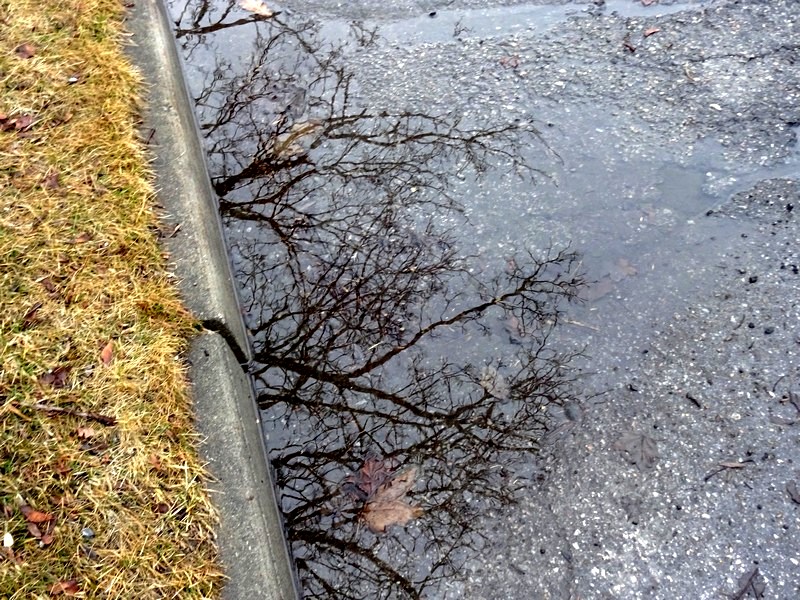
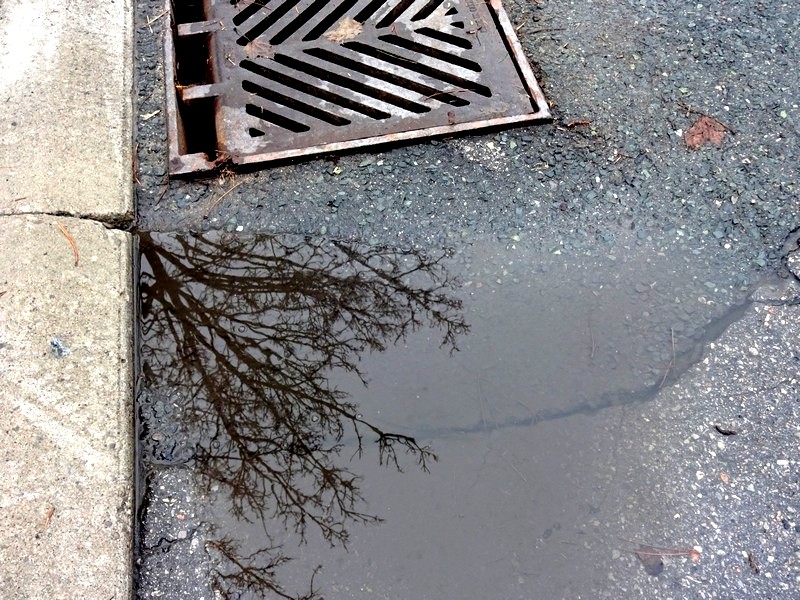
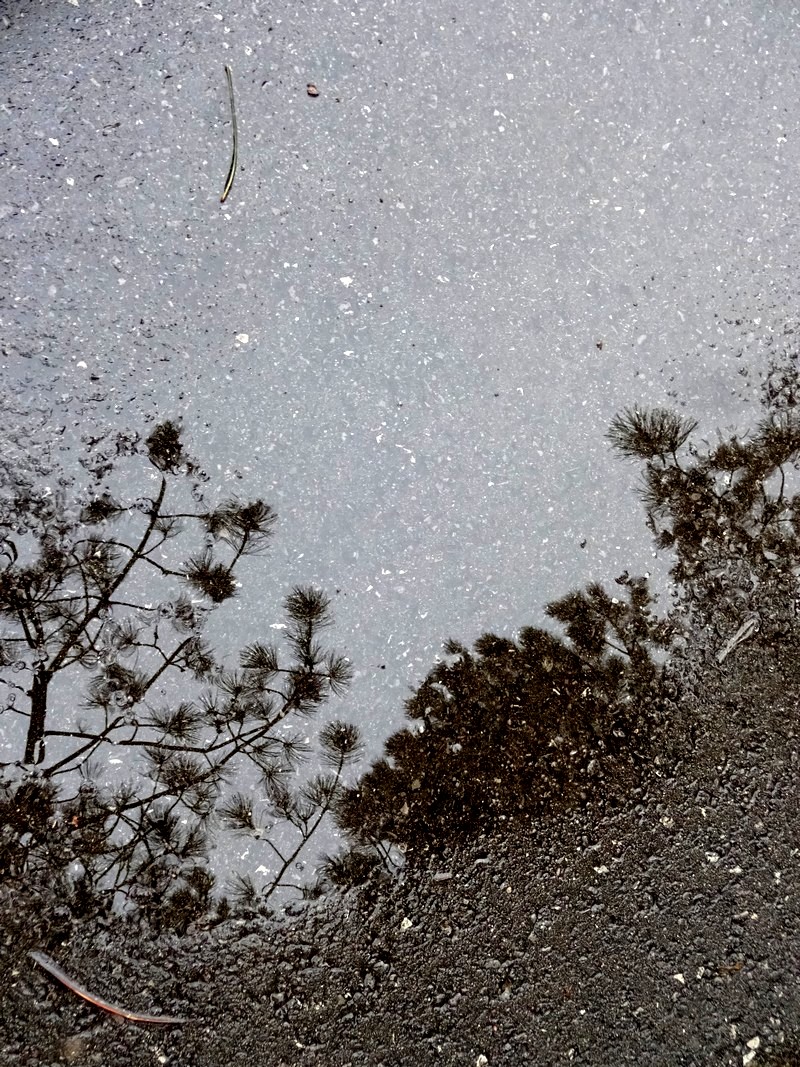
“I hate the rain, but I love puddles.” ~ (shelter resident)


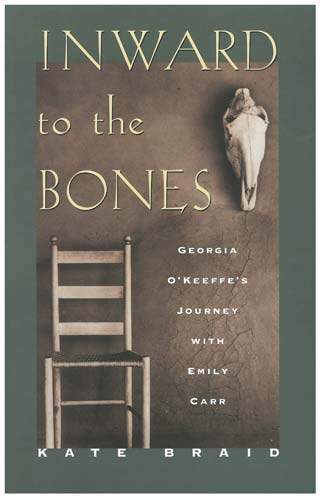
this is not a review — ‘inward to the bones’, by kate braid

As with so much of what crosses my reading path, I can’t recall how this book initially came to me. Originally published in 1998 by Polestar, it was reissued by Caitlin Press in 2010.

Inward to the Bones  is an imagining of a relationship between Georgia O’Keefe and Emily Carr. A relationship that never existed. The two women barely met at a 1930 showing of O’Keefe’s work in New York City. In her introduction Braid writes “To me, this passing incident was a spark that struck fire. Here were two of the great abstract painters of the 20th century—among the very few women of the time with a commitment to being artists. What if they had caught each other’s attention?”

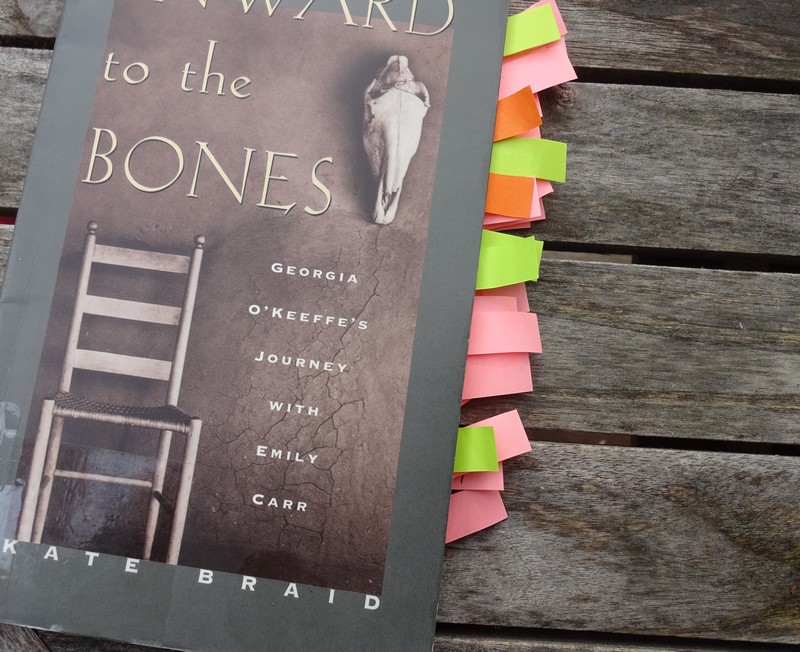
And with that Braid begins the imagining.inward-to-the-bones2

The result is a slim, gorgeous volume of poetic verse written in the voice of Georgia O’Keefe (so true is this voice that the book feels more whispered than written) and based on Braid’s research of both women. Many of the details are founded in actual events (footnotes are included at the back of the book and, in themselves, make good reading).

The story she tells begins with a brief nod to the era in which O’Keefe grew up, the late 19th and early 20th century, a time when women were not taken especially seriously in the art world; O’Keefe tells us about her involvement with the photographer Alfred Stieglitz and, eventually, her thirst for something more, a deeper relationship, a sisterhood of artists.

By the time she meets Emily Carr we’ve pretty much forgotten this telling isn’t entirely real, that the invitation from Carr to join O’Keefe in New Mexico to walk and paint the desert with her, never happened. And yet, there is Emily Carr in the desert with Georgia O’Keefe. There is Carr, feeling out of place and  pining for green in the heat of New Mexico while Georgia O’Keefe looks on and complains about this weird companion.

“She… insists/ on painting my hills/ in shades of British green./ They’re everything but! I snap / Try purple! Try yellow! Try red!”

Then a trip to Bandelier National Park changes everything and suddenly Carr finds connection among the cacti, mesa, bones and bluer than blue sky.

Braid paints a convincing picture of similarities that might have brought these two together, not the least of which their dedication to art in a man’s world. But it’s the case she makes for their differences that moves the book forward, as when O’Keefe wonders at Carr’s ability to function without privilege, wealth, the assistance of a patron such as Stieglitz. Wonder turns to awe and then envy…  “I am brittle and thin, starving/ for what feeds her.”

Ultimately their similarities win out… different lives, shared passion.

“I know absence rather than plenty./ Our only difference is rain.”

O’Keefe also visits Carr’s world and tromps about Vancouver Island in her black clothes and fedora, finding nothing among the giant red cedars, dampness, moss, rotting logs and lichen that speaks to her in a language her desert soul understands.

“When we go into her woods together to paint/ I don’t tell her I am terrified.”

She feels constrained by the city of Victoria’s culture, its population of tea sippers “with knees together impossibly tight and polite”. It’s the ‘violence’ of the ocean that finally soothes her, the “waves speak in an accent”  she understands. “It is the silence of the desert, made manifest in motion.”

But the friendship continues to grow and the fascination for each other’s work is also personal. “I want what she has./ I know no other way to get/ than to be here, in her forest, siting under this damned dripping tree for hours,/ trying to see through her eyes/ with her.”

You might say the book is like a painting made by either O’Keefe or Carr, the power of emotions visible through what appears to be the most ordinary of things. In this case: respect for the sisterhood of artists.

What if they’d caught each other’s attention? 

Such a good question. Braid makes us feel it’s a loss that they didn’t, while at the same time convinces us that surely they did.

DSC05174


this is not a review: ‘newfoundland, journey into a lost nation’, by michael crummey and greg locke

 
So very happily stumbled over this book recently. Published in 2004, the ‘lost nation’, in the title refers of course to the loss of the cod some twelve years earlier, which, in his opening essay, Michael Crummey likens to Saskatchewan losing its grain, or the Arctic its snow. In one short but powerful passage, Crummey takes us back to the moment fishermen were given the news of the moratorium in 1992. (They were asked to sit in a separate room and watch a video of John Crosbie speaking to *invited* guests and media in the next room, behind locked doors.) Crummey offers an account of the lead up to this “public relations disaster” and the subsequent fallout.51P3DRC75FL._SX374_BO1,204,203,200_
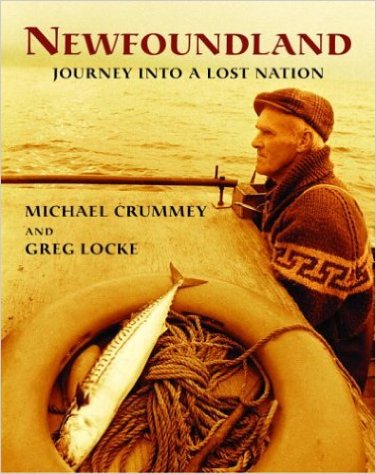
He writes about the fishermen before that day, memories from his father and grandfather being especially poignant. And he writes about Newfoundland since that day: the leaving of so many people, the collapse of communities, lost skills, the tourism that is both a boon and a sadness as it turns traditions into commodities… as well as a surge in arts and the forming of new communities.

It’s all quite dandy until something starts to feel ‘missing’. Oh, yeah. Women. What he doesn’t write about is the women. There’s not a sliver of anything from their perspective in the loss of this ‘nation’. And as much as I enjoyed Crummey’s essay, and the photos by Greg Locke – beautiful, unsentimental shots of, well, men, mostly – there’s no getting away from the fact that, not only something, but much, is weirdly absent from this story. While the devastation of the cod certainly affected the boys who made a living on the water, I suspect not all was trifle and joy at home. I imagine the women had some feelings on the subject, that their lives, too, were affected.

I mean if we’re going to include a shot of men at a kitchen party, then there’s room for more than the ‘fellows and fish’ side of things.

And yet, for some reason, Crummey has chosen to tell, and Locke has chosen to shoot, a Newfoundland pretty much devoid of gals (who certainly don’t involve themselves in the fish business according to this telling) (not sure that’s entirely accurate, but never mind). Worse, though, it’s a story told as if there’s no one inside those houses, those canneries, no one hanging that laundry, raising those children, working at the bank, the grocery store, putting food on tables with less and less money. The guys are fishing. We get that. They’re mending nets. Then they’re not fishing. They’re angry, sad, lost. All very well conveyed in both word and portrait. But what are the women of the lost nation doing, thinking, feeling, while their men are out to sea for all those generations… and then are suddenly not?

I’m guessing that having them lolling about the house in all their misery shook up those girl lives something serious.

There are 101 photos.

Of these, 68 feature men or boys, only males.

21 are un-peopled land or seascapes.

10 are a mix of both male and female, adults and children.

12 feature women or girls only.

While twelve out of 101 is better than nothing (although it’s very close to nothing), the text that accompanies the ‘female’ pictures adds insult to injury by focusing on things other than the female, such as the one where a woman looks at an iceberg (text refers to iceberg alley); or the woman and child walking on beach (text refers to sewage plant); a girl and her pony (text about ponies originally used in mines and how they almost became extinct). Another of the precious twelve shows an elderly woman smoking at a bingo table. Still another has a winsome wench staring out to sea clad for some reason in a long Victorian dress and cap.

There’s a shot of a guy selling jam from the back of his car. I suspect we’re meant to understand that the he’s been reduced to this. Sad, yes. But who made that jam? Did he make it? If not, where’s the shot of the person who did? Let’s see sweat dripping off a brow as that jam cooks in a hot, tiny kitchen. Let’s see that brow being wiped with an old apron because maybe the person making that jam is suffering too, doesn’t have a lot, doesn’t ask for a lot, is merely loyal, merely living the cards they’ve been dealt.

Where’s that story?

And what about “the girl” referred to on page ten (Crummey’s quotation marks), who slept on the other side of a makeshift curtain in a cabin full of fishermen. Crummey, here, is writing about the chaps (including his grandfather) who went to fish along the Labrador coast, difficult to get to, with even more difficult conditions once they arrived.

“Each spring he hired a crew of three or four… along with “the girl” – sometimes as young as thirteen – who cooked for the men and helped clean and cure the fish…. It was rough living and rough work…. The skipper had his own room downstairs, while the crew usually slept under the attic eaves in the loft, on mattresses stuffed with wood shavings. The girl required a room to herself, though this often consisted of nothing more than a blanket hung between her and the men.”

The next lines refer to outhouses being too awkward to construct so they used the shoreline and tides instead as their ‘facilities’. From there immediately to vermin and blackflies. The girl is but a mention, never to be mentioned again. We have no idea why a child would be sent to cook and clean for these men and why must it be a girl? Wouldn’t it have made more sense to send a boy so as to learn the trade? One wonders what more “the girl’s” story involves? Her own hardships beyond vermin and blackflies perhaps.

Where’s that  story in this lost nation?

Some years ago I sat for an hour or so on a hill on the eastern shore of the Avalon Peninsula in Newfoundland. I watched a few boats come in or go out and I revelled in the scenery, but mostly I stared at the houses in this small coastal community and wondered about the women who ‘manned’ them in all weathers, literal or metaphoric.

And then I wrote this tiny thing, called ‘Petty Harbour’:

They hide in square wooden houses,
the women of the boatmen, leaning
on each other’s shadows, thighs
pressed together against the fog
until—all but one returns; thighs
loosen for a moment before they are
alone, immersed in salt and gravy,
hiking cloud paths for berries to send
with him next time; yet for the one
whose boatman doesn’t return—
thighs loosen and life begins.

~

Too often the female side of the story, or the view from there, is considered women’s literature and dismissed as something minor. In the case of Newfoundland: Journey into a Lost Nation, and in the opinion of this ‘woman’, an excellent telling from a narrow perspective weakens the overall experience of the book.

steam devils, stubborn devils

 
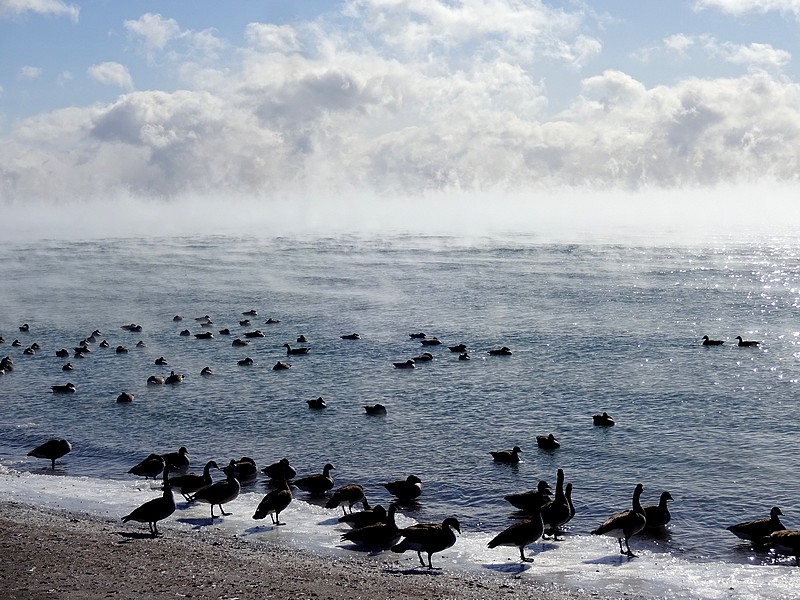
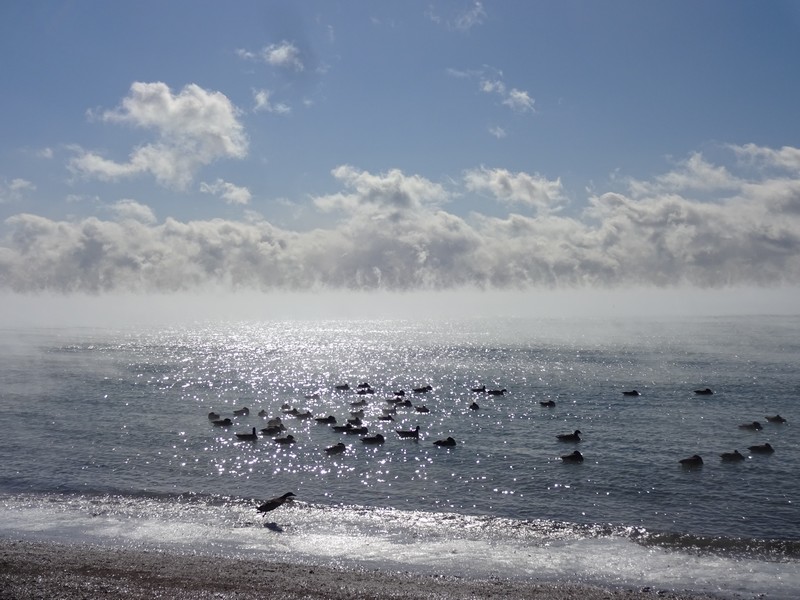
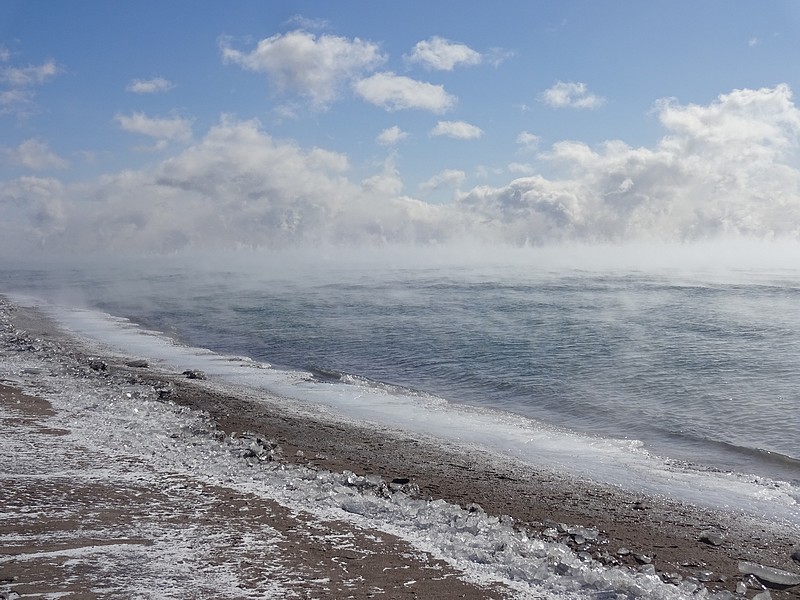
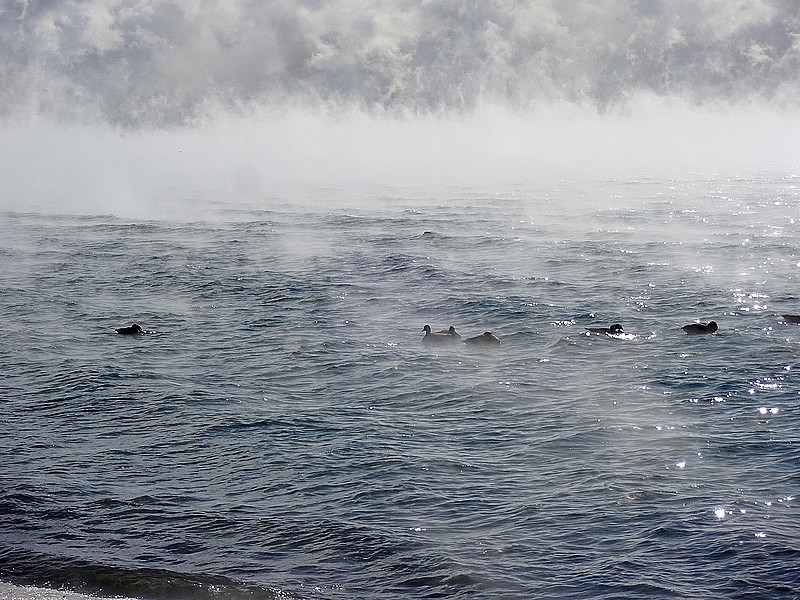
When temperatures drop suddenly, especially after being weirdly mild, this thing happens sometimes, over open water. I’ve only seen it once before, a couple years ago. I remember looking it up when I got home and learning that the term is steam devils.

So here I am on an empty beach crouched down on this minus thirty-something day, taking pictures of the steam rising off Lake Ontario…
DSC04981And a guy with a dog comes by.

DSC04986He yells: “Taking pictures of the clouds, eh?”
DSC04989And I say, “Yeah, the steam…”

DSC04990And I think that’s it, the extent of the conversation, because it’s too cold for chat and my head is wrapped in several layers of fleece and so is his and  we’re at a distance from each other and the dog wants to move on.

So I turn back to my crouching and picture-taking.

DSC04991Then he yells again: “It’s not steam, it’s clouds.” And I say, Oh? I thought it was steam from the warmer water meeting with the suddenly frigid air.

“No,” he yells. “Clouds!”

“Right!” I say, and turn back to my crouching.

And he and his dog move on.

DSC05003I don’t for a minute believe he’s right about this being clouds, especially given that the ‘clouds’ are only over the lake, not the land. But there’s something in the way he shouts “Clouds!”,  that tells me he’s not interested in my thoughts.

Evenso, his arrogance and lack of curiosity makes me more curious, makes me want to double-check my own certainty.

When I get home I google it… “mist over winter lake”.

DSC05000And for the briefest moment, I wonder if he does the same.


so the other day i had canada’s justice system explained to me


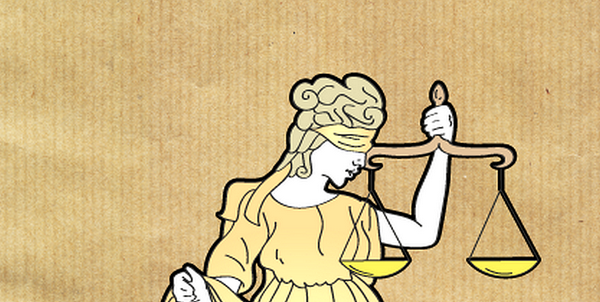
Still slightly gobsmacked after a conversation about our justice system with someone who knows how these things work, who is part of the system at a very high level (let’s call them Hank), during which conversation I was informed that the system is, in fact, designed to protect the accused… the onus being on the accuser to prove that a certain ‘thing’ occurred as alleged.

Okay…

I was also informed by Hank that, depending on which court the case is tried in (in this province that would be either the Superior Court of Justice or the Ontario Court of Justice), it’s up to the accused  as to whether or not they would *like* a jury. It’s also up to the accused as to whether or not they would *like* to take the stand. Or, I’m assuming, whether or not they’d like extra frothy froth on their latte.

The accuser (aka the alleged victim) has no such choice. Hmmm. So while they are repeatedly interrogated and grilled, dirty laundry hung out for all to see, the accused (aka the person who allegedly choked and punched them) is not asked a single question…. Have I got this right?

Hank nods. Yes indeedy, he says, repeating that it’s in order to protect the accused.  He goes on to say what a grand system it is too and if I’m ever accused of anything I’ll be darned pleased about it.

I’m sure I would be, I say, but something just doesn’t sit right. For example, it seems a tad unfair to the accuser (so often women it’s worth noting). Especially if the grilling gets into whacking territory.

Hank doesn’t comment on whacking. He winces instead. Then he explains (rather haughtily I think) that if we didn’t assume innocence for the accused until proven guilty, we’d be like Russia.

Or France, I add.

More wincing. (I’m pretty sure Hank is partial to French wine, croissants and the light in Provence.)

Or France, I say again…

Yes, yes. Or France. He admits that France (along with a number of other countries) subscribe to what is known as an Inquisitorial System, unlike Canada, which takes its model from the British Adversarial System, a system that allows the alleged aggressor to have frothy froth if they choose while the alleged choking victim who did some childish and stupid things in her past can just please sit there and explain why she can’t remember every detail of every day for the past fifteen years.

It’s called lying!  Hank says. He believes accusers whose can remember the choking but not the bikini are nothing but liars!!  He seems to enjoy the word,  insinuating the lying happens a lot. After all, he says, what’s to stop a woman saying whatever she wants?

Yeah, women get all the breaks, I say.

He doesn’t respond. And when I want to talk about the way trauma plays with memory Hank does not welcome this line of chat.

The worst thing he can think of happening, he tells me suddenly, is that an innocent person be found guilty. He says this with tremendous passion.

What about a guilty person who is found innocent? I ask. The question hangs in the air.

Finally, I mention the quite dandy idea of “a subset of judges with special training in the psychological dynamics of sexual assault” and while Hank agrees that it may not be an entirely bad thing he also says that it’s not entirely necessary. He also says Heather Mallick is crazy.

I disagree. Her piece last week is right on the money.

I ask Hank if it were his daughter that was in the accuser’s position, that is, a daughter who claims she was beaten and choked by a ‘date’, would he advise her to take the case to court?

He says he would not advise any such thing.

I regret not thinking at the time to ask him if it were his son who was in the accuser’s position, at the hands of, say a superior at work, a son who had been choked, threatened, punched. Would he advise his son to speak up or just put his tail between his legs and let it pass, keep going to work like a good boy. And if, after a dozen years when his son couldn’t keep it to himself any longer and spoke up for justice… but couldn’t remember every detail… couldn’t remember that, oh yeah, eleven years ago he accepted that invite to the boss’s backyard BBQ and even sent a thank you note…AFTER the (alleged) choking/punching incident… would you call your son a liar, Hank?

Would you??

And if you’d advise your son differently than your daughter… would you mind telling me why?

I’m curious. Plus, it’s not a small point. But even if the advice you were to give both your son and your daughter was the same, i.e. to let the accused (aka possibly known abusive person) go free and possibly do it again, and again… and again…  then would you mind telling me again about justice?

Because I think I missed something.

And you, Hank, you know about these things.

Oh, and, if anyone’s asking, I’ll have a little extra froth.

No one’s asking? Fine. Never mind….

scales