So very happily stumbled over this book recently. Published in 2004, the ‘lost nation’, in the title refers of course to the loss of the cod some twelve years earlier, which, in his opening essay, Michael Crummey likens to Saskatchewan losing its grain, or the Arctic its snow. In one short but powerful passage, Crummey takes us back to the moment fishermen were given the news of the moratorium in 1992. (They were asked to sit in a separate room and watch a video of John Crosbie speaking to *invited* guests and media in the next room, behind locked doors.) Crummey offers an account of the lead up to this “public relations disaster” and the subsequent fallout.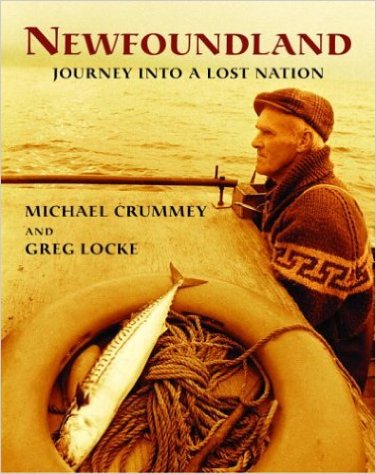
He writes about the fishermen before that day, memories from his father and grandfather being especially poignant. And he writes about Newfoundland since that day: the leaving of so many people, the collapse of communities, lost skills, the tourism that is both a boon and a sadness as it turns traditions into commodities… as well as a surge in arts and the forming of new communities.
It’s all quite dandy until something starts to feel ‘missing’. Oh, yeah. Women. What he doesn’t write about is the women. There’s not a sliver of anything from their perspective in the loss of this ‘nation’. And as much as I enjoyed Crummey’s essay, and the photos by Greg Locke – beautiful, unsentimental shots of, well, men, mostly – there’s no getting away from the fact that, not only something, but much, is weirdly absent from this story. While the devastation of the cod certainly affected the boys who made a living on the water, I suspect not all was trifle and joy at home. I imagine the women had some feelings on the subject, that their lives, too, were affected.
I mean if we’re going to include a shot of men at a kitchen party, then there’s room for more than the ‘fellows and fish’ side of things.
And yet, for some reason, Crummey has chosen to tell, and Locke has chosen to shoot, a Newfoundland pretty much devoid of gals (who certainly don’t involve themselves in the fish business according to this telling) (not sure that’s entirely accurate, but never mind). Worse, though, it’s a story told as if there’s no one inside those houses, those canneries, no one hanging that laundry, raising those children, working at the bank, the grocery store, putting food on tables with less and less money. The guys are fishing. We get that. They’re mending nets. Then they’re not fishing. They’re angry, sad, lost. All very well conveyed in both word and portrait. But what are the women of the lost nation doing, thinking, feeling, while their men are out to sea for all those generations… and then are suddenly not?
I’m guessing that having them lolling about the house in all their misery shook up those girl lives something serious.
There are 101 photos.
Of these, 68 feature men or boys, only males.
21 are un-peopled land or seascapes.
10 are a mix of both male and female, adults and children.
12 feature women or girls only.
While twelve out of 101 is better than nothing (although it’s very close to nothing), the text that accompanies the ‘female’ pictures adds insult to injury by focusing on things other than the female, such as the one where a woman looks at an iceberg (text refers to iceberg alley); or the woman and child walking on beach (text refers to sewage plant); a girl and her pony (text about ponies originally used in mines and how they almost became extinct). Another of the precious twelve shows an elderly woman smoking at a bingo table. Still another has a winsome wench staring out to sea clad for some reason in a long Victorian dress and cap.
There’s a shot of a guy selling jam from the back of his car. I suspect we’re meant to understand that the he’s been reduced to this. Sad, yes. But who made that jam? Did he make it? If not, where’s the shot of the person who did? Let’s see sweat dripping off a brow as that jam cooks in a hot, tiny kitchen. Let’s see that brow being wiped with an old apron because maybe the person making that jam is suffering too, doesn’t have a lot, doesn’t ask for a lot, is merely loyal, merely living the cards they’ve been dealt.
Where’s that story?
And what about “the girl” referred to on page ten (Crummey’s quotation marks), who slept on the other side of a makeshift curtain in a cabin full of fishermen. Crummey, here, is writing about the chaps (including his grandfather) who went to fish along the Labrador coast, difficult to get to, with even more difficult conditions once they arrived.
“Each spring he hired a crew of three or four… along with “the girl” – sometimes as young as thirteen – who cooked for the men and helped clean and cure the fish…. It was rough living and rough work…. The skipper had his own room downstairs, while the crew usually slept under the attic eaves in the loft, on mattresses stuffed with wood shavings. The girl required a room to herself, though this often consisted of nothing more than a blanket hung between her and the men.”
The next lines refer to outhouses being too awkward to construct so they used the shoreline and tides instead as their ‘facilities’. From there immediately to vermin and blackflies. The girl is but a mention, never to be mentioned again. We have no idea why a child would be sent to cook and clean for these men and why must it be a girl? Wouldn’t it have made more sense to send a boy so as to learn the trade? One wonders what more “the girl’s” story involves? Her own hardships beyond vermin and blackflies perhaps.
Where’s that story in this lost nation?
Some years ago I sat for an hour or so on a hill on the eastern shore of the Avalon Peninsula in Newfoundland. I watched a few boats come in or go out and I revelled in the scenery, but mostly I stared at the houses in this small coastal community and wondered about the women who ‘manned’ them in all weathers, literal or metaphoric.
And then I wrote this tiny thing, called ‘Petty Harbour’:
They hide in square wooden houses,
the women of the boatmen, leaning
on each other’s shadows, thighs
pressed together against the fog
until—all but one returns; thighs
loosen for a moment before they are
alone, immersed in salt and gravy,
hiking cloud paths for berries to send
with him next time; yet for the one
whose boatman doesn’t return—
thighs loosen and life begins.
~
Too often the female side of the story, or the view from there, is considered women’s literature and dismissed as something minor. In the case of Newfoundland: Journey into a Lost Nation, and in the opinion of this ‘woman’, an excellent telling from a narrow perspective weakens the overall experience of the book.









 Matilda Magtree