♦
Other wordless friends:
Cheryl Andrews
Allison Howard
Barbara Lambert
Allyson Latta
Elizabeth Yeoman
♦
Other wordless friends:
Cheryl Andrews
Allison Howard
Barbara Lambert
Allyson Latta
Elizabeth Yeoman
♦
Other wordless friends:
Cheryl Andrews
Allison Howard
Barbara Lambert
Allyson Latta
Elizabeth Yeoman
When people come to visit, I never know where to take them.
Inevitably, we find ourselves at this diner or that café or the restaurant that does the excellent veggie naan even though the server is a pill.
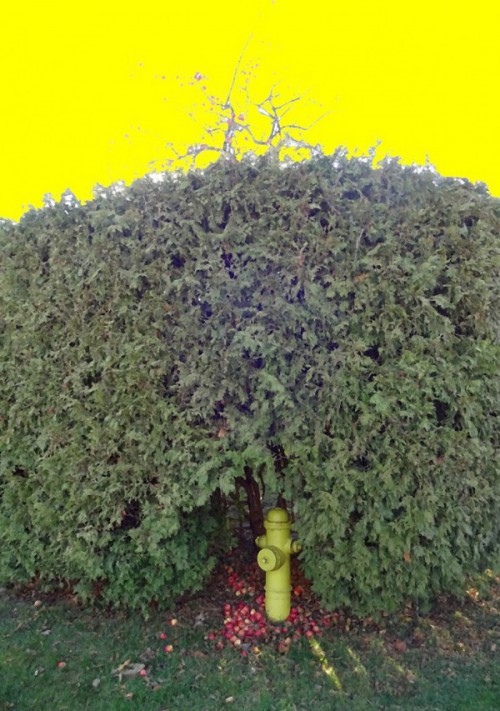
Almost always we walk. Through the ravine, downtown, around the ‘hood, the beach. I point out the tree with windfall apples I use to make a crumble each October. And the place where once the kids and I ate pistachios and played Daniel Boone eating pistachios. It’s not a high end tour but there are almost always stories that spring from it… mine, the visiting people’s.
We’ll go to the galleries of course. There are a lovely abundance of them here. The market. The bookstore. The emu farm.
A concert maybe. A slice of local theatre.
There’s a junk store I might think of taking them, depending on mood and whim and inclination, where you can barely move for the amount of crap and treasure and the owner’s hoarding instinct, which prevents him from ever wanting to sell anything. The only store where when you ask how much this is, you’re told it’s not for sale. You don’t go there to buy, you go there to do anthropological studies.
If it’s summer we’ll paddle a rented kayak and have fries from the best chip truck in these parts or sit on a patio in a trailer park luncheonette and drink iced tea with some not too bad grilled cheese sarnies.
If it’s winter we might stay home and light a fire. I might make a feasty meal or maybe just keep it simple, make an omelette… I’ll mention that final scene in the movie Big Night and I’ll put on the CD and we’ll talk about first times… first omelettes, whatever…
We might drive. To see the xmas lights or the country lights.
This is what I do… and sometimes I wonder: is it enough, these emus and sunsets? And then I wonder why I feel that way because when I visit someone this is exactly what I want. NOT the Eiffel Tower, not a string of organized entertainments, but the experience of actually living in a place… the small slices of everydayness.
(Although I will not decline a quick dash into the Louvre.)
So tell me… when visiting, what is it we want?
And by we I mean you.
♦
Other wordless friends:
Cheryl Andrews
Allison Howard
Barbara Lambert
Allyson Latta
Elizabeth Yeoman
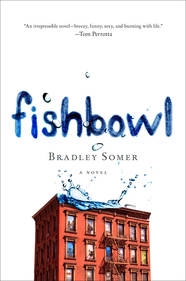
I can’t always say how it is that a book comes to my attention but with Fishbowl I do remember that ‘must read!’ moment. Mind you, I use the word ‘remember’ loosely… it’s more like I have this vague idea that someone whose book sense I value posted somewhere how she was giving this book to everyone she knows for xmas… I could list a few possibles of who that might have been but then everyone’s friends would be living in hope of receiving a copy.
Because to get Fishbowl as a gift would indeed be a happy day.
What we have here is an exceedingly readable, well-written book whose story takes place over the course of thirty minutes. We begin with the knowledge that Ian (resident of the fishbowl) will (only at the end of the book) fall off the balcony of his twenty-seventh floor apartment and will pass all twenty-seven floors in the process.
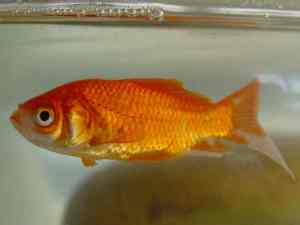
Not only an interesting set-up but in just a few pages Somer has managed to make Ian the goldfish someone we care about… with aquatic information such as the length of a goldfish’s memory (what memory?) and bits of fishbowl zen: “Less thinking, more doing” is the goldfish’s philosophy. “Having a plan is the first step toward failure,” he would say if he could speak.
After we learn that Ian *will* fall… the book, essentially, is our introduction to a few people living in the apartments that Ian will pass on the way down.
By the time he falls, we’re hooked. We want to know about Petunia Delilah and her impending baby, her future; about Herman, home schooled, weird, wonderfully naive and easy to swoon; Connor the bastard who dates far too many women (and on whose balcony Ian lives so that he doesn’t stare at the doings in Connor’s bedroom); a construction worker who likes to dress up; a lonely building superintendent; an agoraphobic phone sex worker.
The characters, despite their tics, are represented as fairly ordinary. It’s not about the tics. The point, instead, is that we all have peculiar elements to our lives. Their stories, not their quirks, are what keep us reading… (that and the dry humour, and sentences that consistently offer up happy surprises…)
The bigger story is how we feel at the end of the book and how we might understand the wider world just a titch better. For a moment anyway.
A credit to the author that a single fish could do so much.
And even if our vision of the whole wider world isn’t altered, then maybe this:
I dare you to look at an apartment building quite the same way again.
(my vision of Ian; courtesy of wikicommons)
♦
Other wordless friends:
Cheryl Andrews
Allison Howard
Barbara Lambert
Allyson Latta
Elizabeth Yeoman
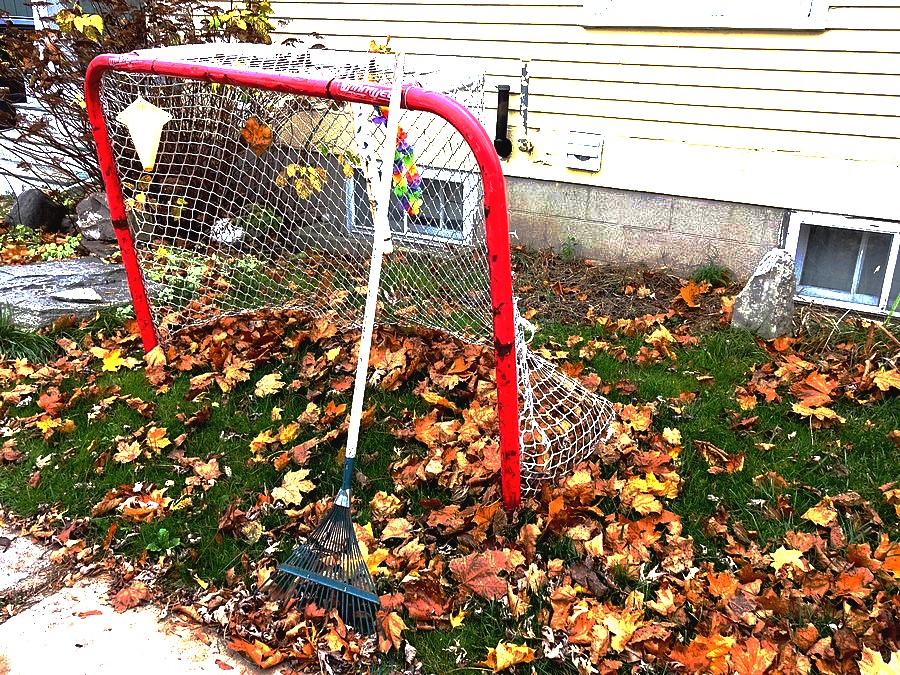
A boy in his driveway the other day shouts hello as I pass. He says his name is Simon, what’s mine? I say Carin and he tells me he has a Batman tee shirt. He opens his coat. I say that’s some great tee shirt and he says yeah, then tells me he’s seven. Not that I asked. He continues talking, about being seven maybe, or the tee shirt, just chattering away… all of this in only seconds; I’ve barely slowed my stride. His mum is raking leaves, smiling. And in all the chattering somewhere the boy asks… in a way he might ask a chum at school, or anyone… “How old are you?” His mother’s smile immediately turns into a nervous laugh, she puts down her rake, edges Simon toward the house and tells him that isn’t the sort of question he’s supposed to ask. Meanwhile I’ve answered by saying “Well, I’m not seven!”, as I continue on my way. Also laughing nervously.
And for the rest of my walk all I can think about is why.
Why is that not the sort of question Simon should ask? And is it only not the sort of question Simon should not ask people of certain ages? And how should Simon know which ages those are? And who decides that anyway? And doesn’t the whole way his mother reacted give off a vibe that suggests to Simon, if only subliminally, that there’s something *wrong* about certain ages and THAT’S why we don’t ask.
And if there’s something wrong with certain ages… what, exactly is that wrongness? I mean if Simon were to ask his mother Why can’t I ask? what would she say? Something about politeness probably. But why is it polite NOT to ask someone their age when you are seven and you ask everyone ? (And everyone asks you.)
Of course I was taught the same lesson as a kid. (But we’re back to the why… Is it to spare people the embarrassment of admitting they aren’t seven, or twenty-seven or thirty-seven or whatever decade + seven it suddenly becomes an embarrassment to *be*?)
North America’s twisted version of age aside, what really bothered me was my own response, that weird bit of laughter I threw out in order to make Simon’s mother feel okay about the whole thing. By laughing it off, by saying “Well, I’m not seven,” I condoned her discomfort and was party to the stupid lesson Simon was being taught.
Why didn’t I just answer the question?
Conditioning, that’s why. (And, mostly, conditioning almost always sucks.)
The thing is I happen to be a non-ageist kind of person. Even as a kid (just like Simon) I barely noticed someone’s vintage. I still can’t see how it matters. It’s their energy that registers with me. One of my favourite people to hang out with lived to be 101 and it never struck me as an unusual match.
I also have friendships where *I’m* the 101 year old.
And a few in between.
The thing is this: dullness and negativity, ego and bullshit appear at every mile marker. So do joie de vivre, curiosity, kindness, engagement with life, humour, a creative spark and the balls to be yourself. A tedious schmuck at sixty was probably a tedious schmuck at thirty.
Only with better abs.
My walk takes me on a loop and eventually I’m heading back toward Simon’s house. I resolve to tell him my age as I pass. I’ll throw it out, casually, maybe mention that I have a fondness for the colours green and orange and yellow and that I do not know how to tap dance. Not that anyone asked.
But the leaves in front of Simon’s house are raked and no one’s there.
Too bad. Because I think Simon would have found that particular line of chat quite normal. And that would have been so much better a lesson than the last.
♦
Other wordless friends:
Cheryl Andrews
Allison Howard
Barbara Lambert
Allyson Latta
Elizabeth Yeoman
I discovered a beautiful thing today.
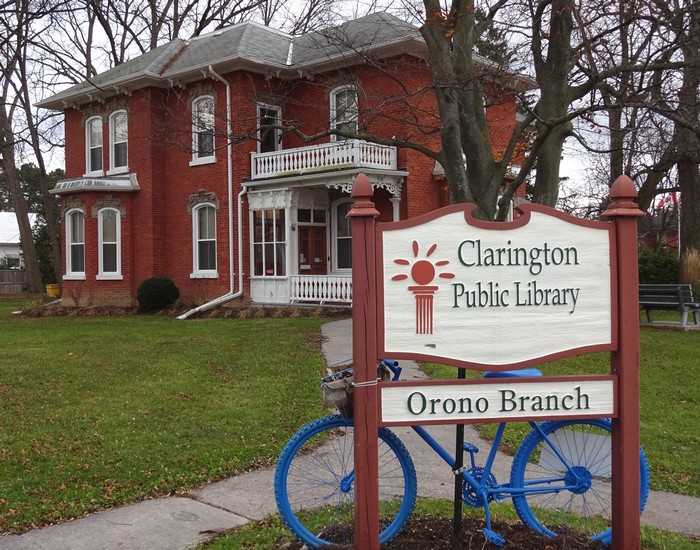
A library in a town I’ve been to three thousand times. I don’t know how
I ever missed it other than to say I was likely distracted by the bakery.
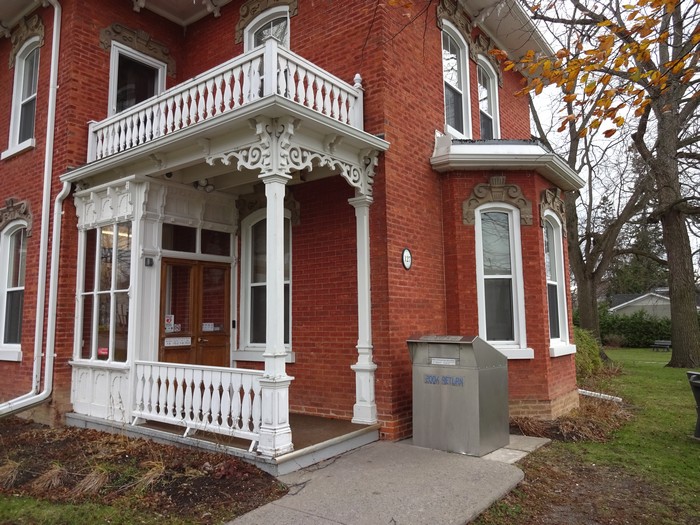
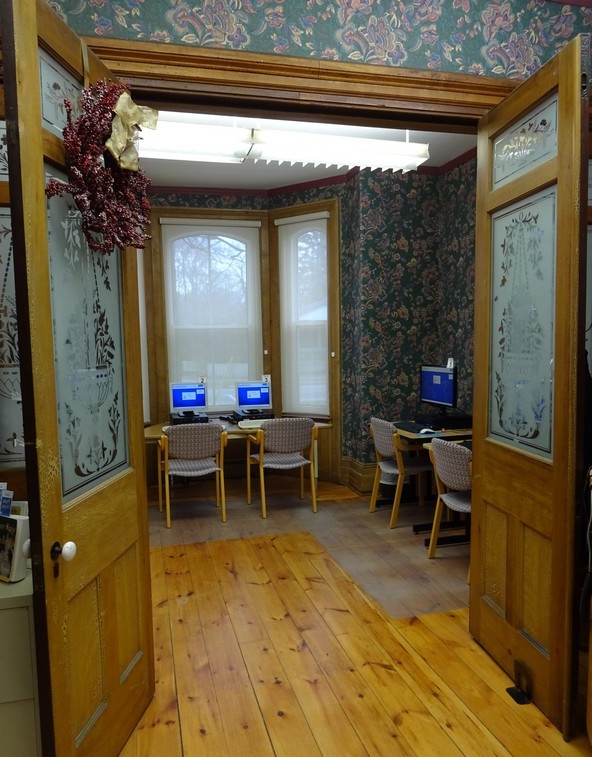
It’s in a house built in 1882 for $450. Originally owned by the Waddell family, local furniture magnates. They also owned a hotel in town and had some doings with a cheese factory. Big money in cheese.
No official library in those days but there was a makeshift sort of lending service using 34 books the townsfolk gathered up and kept in various shop basements where, on various days, you could take out the latest best seller.
One of the Waddell children, a lad, tried to start a flax business. I like his style. Sorry it didn’t work out.
And, this is interesting… the Waddell daughter, in 1903, became the first Canadian woman to join the American Mathematics Association, which included women from not only the U.S. but the U.K., Canada and Europe.
In 1969, the house was purchased by the Township Library Board and voila, presto bongo, the library opened in 1970, looking very much like a house with many books.

I love how they’ve kept it authentic in feel. The ceilings are high. The floors are original.
And it’s so, so, so… quiet. Which is something I miss in libraries. (Whatever happened to stern women with buns shushing everyone??)
I’m told there was talk some years ago of closing it down because it doesn’t meet somebody’s idea of “adequate usage” or whatever, and the town went ape shit and, long story short, the adequate usage people decided to keep it open.
Going ape shit for a good cause is not to be under-rated.
And because this gorgeous bit of brick and mortar history—and the slice of sanity it provides—isn’t enough on its own… you’ll be happy to know it happens to sit on an acre or so of treed land with oodles of parking and a large gazebo that begs to be read on.
As in aloud.
As in what a great space for a literary event.
The Juan du Fuca Literary Event we could call it.
An ocean of flax would be our logo.
And something with cheese.
♦
Other wordless friends:
Cheryl Andrews
Allison Howard
Barbara Lambert
Allyson Latta
Elizabeth Yeoman